Executive Overview
Twenty-five years ago, the global video game landscape shifted fundamentally when Microsoft stepped into the hardware arena with a bulky, heavy, and audaciously powerful black-and-green box. Today, the brand is commemorating that milestone with a heavy dose of nostalgia, a hefty price tag, and a design choice that is as polarizing among historical purists as it is universally adored by retrospective enthusiasts.
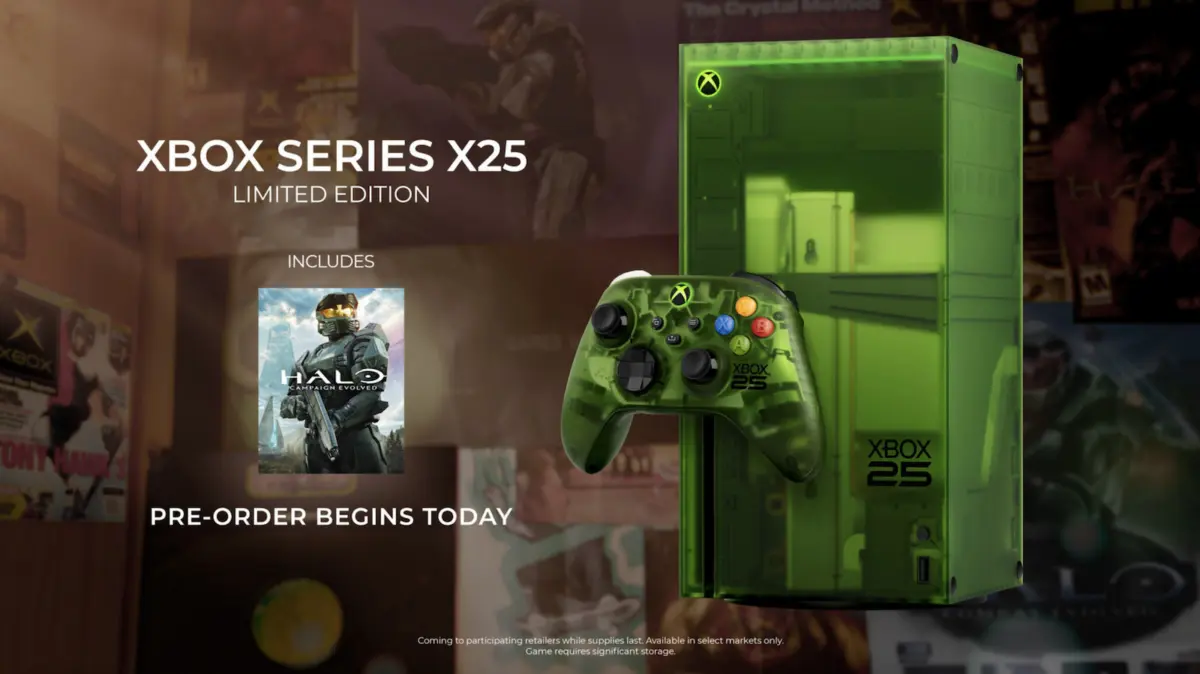
The officially unveiled Xbox 25th Anniversary Collection Bundle marks a quarter-century of gaming innovation, cultural impact, and industry evolution. Centered around a limited-edition, translucent green Xbox Series X console, a matching wireless controller, and a digital copy of Halo: Campaign Evolved, the package carries a steep retail price of $900. While the sticker shock has dominated early internet discourse, a closer look at the current macroeconomic climate, escalating global hardware component costs, and the strict exclusivity of the drop reveals a calculated strategy by Microsoft.
Far from a simple cash grab, this anniversary release arrives during a turbulent era for consumer electronics. Driven by a protracted, industry-wide RAM crisis and soaring manufacturing overhead, standard hardware prices have crept steadily upward. Viewed through this lens, the $900 price point for a numbered, uniquely engraved collector’s item that undercuts the sheer value of buying standard components in today’s inflated market is sparking profound debate across the industry.
Yet, beneath the glossy plastic and the commemorative logos lies a fascinating historical irony: the original 2001 launch console was never translucent green. By leaning into an aesthetic born of mid-2000s special editions and mythical developer-only prototypes, Microsoft is rewriting its own visual history to capture the elusive lightning in a bottle that defined an era. As preorders roll out in waves—beginning with an exclusive early-access window for the platform’s most dedicated followers—collectors, casual fans, and industry analysts are left asking: What does it truly mean to celebrate 25 years of Xbox in a modernized, digital-first gaming ecosystem?
Detailed Chronology: From the Original "Green and Black" to the 2026 Anniversary Drop
To understand the weight of the Xbox 25th Anniversary Collection, one must journey back to the precipice of the millennium, when the console market was ruled by Sony’s juggernaut PlayStation 2 and Nintendo’s GameCube.
The 2001 Genesis: Industrial Design Meets the Original Xbox
When Microsoft launched the original Xbox on November 15, 2001, its aesthetic identity was unmistakable. Clad in matte black with a massive, iridescent green "X" jewel crowning the chassis, the console was accompanied by the gargantuan "Duke" controller—a peripheral so large it became a pop-culture punchline and a beloved ergonomic anomaly.
Despite revisionist history, neither the launch console nor the standard controller featured a translucent green chassis. They were sleek, industrial, and undeniably dark. The transparent green look that fans universally associate with the legacy era actually traces back to rare, highly sought-after developer units gifted to the original design team in 2001, bearing the laser-etched signature of Microsoft co-founder Bill Gates. It wasn’t until 2004, amidst the twilight years of the original generation, that the general public received their first taste of transparent hardware via the Crystal Green Special Edition console released in select international markets.
The Evolution of Special Editions
Over the next two decades, Microsoft mastered the art of the special-edition console. From the iconic green-and-gold Halo 3 Xbox 360 to the custom Cyberpunk 2077 Xbox One X, limited-hardware releases became powerful cultural touchstones. They served as physical trophies for a community that prided itself on being part of the "Green Team."
CHRONOLOGICAL TIMELINE OF ICONIC XBOX HARDWARE MILESTONES
----------------------------------------------------------------------------------------
[Nov 15, 2001] -> Original Xbox Launch (Matte Black, Green Jewel, "The Duke")
[2004]         -> Crystal Green Special Edition (First public translucent green variant)
[Nov 2011]     -> Xbox 360 Limited Edition Halo: Reach Console (Custom sound effects)
[Nov 2017]     -> Xbox One X Project Scorpio Edition (Unique dark gradient & inscriptions)
[Nov 15, 2026] -> Xbox 25th Anniversary Collection (Translucent Green Series X, $900)
----------------------------------------------------------------------------------------
The announcement of the 25th Anniversary Collection on August 26, 2026, bridges this historical gap. By choosing the legendary translucent green motif, Microsoft is invoking the nostalgic fever dream of early-2000s tech culture—an era defined by see-through Game Boy Colors, translucent iMacs, and custom PC modding.
The Rollout Strategy
The distribution of the anniversary bundle has been meticulously engineered to reward long-term brand loyalty. Preorders opened in phases, starting with an exclusive digital invite sent directly to the inboxes of the platform’s most dedicated, tenure-tracked fans. For those who did not make the initial cut, a broader public preorder window opened on August 27 at 10:00 AM ET via the official Xbox store.
True to historical form, the official launch date is locked in for November 15, 2026—precisely 25 years to the exact calendar day that the original system landed on retail shelves.
Supporting Context & Metrics: Navigating the RAM Crisis and the $900 Price Tag
When the $900 price tag for the Xbox 25th Anniversary Collection was revealed, the internet reacted with predictable dismay. In a gaming market where consoles have traditionally hovered between $400 and $500, a sub-brand hardware package approaching the thousand-dollar mark demands serious scrutiny.
However, contextualizing this pricing requires analyzing the brutal economic reality currently choking the consumer electronics industry.
The Global RAM Crisis and Component Inflation
Over the past two years, the technology sector has been battered by an ongoing, severe RAM and memory component crisis. Driven by surging demand for enterprise-grade artificial intelligence infrastructure, semiconductor fabrication plants have redirected massive portions of their production lines away from consumer-grade GDDR6 and DRAM chips.
Consequently, the cost of raw components required to build high-performance gaming consoles has skyrocketed. Earlier this year, Microsoft adjusted its baseline hardware pricing, bumping the cost of a standard Xbox Series X configuration up to $800 in several key regions.
When stacking the 25th Anniversary Collection against these macroeconomic realities, the pricing structure becomes clearer:
- Standard Series X (Current Baseline): $800 (Unbundled, standard colorway, no pack-in game).
- 25th Anniversary Collection Bundle: $900 (Includes a custom-molded translucent green shell, unique individual laser engraving, customized Xbox 25 controller, and a digital download of Halo: Campaign Evolved).
For hardware collectors, paying a mere $100 premium over the baseline inflated cost of a standard console—while securing individually numbered, serial-engraved commemorative hardware—represents a surprisingly calculated value proposition, albeit one locked behind an exclusionary price tier.
The A La Carte Alternative: Accessories for Every Budget
Recognizing that $900 is prohibitive for the average gamer, Microsoft has structured the anniversary celebration to include alternative entry points.
- The Anniversary Controller: Available as a standalone purchase for $80, featuring the same translucent green aesthetic, metallic D-pad accents, and Xbox 25 branding.
- Third-Party Ecosystem Partnerships: Microsoft has collaborated with premier accessory manufacturers to launch a comprehensive ecosystem of translucent green peripherals. From charging docks and headset stands to custom controller shells and carrying cases, the broader hardware market is adopting the aesthetic theme, allowing fans to partake in the silver jubilee without purchasing an entirely new console.
Official Statements and Industry Reception
The reveal of the 25th Anniversary Collection has generated widespread dialogue among industry analysts, design historians, and community leaders. While consumer commentary on social media remains split between praise for the nostalgic design and frustration over pricing, official communications from Xbox emphasize celebration, heritage, and premium craftsmanship.
"When we set out to design the 25th Anniversary Collection, we knew we couldn’t just slap a logo on a standard chassis," noted a representative from the Xbox Hardware Design division during the reveal broadcast. "We wanted to capture the rebellious, experimental spirit of early gaming culture. The translucent green finish is a love letter to our most passionate historians—the players who have stood by this brand through every generation, every triumph, and every hardware evolution."
Industry analysts, meanwhile, view the release as a masterclass in targeted collector marketing. By leveraging scarcity, unique laser-etched serial numbers, and historical revisionism that leans into fan-favorite aesthetics rather than rigid historical accuracy, Microsoft is effectively turning its hardware into a luxury investment commodity.
Furthermore, the timing of the release—slated precisely for the holiday shopping season and hitting doorsteps on the exact silver anniversary date—highlights a disciplined execution plan designed to maximize emotional resonance.
Future Outlook: What the 25th Anniversary Signals for the Next Era of Xbox
As Xbox looks past its silver jubilee toward the horizon of digital gaming, cloud integration, and cross-platform hardware, the 25th Anniversary Collection serves as both a retrospective anchor and a strategic signpost.
The Shift Toward Collector-Grade Hardware
The success (or failure) of the $900 anniversary bundle will provide critical data for Microsoft’s hardware division moving forward. As traditional console profit margins shrink under the weight of component inflation and R&D costs for next-generation platforms, the industry is increasingly leaning into high-margin, low-volume collector editions. By positioning high-end hardware as luxury collector items rather than ubiquitous mass-market appliances, manufacturers can maintain premium brand prestige while offsetting the financial strains of the silicon supply chain.
The Evolution of Brand Identity
The enthusiastic embrace of the translucent green colorway—despite its historical inaccuracy regarding the original 2001 launch unit—proves that a brand’s mythology often outweighs its literal history. Over 25 years, Xbox has successfully cultivated a visual language anchored by the color green. Whether it is the neon glow of the original Halo menus, the green ring of light on the Xbox 360, or this new translucent chassis, the color has become synonymous with digital camaraderie and competitive spirit.
As players unbox their numbered, green-tinted consoles this coming November 15, they will not just be booting up a piece of hardware; they will be participating in a quarter-century ritual of power, community, and perseverance. Whether the next 25 years bring traditional living-room boxes, ubiquitous cloud streams, or entirely new paradigms of interactive entertainment, the "Green Team" has firmly cemented its legacy in the annals of digital history.