Executive Overview
As Apple prepares to roll out its latest generation of operating systems—including iOS 27, iPadOS 27, and macOS 27—the technology giant has found itself managing a massive technical transition: the harmonization of its deep, device-wide search infrastructure with advanced, next-generation Siri artificial intelligence capabilities. To ensure that users experience minimal friction during this generational software leap, Apple has released an exhaustive technical support document outlining how Spotlight indexing functions across its ecosystem.
The transition is far from trivial. Modern Apple devices are repositories of terabytes of personal data, ranging from high-resolution media and local documents to expansive email archives, messages, contacts, and granular system settings. To empower Spotlight and the newly minted Siri AI to surface these assets almost instantaneously, the operating system must construct, verify, and continuously maintain a deeply detailed local index. Because Apple prioritizes user privacy through on-device processing rather than cloud-based data harvesting, this heavy lifting must occur locally on every individual device a user owns.
For users transitioning to the newest software iterations, the initial indexing process can span hours or even days, depending heavily on the volume of stored content and hardware specifications. Recognizing the potential for user confusion or perceived performance degradation during this background computation phase, Apple’s new documentation offers vital clarity. It details not only how to monitor the ongoing indexing progress across different form factors—from iPhones and iPads to Macs—but also highlights key strategies to accelerate the process.
This comprehensive report explores the mechanical underpinnings of the updated Spotlight infrastructure, analyzes the groundwork laid by preceding software patches such as iOS 26.6, breaks down Apple’s official recommendations for speeding up the index build, and evaluates what this means for the future of on-device machine learning and user privacy.
Detailed Chronology: From iOS 26.6 Groundwork to the Launch of iOS 27
Understanding the urgency and timing of Apple’s recent support document requires looking back at the strategic roadmap the company deployed in the months leading up to the autumn software cycle. The journey toward the Spotlight and Siri AI overhaul did not begin at WWDC; rather, it represents the culmination of a multi-tiered rollout strategy designed to mitigate the resource-intensive nature of device indexing.
Laying the Infrastructure: The Role of iOS 26.6
In July, ahead of the anticipated developer and public beta cycles for the 27-generation operating systems, Apple quietly distributed iOS 26.6. While minor point releases often focus exclusively on security patches and bug fixes, iOS 26.6 carried a profoundly significant, functional payload. According to Apple’s release notes and diagnostic observations at the time, the update was explicitly engineered to "optimize the Spotlight index to prepare for iOS 27."
By pushing foundational indexing adjustments ahead of the primary OS upgrade, Apple sought to split the computational burden. Instead of forcing users’ devices to perform a complete, ground-up rebuild of their search and AI catalogs simultaneously with the installation of a massive new operating system—which would inevitably lead to thermal throttling, battery drain, and sluggish performance—iOS 26.6 performed preliminary restructuring in the background.
This phased migration proved critical. It allowed the existing system architecture to pre-sort file hierarchies, metadata tags, and core application links, ensuring that when the user eventually initiated the upgrade to iOS 27, the gap between installation and full system responsiveness was substantially narrowed.
The WWDC Unveiling and the Rise of Siri AI
During Worldwide Developers Conference (WWDC), Apple showcased the next evolution of its ecosystem intelligence. Central to these announcements was the deeper integration of multimodal AI directly into Siri, powered by expanded on-device language models and contextual awareness engines.
Unlike traditional keyword-matching search engines, Siri AI relies on an infinitely more complex web of relationships. It doesn’t just look for a file named "Invoice.pdf"; it understands conceptual queries like "Find that PDF my accountant sent me last Tuesday while I was in Chicago" or "Show me photos of my dog running on the beach from last summer."
To achieve this level of semantic understanding in real-time, the Spotlight index had to evolve from a basic file-path catalog into a dense, multi-dimensional vector database mapping text, images, voice memos, and system states. The sheer magnitude of transforming raw files into queryable AI vectors explains why the indexing phase requires substantial CPU, GPU, and Neural Engine processing power, turning Apple’s recent documentation release into an essential piece of user enablement.
Supporting Context & Metrics: The Mechanics of Local Indexing and Privacy
To fully appreciate why Spotlight indexing demands such careful stewardship, one must examine the architectural constraints and design philosophies governing modern Apple hardware and software.
The Privacy Paradigm: Why Local Indexing Matters
In an era where major technology competitors routinely offload heavy data processing, indexing, and machine learning tasks to sprawling cloud data centers, Apple remains staunchly committed to a privacy-first, on-device paradigm.
When Spotlight catalogs your personal messages, private photographs, location histories, and sensitive financial documents, that data never leaves your device for processing. The local index is compiled, encrypted, and stored entirely within your device’s Secure Enclave and local solid-state storage architecture.
However, this uncompromising commitment to privacy shifts the computational burden entirely onto the consumer’s hardware. A cloud-based service can marshal thousands of server blades to index a user’s digital footprint in seconds; a smartphone or laptop, constrained by thermal limits, battery preservation algorithms, and localized silicon, must pace its operations to ensure the device remains usable for phone calls, web browsing, and professional workflows while the indexing runs quietly in the background.
Quantifying the Computational Load
Depending on whether a user is rocking a base-model iPhone with 128GB of storage or a maxed-out Mac Studio housing multiple terabytes of raw video footage, the indexing scope varies wildly. Apple’s documentation notes that for typical devices, initial indexing can span anywhere from a few hours to multiple days.
During this window, the operating system is performing several intensive tasks concurrently:
- File System Crawling: Traversing the APFS (Apple File System) directory structure to catalog every file modification, creation date, and metadata tag.
- Content Parsing: Extracting text from documents, PDFs, emails, and notes to build reverse lookup tables.
- Media Analysis: Running on-device computer vision models to identify objects, text (Live Text), faces, and scenes within the Photos library.
- Vector Embedding Generation: Translating unstructured data into high-dimensional numerical vectors that the new Siri AI can parse for semantic, conversational search queries.
Official Guidelines: How to Help Spotlight Finish More Quickly
Recognizing that users often panic when they notice elevated battery consumption, occasional interface stutters, or incomplete search results following a major update, Apple’s new support document provides actionable advice. While the system operates largely autonomously, users can actively facilitate the process by understanding the environmental conditions under which indexing thrives.

Three Key Factors That Accelerate Indexing
While Apple’s overarching timeline depends on the sheer volume of data, the company highlights three primary operational conditions that allow the background daemons to execute at maximum efficiency:
- Uninterrupted Power Connection: Indexing is a power-hungry process that taxes the CPU and Neural Engine. Connecting the device to a reliable power source (such as a MagSafe charger, a USB-C power adapter, or a Mac power brick) signals to the operating system that it no longer needs to throttle performance for battery conservation, allowing background processes to ramp up execution speed.
- Thermal Equilibrium and Idle States: Operating systems are programmed to prioritize active user interactions above all else. If you are actively gaming, rendering 4K video, or multitasking heavily, the system dials back indexing threads to keep the UI buttery smooth. Indexing completes significantly faster when the device is left idle—such as overnight while charging—allowing background daemons dedicated access to system resources without thermal throttling interference.
- Stable Network Connections (for Cloud-Synced Assets): While the index is local, many assets (such as iCloud Photos, iCloud Drive documents, and IMAP/Exchange email accounts) rely on cloud synchronization. If a device is actively downloading missing media headers or syncing large mailboxes while trying to index, the process bottlenecks. A fast, stable Wi-Fi connection ensures that data retrieval and local indexing run in seamless tandem.
Monitoring Progress Across the Ecosystem
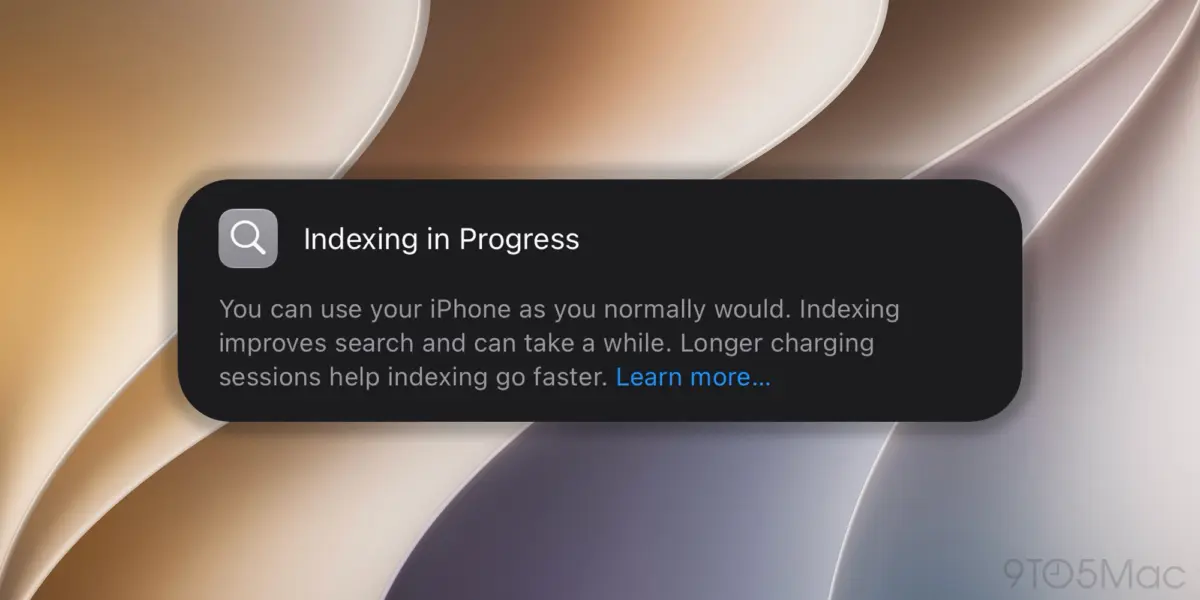
One of the historical frustrations with Spotlight updates has been the opacity of the process; users rarely knew whether search was fully functional or still catching up. Apple has addressed this by integrating clear visual indicators across its various operating systems:
- macOS: Mac users can check indexing progress instantaneously by pressing the standard shortcut (
Command + Space) to invoke Spotlight or Siri. If optimization is still underway, a clean, informative status indicator will appear at the top of the search window, displaying real-time progress. Furthermore, Apple notes that the Mail application features a dedicated notification banner if email-specific message indexing remains incomplete. - iOS, iPadOS, and Other Platforms: On mobile devices, users do not typically interact with a floating desktop window. Instead, Apple routes status updates directly through the Settings application. If Search and Siri are actively optimizing your local database, a descriptive notification banner appears within the main Settings menu, keeping users informed without cluttering the home screen.
Future Outlook: The Next Era of Ambient Computing
Apple’s detailed documentation regarding Spotlight indexing is much more than a routine customer support update; it offers a fascinating window into the future of consumer technology and ambient computing.
As we look toward the widespread adoption of iOS 27 and its sibling operating systems, the boundary between "searching for a file" and "conversing with your personal operating system" is evaporating. Spotlight is no longer a mere utility tucked away in the corner of a desktop or pulled down from the home screen—it is the central nervous system of Apple’s device ecosystem, serving as the bridge between raw local data and sophisticated on-device artificial intelligence.
In the coming years, as silicon architectures become even more specialized—with neural processing units boasting unprecedented tokens-per-second capabilities—the friction of initial device indexing will likely diminish. Faster solid-state storage speeds, more efficient background scheduling algorithms, and hyper-optimized machine learning models will make multi-terabyte on-device indexing feel instantaneous.
Until then, Apple’s proactive approach in releasing granular support documentation, combined with pre-indexing strategies like those deployed in iOS 26.6, demonstrates a maturing understanding of user experience management. By demystifying the background mechanics of Spotlight and providing clear, actionable steps to accelerate optimization, Apple ensures that users can transition smoothly into the AI-driven era without losing faith in the responsiveness and reliability of their devices.
Ultimately, the brief period of waiting for an index to complete is a small price to pay for a system that respects user privacy by keeping personal data securely on-device, while simultaneously delivering the instantaneous, context-aware power of next-generation Siri intelligence.