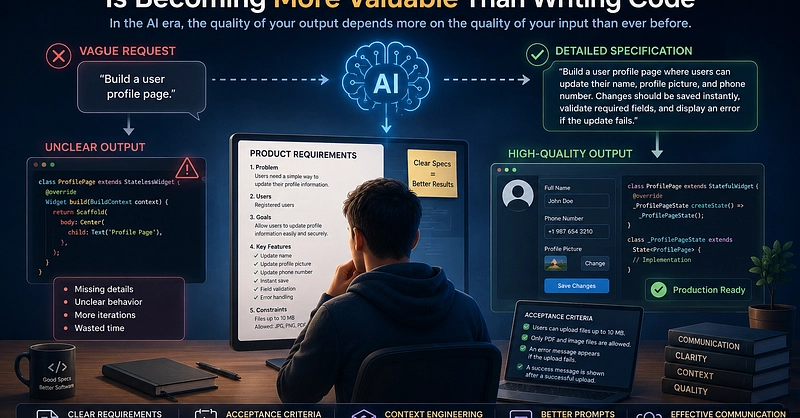
In the artificial intelligence era, the quality of your output depends more on the quality of your input than ever before. As automated code generation matures, the software engineer’s ultimate superpower is no longer syntax mastery—it is absolute clarity of communication.
Executive Overview
For decades, the bottleneck of software engineering was mechanical translation. Bridging the gap between human intent and machine instructions required painstaking mastery of syntax, memory management, algorithmic optimization, and framework idiosyncrasies. Programmers spent their days wrestling with semicolons, hunting down elusive null-pointer exceptions, and manually scaffolding boilerplate code.
Today, that paradigm has fundamentally shattered. Artificial intelligence can generate code, write unit tests, suggest complex database schemas, and scaffold entire software features in mere minutes. Yet, as the mechanics of writing code become commoditized, a glaring vulnerability has been exposed: AI cannot read your mind.
When given vague, incomplete, or ambiguous instructions, large language models (LLMs) and autonomous coding agents happily generate confident, production-ready-looking garbage. The industry is rapidly learning that the core bottleneck of software development has shifted. The problem is no longer how to write the code; the problem is defining what needs to be built in the first place.
As a result, specification writing, Product Requirements Document (PRD) authoring, acceptance criteria definition, and context engineering are transforming from administrative overhead into the most valuable, highly leveraged skills in modern software engineering. Great software no longer starts with great syntax; it starts with great specifications.
Detailed Chronology: The Evolution from Syntax to Specification
To understand why the software industry has arrived at this inflection point, it is instructive to examine the chronological evolution of software development abstractions.
[1950s-1970s: The Machine Layer]
   └── Assembly & Early High-Level Languages (Focus: Hardware constraints & syntax)
         ↓
[1980s-2000s: The Architecture Layer]
   └── Object-Oriented & Enterprise Frameworks (Focus: Design patterns & scaling)
         ↓
[2010s-Early 2020s: The Automation Layer]
   └── DevOps, CI/CD, & Cloud-Native (Focus: Deployment speed & infrastructure)
         ↓
[The AI Era: The Intent Layer]
   └── Generative AI & Autonomous Coding (Focus: Requirements & context engineering)
1. The Machine and Assembly Era (1950s–1970s)
In the infancy of computing, engineering was synonymous with raw hardware manipulation. Programmers wrote in assembly language or directly toggled binary switches. The primary intellectual challenge was managing memory registers, instruction sets, and CPU cycles. Syntax errors meant literal hardware faults or catastrophic system crashes.
2. The High-Level Language and Paradigm Shift (1980s–2000s)
The introduction of structured programming, object-oriented languages (C++, Java, C#), and later dynamic web languages (JavaScript, Python) abstracted away hardware constraints. The industry focused heavily on design patterns, architectural modularity, and managing complexity through abstractions. Mastery of language syntax and algorithmic efficiency remained the hallmark of a senior engineer.
3. The Agile and DevOps Acceleration (2010s–Early 2020s)
Software delivery shifted toward speed and automation. Agile methodologies broke projects into two-week sprints, while cloud computing, containerization (Docker), and continuous integration/continuous deployment (CI/CD) pipelines eliminated physical infrastructure bottlenecks. The developer’s day-to-day became a mix of business logic implementation, API integration, and pipeline troubleshooting.
4. The AI Era and the Rise of Intent Engineering (Present Day)
With the advent of advanced code-generation models, the cost of generating code has plummeted toward zero. Developers are no longer typists translating logic into syntax; they are orchestrators, reviewers, and directors of silicon assistants. The critical path of software delivery has officially inverted: the time spent writing code is now dwarfed by the time spent figuring out what code should be written.
Supporting Context & Metrics: The Hidden Costs of Ambiguity
The traditional software engineering lifecycle has long suffered from the "garbage in, garbage out" phenomenon, but the integration of AI has magnified its financial and operational impact.
Industry research into software defect origins consistently reveals that the majority of software bugs do not originate from poor coding practices—they originate from ambiguous or misunderstood requirements.
The Economics of Clarification
According to foundational software engineering metrics popularized by the IBM Systems Sciences Institute, the cost of fixing a defect discovered during the requirements phase is exponentially lower than fixing it post-release:
- Requirements Phase: 1x baseline cost
- Design Phase: 3x to 6x cost
- Coding/Implementation Phase: 10x cost
- Testing Phase: 15x to 40x cost
- Production/Post-Release Phase: 40x to 100x+ cost
When an engineer feeds a vague prompt into an AI assistant—such as "Build a user profile page"—the AI is forced to hallucinate missing business logic, UI layouts, validation rules, and security constraints.
Contrast this with a precise instruction set:
"Build a user profile page where users can update their name, profile picture, and phone number. Changes should be saved instantly via a debounced API call, validate required fields client-side, and display a localized toast error message if the network request fails."
By replacing ambiguity with structure, the AI generates code that requires zero or minimal refactoring, preserving engineering momentum and preventing technical debt from entering the codebase at inception.
Official Statements & Industry Perspectives
Leading voices across the technology sector are echoing a singular consensus: the future belongs to engineers who can communicate with absolute precision.
"The most important programming language is English (or your natural human language)."
— Andrej Karpathy, AI Researcher and founding member of OpenAI
Karpathy’s observation highlights a profound shift in computer science. As natural language models become the primary interface for software creation, human communication skills—traditionally categorized as "soft skills"—have become core technical competencies.
Industry analysts at major tech firms point out that junior and senior engineers alike must adapt their workflows. Engineering managers no longer evaluate candidates solely on their ability to invert a binary tree on a whiteboard, but on their capacity to break down complex business domains into rigorous, machine-consumable specifications.
Furthermore, enterprise software architects note that autonomous coding agents fail not because they lack coding capability, but because enterprise applications are burdened by vast webs of implicit institutional knowledge, compliance mandates, and architectural constraints. Without explicit documentation and clear boundary definitions, AI models grope in the dark.
Core Pillars of Modern Specification Engineering
To thrive in this new landscape, engineers and product managers must master four foundational pillars of input engineering.
1. The Lean PRD (Product Requirements Document)
A Product Requirements Document in the AI era does not need to be a dense, 50-page corporate artifact that sits unread in a wiki. Instead, it should be a modular, highly structured blueprint designed to serve as both human alignment and AI context. A lean PRD must answer:
- What problem are we solving, and for whom?
- What are the strict boundaries and out-of-scope items?
- What are the non-functional requirements (latency, security, accessibility)?
2. Precise Acceptance Criteria
Ambiguity is the enemy of automated execution. Acceptance criteria must act as a binary checklist for success. Instead of vague aspirations like "Users should be able to upload files," modern specifications utilize definitive constraints:
- Users can upload files up to 10 MB in size.
- Only PDF, JPEG, and PNG formats are accepted.
- A progress bar must be displayed during upload.
- An explicit error message must appear if the file exceeds the size limit or has an invalid extension.
3. Context Engineering over Prompt Tricks
A prompt is a single transactional request; context engineering is the deliberate curation of the entire informational environment surrounding that request. AI performs exponentially better when it is fed:
- Existing code patterns and style guides to maintain architectural consistency.
- Technical constraints (e.g., "Must be implemented in Flutter 3.x using Riverpod for state management").
- Business domain context (e.g., "This module handles PCI-DSS compliant payment processing, so strict input sanitization is mandatory").
4. Eliminating Ambiguity Through Collaborative Communication
Specifications are ultimately communication instruments. They bridge the chasm between stakeholders, product designers, backend engineers, QA testers, and AI agents. When a specification is airtight, every participant operates from a shared mental model, slashing the cognitive overhead of meetings, clarification loops, and rework cycles.
Future Outlook: The Next Decade of Software Development
As we look toward the horizon of software engineering, several transformative trends are coming into focus:
- The Rise of the "Specification Engineer": We will see the emergence of specialized roles focused entirely on domain modeling, systems architecture definition, and intent translation. These engineers will act as master architects who translate human desires into hyper-rigorous specifications that autonomous multi-agent AI systems execute.
- Automated Spec-Driven Development: Future development environments will likely feature automated agents that interrogate product managers when a requirement is vague, proactively asking clarifying questions before a single line of code is compiled.
- The Devaluation of Syntax Memorization: Educational institutions and bootcamps will pivot away from teaching rote syntax memorization and syntax drills, focusing instead on logic decomposition, system design, formal verification, and clear technical writing.
- Shorter Time-to-Market, Higher Quality Standards: As the friction of implementation approaches zero, the competitive advantage will belong to organizations that can conceptualize, specify, and validate superior products faster than their competitors.
Conclusion
Software engineering is undergoing its most profound metamorphosis since the invention of the compiler. As artificial intelligence continues to automate the mechanical execution of coding, writing code is becoming easier—while defining the right problem is becoming harder, and infinitely more valuable.
Great software has never started with great syntax; it starts with great specifications. In the AI era, engineers, architects, and product leaders who can master the art of clear communication, rigorous acceptance criteria design, and context engineering will consistently outperform their peers.
The future of software development is no longer about writing better code. It is about writing better instructions.