In a milestone release that bridges the gap between traditional operational databases and modern artificial intelligence architectures, Amazon Web Services (AWS) has announced the general availability of native vector search in Amazon DynamoDB. This development marks a paradigm shift in how developers handle semantic retrieval, Retrieval-Augmented Generation (RAG), agentic memory, and recommendation engines.
Historically, implementing vector search required architecting a bifurcated system: transactional operational data resided in a primary data store like DynamoDB, while vector embeddings—numerical representations of text, images, or audio captured by machine learning models—had to be replicated to a specialized, dedicated vector database. This dual-database approach introduced persistent engineering friction. Teams had to maintain complex, real-time synchronization pipelines, absorb the economic penalties of duplicated storage and cross-service data movement, and wrestle with managing predictable low latencies at high scale.
With this release, DynamoDB eliminates the need for external vector stores. Developers can now store vector embeddings natively alongside standard operational attributes—such as pricing, identifiers, and categories—within the same serverless infrastructure. Powered by a single-digit millisecond latency profile and achieving over 99% recall accuracy even at a scale of trillions of vectors, native vector search in DynamoDB operates entirely on serverless principles. There are no servers to provision, no maintenance windows to schedule, and no versioning bottlenecks to navigate. By merging high-performance NoSQL operations with scalable vector mathematics, AWS has redefined the foundational stack required to build production-grade, AI-driven applications.
The journey toward native vector search in DynamoDB stems from years of enterprise demand for streamlined AI architectures. As generative AI models transitioned from experimental novelties to core enterprise production workloads, the architectural overhead of managing disparate databases became a primary bottleneck for software engineering teams. AWS engineers addressed this by developing a specialized index type natively integrated into the DynamoDB query engine, bypassing the need for third-party bridges or separate microservices.
For organizations transitioning existing tables or architecting greenfield solutions, integrating vector search follows a structured, streamlined progression.
Phase 1: Preparing the DynamoDB Table
To enable semantic search capabilities, applications must first transform unstructured data—such as product descriptions, customer support logs, or user profiles—into numerical arrays known as vector embeddings. These embeddings can be generated using a machine learning model of the developer’s choice, including Amazon Bedrock Titan Text Embeddings, Cohere Embed, or OpenAI text embedding formats.
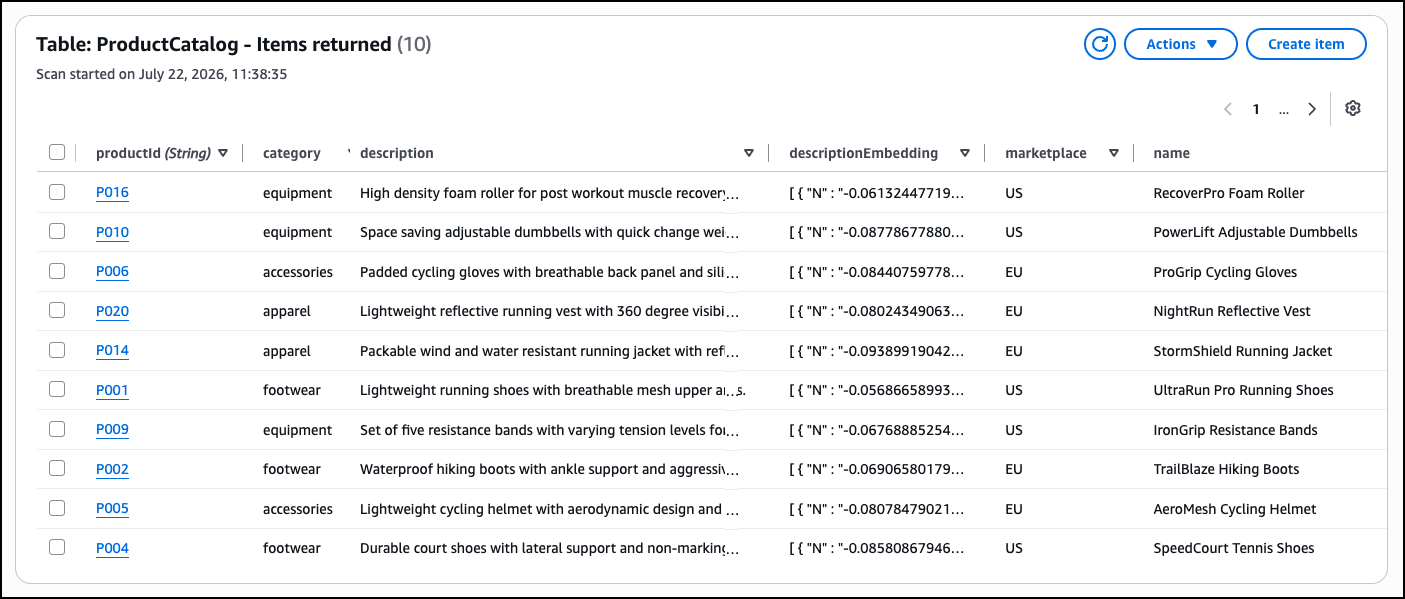
Once generated, these embeddings are added to an existing table (for instance, a ProductCatalog table) as a standard attribute, such as descriptionEmbedding, utilizing an UpdateItem or PutItem API call. Notably, DynamoDB leverages its native List data type to store vector embeddings, where each element in the list is a Number representing a single float value. This architectural decision means developers do not need to alter core database schemas or adopt exotic data types to begin integrating vectors alongside operational metadata.
Phase 2: Creating the Vector Index
Once the vectors reside within the table items, developers configure a vector index through the AWS Management Console, AWS CLI, AWS SDKs, or Infrastructure-as-Code (IaC) tools like AWS CloudFormation.
The configuration process involves several critical architectural decisions:
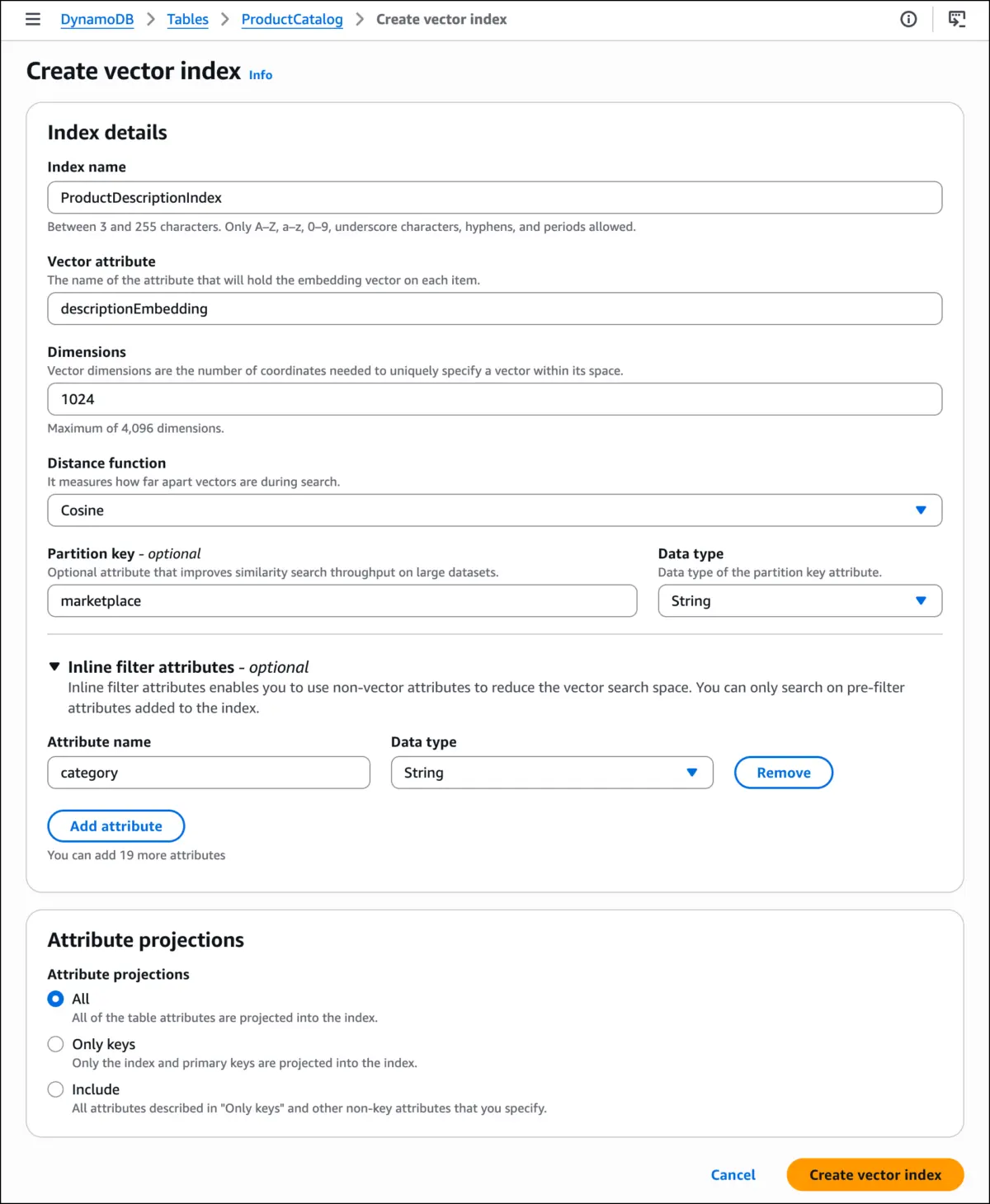
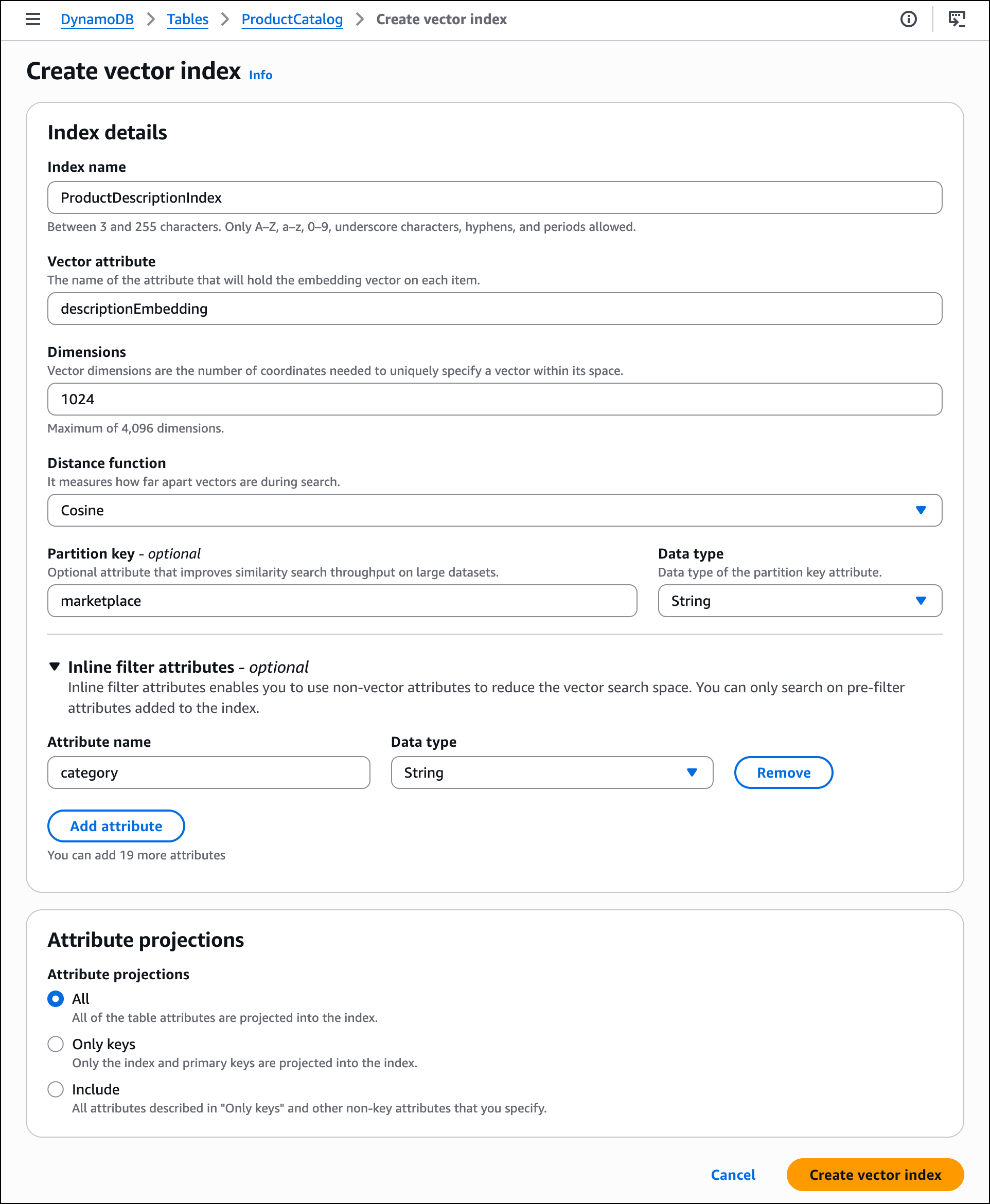
Index Naming & Attribute Mapping: Designating a unique index name (e.g., ProductDescriptionIndex) and mapping it to the vector-storing attribute (descriptionEmbedding).
Dimensionality Configuration: Matching the number of dimensions precisely to the output specification of the chosen embedding model (supporting up to 4096 dimensions).
Distance Function Selection: Choosing the mathematical approach for calculating vector proximity. DynamoDB supports three primary distance functions:
Cosine Distance: Measures the angle between vectors, highly effective for evaluating the semantic similarity of text regardless of magnitude.
Euclidean Distance: Measures the straight-line distance between two points in vector space.
Dot Product: Measures the projection of one vector onto another, frequently used in recommendation systems.
Partition Key Designation: Specifying an optional partition key (such as marketplace) to optimize query distribution. By scoping vector indexes across distinct partitions, large datasets can scale horizontally without forcing the query engine to scan the entire index, ensuring predictable, ultra-low latencies.
Inline Filtering: Adding non-vector attributes (e.g., category) as inline filters to narrow search results at query time, though restricted to exact-match conditions.
Phase 3: Executing Vector Search Queries
With the index status transitioning to Active, the system is ready to process queries. When a user executes a natural language search—such as "lightweight running shoes for summer"—the application converts the query string into a vector using the same embedding model utilized during ingestion.
Using the SearchVectors API (or via the DynamoDB console interface), the application passes the query vector, the target vector index, the desired number of results (Top $K$ up to 100), and optional inline filter conditions (e.g., category = footwear scoped within a specific US marketplace partition). DynamoDB immediately evaluates the proximity of the query vector against stored embeddings, returning the most semantically relevant items ranked by similarity score alongside all associated operational attributes in a single, unified response.
Supporting Context & Metrics
The architectural implications of moving from a multi-database topology to a unified serverless vector store are profound. In traditional enterprise environments, maintaining a dedicated vector database alongside an operational store incurred a compound tax:
Operational Overhead: Engineering teams were forced to manage two distinct database technologies, monitor two sets of infrastructure health metrics, and patch vulnerabilities across disparate codebases.
Data Synchronization Latency: Real-time data mutation in the primary database (e.g., a price update or inventory restock) had to be captured via change data capture (CDC) pipelines, transformed, and streamed into the vector database. This introduced synchronization lag, where search results could temporarily drift from actual operational state.
Financial Friction: Duplicate data storage, complex cross-network data movement, and separate software licensing or provisioned capacity costs inflated total cost of ownership (TCO).
Performance Metrics & Benchmarks
DynamoDB’s native vector search shatters these constraints by sharing the underlying serverless infrastructure and pay-per-request pricing model of the parent table. Key technical benchmarks include:
Latency Profile: Single-digit millisecond execution times for similarity queries, ensuring real-time responsiveness for user-facing applications.
Recall Accuracy: Maintained at 99%+ accuracy thresholds, ensuring high precision in semantic retrieval tasks.
Scalability Limits: Engineered to handle arbitrarily massive workloads, supporting up to trillions of vectors with unlimited storage capacity scaling horizontally.
Dimensional Range: Full support for high-dimensional models ranging up to 4096 dimensions, accommodating advanced multi-modal and large language model (LLM) embeddings.
Official Statements & Industry Perspectives
Industry analysts and AWS architecture leads have emphasized the transformative nature of this release. By embedding vector capabilities directly into a foundational NoSQL database, AWS has effectively democratized advanced artificial intelligence capabilities for organizations of all sizes.
"For years, developers building intelligent applications faced an unnecessary architectural tax," noted enterprise cloud architects close to the release. "Splitting operational data from vector embeddings created synchronization headaches, inflated operational costs, and complicated disaster recovery strategies. By bringing vector search natively into Amazon DynamoDB, AWS has removed the friction between operational state and semantic discovery. Teams can now build sophisticated RAG applications, agentic memory stores, and personalized recommendation engines with the same serverless simplicity they have come to rely on for high-scale transactional workloads."
Furthermore, the introduction of integration tooling—such as the AWS Model Context Protocol (MCP) Server and associated AI coding plugins—signals a broader push by AWS to ensure developers can interact with these new APIs programmatically using natural language and advanced AI development assistants, drastically reducing time-to-market for modern cloud applications.
Future Outlook
The launch of native vector search in Amazon DynamoDB signals a broader evolution in database design: the convergence of transactional processing (OLTP), analytical capabilities, and artificial intelligence vector math into unified, serverless engines.
As enterprises increasingly transition from experimental generative AI pilots to deeply embedded production systems, the demand for low-latency, zero-management infrastructure will only intensify. Use cases spanning agentic memory systems—where autonomous AI agents require persistent, context-aware recall over vast operational histories—will rely heavily on databases that can read, write, and semantically query data simultaneously without multi-hop network overhead.
Looking forward, we can anticipate deeper integrations between DynamoDB vector indexes and managed machine learning ecosystems, automated embedding generation pipelines managed directly at the database layer, and further optimizations in distance calculation hardware acceleration. For software engineers and enterprise architects, the message is clear: the era of managing siloed vector databases is drawing to a close, replaced by an era of unified, intelligent, and infinitely scalable serverless data platforms.
Summary of Capabilities & Regional Availability
Vector search in Amazon DynamoDB is generally available today across all commercial AWS Regions, including AWS GovCloud (US) Regions.
Core Feature Matrix:
Infrastructure Model: Fully serverless (pay-per-request pricing; zero servers to provision, patch, or manage).
Maximum Dimensions: Up to 4096 dimensions.
Distance Metrics: Cosine, Euclidean, and Dot Product.
Max Top $K$ Retrieval: Up to 100 results per query.
Maintenance Profile: Zero downtime maintenance, zero version windows.
Developers can begin building and testing vector-enabled tables today using the Amazon DynamoDB console, AWS SDKs, AWS CLI, or CloudFormation templates, with community support active via AWS re:Post and official developer documentation channels.