
Executive Overview
The digital storefront of Steam is a relentless engine of commerce and creative expression, processing a massive volume of software launches on a weekly basis. Yet, behind the headline-grabbing multi-million-dollar successes lies a sobering reality: a staggering majority of releases fail to generate meaningful revenue. Navigating this hyper-saturated marketplace requires more than just creative vision; it demands a granular understanding of genre economics, platform analytics, and player consumption habits.
To demystify these mechanics, industry data analysts Ichiro Lambe, Matt Martindale, and Dr. Tim Ermilov developed weloveit.io, a specialized platform designed to estimate the earnings of over 100,000 paid Steam games utilizing user reviews. By applying time-tested industry formulas such as the Boxleiter method, the project offers an unprecedented look into the financial viability of different game genres.
This comprehensive report examines the methodology behind these revenue projections, breaks down the highest- and lowest-performing genres on Steam by hit rate, analyzes the top-performing titles by revenue over a definitive weekly window, and evaluates the long-term viability of independent game development in an increasingly crowded marketplace.
Detailed Chronology: Unpacking the Data Behind the Steam Revenue Report
The quest to quantify Steam’s opaque economic landscape has long been a pursuit for indie developers, major publishers, and market analysts alike. Valve Corporation famously guards its internal sales metrics, leaving external observers to devise clever heuristics to gauge market performance.
The Evolution of Sales Estimation
For years, analysts relied on sparse data points, press releases, and concurrent player peaks to estimate game sales. However, the maturation of data aggregation tools and empirical methodologies has allowed researchers to paint a far more accurate picture. The cornerstone of this recent breakthrough is the Boxleiter method.

First popularized by indie developer Jake Boxleiter, this method relies on a simple premise: a game’s total number of user reviews on Steam correlates directly with its unit sales. By applying a standard multiplier—typically 35 times the total review count for a balanced estimate—analysts can establish a reliable baseline for total units sold, and consequently, lifetime gross revenue.
Mapping 100,000+ Games
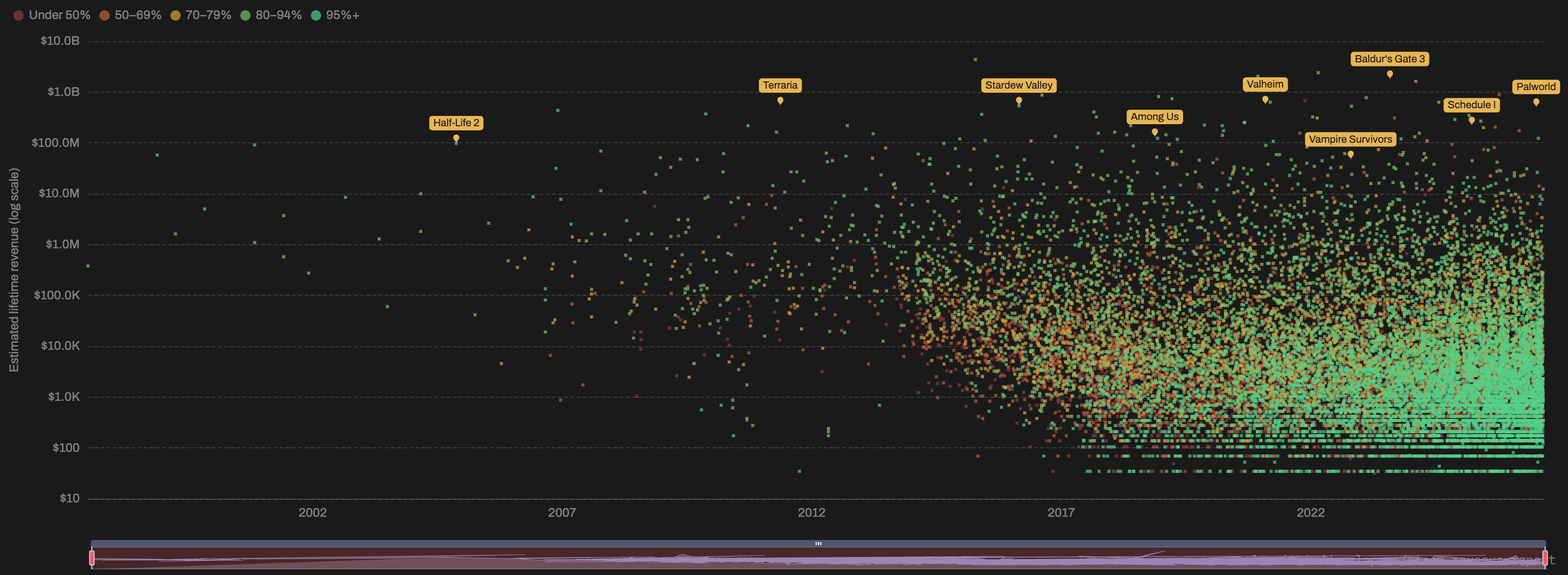
Collaborating under the banner of data transparency, Lambe, Martindale, and Ermilov ingested data for over 100,000 paid games listed on Steam. The resulting visualizations on weloveit.io illustrate the stark economic polarization of the platform.
- The Titans: At the extreme upper echelon, blockbusters like Larian Studios’ Baldur’s Gate 3 have generated an estimated $1.79 billion since its early access debut in late 2020.
- The Long Tail: Conversely, at the bottom of the distribution curve sit obscure experiments and hobbyist projects, such as the physics-based climbing game Free Solo, which launched in March and has grossed a meager estimated $34.
This vast disparity underscores the central thesis of modern digital distribution: Steam is a winner-take-all ecosystem where visibility and player engagement dictate fiscal survival.
Supporting Context & Metrics: Genre Economics and Hit Rates
One of the most revealing facets of the weloveit.io study is its "genre economics" breakdown. By analyzing user-generated tags—specifically filtering for genres that appear within a game’s top six most popular tags to ensure community consensus—the researchers calculated the "hit rate" for various categories. In this context, a "hit" is defined as any game generating more than $100,000 in gross revenue.
The Top-Performing Genres on Steam
The analysis reveals clear preferences among Steam’s vast consumer base, favoring titles that offer player agency, emergent gameplay loops, and high replayability.

| Rank | Genre / Tag | Hit Rate (% of games making >$100k) |
|---|---|---|
| 1 | Sandbox | 27.3% |
| 2 | FPS (First-Person Shooter) | 21.6% |
| 3 | RPG (Role-Playing Game) | 19.4% |
| 4 | Simulation | 16.9% |
| 5 | Visual Novel | 16.5% |
| 6 | Horror | 16.1% |
| 7 | Strategy | 16.1% |
| 8 | Racing | 15.8% |
| 9 | Roguelite | 15.3% |
| 10 | Sports | 14.8% |
Analyzing the Winners
- Sandbox (27.3%): While "sandbox" is a broad descriptor encompassing wildly divergent titles like Terraria, Red Dead Redemption 2, and Project Zomboid, its high hit rate demonstrates that Steam users overwhelmingly favor experiences defined by player freedom, open-ended progression, and emergent storytelling.
- FPS (21.6%): Acting as a traditional pillar of PC gaming, the First-Person Shooter genre maintains a robust commercial floor. However, the tag often captures adjacent genres—such as narrative adventures and puzzle games with first-person perspectives—boosting its overall footprint.
- Visual Novels (16.5%): A surprise entry for many observers, visual novels exhibit remarkable consistency. While individual budgets are often low, dedicated fanbases and steady niche demand keep their commercial viability surprisingly high compared to more expensive development categories.
The High-Risk Categories
On the opposite end of the spectrum, certain genres present significant financial hazards for developers. Hidden Object games (5.4% hit rate) and 2D Platformers (5.5% hit rate) occupy the lowest tiers of commercial success.
While these genres may benefit from lower initial development costs, their saturation on the platform creates immense discoverability challenges. Furthermore, historical data indicates that 2D platformers have experienced a steady decline in market share and discoverability since their peak in 2016, whereas visual novels have maintained stable demand over a decade.
Weekly Revenue Spotlight: August 18–25 Performance
To contextualize macro-trends with short-term market movements, the weekly Steam revenue charts provide a snapshot of consumer spending habits.
Top Steam Games by Revenue (August 18–25)
- Counter-Strike 2
- How to Fish
- Call of Duty: Modern Warfare 4
- Mortal Shell II
- Wardogs
- Apex Legends
- Dota 2
- Stalker 2
- Helldivers 2
- Marvel Rivals
Key Market Observations
- The Rise of Physics-Based Co-Op (How to Fish): Securing the number two spot, How to Fish—a 1-to-4 player physics-based fishing simulator with surprisingly violent mechanics—exemplifies the viral potential of multiplayer "friendslop" titles that capture community attention through chaotic emergent gameplay.
- Live-Service and Evergreen Giants: Permanent fixtures like Counter-Strike 2, Dota 2, and Apex Legends continue to dominate raw revenue metrics through microtransactions and battle passes, proving that engagement-driven ecosystems remain unmatched in steady financial return.
- Discounts and Updates (Stalker 2): A strategic combination of a massive 2.0 update and steep promotional discounting propelled Stalker 2 back into the upper echelons of the revenue charts, highlighting how post-launch support can successfully revitalize older inventory.
- Pre-Order Momentum (Star Wars Zero Company): Although missing the strict window due to an impending review embargo lift, Star Wars Zero Company surged to number 12 ahead of its official release, driven by cosmetic pre-order incentives that galvanized the fanbase in the final days before launch.
Future Outlook: Navigating the Modern PC Gaming Landscape
As the digital marketplace continues to expand at an unprecedented rate, the insights provided by data platforms like weloveit.io serve as both a roadmap and a warning for game developers and industry investors.
1. The Death of Build-It-And-They-Will-Come
The data makes it abundantly clear that simply publishing a game on Steam is no longer a viable business strategy. With thousands of titles launching annually, developers must identify underserved niches, leverage high-performing tags (such as sandbox elements or robust simulation loops), and implement aggressive community-building strategies long before release day.
2. The Resilience of Niche Genres
While AAA blockbusters command the highest absolute revenue figures, genres like visual novels, horrors, and roguelites prove that a targeted, loyal audience can sustain independent studios. Understanding the statistical realities of genre hit rates allows development teams to right-size their budgets, mitigating risk in an increasingly volatile financial climate.
3. Data-Driven Development
As analytical methodologies become more sophisticated, publishers and independent creators alike will increasingly rely on transparent metric estimation tools. By studying historical review-to-sales multipliers and genre performance trends, the industry is moving past guesswork toward a more calculated approach to game conceptualization, funding, and marketing.
Ultimately, Steam remains a land of extreme contrasts—a place where a single developer can capture lightning in a bottle, yet thousands of others remain unseen. For those looking to succeed, data is no longer just a luxury; it is the ultimate survival tool.