EXECUTIVE OVERVIEW
For the past six months, the core operational engine of SaaStr—one of the world’s largest communities and resource hubs for B2B software executives—has operated under a radical premise: almost no one has logged into Salesforce.
The underlying data remains intact. The subscription fees continue to be paid, and the system of record is deeply depended upon. Yet, the traditional graphical user interface (GUI) has been entirely abandoned as the primary touchpoint for data retrieval and entry. SaaStr’s leadership and its lean roster of human operators no longer waste valuable minutes clicking through layouts, navigating nested menus, or wrestling with a software vendor’s opinion on how customer records ought to be displayed.
Instead, SaaStr runs on a lean human core augmented by more than 20 production-grade artificial intelligence agents. This shift has not come at the expense of business performance; rather, the organization has seen its revenue surge by 47% year-over-year, following a previous 19% contraction.
This operational pivot highlights a fundamental evolution in modern enterprise software. When an organization scales its digital workforce through AI agents rather than linear headcount growth, the traditional software bottleneck shifts. The constraint is no longer whether a CRM’s interface is intuitive or whether human employees have time to keep records updated. The new constraint is whether automated systems can seamlessly reach, process, and act upon the underlying data.
By turning Salesforce "headless"—utilizing its API layer coupled with custom-built Claude-powered agents—SaaStr has dismantled the traditional SaaS interaction model. The results challenge long-held assumptions about software consumption, pricing models, and the future of enterprise user experience. Data usage has skyrocketed by tenfold, software spend has climbed by 40%, and the traditional seat-based licensing model has been upended by consumption-driven, agentic workflows.
DETAILED CHRONOLOGY: HOW SAASTR WENT HEADLESS
The transition away from the traditional CRM interface was not born out of a desire to chase technological novelties; it was an operational necessity forced by hyper-growth and severe human resource constraints.
The Breaking Point: Humans vs. Agents
SaaStr’s operational reality changed dramatically as the company began scaling its digital labor force. Running a high-volume media, event, and community business with a minimal human footprint requires aggressive automation. As the company deployed more than 20 distinct production AI agents to handle operational workloads—ranging from lead qualification and customer success touchpoints to marketing automation—the traditional interface became a liability.
Human-centric interfaces assume human-scale interaction speeds. A human sales representative might log into Salesforce twice a day, review a handful of accounts, manually update pipeline stages, and log meeting notes. An AI agent, by contrast, operates continuously, executing thousands of micro-transactions, data synchronizations, and context retrievals in real time. Forcing autonomous agents to interact with a human graphical interface is inefficient, error-prone, and fundamentally bottlenecks throughput.
Building "Claudeforce" and "10K"
The technical implementation of SaaStr’s headless strategy was remarkably straightforward, relying less on complex, proprietary engineering hacks and more on open architecture principles.
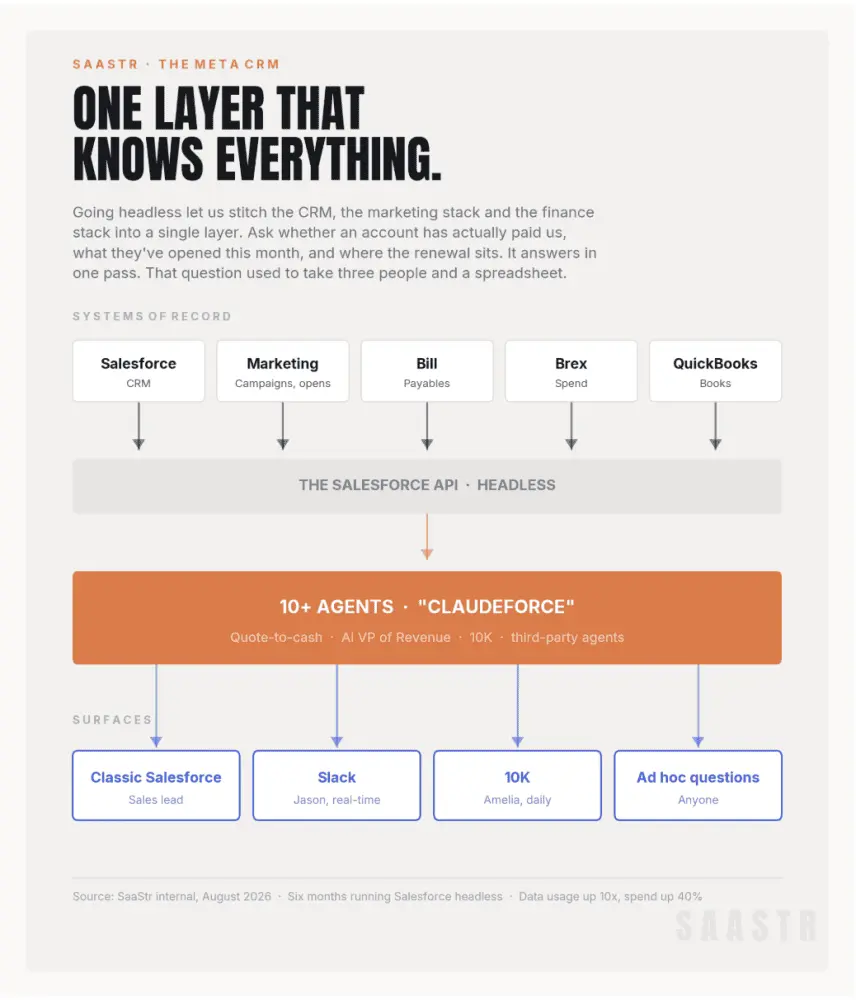
The engineering team decoupled Salesforce’s frontend by leveraging its robust API layer, effectively converting the enterprise software platform into a pure system of record. On top of this API infrastructure, the team deployed a custom-built AI agent powered by Anthropic’s Claude. Internally dubbed "Claudeforce," with the primary orchestrating agent named "10K," this layer serves as the universal translation engine between SaaStr’s human leadership, automated workflows, and the CRM database.
With this architecture in place, the CRM ceased to be a destination website or a desktop application. It became an invisible, foundational backend. The user interface for any given team member became whatever surface they happened to prefer at that exact moment—whether that meant Slack, a conversational chat window with 10K, or, in rare legacy cases, the classic Salesforce dashboard.
SUPPORTING CONTEXT & METRICS: THE SIX-MONTH ASSESSMENT
Six months into running a headless CRM architecture, SaaStr has documented profound shifts in efficiency, data integrity, and financial metrics. The experiment has yielded six core lessons that provide a blueprint for the future of enterprise software.
1. The Point of No Return: Why Classic UIs Are Obsolete
The verdict from leadership is absolute: there is zero chance SaaStr will ever return to traditional CRM usage patterns. Interacting with business data through an inflexible, vendor-dictated layout now feels archaic.
Executives report logging into the classic Salesforce interface perhaps twice a month, and strictly for administrative anomalies, such as verifying obscure data fields or triggering legacy marketing workflows. While certain roles—such as the company’s dedicated sales lead—initially clung to the classic interface out of habit, even those workflows are steadily being absorbed by autonomous agents. The realization that different team members require entirely different interaction surfaces without breaking the underlying data model has validated the entire headless thesis.
2. Scaling Autonomous Workflows Without Friction
More than 10 of SaaStr’s 20+ production AI agents now operate directly on top of the headless Salesforce architecture. Crucially, these include both proprietary agents built in-house and third-party commercial agents that plug directly into the open API layer.
In a traditional SaaS environment, deploying a new software agent or integration requires navigating complex permission structures, negotiating UI real estate, and waiting months for vendors to ship custom connectors. In a headless architecture, onboarding a new AI agent is reduced to a simple configuration change. The marginal cost and time required to deploy the eleventh agent approaches zero, enabling organizations to scale their digital workforce horizontally without architectural friction.
3. The Emergence of the "Meta-CRM"
One of the most powerful and underestimated outcomes of going headless was the ability to synthesize fragmented enterprise data.
In most organizations, customer data exists in strict silos: CRM data lives in Salesforce, marketing metrics live in automated email platforms, and financial realities are scattered across accounting tools like QuickBooks, Bill, and Brex. Historically, these systems operated in a vacuum, forcing human workers to manually bridge the gaps using cumbersome spreadsheets and periodic data exports.
By going headless, SaaStr engineered a unified "meta-CRM" layer. Because the AI agents maintain real-time API access across the CRM, marketing stack, and financial infrastructure simultaneously, they can answer complex, multi-system queries in a single conversational pass. An executive can ask whether a specific account has cleared its latest invoice, what content marketing assets the team engaged with over the past 30 days, and what the precise status of their upcoming contract renewal looks like—receiving an instantaneous, synthesized answer that previously would have required hours of cross-departmental auditing.
4. End-to-End Agentic Quote-to-Cash
To prove the operational viability of the architecture, SaaStr deployed an agentic quote-to-cash workflow operating entirely on top of the headless CRM and financial stack.
Quote-to-cash has long been touted as an automated business process, yet in practice, it traditionally relies on human administrative labor to copy numbers between contracts, billing platforms, and CRMs. By unifying these systems under a shared API layer, the handoffs were eliminated entirely. The AI agent now dynamically generates agreements, tracks signature acquisitions, and monitors collections autonomously, transforming a multi-day administrative bottleneck into an instantaneous background process.
5. Ambient Intelligence via Real-Time Slack Integration
The daily rhythm of executive oversight has fundamentally shifted. Rather than requiring human leaders to pull reports, compile dashboards, or read delayed end-of-week summaries, SaaStr’s AI VP of Revenue proactively pushes updates directly into Slack.
Real-time notifications regarding pipeline velocity, closed-won contracts, stalled deals, and predictive risk factors appear organically within existing communication channels. This transition from "pull" analytics (where humans hunt for data) to "push" intelligence (where agents deliver contextual insights) has accelerated decision-making speed across the entire executive team.
6. The Economics of Agentic Consumption: 10x Data, 40% Higher Bills
Perhaps the most critical finding from SaaStr’s experiment is the economic reality of AI-driven software consumption.
Since transitioning to a headless architecture driven by autonomous agents, SaaStr’s data consumption against Salesforce has increased by roughly tenfold, with projections pointing toward a 100-fold increase. Concurrently, software licensing and API consumption bills have risen by 40%.
For enterprise software vendors, this metric shatters prevailing anxieties that AI agents will cannibalize software revenue by reducing human seat counts. Autonomous agents do not check databases twice a day like human employees; they query APIs constantly because doing so incurs zero cognitive cost while yielding continuous operational value. SaaStr’s experience mirrors broader enterprise trends—such as data compiled in the Okta Enterprise AI Index—confirming that active data consumption, rather than static seat provisioning, is the true indicator of enterprise AI integration. Vendors who penalize consumption or lock down their platforms risk driving their customers to build alternative meta-layers, eventually rendering the foundational CRM entirely replaceable.
OFFICIAL STATEMENTS & INDUSTRY IMPLICATIONS
The implications of SaaStr’s headless transition extend far beyond a single organization’s tech stack; they signal a structural reckoning for the software-as-a-service (SaaS) industry.
Industry analysts and enterprise leaders are increasingly viewing the traditional monolithic application—where the database, application logic, and user interface are permanently fused together—as an obsolete paradigm.
"Your UI is one surface among many now, and for a growing share of your users it won’t be the primary one," notes the operational assessment from SaaStr leadership. "That’s not a threat to your product. Your product is the data model, the workflow logic, and the system of record. The UI was always just one way to reach it."
Software vendors that cling to closed ecosystems, proprietary user interfaces, and restrictive seat-based pricing models face an existential threat. If platforms fail to provide open, developer-friendly API layers that allow customers to freely deploy autonomous agents, organizations will bypass the native interface entirely, routing their operational workflows through custom-built meta-layers. Once an enterprise successfully abstracts its operations away from a vendor’s native UI, the underlying database becomes a commodity utility, easily swapped out for a more flexible alternative.
FUTURE OUTLOOK: THE MULTI-SURFACE ENTERPRISE
As enterprise software enters its next evolutionary phase, the assumption of a single, canonical user interface for every employee is officially finished.
SaaStr’s six-month experiment proves that the future belongs to multi-surface flexibility. Within a single four-person leadership and sales ecosystem, four distinct interaction surfaces now coexist harmoniously against a single source of truth:
- A sales lead relying on a traditional record-view UI for deep transactional focus.
- An executive monitoring ambient operational pulses via real-time Slack push notifications.
- A co-founder conducting conversational, strategic analysis with an AI agent every morning.
- Autonomous background agents executing quote-to-cash and data synchronization tasks without human intervention.
None of these surfaces are incorrect; they are simply optimized for different cognitive demands, roles, and temporal rhythms.
For enterprise software buyers, the directive is clear: decouple your core data layers, embrace headless architecture, and let autonomous agents interact with your systems at machine speed. For software vendors, the warning is equally stark: open your platforms, support every surface your customers demand, and monetize consumption rather than human friction—or risk watching your customers build the future somewhere else.