Executive Overview
In the rapidly evolving landscape of cloud computing, developer communities are the vital heartbeat that transforms raw infrastructure into transformative applications. Last week marked a significant milestone for Amazon Web Services (AWS) as the AWS Builder Center officially celebrated its first anniversary. Launched on July 9, 2025, the platform has grown from an initial community hub featuring basic wishlist voting and profile management into an expansive, full-stack ecosystem. Today, it incorporates interactive sandbox environments, hands-on workshops, dedicated community "Spaces," and a comprehensive Builders’ Library.
To commemorate this anniversary, senior AWS leaders published a series of retrospective deep-dives tracking the platform’s meteoric rise. Most notably, the debut of Sandbox Environments—a feature that provides developers with zero-friction, pre-provisioned AWS accounts—signals a new era of accessible, risk-free learning. Over its inaugural year, the platform has cultivated a prolific community of contributors, amassing millions of page views, thousands of peer-reviewed articles, and tens of thousands of engagement badges.
This retrospective examines the technological evolution of the AWS Builder Center, the metrics defining its first year of operation, standout community contributions, and the strategic implications of its newest features for developers worldwide.
Detailed Chronology: A Year of Rapid Iteration
The journey of the AWS Builder Center over the past 365 days reflects a relentless pace of feature shipping and user experience refinement. According to the comprehensive feature timeline published by Rick Suttles to mark the anniversary, the platform has systematically rolled out capabilities designed to bridge the gap between theoretical knowledge and practical cloud architecture.
Phase 1: Foundation and Early Community Tools (Mid-2025)
When the AWS Builder Center first opened its virtual doors in July 2025, its primary objective was to establish a centralized gathering place for cloud builders, engineers, and architects. Early iterations focused on core community infrastructure:
- Wishlist Voting: A democratic mechanism allowing developers to lobby for specific AWS service features, regional expansions, and documentation enhancements.
- Community Profiles & Toolboxes: Personalized spaces where builders could showcase their projects, certifications, and preferred technology stacks.
- Foundational Publishing: Early blogging capabilities that enabled thought leaders to share architectural patterns and migration strategies.
Phase 2: Expanding the Ecosystem (Late 2025 – Early 2026)
As adoption accelerated, the platform engineering team focused on deepening engagement through structured learning and user personalization:
- AWS Capabilities by Region: A comprehensive tracking matrix detailing the availability of over 1,500 distinct AWS services across 37 global regions.
- Spaces: The introduction of community-created and curated groups, allowing developers with niche interests—ranging from serverless architectures to machine learning pipelines—to collaborate in focused sub-communities.
- Workshops with Filters: Enhanced educational modules equipped with category and complexity filters, ensuring that everyone from absolute beginners to enterprise-grade systems architects could find relevant labs.
- Gamification and Tracking: The rollout of article view counters, saved items functionality, student status verifications, availability notifications, and streamlined authentication options via GitHub and Amazon accounts.
Phase 3: Gamification, Security, and Sandboxes (Spring – Summer 2026)
Entering its second year, the platform introduced advanced incentive structures and critical utility features:
- The Badge System (March 2026): A gamified reward structure designed to recognize consistent community participation, content creation, and workshop completion.
- Sandbox Environments (July 2026): The marquee anniversary feature, eliminating the historical barriers of entry for hands-on AWS experimentation.
Supporting Context & Metrics: By the Numbers
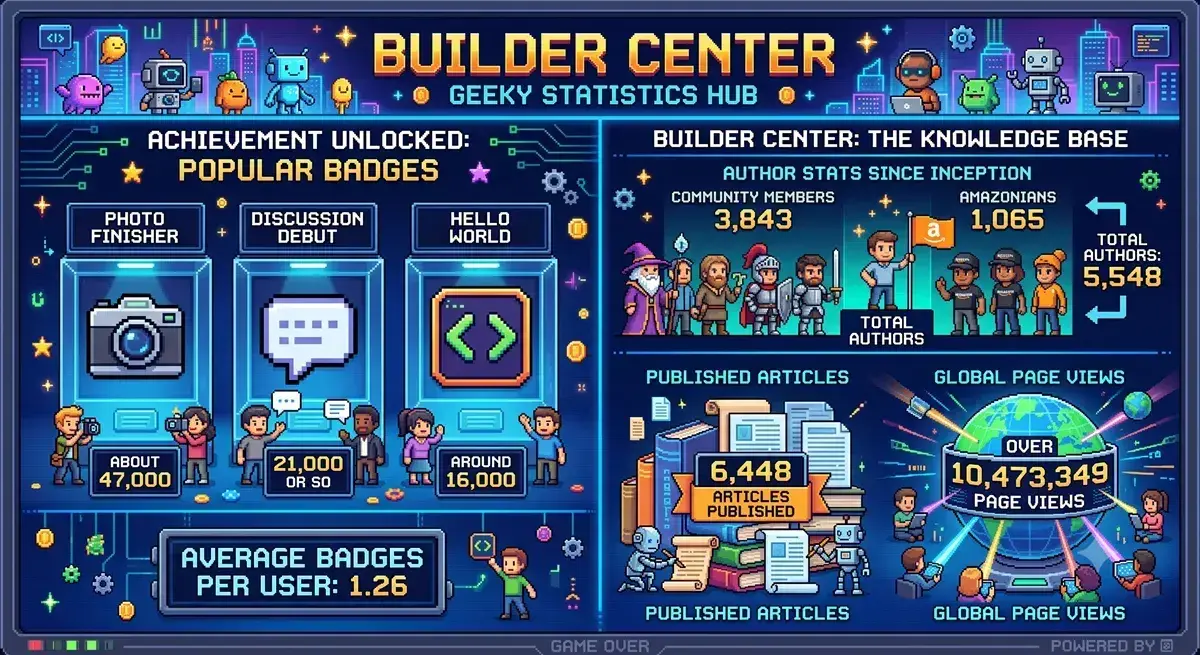
To truly understand the impact of the AWS Builder Center, one must examine the data. In a retrospective post detailing the platform’s first twelve months, AWS Chief Evangelist Jeff Barr shared a staggering set of engagement metrics that underscore the platform’s rapid viral adoption among global developers.
Content Creation and Reach
- 5,548 Authors: Over five thousand unique engineering professionals, hobbyists, and enterprise architects have stepped forward to share their technical insights.
- 6,448 Published Articles: A vast library of peer-produced literature covering everything from container orchestration to serverless cost optimization.
- 10.4 Million+ Page Views: The aggregate readership highlights the massive appetite for practitioner-written guides that complement official AWS documentation.
Community Gamification
- 99,226 Badges Earned: Since the official launch of the badge system in March 2026, nearly 100,000 digital achievements have been unlocked by users demonstrating technical proficiency, consistency, and community helpfulness.
Collaborative Feedback Loops
- 565 Wishes Submitted: Through the Builder Center Wishlist, the community has directly petitioned AWS product teams for specific feature enhancements.
- 10 Shipped, 20 Roadmap Items: Demonstrating a healthy feedback loop between builders and product managers, 10 community-requested features have already made their way into production, with another 20 slated for the near-term roadmap.
Official Statements and Standout Community Contributions
The success of any community platform is ultimately measured by the quality of the content generated by its members. Over the past year, several community-authored articles rose above the noise, capturing the imagination of the global developer base and racking up tens of thousands of views.
Top-Performing Community Articles
- "Building an AWS Study Buddy with MCP + Strands Agents SDK"
Author: Dineshraj Dhanapathy
Readership: 50,000+ views
Significance: Tapping into the explosive growth of generative AI and multi-agent systems, this guide demonstrated how developers can leverage Model Context Protocol (MCP) and advanced agent frameworks to build intelligent educational companions on AWS. - "Migrating an End-of-Life (EOL) Linux Server to AWS in 8 Hours with Kiro"
Author: Chris Miller
Readership: 45,000+ views
Significance: Addressing a perennial enterprise pain point, this high-utility migration guide provided a tactical blueprint for rescuing legacy workloads before operating system support deadlines expired. - "AIdeas: NeuroVoice – Multimodal AI for Early Screening of Neurological Diseases"
Author: Yash Aggarwal
Readership: 38,000+ views
Significance: Highlighting the intersection of cloud computing and healthcare tech, this article showcased how multimodal machine learning pipelines can be deployed on AWS architecture to assist in early medical diagnostics.
Deep Dive: Introducing Sandbox Environments on AWS Builder Center
The undisputed centerpiece of the one-year anniversary announcements is the official launch of Sandbox Environments, introduced by Rick Suttles. Historically, one of the primary friction points for aspiring cloud architects and developers participating in online tutorials has been the requirement to set up a personal AWS account, configure billing alerts, input credit card information, and rigorously clean up resources to avoid unexpected charges.

Sandbox Environments completely remove these operational hurdles.
Key Mechanics of AWS Builder Center Sandboxes:
- Zero Financial Risk: Users receive a free, pre-provisioned AWS account specifically tailored to complete a chosen workshop exercise. No credit card or personal billing setup is required.
- Automated Lifecycle Management: Each sandbox environment remains active for a strict duration of 8 hours. Once this window closes, the account and all associated cloud resources are automatically and permanently de-provisioned, ensuring complete data hygiene and security.
- Thoughtful Rate Limiting: To ensure fair access for the entire global community, builders are permitted to have one active sandbox at a time, with a maximum request allowance of one sandbox per week.
- Frictionless Execution: By bundling the execution environment directly into the workshop interface, AWS has drastically lowered the cognitive and financial barriers to hands-on cloud education.
Future Outlook: What’s Next for AWS Builders
As the AWS Builder Center transitions from its foundational first year into its second, the strategic trajectory for the platform is clear: deeper integration, broader accessibility, and an even tighter feedback loop between individual developers and core AWS engineering teams.
The rapid implementation of user wishes—with 10 features already shipped and 20 more on the near-term roadmap—proves that the Builder Center is not merely a publishing platform, but an active listening post for Amazon Web Services. As more developers leverage the new Sandbox Environments to test out complex architectures without financial anxiety, the velocity of innovation within the community is expected to accelerate even further.
Whether you are looking to publish your first technical deep dive, earn recognition through the platform’s gamified badge system, or test out a multi-region serverless pattern in a risk-free sandbox, the AWS Builder Center has solidified its place as the premier digital home for cloud practitioners.
To explore these new features, participate in upcoming workshops, or connect with fellow architects, visit the official AWS Builder Center.