Date: September 3, 2026 Author: Saf Malik (Adapted and Expanded for Extended Editorial Insight)
Executive Overview
For the past several years, the narrative surrounding the explosive expansion of data centres has been dominated by a single, monolithic hurdle: power. As hyperscale cloud providers, artificial intelligence (AI) labs, and colocation operators raced to feed the insatiable energy demands of large language models (LLMs) and dense computing clusters, grid capacity, substation queues, and sustainable energy sourcing became the definitive bottlenecks of digital infrastructure development.
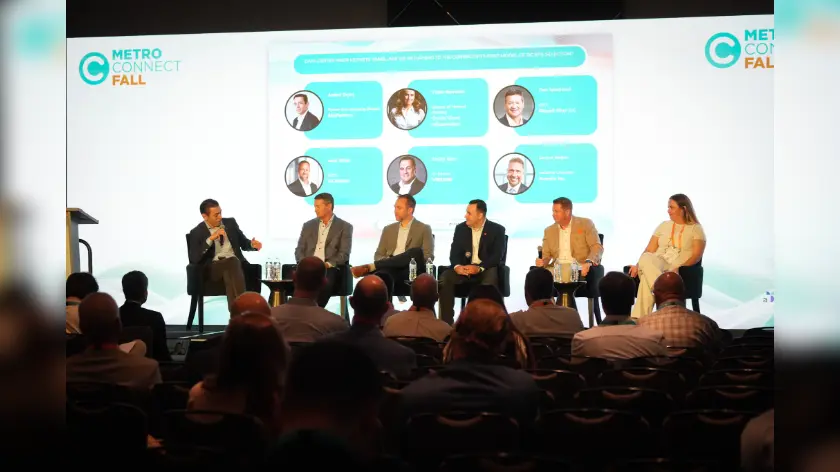
However, a dramatic shift is underway. According to an authoritative survey of investors, lenders, operators, and builders discussed during a high-profile keynote panel on the opening day of Metro Connect 2026, fibre availability has officially unseated power as the single biggest constraint on data centre development.
Moderated by Andrej Danis, partner and managing director at AlixPartners, the opening panel—titled "Are we returning to the connectivity-first model of DC site selection?"—signalled a profound philosophical reversal from just a few years ago. While access to megawatts remains non-negotiable, the industry is waking up to the reality that a fully powered data centre is effectively a stranded asset if it cannot move petabytes of data at lightning-fast speeds to the rest of the world.
As digital transformation accelerates, driven heavily by the operational maturation of AI inference, edge computing, and real-time enterprise workloads, the race for high-capacity connectivity has transformed site selection, regulatory navigation, and public relations.
Detailed Chronology & Panel Insights: The Anatomy of a Bottleneck
The keynote session brought together a powerhouse of digital infrastructure leadership:
Tricia Harvester, Director of Network Planning, Oracle Cloud Infrastructure (OCI)
Tom Spackman, Chief Executive Officer, Gigabit Fiber LLC
John White, Chief Operating Officer, US Signal
Emilio Baez, Senior Director, Verizon
Lindon Hayes, Executive Chairman, Essentia
The Permitting Quagmire
While public discourse often focuses on construction costs or raw material supply chains, the panellists were unanimous in identifying permitting as the true critical path for new fibre deployments.
Tom Spackman of Gigabit Fiber offered a stark breakdown of timelines, noting that a modest 10-mile lateral connection typically takes around six months from inception, whereas a sprawling 200-mile long-haul route can easily span 24 to 36 months.
"Our critical path is not construction. It’s all about permitting," Spackman emphasized.
He explained that shaving months off these timelines has less to do with engineering prowess and more to do with possessing trusted, pre-established relationships with local permitting authorities rather than attempting to forge bureaucratic alliances from scratch on every individual project.
Echoing these operational realities, Lindon Hayes of Essentia shared that his firm builds extensive contingencies directly into its project modeling. While Essentia typically quotes clients an 18-month delivery window, it aggressively targets a 12-month completion mark. They achieve this agility by deploying an in-house design and permitting software platform supercharged with what Hayes termed "performance intelligence"—historic, data-driven insights harvested from prior builds.
Community Engagement and the "Two-Step" Deployment Model
Another friction point in modern fibre deployment is local pushback. Tricia Harvester of Oracle noted that while fibre may not be the primary check-box item in early-stage site selection, the broader digital infrastructure sector has historically under-communicated with the host municipalities where these multi-billion-dollar projects land.
To bypass initial connectivity delays, operators are increasingly forced to adopt a pragmatic approach. Harvester revealed that OCI and other hyperscalers frequently launch operations using partial or temporary "lit" connectivity solutions before their permanent, high-capacity fibre paths are fully trenched and certified. She described this adaptive strategy as "always a two-step."
The AI Shift: From Training to Inference, and the Edge Revolution
A major focal point of the Metro Connect discussion was the evolving nature of AI workloads. The industry is rapidly pivoting away from purely centralised AI model training toward distributed inference workloads—the phase where trained models are actively deployed to make real-time decisions, run automation, and interact with end-users.
Edge Computing and Latency Realities
Emilio Baez of Verizon pointed to interactive voice agents, autonomous systems, and advanced robotics as the primary catalysts driving a new wave of edge deployments.
"AI learns in the cloud, but it’s going to live at the edge," Baez stated, encapsulating the architectural mandate facing telecom and cloud providers alike.
Adding to this perspective, John White of US Signal highlighted concrete enterprise use cases, such as real-time vehicle telematics for insurance firms and predictive logistics tracking. These applications, White noted, are utterly dependent on distributed, ultra-low-jitter networks rather than raw compute horsepower residing in a single, distant hyperscale warehouse.
However, this enthusiasm for the edge sparked a healthy debate among panel members. Tom Spackman openly questioned whether latency genuinely justifies some of the colossal, remote data centre mega-sites currently being planned. He suggested that mounting community pushback and severe power constraints could ultimately force the industry away from reliance on massive 500-megawatt-plus single sites. Instead, Spackman foresees a decentralised future defined by clusters of smaller, highly distributed facilities ranging between 10 and 50 megawatts.
Supporting Context, Infrastructure Specs, and Industry Standards
To support the massive data throughput demanded by modern AI and cloud architectures, the underlying physical and optical infrastructure is undergoing a radical upgrade.
Engineering Specifications
Panellists noted that the baseline engineering specifications requested by hyperscale tenants have evolved significantly over the past five years. Today, the standard conduit specification demanded by hyperscalers is heavily tilted toward 2.25-inch, three-microduct configurations, enabling operators to blow multiple high-count fibre strands through a single conduit pathway as bandwidth demands scale.
Verizon’s AI Connect and Terabit Trials
On the telecommunications front, Verizon is actively positioning itself at the bleeding edge of high-capacity transport. Baez outlined the company’s comprehensive AI Connect strategy, which builds directly upon Verizon’s earlier "one-fibre" infrastructure initiative and its strategic integration of Frontier’s extensive network assets.
While Baez spoke broadly about backbone capacity testing on stage, Verizon has separately confirmed milestone trials transmitting a staggering 1.6 terabits per second (Tbps) of data on a single wavelength across its Boston metro network, utilising Ciena’s state-of-the-art WaveLogic 6 Extreme technology. Such breakthroughs illustrate the immense optical backbone capacity required to feed downstream edge data centres.
The Boundary Line: Who Operates the Network?
A fundamental structural question addressed during the panel was who should ultimately own and operate the complex web of AI data centre networks: the hyperscalers themselves or licensed telecommunication service providers?
The consensus among panellists was unequivocal. Public right-of-way access laws across the vast majority of U.S. states legally require public utility status—a heavy regulatory burden that hyperscale giants are generally unwilling or structurally unsuited to shoulder.
Tricia Harvester crisply summarized the industry’s working division of labor with a guiding principle for OCI:
"Inside the fence, it’s mine. Outside the fence, get it to the people that know how to run it."
Future Outlook: Workforce Constraints vs. Supply Chain Realities
Looking ahead to the projected infrastructure demand curve of 2027 and 2028, the panel dismantled some of the prevalent market anxieties regarding hardware and component shortages.
When queried about an impending fibre or material shortage, Tom Spackman dismissed mainstream reports of severe supply chain blockages and workforce bottlenecks as "way overexaggerated."
However, Lindon Hayes injected a note of caution regarding human capital. He identified talent scaling—recruiting, training, and retaining skilled engineering and permitting professionals—as the single most pressing constraint facing the sector today. Interestingly, Hayes pointed out that industry hiring continues to outpace any theoretical job losses or displacements attributed to enterprise AI adoption.
Conclusion
The discussions at Metro Connect 2026 mark a watershed moment for the digital infrastructure sector. As the industry grapples with the transition to ubiquitous AI inference, edge computing, and real-time enterprise services, the old playbook of simply parking a massive data centre wherever cheap power could be secured is no longer viable.
With fibre availability now reigning supreme as the ultimate project constraint, success in the next era of data centre development will belong to those who master the intricate dance of regulatory permitting, strategic telecom partnerships, and forward-thinking edge architecture.