Executive Overview
Humanity’s fascination with the Red Planet has driven decades of robotic exploration, yielding unprecedented insights into its ancient riverbeds, towering volcanoes, and the thin, rust-tinted atmosphere that blankets its surface. Yet, while orbiters, landers, and rovers have extensively cataloged Mars itself, its two enigmatic moons—Phobos and Deimos—remain largely mysterious.
That is about to change.
Scheduled to launch from the Tanegashima Space Center on October 20, 2026, the Martian Moons eXploration (MMX) mission, spearheaded by the Japan Aerospace Exploration Agency (JAXA), represents a monumental leap forward in interplanetary science and deep-space engineering. Costing an estimated $345 million USD and marking Japan’s first Mars-focused probe launch in 28 years, the MMX mission aims to resolve one of the most enduring debates in planetary science: the origin of the Martian moons.
If successful, the MMX spacecraft will accomplish a historic world first: collecting at least 10 grams of pristine material from the surface of Phobos, the larger of the two Martian satellites, and returning those samples safely to Earth. This ambitious multi-year odyssey is not merely a localized geological excavation; it is a technological tour de force. Designed to overcome the immense gravitational, logistical, and communicative hurdles of deep-space flight, MMX relies on cutting-edge autonomous navigation, international collaboration, and sophisticated multi-module architecture.
By analyzing these samples when they finally arrive on Earth in 2031, scientists hope to piece together how planetary systems evolve, whether captured asteroids or collision debris shape the moons of the inner solar system, and how impacts have redistributed material across the Martian system.
Detailed Chronology and Mission Architecture
The trajectory of the MMX mission is a carefully orchestrated choreography of orbital mechanics, propulsion management, and autonomous execution. Spanning a total duration of roughly five years from launch to sample delivery, the mission timeline is divided into distinct operational phases.
Phase 1: Launch and Interplanetary Transit (2026–2027)
The journey begins on October 20, 2026, when the MMX spacecraft lifts off from the Tanegashima Space Center aboard a Japanese launch vehicle. At launch, the spacecraft will boast a gross mass of 4,480 kilograms (approximately 9,900 pounds). More than half of this initial mass—roughly 2,500 kilograms—consists of liquid propellant, meticulously portioned into three distinct reserves dedicated to the outbound transit, orbital operations around Mars, and the perilous return trip to Earth.
The interplanetary cruise phase will take approximately one year. During this transit, systems will undergo routine checkouts as the spacecraft navigates the vast expanse between Earth and Mars, continuously adjusting its trajectory to align with the Red Planet’s orbital path.
Phase 2: Martian Orbital Operations and Exploration (2027–2030)
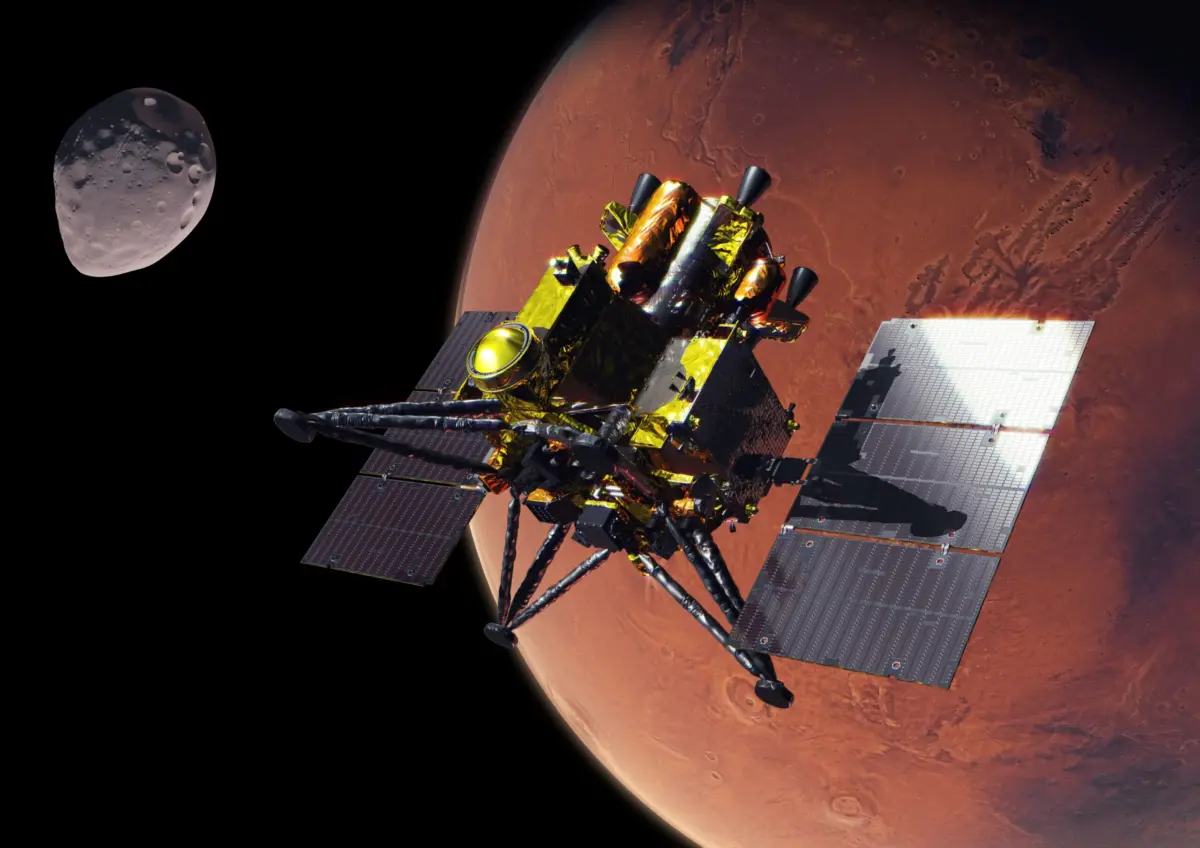
Upon arrival in the Martian system in late 2027, MMX will insert itself into orbit around the Red Planet. Shortly after achieving Martian orbit, the spacecraft will jettison its outbound propulsion module, having exhausted its propellant reserve. This marks the beginning of an intensive three-year operational phase dedicated to studying both Mars and its moons, Phobos and Deimos.
During this period, the spacecraft will perform a series of close flybys, mapping the surface topography, mineralogy, and thermal characteristics of the moons with unprecedented resolution. Following a targeted flyby of Deimos, the exploration module will also be jettisoned, leaving the core landing vehicle prepared for its final descent to Phobos.
Phase 3: The Descent, Landing, and Sampling Sequence (2030)
Landing on Phobos presents a uniquely formidable engineering challenge. With an approximate radius of just 11 kilometers, Phobos is dwarfed by Earth’s moon (which boasts a radius exceeding 1,700 kilometers). Consequently, its gravitational pull is exceedingly weak—about 300 times weaker than Earth’s gravity, though roughly 50 times stronger than the gravity of asteroid Ryugu, where JAXA previously executed successful sample-collection operations with the Hayabusa2 mission.
On Ryugu, JAXA utilized a prolonged hovering technique—a standard maneuver for landing on micro-gravity bodies. However, this strategy is entirely unfeasible for MMX at Phobos; the slightly stronger gravitational pull of Phobos would cause a hovering spacecraft to burn through its remaining fuel reserves catastrophically.
To navigate this "gravitational middle ground," MMX is equipped with advanced, high-precision autonomous navigation systems. Because radio signals between Earth and Mars experience a light-speed communication delay of up to 20 minutes each way, real-time joystick control from mission control in Tsukuba, Japan, is impossible. MMX must think, decide, and act on its own.
- Autonomous Descent and Terrain Relative Navigation: As the probe descends, its onboard optical systems will compare real-time imagery of Phobos’s cratered terrain with pre-loaded topographical data, dynamically adjusting its vector to pinpoint the optimal landing zone.
- Hazard Detection and Avoidance: Upon descending below an altitude of 300 meters, the probe will actively scan the surface for elevation anomalies, sharp boulders, and steep slopes. Any identified hazard will trigger an autonomous response: the probe can either shift its landing coordinates on the fly or abort the landing entirely, temporarily ascending to a safe holding altitude.
- The IDEFIX Scout: Just moments before the main spacecraft touches down, the IDEFIX rover—jointly developed by the French space agency (CNES) and the German aerospace center (DLR)—will be deployed directly onto the surface of Phobos. Operating independently for approximately 100 days, IDEFIX will conduct a preliminary geological survey, acting as a crucial scout to ensure the safety and viability of the surrounding terrain.
Phase 4: Sample Extraction and Return Journey (2030–2031)
Once the main spacecraft successfully anchors to the surface of Phobos, the robotic sampling sequence will commence. MMX will employ two distinct methods to harvest material:
- Core Drilling: A robotic arm will drive cylindrical coring tubes deep into the regolith to extract undisturbed subsurface samples.
- Pneumatic Sampling: Utilizing a technology originally pioneered by NASA during asteroid-sampling missions, a burst of compressed nitrogen gas will be blasted against the surface, blowing fine dust and particles upward into a specialized collection chamber.
Intriguingly, scientists estimate that roughly 0.1 percent of the collected material will not actually originate from Phobos at all. Over billions of years, powerful meteorite impacts on the surface of Mars have blasted tons of Martian crust and sand into space, some of which ultimately settled onto the surfaces of its moons. By scooping up the top layer of Phobos’s regolith, MMX may inadvertently capture authentic Martian meteoritic debris, providing a bonus cache of Martian surface samples without ever having to land directly on the hazardous terrain of the Red Planet itself.
With at least 10 grams of precious cargo secured, the ascent module will blast off from Phobos, rendezvous with the return spacecraft, and initiate the one-year interplanetary cruise back toward Earth.
Phase 5: Earth Return and Delivery (2031)
If all goes according to plan, the sample-return capsule will re-enter Earth’s atmosphere in 2031, parachuting down to a designated landing site (traditionally the Woomera Test Range in Australia). The sealed containers will then be transported to specialized curation facilities, where international teams of scientists will open them for pristine analysis.
Supporting Context & Scientific Metrics
To fully appreciate the significance of the MMX mission, one must examine the profound scientific questions it seeks to answer, supported by the quantitative metrics of the spacecraft and its targets.
The Great Martian Moon Debate: Impact vs. Capture
For decades, planetary geologists have debated the true origins of Phobos and Deimos. Two primary hypotheses dominate the discourse:
- The Giant Impact Hypothesis: Proposes that early in solar system history, a massive protoplanet collided with Mars, ejecting a vast ring of debris into orbit. Over time, this debris accreted to form Phobos and Deimos. The orbital characteristics of the moons—specifically their nearly circular orbits lying directly along Mars’s equatorial plane in the direction of the planet’s rotation—strongly favor this scenario.
- The Captured Asteroid Hypothesis: Suggests that Phobos and Deimos were originally carbonaceous, water-rich asteroids originating from the outer asteroid belt. Passing too close to Mars, they were ensnared by the planet’s gravitational well. This theory is supported by the dark, low-albedo visual appearance and light-reflecting spectra of the moons, which closely mirror outer-belt asteroids.
By bringing samples from Phobos back to Earth, laboratory instruments can analyze isotopic ratios, mineral compositions, and volatile contents with a level of precision impossible to achieve remotely. Comparing these moon rocks directly against existing Martian meteorites and surface data gathered by rovers like Curiosity and Perseverance will provide the definitive smoking gun needed to solve this cosmic mystery.
Key Mission Metrics at a Glance
| Metric Category | Specification / Detail |
|---|---|
| Launch Date | October 20, 2026 (Scheduled) |
| Launch Site | Tanegashima Space Center, Japan |
| Spacecraft Wet Mass | 4,480 kg (9,900 lbs) |
| Propellant Mass | > 2,500 kg (divided into 3 distinct reserves) |
| Target Body | Phobos (with flybys of Deimos and Mars) |
| Target Sample Mass | Minimum 10 grams |
| Mission Cost | Approximately $345 million USD |
| Total Duration | ~5 years (Launch 2026; Sample Return 2031) |
| Communication Delay | Up to 20 minutes one-way (requiring full autonomy) |
| Primary International Partners | CNES (France), DLR (Germany), NASA (USA) |
Official Statements and International Collaboration
The MMX mission is a shining testament to the power of global scientific cooperation. While conceived, funded, and managed primarily by JAXA—with Mitsubishi Electric serving as the prime industrial contractor—the mission integrates vital contributions from international space agencies.
"The Martian Moons eXploration mission is not just a national milestone for Japan, but a critical collaborative endeavor for the global planetary science community," noted senior JAXA mission planners during technical briefings. "By pooling our engineering prowess with our European and American partners, we are opening a new chapter in robotic exploration that bridges the gap between asteroid sample returns and full-scale planetary surface sample returns."
The inclusion of the Franco-German IDEFIX rover highlights the collaborative spirit of the mission. Built jointly by CNES and DLR, IDEFIX represents Europe’s first mobile surface exploration of a Martian moon.
Furthermore, NASA’s technological contribution—specifically the pneumatic sampling mechanism adapted from asteroid-retrieval techniques—demonstrates how space agencies increasingly share specialized hardware to maximize scientific yield and minimize developmental redundancy.
Future Outlook and Technological Implications
Beyond its immediate scientific dividends regarding the formation of Mars and its moons, the MMX mission serves as a vital technological stepping stone for human spaceflight.
As space agencies globally turn their sights toward crewed missions to Mars in the coming decades, mastering round-trip interplanetary trajectories is paramount. MMX tests critical capabilities that will dictate the success of future Mars logistics:
- Advanced Autonomous Guidance: Managing spacecraft operations under high communication latency ensures that future deep-space cargo haulers can navigate and land safely without constant human oversight from Earth.
- Multi-Stage Propulsion Management: Jettisoning spent propellant modules maximizes fuel efficiency, a principle that will be vital for heavier crewed return vehicles.
- Precise Surface Sampling in Low-Gravity Environments: Techniques refined on Phobos will inform future mining, resource utilization (In-Situ Resource Utilization, or ISRU), and habitation strategies on small bodies throughout the solar system.
When the MMX spacecraft lifts off from Tanegashima in October 2026, it will carry more than just scientific instruments and fuel. It will carry the ambitions of a global scientific community eager to unlock the deep history of our neighboring world. If all goes according to plan, the tiny, crater-pocked surface of Phobos will yield its secrets by 2031, forever altering our understanding of how planets and their moons take shape in the cosmic theater.