The landscape of enterprise artificial intelligence is undergoing a foundational shift. While initial AI deployments focused on stateless, short-lived interactions—such as answering a single customer query or summarizing a brief document—the frontier has rapidly expanded toward autonomous AI agents. These systems are designed to operate independently across multi-step workflows, run continuously for hours or days, reason through complex tasks, and collaborate with one another. However, moving these sophisticated agents from experimental prototypes to robust production environments has exposed severe infrastructure bottlenecks.
Historically, developers attempting to deploy long-running, multi-agent systems faced a daunting architectural tax. They were forced to manually provision, configure, and orchestrate underlying cloud infrastructure—stitching together raw Amazon Elastic Compute Cloud (EC2) instances, managing complex virtual private cloud (VPC) networking, building custom session persistence layers, and implementing bespoke monitoring systems.
Addressing this critical gap, AWS has announced the launch of runtime instances within Amazon Bedrock AgentCore Runtime. This new, complementary compute option provides AWS-managed EC2 infrastructure purpose-built for complex, resource-intensive, and long-running agent workloads. By combining managed persistence, multi-agent collaboration on shared hosts, GPU acceleration, and deep integration with existing AgentCore APIs, runtime instances remove the heavy lifting of infrastructure management. This empowers development teams to focus entirely on agent logic, autonomous reasoning, and high-value business outcomes.
Detailed Chronology: Solving the Production Agent Bottleneck
To understand the significance of runtime instances, one must examine the evolution of agentic infrastructure on AWS and the specific technical hurdles developers encounter as their systems scale.
The Prototype-to-Production Chasm
When AI agents operate in local environments or isolated proof-of-concept setups, resource management is rarely a concern. A developer invokes an agent via a script, watches it execute, and terminates the process. However, production requirements are vastly different. Production agents demand:
- Extended Execution Windows: Workflows that span hours, days, or even weeks.
- State Persistence: The ability to retain context, intermediate outputs, and system state across interruptions, reboots, or periods of inactivity.
- Multi-Agent Coordination: The capability for multiple specialized agents to share context, divide labor, and collaborate without high-latency API overhead.
- Specialized Compute: Access to graphics processing units (GPUs) for compute-heavy tasks like computer vision, local model fine-tuning, or large-scale code compilation.
The Traditional DIY Approach
Before the introduction of runtime instances, meeting these requirements meant building custom infrastructure layers from scratch. Developers had to:

- Provision EC2 instances or container clusters.
- Establish custom networking and security groups to safeguard inter-agent communication.
- Design database schemas or shared storage volumes to handle session state across reboots.
- Write custom orchestration scripts to handle agent handoffs and failure recovery.
This operational overhead diverted valuable engineering hours away from core AI model tuning and agent behavior design.
The Birth of AgentCore Runtime MicroVMs and Runtime Instances
Amazon Bedrock AgentCore Runtime initially introduced lightweight microVMs designed for fast-scaling, short-to-medium invocations running for up to 8 hours, supported by managed session storage. While highly effective for stateless or moderately stateful tasks, certain workloads required deeper, more persistent, and more capable environments.
Recognizing this dichotomy, AWS engineered runtime instances as a complementary compute tier. Running on AWS-managed EC2 infrastructure, runtime instances allow developers to deploy multiple agents within a single runtime environment, each equipped with distinct dependencies, artifact types, and resource allocations. Sessions can persist for up to 14 days, with built-in capabilities to hibernate and resume workflows seamlessly.
Supporting Context & Metrics: Under the Hood of Runtime Instances
To appreciate the technical mechanics of Amazon Bedrock AgentCore Runtime instances, it is helpful to examine their core components, architectural patterns, and practical implementation workflow.
Architectural Anatomy: MicroVMs vs. Runtime Instances
AWS has structured AgentCore Runtime around two complementary compute paradigms that can be deployed independently or orchestrated in tandem:
| Feature / Dimension | Runtime MicroVMs | Runtime Instances |
|---|---|---|
| Primary Infrastructure | Fully managed microVMs | AWS-managed Amazon EC2 instances |
| Max Execution Duration | Up to 8 hours | Up to 14 days (with hibernate/resume) |
| State Management | Managed session storage | Persistent local storage via Amazon EBS & shared file systems |
| Multi-Agent Co-hosting | Isolated invocations | Multiple agents co-hosted on a single host with shared sessions |
| Hardware Acceleration | Standard compute profiles | GPU acceleration support for intense workloads |
| Ideal Use Case | Fast API routing, orchestrators, short tasks | Code compilation, security scanning, long-running simulations, GUI automation |
A Hybrid Orchestration Pattern
In advanced production deployments, developers do not need to choose exclusively between microVMs and runtime instances; instead, they can leverage both through unified AgentCore APIs.
A common architectural pattern involves deploying a lightweight orchestrator agent on a runtime microVM. This orchestrator handles incoming API requests, manages task routing, and aggregates results with rapid scaling. When heavy lifting is required, the orchestrator dispatches tasks to specialized worker agents running on dedicated runtime instances. These worker agents perform compute-intensive operations—such as compiling large codebases, running automated security vulnerability scans, or executing complex graphical user interface (GUI) automation scripts—that demand direct operating system access and persistent state.
Hands-On Demonstration: Collaborative Code Generation and Review
To illustrate how runtime instances facilitate seamless multi-agent collaboration, consider a multi-agent pipeline comprising a Code Writer Agent and a Code Reviewer Agent.
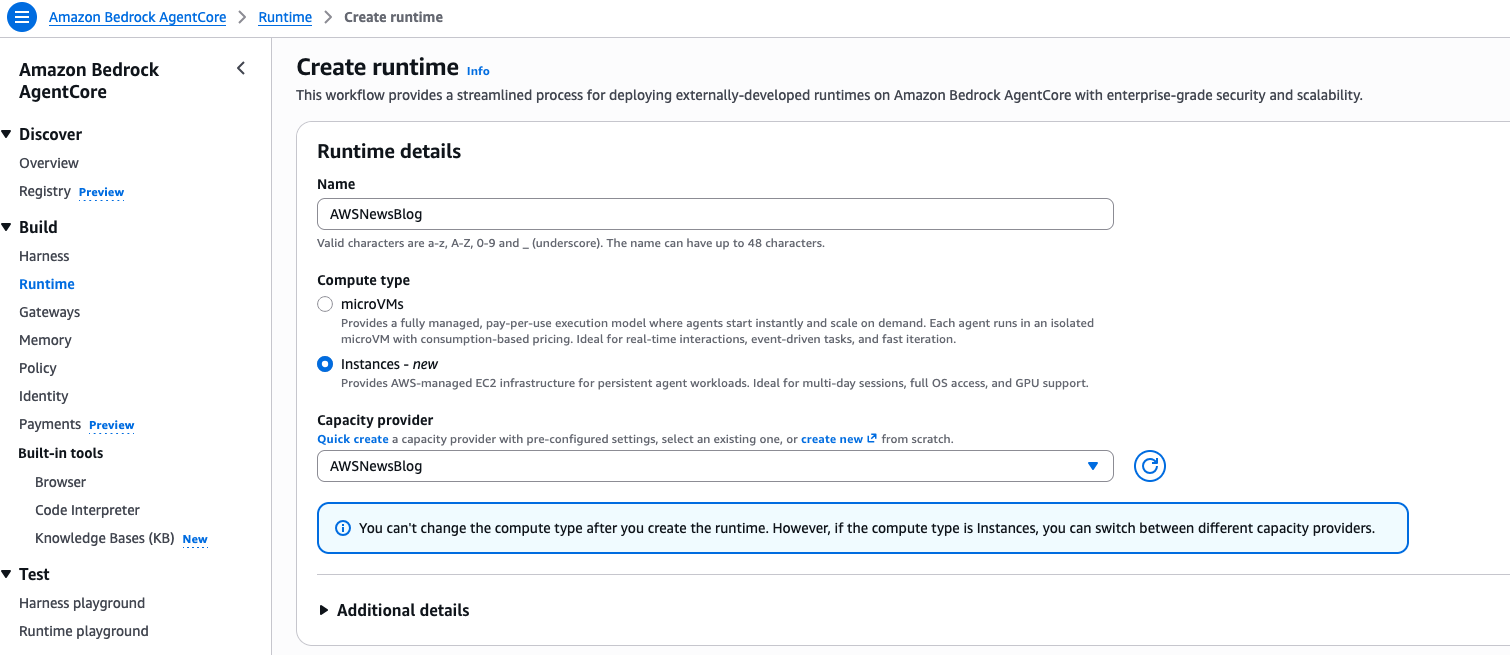
In this setup, both agents operate on the same underlying EC2 capacity provider and share a local file system within a unified session.
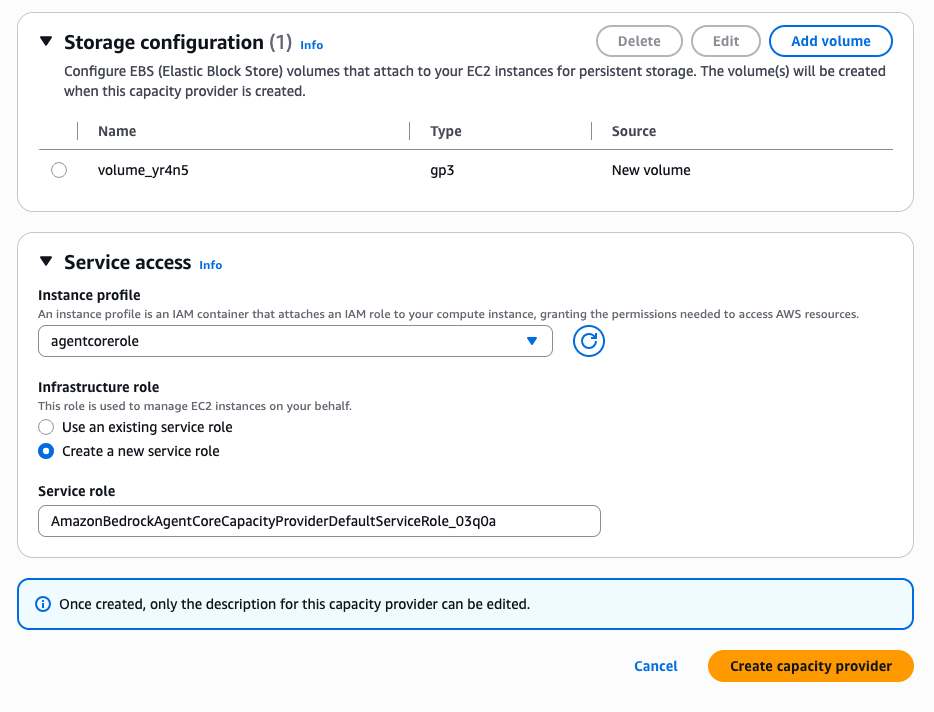
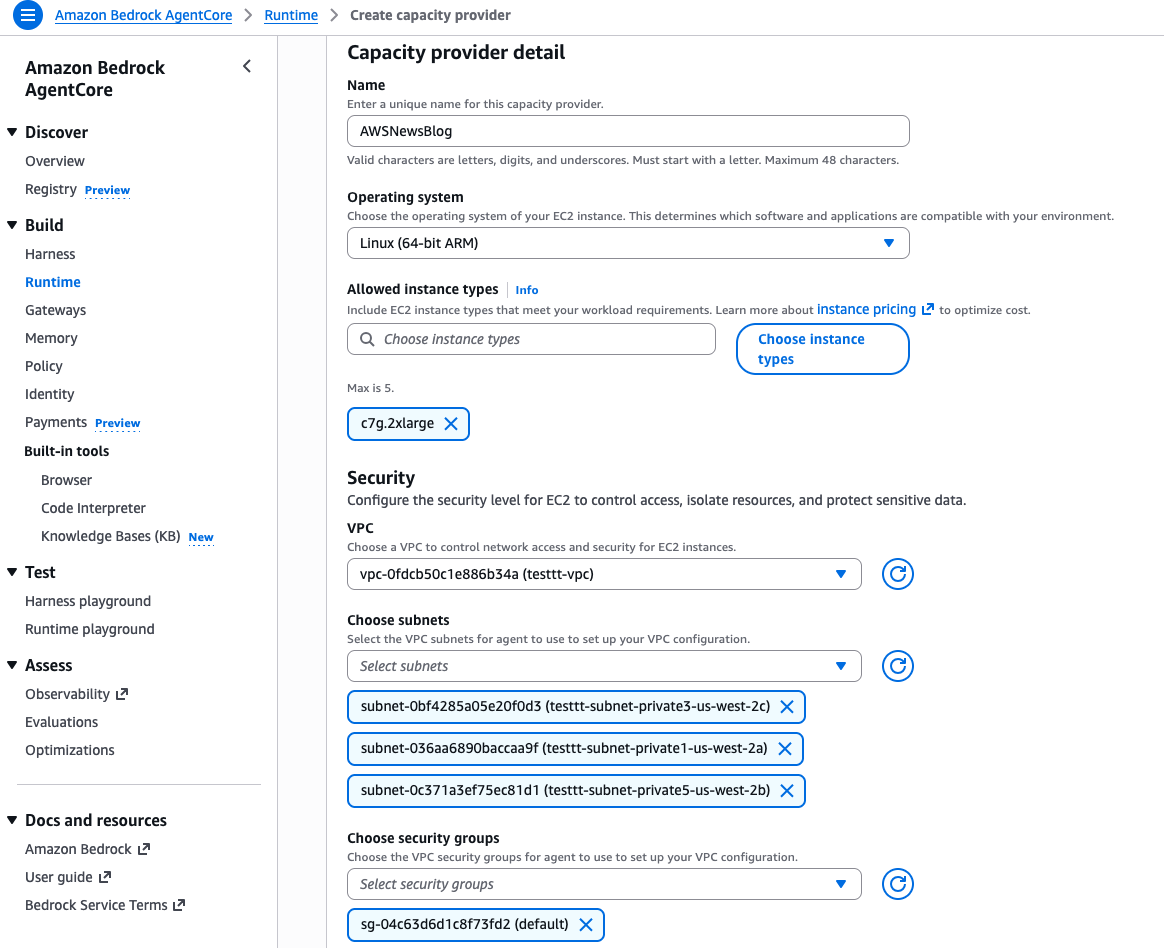
1. Establishing the Capacity Provider
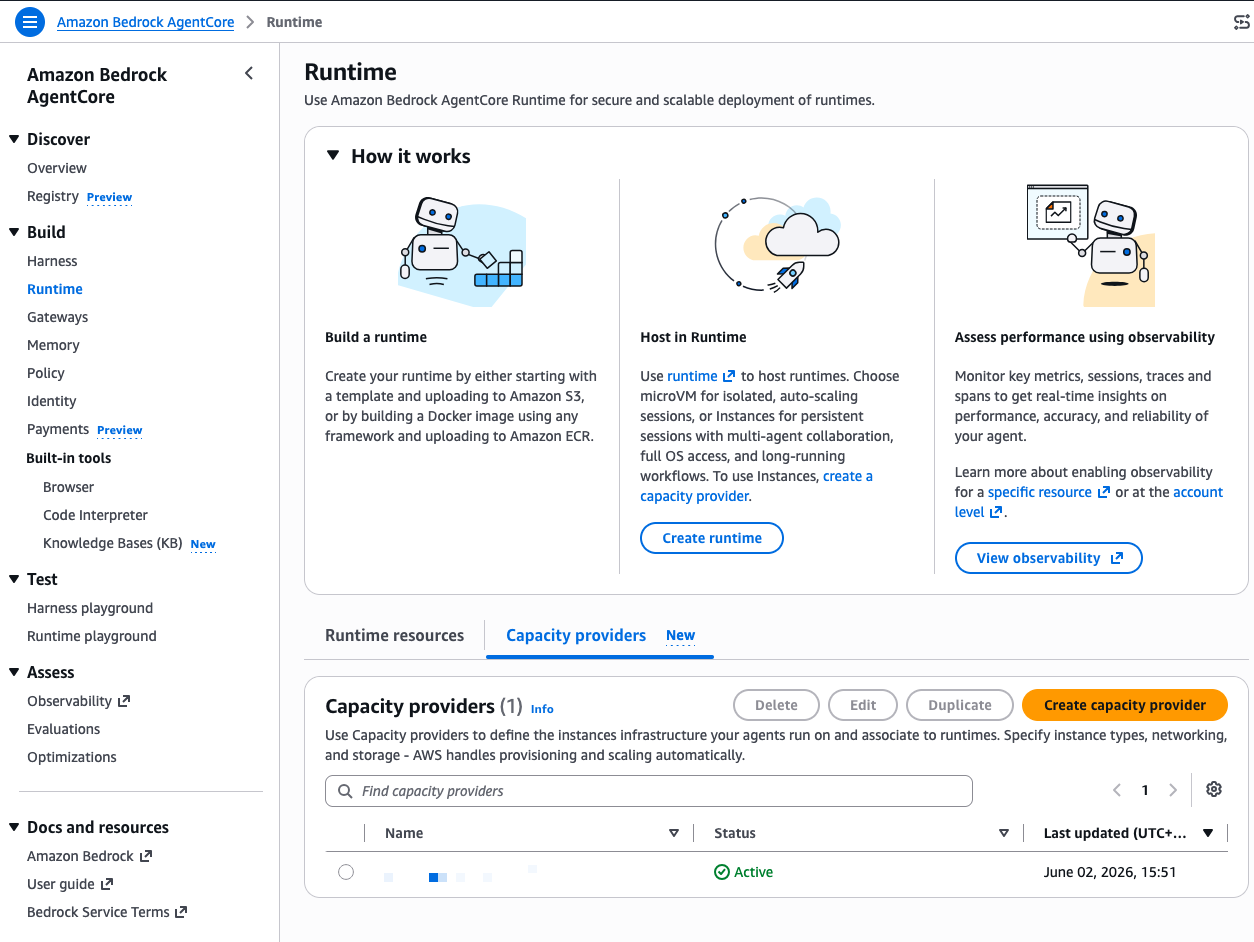
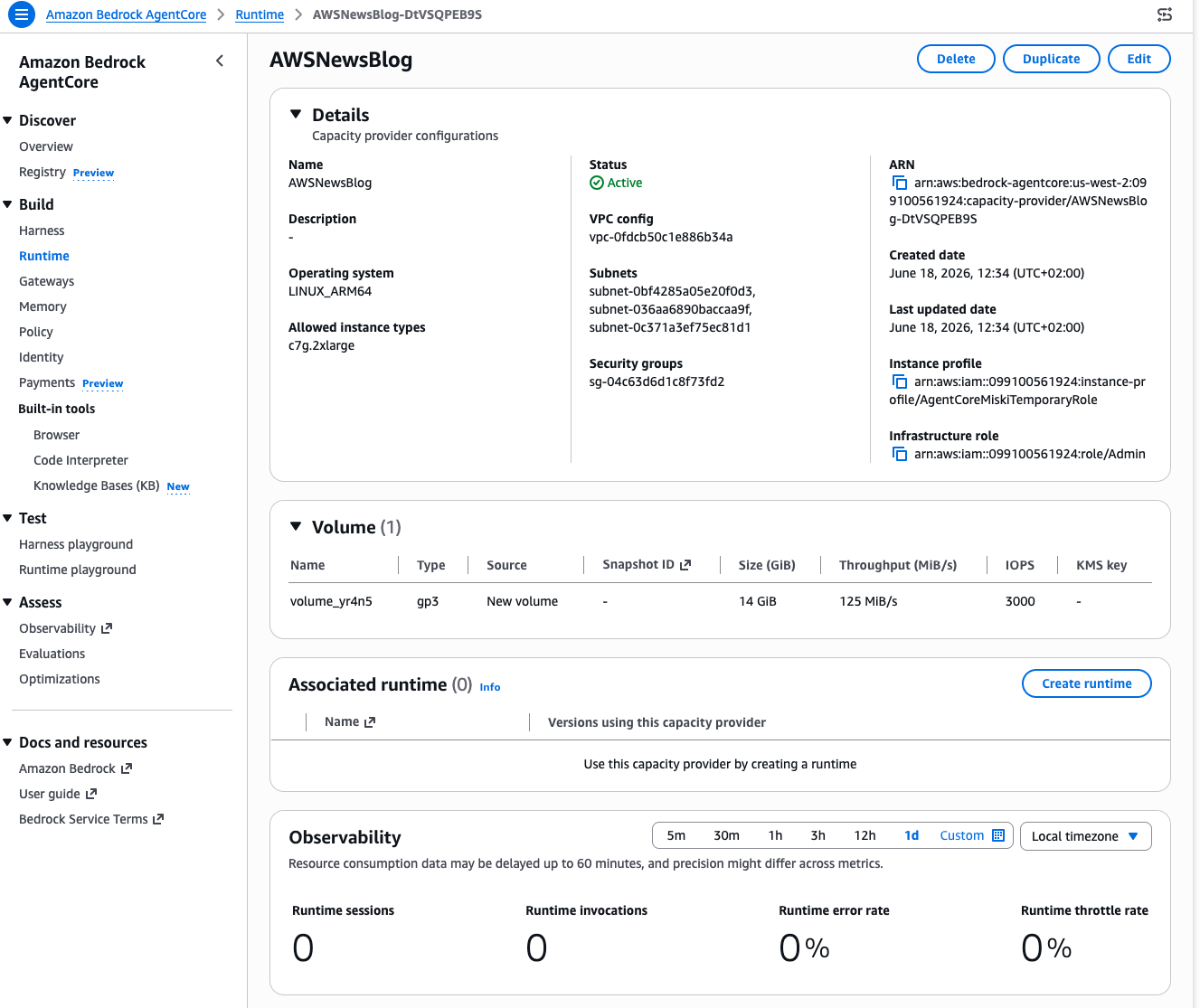
Developers begin by configuring a capacity provider via the AWS Management Console, AWS CLI, or infrastructure-as-code tools. For instance, selecting an ARM-based c7g.2xlarge instance provides 8 vCPUs and 16 GiB of memory—sufficient capacity to run multiple demanding AI agents side by side. Network parameters, VPC subnets, security groups, and automated IAM service roles are configured during this provisioning phase.
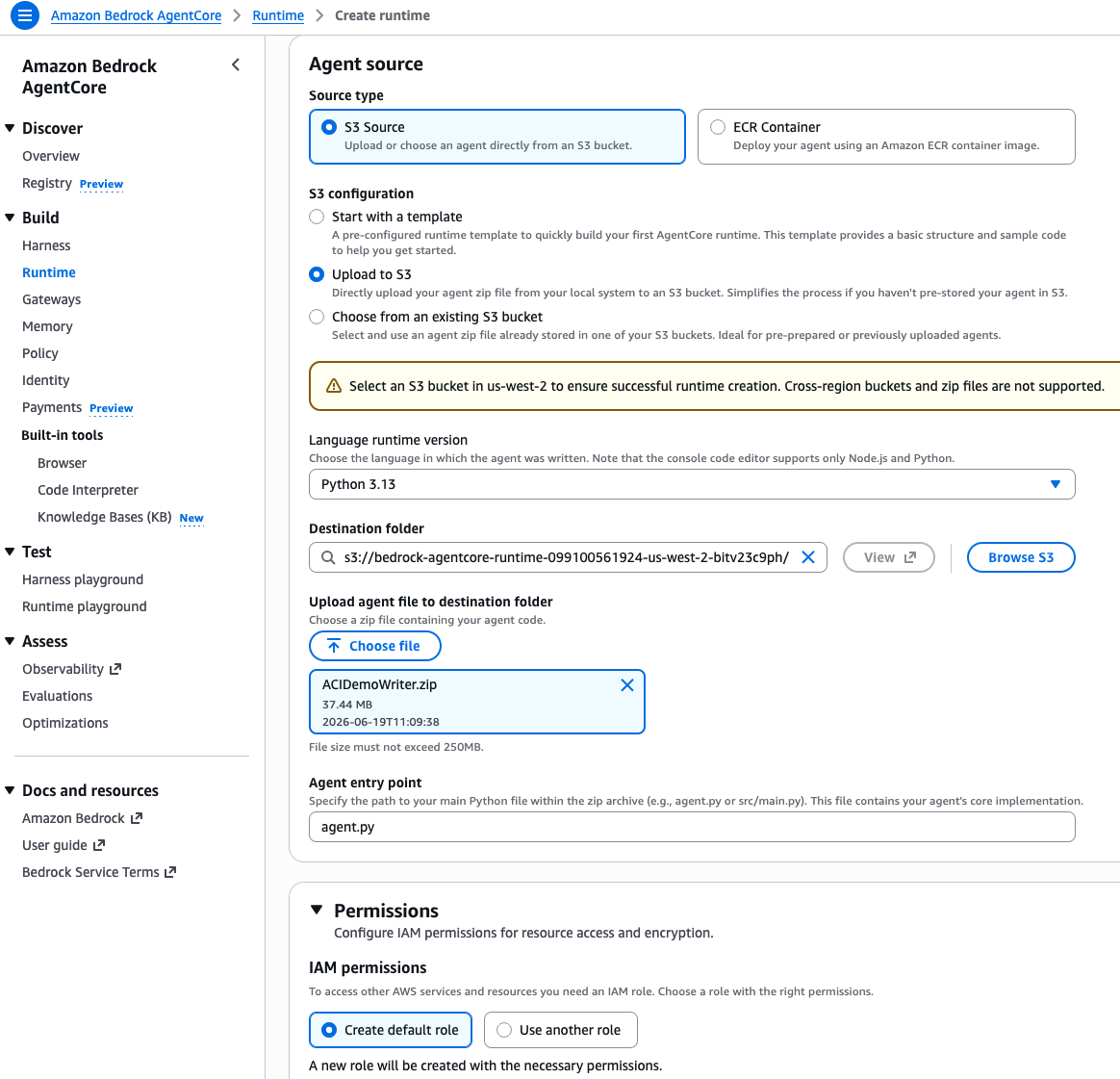
2. Packaging and Deploying the Agents
Each agent is written as a Python application (utilizing frameworks such as Strands Agents, CrewAI, LangGraph, or LlamaIndex) marked with an @app.entrypoint decorator and packaged into a zip file or container image.
- The Code Writer Agent: Generates Python code based on natural language prompts and writes the output directly to a shared session directory (
SHARED_DIR / session_id / code.py). - The Code Reviewer Agent: Reads the generated file directly from the shared file system without requiring API calls or network data transfers between the agents. It analyzes the code for potential bugs, style issues, and performance improvements, returning a structured review.
3. Execution and Shared Session Persistence
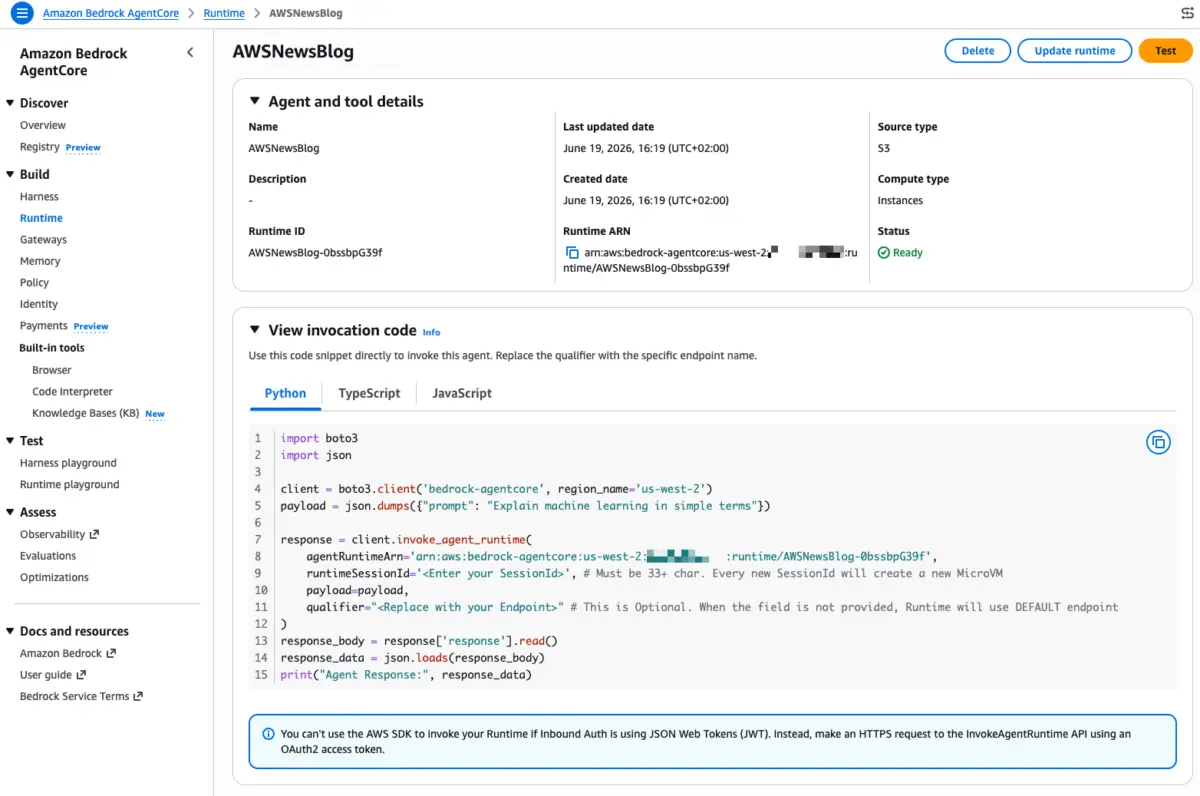
When an operator invokes the writer agent with a prompt (e.g., "prompt": "write a fibonacci suite"), the agent generates the module and writes it to /tmp/agentcore-session/session_id/code.py.
By switching the active agent in the runtime playground to the reviewer while retaining the exact same session_id, the reviewer agent instantly accesses the shared workspace. It reads the newly generated code, performs its analysis, and delivers feedback. This zero-overhead file sharing demonstrates the profound efficiency of co-hosting agents on managed EC2 runtime instances.
Official Statements and Industry Impact
The release of Amazon Bedrock AgentCore Runtime instances has drawn significant attention from enterprise architects, AI researchers, and cloud infrastructure engineers.
Industry analysts note that while foundation models have matured rapidly, the tooling required to safely operationalize autonomous agents at scale has lagged behind. By bridging the gap between managed serverless execution and persistent, stateful virtual servers, AWS is addressing one of the most prominent friction points in enterprise AI adoption.
Cloud architects emphasize that the ability to pause agent workflows over multi-day spans—hibernating state on Monday night and resuming operations on Wednesday morning without data loss—fundamentally changes the economic viability of autonomous background agents. Organizations no longer need to maintain expensive, idle compute resources or write complex checkpointing logic to save agent progress across system reboots.
Furthermore, security and compliance teams have welcomed the integration of native AWS identity controls, VPC isolation, and granular IAM role management. By maintaining enterprise-grade security guardrails while granting agents the operating system-level access they require for complex tasks, AWS provides a secure foundation for mission-critical enterprise automation.
Future Outlook: The Next Wave of Autonomous Enterprise Operations
The introduction of runtime instances marks a pivotal milestone in the evolution of Amazon Bedrock and the broader generative AI ecosystem. As enterprises move beyond simple conversational interfaces toward fully autonomous digital workforces, the underlying infrastructure must evolve to support continuous, collaborative, and long-running agent swarms.
Looking ahead, several key trends are expected to shape the trajectory of agentic runtime environments:
- Autonomous Swarm Scaling: We will likely see native orchestration frameworks leverage runtime instances to spin up dynamic swarms of hundreds of collaborating agents, automatically allocating GPU clusters for model fine-tuning and CPU clusters for parallelized data processing.
- Deepened Long-Term Memory Integration: The seamless pairing of runtime instances with Amazon EBS and AgentCore Memory will enable agents to retain institutional knowledge across weeks, months, or years, effectively giving corporate AI assistants persistent memory analogous to human employees.
- Expanded Framework Agnosticism: As the ecosystem matures, runtime instances will continue to lower the barrier for third-party orchestration frameworks, allowing developers to deploy complex graphs built in LangGraph, CrewAI, LlamaIndex, and emerging open-source protocols with minimal packaging friction.
Ultimately, Amazon Bedrock AgentCore Runtime instances represent a maturation of cloud computing for the age of artificial intelligence. By abstracting away the undifferentiated heavy lifting of infrastructure management while granting agents the persistence, co-location, and hardware acceleration they demand, AWS has established a robust foundation for the next generation of autonomous enterprise software.