By Global Science Desk
Published in association with planetary observation updates
Executive Overview
In the grand tapestry of our solar system, few celestial bodies capture the human imagination quite like Saturn. Adorned with its iconic, luminous ring system and cloaked in banded hazes of amber and gold, the second-largest planet in our cosmic neighborhood has long served as a laboratory for the extreme physics of gas giants. For decades, planetary scientists have marveled at one of its most persistent and baffling anomalies: a massive, perfectly symmetrical hexagonal cloud pattern locked into the atmosphere at Saturn’s north pole. First observed 44 years ago, this northern hexagon has stood as a solitary meteorological wonder—until now.
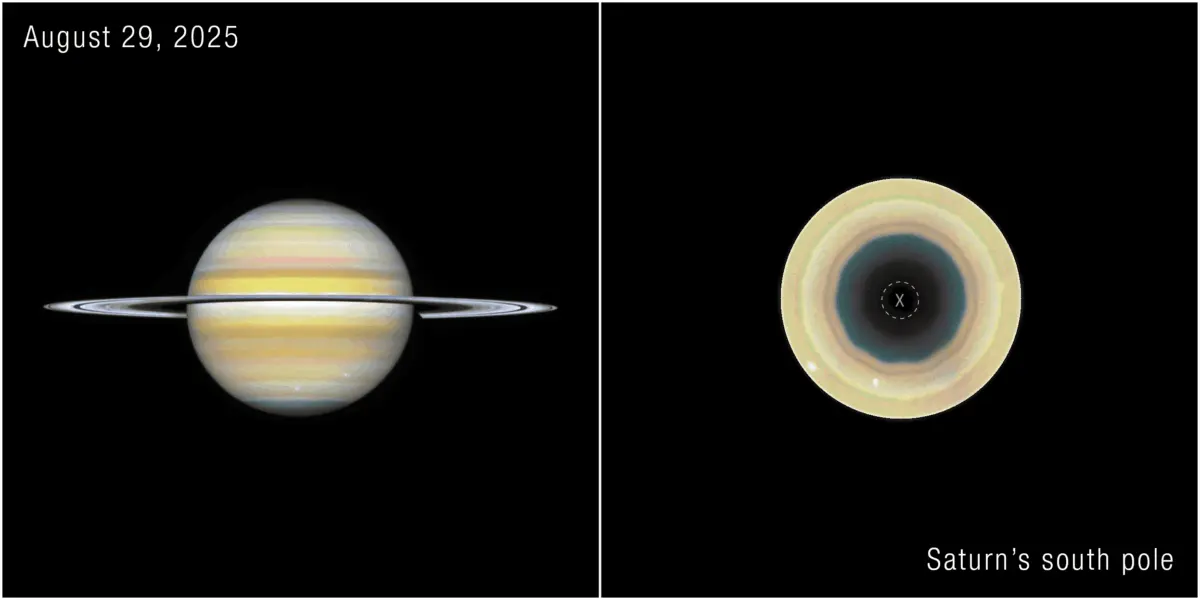
In a landmark discovery recently published in the prestigious journal Science Advances, an international team of astronomers has unveiled the existence of a strange, polygonal atmospheric structure at Saturn’s opposite end: the south pole. Captured by the legendary Hubble Space Telescope and supplemented by persistent ground-based observations, this newly identified feature is not a hexagon, but a staggering 10-sided decagon.
This revelation shatters previous assumptions about polar symmetry on gas giants. While scientists have spent generations searching for a southern counterpart to the northern hexagon, the emergence of a distinct decangular geometry suggests that Saturn’s upper atmosphere harbors complex, deeply seated dynamical forces far beyond our current atmospheric models. Far from being a solid geological structure, this shifting, planetary-scale cloud pattern challenges our understanding of fluid dynamics, wave propagation, and the ferocious jet streams that sculpt the weather systems of worlds millions of miles from our own.
Detailed Chronology: From Ground-Based Whispers to Hubble Confirmation
The path to discovering Saturn’s southern decagon is a testament to the tenacity of modern astronomers, blending the high-precision capabilities of space-based observatories with the relentless curiosity of ground-based skywatchers.
The Blind Spot of the Southern Skies
For decades, the exploration of Saturn’s poles was severely hampered by geometry. Because of Saturn’s axial tilt—roughly 26.7 degrees, comparable to Earth’s 23.5-degree inclination—the planet undergoes seasonal cycles lasting nearly 30 Earth years. For long stretches, Saturn’s southern hemisphere was tilted away from Earth-bound telescopes, casting it into seasonal darkness or unfavorable viewing angles.
Major historic missions, including NASA’s Cassini spacecraft—which orbited Saturn from 2004 to 2017—provided unprecedented close-up data of the northern hexagon. Yet, capturing a clear, long-lasting equivalent in the south proved frustratingly elusive. While Cassini and earlier flybys hinted at transient storm activity and localized vortices at the south pole, no persistent, large-scale polygonal structure could be definitively confirmed. As a result, planetary scientists largely operated under the assumption that Saturn’s southern polar meteorology was fundamentally different from its northern counterpart, lacking the rigid geometric constraints seen up north.
The First Clues and Amateur Contributions
The tide began to turn thanks to an unlikely alliance between professional researchers and dedicated amateur astronomers. Utilizing advanced backyard telescopes equipped with high-resolution planetary cameras and sophisticated image-stacking software, amateur astrophotographers began noticing subtle, recurring anomalies within Saturn’s southern cloud bands.
These persistent ground-based observations picked up faint, non-standard atmospheric configurations near the south pole that defied simple random weather patterns. Recognizing the significance of these anomalies, professional teams requested dedicated observation time on spaceborne assets to peer deeper through the cosmic veil.
The Hubble Breakthrough (2023–2025)
The definitive breakthrough arrived through the Hubble Space Telescope. By meticulously analyzing archival imagery and commissioning targeted observation campaigns, astronomers were able to trace the early architectural outlines of the southern feature back to images captured in 2023.
Over the subsequent two years, as monitoring continued and imaging processing techniques improved, the structure sharpened into undeniable focus. By 2025, the 10 distinct vertices of the decagon had become unmistakably clear. The data confirmed what once seemed improbable: Saturn possessed a second, distinct polygonal wave pattern at its opposite pole, transforming the planet from a single-hemisphere anomaly into a dual-hemisphere geometric puzzle.
Supporting Context & Metrics: Decoding the Scale of a Cosmic Phenomenon
To truly grasp the magnitude of Saturn’s southern decagon, one must translate its scale into terrestrial terms. The numbers involved defy everyday human experience, painting a picture of planetary-scale violence operating with clockwork precision.

Anatomy of a Decagon
- Geometric Classification: 10-sided polygon (Decagon) with 10 distinct vertices.
- Scale per Side: Each individual side of the decagon measures approximately 16,800 kilometers (roughly 10,440 miles). To put this into perspective, a single side of this atmospheric polygon is several thousand miles longer than the entire diameter of planet Earth (which measures about 12,742 kilometers across).
- The Surrounding Jet Stream: The decagon is tightly coupled with a raging jet stream flowing nearby. This atmospheric river reaches blistering speeds of 116 meters per second, translating to nearly 260 miles per hour (418 km/h). For comparison, a Category 5 hurricane—the most intense meteorological storm classification on Earth—is defined by sustained wind speeds exceeding 157 mph (252 km/h).
- Phase Shift Velocity: Despite the ferocious speeds of the surrounding jet stream, the decagon pattern itself behaves with eerie tranquility. The overall geometric shape shifts at a mere 2.5 meters per second, or less than 6 miles per hour (9.6 km/h). This differential speed implies that the high-speed jet stream is flowing through or around a much more stable, slowly drifting wave pattern.
The Nature of the "Surface"
A critical point emphasized by planetary scientists is that neither the northern hexagon nor the new southern decagon are solid physical structures. Saturn is a gas giant—composed primarily of hydrogen and helium—and possesses no defined, solid surface akin to the rocky crusts of Earth, Mars, or Venus.
If an exploratory probe were to descend through Saturn’s upper atmosphere, it would experience a progressive, unbroken escalation of atmospheric pressure and density. There is no hard "ground" upon which to land. Instead, what astronomers are observing via Hubble and historical missions are stunning, highly organized patterns formed entirely by drifting clouds and circulating gas bands at high altitudes.
Scientific Hypotheses: How Do Nature’s Geometric Waves Form?
The discovery of the northern hexagon four decades ago sparked a flurry of fluid dynamics experiments in laboratories across the globe. Researchers managed to recreate similar polygonal shapes in cylindrical tanks of rotating water by introducing differential speeds between inner and outer rings. However, explaining how nature sustains such rigid geometry on a planetary scale remains one of the most stubborn mysteries in modern astrophysics.
The Atmospheric Wave Hypothesis
The leading scientific consensus posits that these polygons are the visible manifestations of massive atmospheric waves confined and sculpted by powerful jet streams. On Earth, we are familiar with atmospheric waves—such as Rossby waves—which snake through the jet stream and influence global weather patterns.
On Saturn, imagine these waves not as isolated objects traveling across an open medium, but as continuous disturbances propagating through a fluid shell. The behavior of a wave fundamentally changes depending on the spatial boundaries it encounters.
The "Planetary Beach" Effect
To visualize this, scientists often draw an analogy to ocean waves breaking against a shoreline. Ocean waves behave differently near a beach because the seafloor rises and the land abruptly halts the water’s momentum.
On Saturn, the atmospheric gas waves are believed to encounter powerful, circumglobal jet streams that act as continuous, invisible boundaries. In essence, the jet stream functions like the edge of a beach—except this "beach" does not terminate at a coastline; it wraps entirely around the circumference of the planet. This global containment system forces the fluid waves to bend, fold, and lock into stable harmonic polygons.
The appearance of a 10-sided decagon in the south, contrasted with the 6-sided hexagon in the north, provides theorists with crucial comparative data. It forces researchers to ask: Why 6 sides at one pole and 10 at the other? What differences in internal heat distribution, rotation profiles, or deep-seated mantle dynamics dictate the number of vertices a polar wave forms?
Future Outlook: The Next Frontier in Gas Giant Meteorology
The publication of the southern decagon discovery in Science Advances marks not an endpoint, but a beginning. It has ignited a renewed wave of urgency within the planetary science community to re-examine existing models of fluid dynamics and atmospheric circulation.
Rewriting Planetary Models
Current atmospheric circulation models for gas giants will need to be stress-tested against the new data. Most existing models struggle to maintain stability for such complex polygons over long durations. The fact that the southern decagon has sustained its 10-sided form through observational tracking from 2023 to 2025 indicates that these structures are not fleeting meteorological anomalies, but remarkably stable, long-lived atmospheric phenomena.
Future Observation Campaigns
With the Hubble Space Telescope continuing its stellar service and next-generation ground-based observatories coming online—such as the Extremely Large Telescope (ELT) currently under construction in Chile—astronomers are poised to monitor Saturn with unprecedented clarity. Furthermore, future space missions proposed for the outer solar system will undoubtedly prioritize high-resolution, long-term monitoring of Saturn’s polar regions to track how these geometric waves evolve over seasonal timescales.
As we look out across the vastness of space toward the ringed jewel of our solar system, Saturn continues to remind us of the universe’s capacity for profound elegance. The discovery of the southern decagon proves that even after centuries of telescopic stargazing, our cosmic backyard still holds breathtaking secrets, waiting patiently for the right lens—and the right inquiring minds—to bring them into focus.