Executive Overview
As NASA prepares for the imminent launch window of the highly anticipated Nancy Grace Roman Space Telescope, a pair of palm-sized mirrors is quietly positioning itself to rewrite the textbooks of modern astrophysics. While the primary instrument of the Roman Space Telescope is designed to cast a wide net across a multitude of cosmic phenomena—spanning dark energy, exoplanet demographics, and galactic structures—tucked inside its framework lies a piece of experimental technology that could change the trajectory of human exploration.
This specialized instrument is an advanced coronagraph, an apparatus engineered with a singular, monumental ambition: to directly capture, for the very first time, the faint glint of starlight reflected off the surface of a distant exoplanet.
The stakes for this experiment extend far beyond the immediate data it will gather. NASA views the Roman coronagraph as an indispensable technological proving ground, a vital stepping stone toward a future space telescope capable of capturing a pristine, direct image of an Earth-like planet orbiting a sunlike star. Achieving such a milestone requires surmounting engineering hurdles that have long stymied astronomers. By taking this cutting-edge technology for a high-stakes spin in the vacuum of space, NASA aims to validate hardware that will underpin the search for habitable worlds for decades to come.
Detailed Chronology: From Concept to Cosmic Pioneer
The journey toward direct imaging of Earth-like exoplanets has been decades in the making, marked by incremental advances in optics, aerospace engineering, and computational modeling.
The Legacy of Atmospheric Interferences
For centuries, ground-based astronomy battled the turbulent, shifting layers of Earth’s atmosphere. Starlight, having traveled across light-years of pristine vacuum, hits our atmosphere and scatters, creating the familiar twinkling effect that poets love but astronomers despise. In the late 20th and early 21st centuries, ground-based observatories—such as the Very Large Telescope (VLT) in Chile and the twin Keck Observatory in Hawaii—revolutionized observational astronomy by introducing adaptive optics. These systems utilize deformable mirrors that physically reshape themselves hundreds of times per second, dynamically counteracting atmospheric blurring to deliver sharp images.
Moving Beyond the Atmosphere
When space telescopes like NASA’s Hubble and the James Webb Space Telescope (JWST) were launched, they bypassed atmospheric interference entirely by operating above the blanket of air surrounding Earth. However, traditional space telescopes have historically relied on relatively crude coronagraphs. As Bruce Macintosh, an astronomer leading the University of California Observatories and a Roman coronagraph science team member, points out, historical space-based coronagraphs have utilized a "completely brute force" approach—often nothing more than a small piece of metal physically blocking the blinding light of a host star to reveal surrounding structures.
These older systems were sufficient for viewing young, hot, self-luminous gas giants that glow brightly in infrared wavelengths. However, they were entirely unequipped to spot older, cooler planets illuminated solely by the reflected light of their parent stars.
The Roman Innovation
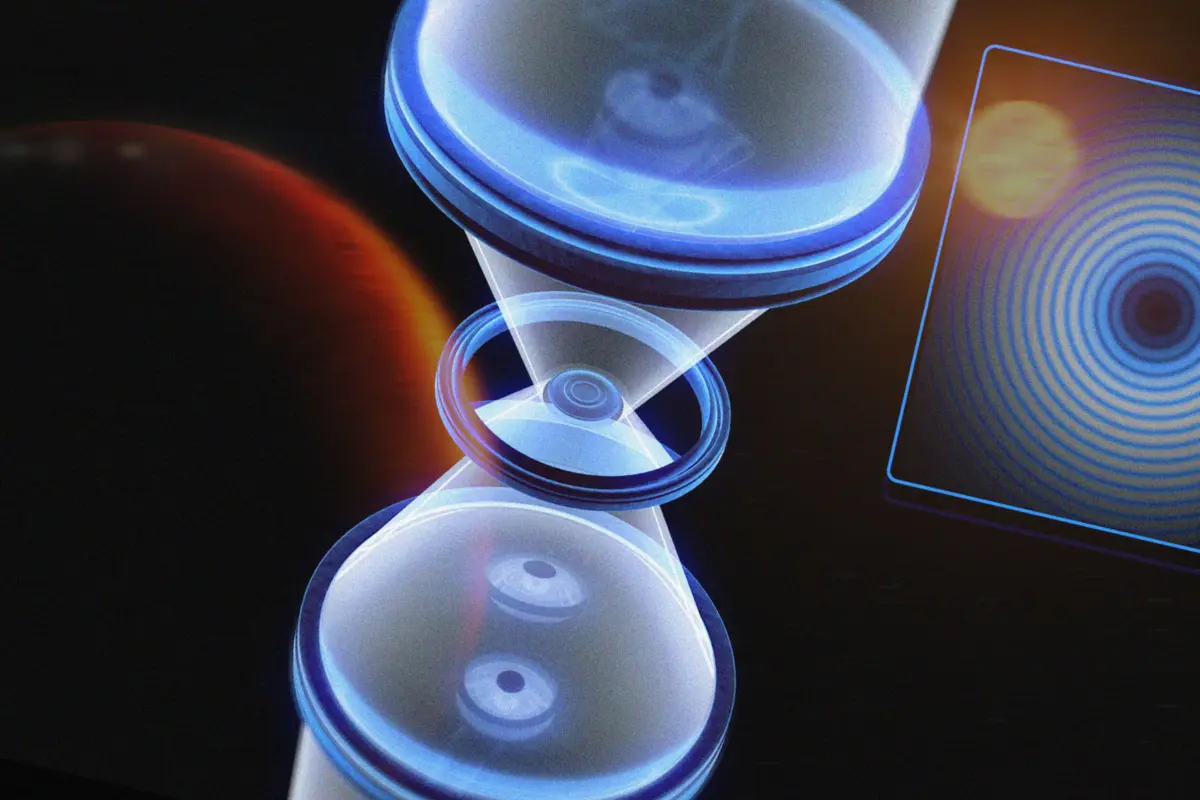
Enter the Nancy Grace Roman Space Telescope. Scheduled for launch in the coming years, Roman introduces the first active deformable mirrors ever flown in space. Measuring small enough to fit comfortably in the palm of a human hand, these two mirrors are marvels of modern engineering. Each is embedded with approximately 2,300 microscopic actuators. When stimulated by precise jolts of electricity, these actuators expand or contract, infinitesimally reshaping the mirror’s surface to actively cancel out optical imperfections and diffraction patterns that would otherwise ruin an image.
Operating in tandem with supersensitive photon-counting detectors and exquisitely complex, specially shaped occulting masks, Roman’s coronagraph represents a quantum leap in space-based optical engineering.
Supporting Context & Metrics: The Firefly Next to a Floodlight
To fully appreciate the difficulty of the task facing the Roman Space Telescope, one must understand the extreme optical contrast inherent in exoplanet imaging.
NASA frequently summarizes the challenge of the Roman coronagraph using a vivid analogy: it is the equivalent of attempting to photograph a tiny firefly perched right next to a blindingly powerful floodlight—while standing all the way across the United States. Stars are billions of times brighter than the planets that orbit them. Without unprecedented suppression of starlight, any reflected light from a planet is instantly lost in the overwhelming glare of the host star.
The Mechanics of Precision Light Suppression
The tolerances required for success are razor-thin. Margaret Turnbull, an exoplanet scientist at the SETI Institute in California who leads a Roman coronagraph science team, underscores the delicate nature of the endeavor:
"Any little bit of starlight that gets in the wrong place could just destroy a whole portion of the image."
To prevent stray photons from corrupting the data, the Roman coronagraph integrates three primary technological pillars:
- Active Deformable Mirrors: Two palm-sized mirrors equipped with 2,300 piezoelectric actuators capable of real-time surface adjustments on the nanometer scale.
- Supersensitive Photon Detectors: Advanced sensors capable of registering individual photons, a necessity given the agonizingly sparse return signal bouncing off a distant planet’s surface.
- Complex Occulting Masks: Unlike the simple circular metal blocks of the past, Roman utilizes mathematically optimized, highly intricate wave-front control shapes designed to bend and cancel out light waves through destructive interference.
Testing the Hardware in the Cosmos
Once operational, the engineering team will embark on a rigorous validation campaign. To prove the system works, scientists will direct the coronagraph toward a carefully selected roster of already-known exoplanets.
As Turnbull explains:
"If we go through the whole thing and we don’t see them, then we know something is wrong with the coronagraph, because those planets are there."
Beyond confirming known worlds, the instrument will target stars surrounded by massive circumstellar disks of dust and debris. By analyzing the subtle gaps and gravitational wakes carved into these debris disks, researchers hope to infer the presence of hidden, non-transiting planets. This data will simultaneously provide a crucial baseline, helping scientists understand whether our own solar system’s relative lack of heavy debris is an astronomical norm or an anomaly.
Official Statements and Perspectives
The collaborative effort behind the Roman Space Telescope involves hundreds of scientists, engineers, and institution leaders spanning NASA centers, universities, and private research entities. Their unified consensus highlights the transition from theoretical modeling to empirical validation in space exploration.
-
Vanessa Bailey, Instrument Scientist for the Coronagraph (NASA’s Jet Propulsion Laboratory):
Emphasizing the experimental nature of the mission, Bailey notes:"We’ll test them in space for the first time, and we’ll understand what work still is left to go."
-
Julie McEnery, Senior Project Scientist for Roman (NASA’s Goddard Space Flight Center):
Highlighting the dual objective of advancing technology while driving groundbreaking science, McEnery asserts:"Obviously, the best way of demonstrating that something works is to do something interesting scientifically."
-
Bruce Macintosh, Astronomer and University of California Observatories Lead:
Contrasting historical technology with Roman’s sophisticated design, Macintosh remarks on the evolution of star shades, noting that older iterations like those on Hubble relied on brute-force blocking, whereas Roman utilizes "beautiful, complicated shapes" that represent a paradigm shift in space-based optics.
Future Outlook: Paving the Way for the Habitable Worlds Observatory
While capturing images of nearby giant exoplanets and debris disks is a breathtaking scientific achievement in its own right, the Roman coronagraph is fundamentally a pathfinder mission. The lessons learned, the anomalies resolved, and the software pipelines perfected during Roman’s operational lifespan will directly dictate the success of future flagship missions.
The Habitable Worlds Observatory (HWO)
NASA’s long-term strategic vision points toward the Habitable Worlds Observatory (HWO), a conceptual telescope slated for launch in the 2040s. HWO will be explicitly tasked with hunting for signs of life on rocky, Earth-sized exoplanets located within the habitable zones of their parent stars. To accomplish this, engineers calculate that HWO will require a coronagraph up to 100 times more effective and stable than the one flying on Roman.
Expanding Private and Public Partnerships
The technological ripple effects of Roman are already influencing the broader aerospace landscape. In January, a research institution funded by former Google CEO Eric Schmidt announced plans for the Lazuli Space Observatory, which aims to incorporate an advanced coronagraph armed with adaptive optics of comparable sensitivity to Roman’s architecture.
Furthermore, while the primary cultural fascination centers on spotting alien worlds, the maturation of space-based coronagraph technology opens up entirely new avenues of observational astronomy. In the years to come, refined coronagraphs could allow astronomers to resolve tight binary star systems, study the environments surrounding supermassive black holes, and observe elusive objects lurking in the blinding glare of distant quasars.
A Historic Milestone
The Nancy Grace Roman Space Telescope stands at the threshold of a new era. By compressing cutting-edge adaptive optics onto two palm-sized mirrors, NASA is preparing to peer deeper into the contrast-rich realms of distant solar systems than ever before. As the launch window opens, the global scientific community watches with bated breath, knowing that every photon captured by these tiny mirrors brings humanity one step closer to answering the ultimate existential question: Are we alone in the universe?