Executive Overview
The digital renaissance of the 2020s has been defined by a relentless democratization of creativity, catalyzed by the rapid maturation of generative artificial intelligence. Yet, as tools like Midjourney, DALL-E, and Stable Diffusion flooded the market with unprecedented capabilities, a persistent structural flaw remained for everyday creators: the chasm between generation and monetization. Producing breathtaking synthetic art was easier than ever, but capturing sustainable economic value from those creations often remained an elusive puzzle of complex web3 integrations, fractured social media funnels, and uncompensated digital distribution.
Enter LimeWire. For millions of digital natives who came of age in the early 2000s, the name evokes a nostalgic—and occasionally legally fraught—era of peer-to-peer file sharing, downloaded MP3s, and the nascent Wild West of internet culture. Today, that legacy has been thoroughly overhauled. Transformed from a defunct file-sharing client into a sophisticated, AI-driven content publishing platform, LimeWire Studio has quietly carved out a distinctive niche in the crowded generative AI landscape.
By fusing cutting-edge image generation models with automated blockchain minting, multi-tiered subscription architectures, and an ad-revenue sharing model powered by its native cryptocurrency (LMWR), LimeWire is no longer just a tool for making art. It is an end-to-end decentralized studio. This investigative report examines how the platform has reinvented its historic brand, the technological mechanics underpinning its generative tools, its unique web3 economic flywheel, and what its evolution signals for the future of the creator economy.
Detailed Chronology: From Underground P2P Client to Web3 AI Studio
To understand LimeWire’s modern incarnation, one must first look back at the dramatic trajectory that preceded it. The platform’s history can be categorized into three distinct generational epochs:
Phase 1: The Napster Successor and Legal Twilight (2000–2010)
Launched in 2000 by Mark Gorton, LimeWire quickly became the world’s most popular peer-to-peer (P2P) file-sharing client. Operating on the Gnutella network, it allowed users to trade music, movies, software, and documents directly from desktop to desktop. At its peak, it was installed on tens of millions of computers worldwide. However, the platform’s decentralized architecture made it a primary vector for copyright infringement. Following a protracted, high-profile legal battle brought by the Recording Industry Association of America (RIAA)—Arista Records LLC v. Lime Wire LLC—a federal judge ordered the shutdown of the platform’s search and download functions in late 2010, culminating in a massive $105 million settlement in 2011. For a decade, the brand lay dormant, remembered primarily as a cultural touchstone of early internet piracy.
Phase 2: The Blockchain Rebirth and NFT Marketplace (2022)
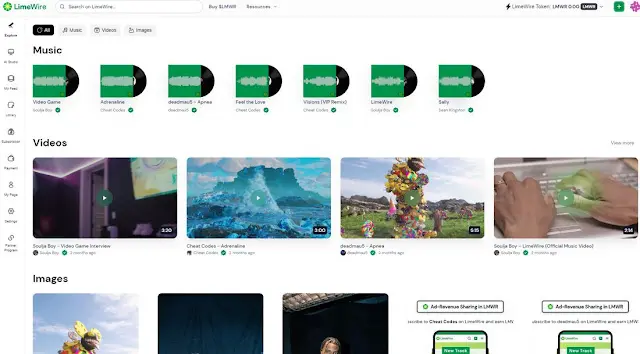
In early 2022, serial entrepreneurs Julian and Paul Zehetmayr acquired the dormant LimeWire brand with a bold vision: to resurrect it not as a file-sharing tool, but as a mainstream digital collectibles marketplace. Initially repositioned as a curated marketplace for music NFTs, the platform attracted high-profile early adopters and mainstream artists—including legendary electronic music producer Deadmau5, hip-hop pioneer Soulja Boy, and reggae-pop star Sean Kingston. This phase laid the groundwork for community-driven digital asset ownership, proving that the LimeWire brand still held powerful nostalgic recognition that could be leveraged for modern digital assets.
Phase 3: The Generative AI Pivot and Creator Studio (2023–Present)
Recognizing the seismic shift toward artificial intelligence, LimeWire underwent its most radical transformation yet. In 2023, the platform integrated sophisticated generative AI models, officially rebranding as LimeWire AI Studio. By pivoting away from a purely retrospective marketplace to an active, creation-first ecosystem, LimeWire bridged the gap between AI art generation and web3 monetization. Today, the platform functions as a hybrid canvas and publishing house, enabling users to generate, mint, trade, and monetize digital content seamlessly.
Supporting Context & Metrics: Inside the LimeWire Ecosystem
LimeWire’s modern platform architecture is designed to lower the barrier to entry for novice creators while offering robust infrastructural depth for power users. Below is an exhaustive breakdown of how its core pillars function:
The AI Image Generation Suite
At the time of writing, LimeWire’s generative capabilities are anchored primarily in state-of-the-art AI image creation tools. The platform does not rely on a single proprietary model; instead, it aggregates and integrates several of the industry’s most powerful open-source and commercial engines, including:
- Stable Diffusion 2.1 & Stable Diffusion XL (SDXL): Known for photorealistic detailing, high-resolution rendering, and complex prompt adherence.
- DALL-E 2: Integrated to provide alternative artistic interpretations and conceptual depth.
Users can interface with these models using natural language prompts ranging from simple descriptive phrases to highly detailed parameters. What distinguishes LimeWire from standalone interfaces is its style-switching and fine-tuning agility. Creators can toggle across a diverse array of aesthetic presets—including cinematic, digital art, pixel art, anime, and analog film—instantly transforming the visual identity of their output. Furthermore, built-in samplers and prompt guidance mechanisms allow both amateurs and seasoned digital artists to exercise granular control over output quality. Crucially, LimeWire is actively developing its own proprietary AI model, signaling a transition from an aggregator of third-party tech to an independent AI innovator.
Automated Blockchain Minting
One of LimeWire’s most frictionless innovations is its automated NFT minting pipeline. Once a user generates an image, music track, or video clip within the Studio and elects to publish it, the platform automatically mints the creation as a Non-Fungible Token (NFT) on either the Polygon or Algorand blockchain.
This process eliminates the technical friction typically associated with web3 publishing—such as manual gas fee calculations, wallet bridging, and smart contract deployment. The resulting NFT acts as a secure, decentralized certificate of authenticity and ownership. Creators retain absolute sovereignty over distribution:
- Public Release: Content is discoverable by the broader LimeWire community, allowing enthusiasts to trade, collect, and interact with the artwork on the secondary market.
- Subscriber-Only Exclusivity: Creators can gate content behind a paywall, offering exclusive drops strictly to their dedicated, paying subscribers.
The LMWR Token and Ad-Revenue Sharing Model
The financial engine driving LimeWire is built on a dual-incentive structure: direct ad revenue sharing and cryptocurrency integration.
When creators publish content to LimeWire Studio, they become eligible to receive up to 70% of all ad revenue generated when other users view their images, music, or videos on the platform. This payout is distributed monthly in LMWR tokens, LimeWire’s native utility cryptocurrency.
LMWR operates as a closed-loop economic asset within the ecosystem:
- Earnings: Creators accumulate LMWR based on platform views and ad impressions.
- Liquidity: Tokens can be withdrawn and traded on major global cryptocurrency exchanges, including Kraken, ByBit, and Uniswap.
- Utility: Users can also spend LMWR directly on the platform to purchase additional prompt credits for their generative AI workflows.
Official Statements and Strategic Vision
The leadership behind LimeWire’s resurrection has been vocal about their intent to redefine what an AI platform can achieve by integrating community ownership.
In public disclosures accompanying the platform’s technological rollouts, co-CEO Julian Zehetmayr emphasized the necessity of a creator-first economic model in an automated world:
"The generative AI landscape is moving at a breathtaking pace, but the financial rewards have historically been concentrated in the hands of platform owners rather than the artists themselves. With LimeWire, our goal is to invert that paradigm. By combining world-class AI generation tools with automated blockchain provenance and ad-revenue sharing, we are building an environment where creativity directly translates into sustainable, ownable financial equity for the creator."
Industry analysts have noted that LimeWire’s pivot reflects a broader maturation in the web3 space—moving away from speculative, community-less NFT hype cycles and toward utility-driven ecosystems where blockchain technology functions invisibly beneath user-friendly software interfaces. By utilizing eco-conscious, high-speed networks like Polygon and Algorand, LimeWire has insulated its user base from the exorbitant transaction costs and environmental criticisms that plagued earlier generations of digital collectibles.
Future Outlook: The Horizon of AI Music and Video Generation
While LimeWire’s current footprint is heavily anchored in sophisticated image generation and community-driven digital publishing, the platform’s roadmap points toward a much wider technological expansion.
Expanding Beyond Still Imagery
Executives have confirmed ambitious plans to roll out dedicated AI music and video generation tools in the near future. Given the platform’s early roots in digital music sharing and its historical relationships with prominent recording artists, the introduction of AI-assisted audio composition and video synthesis tools is a natural evolutionary step.
This upcoming expansion promises to unlock entirely new vectors for multimedia creators:
- AI Music Composition: Allowing independent artists to generate backing tracks, synthetic vocals, and complete audio arrangements using text prompts, subsequently minting them as tradeable audio-visual NFTs.
- Generative Video: Equipping filmmakers and digital designers with text-to-video tools that integrate directly into the existing LimeWire Studio publishing and monetization pipeline.
Democratizing the Creative Economy
As the generative AI market matures, platforms that survive will likely be those that offer genuine utility, community engagement, and clear monetization pathways. LimeWire has successfully shed the legal baggage of its past, replacing it with a forward-thinking architecture that addresses the primary pain points of modern digital creators: high production costs, complex distribution hurdles, and inadequate compensation.
For creators looking to experiment with generative art without wrestling with complex technical configurations—while retaining ownership and earning passive revenue through ad-shares and crypto royalties—LimeWire Studio presents a compelling, unified ecosystem. As the platform prepares to launch its proprietary AI models alongside upcoming audio and video tools, it stands poised as a formidable laboratory for the future of digital art, community curation, and decentralized commerce.