Executive Overview
On June 29, 2026, California Governor Gavin Newsom signed Senate Bill 122 (SB 122), marking a historic and aggressive shift in state tax policy. Effective January 1, 2027, the Golden State will officially apply its sales and use tax to prewritten software and Software-as-a-Service (SaaS), regardless of how it is delivered—whether downloaded to a local drive, streamed over a network, or accessed seamlessly via a web browser.
For decades, California stood as the final economic titan holding out against taxing cloud software. While over 20 other states have implemented some form of digital taxation over the years, California’s historical distinction taxed software delivered on physical media while leaving browser-based applications untouched. That legislative dividing line has been permanently erased.
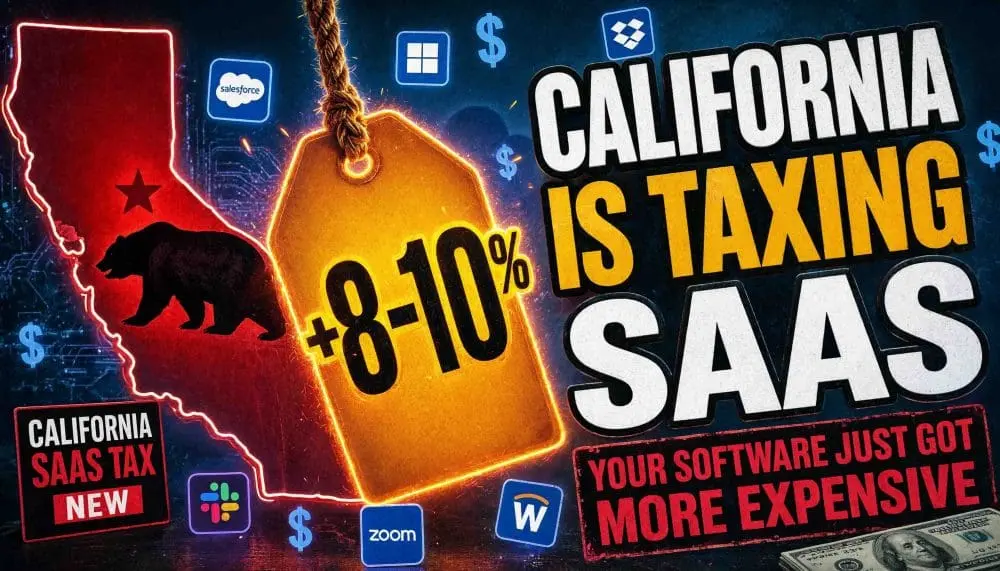
The financial stakes are staggering. California projects roughly $2 billion a year in combined state and local revenue from the change. For corporate buyers, software budgets are facing an unnegotiated 8% to 10% price inflation depending on the local district tax rate. For vendors, B2B founders, and finance teams, the race is on to overhaul billing systems, restructure invoicing, and decode a labyrinth of unresolved compliance rules before the clock runs out on December 31, 2026.
Detailed Chronology: The Road to SB 122 and the Path Ahead
The timeline leading to the implementation of SB 122 has moved at a breakneck pace, leaving stakeholders with a tight window to adapt.
- June 29, 2026: Governor Gavin Newsom signs SB 122 into law, officially redefining "tangible personal property" to encompass digital products.
- July 2026: The California Department of Tax and Fee Administration (CDTFA) hosts its inaugural public workshops to clarify enforcement mechanics, address the controversial $5 million enterprise flip, and field early concerns regarding usage-based pricing.
- Late August – September 2026: CDTFA circulates discussion drafts of emergency regulations, followed by mandatory Interested Parties Meetings to hash out gray areas like hybrid platforms, the human effort exemption, and multi-state sourcing.
- Early December 2026: Final emergency regulations are submitted to the Office of Administrative Law, setting the definitive enforcement framework just weeks before the law goes live.
- January 1, 2027: SB 122 officially takes effect. Concurrently, Colorado expands its own tax laws to cover electronically delivered prewritten software and SaaS, signaling a broader national trend.
Supporting Context & Metrics: Decoding the Financial Impact
To understand the macro and micro economic shifts triggered by SB 122, finance teams must break down how the tax is applied, sourced, and enforced.
The Math: California’s Full Stack Rate
The base tax rate is California’s standard state-level charge of 7.25%, compounded by local district taxes that vary depending on the buyer’s address. For most companies operating in real metropolitan hubs—such as San Francisco, Los Angeles, or San Jose—the final added cost lands between 8% and 10%.
For a mid-sized enterprise spending $2 million annually on taxable cloud software, this translates to an immediate, non-negotiable $160,000 to $200,000 in fresh operational expenses that yield zero added product value.
Nexus and Sourcing Rules
SB 122 does not introduce a brand-new economic threshold; rather, it makes software sales count toward pre-existing standards. Companies with a physical presence in California, or remote sellers hitting $500,000 in annual California sales, must now register with the CDTFA.
Sourcing remote sales follows a strict hierarchical priority list based on the purchaser’s known California address:
- Billing address
- Shipping or delivery address
- Address on the payment instrument
- General mailing address
Furthermore, the law establishes a strict presumption of California use for any software purchased out-of-state but accessed within California boundaries within 90 days of acquisition.
The $5 Million Enterprise Flip
For massive enterprise software deals, the collection burden shifts entirely. If a single vendor’s digital product sales to a single corporate purchaser exceed $5 million in a calendar year, the vendor is relieved of collection duties. Instead, the purchaser must self-assess and remit use tax directly. This requires the buyer to secure a use tax direct payment permit, issue an exemption certificate to the vendor, and meticulously report local use tax broken down by individual counties and cities.
Official Statements & Regulatory Gray Areas
While the core tenants of SB 122 are clear, several critical categories remain shrouded in regulatory ambiguity, leaving both buyers and sellers walking a tightrope of compliance.
The AI and Usage-Based Pricing Quagmire
While seat-based AI application subscriptions (such as productivity tools embedded with language models) are clearly taxable as remotely accessed prewritten software, consumption-based AI spend remains a major gray area.
When organizations pay per token or per API call for model access, it remains legally unsettled whether this constitutes taxable software or exempt digital infrastructure. CDTFA officials have conceded that the boundary between taxable software and excluded digital infrastructure may ultimately be settled through legal opinions and formal litigation rather than administrative rulemaking.
Infrastructure Carve-Outs: AWS vs. Salesforce
The legislation explicitly exempts "digital infrastructure"—defined as remotely provided cloud services that allow users to create, deploy, scale, or run their own software without managing underlying hardware.
- Clearly Exempt: Infrastructure-as-a-Service (IaaS) and Platform-as-a-Service (PaaS) platforms like AWS (EC2, S3) and Google Cloud Platform compute.
- Clearly Taxable: Application-layer software tools like Salesforce, Slack, HubSpot, and Microsoft 365.
- The Gray Middle: Data warehouses, developer platforms, and hybrid workflow tools that blur the line between infrastructure and application services.
Future Outlook & Actionable Guidance
With the CDTFA writing emergency regulations through the fall of 2026, stakeholders must take proactive measures today to protect their bottom lines.
For Software Buyers:
- Audit Your Vendor Stack: Categorize your top ten vendors into clearly exempt, clearly taxable, and gray buckets immediately. Secure written compliance positions from gray-bucket vendors before January.
- Unbundle Invoices: Review how contracts are structured. Bundled invoices combining software access, implementation, and support default to 100% taxability. Push vendors to itemize services separately.
- Clean Up User Location Data: Anticipate upcoming apportionment mechanisms. Tracking where your users physically sit is the only way to substantiate future multi-state allocation claims.
For Software Vendors:
- Establish Registration & Tech Stacks: Leverage compliance tools like Avalara, Anrok, or Stripe Tax to automate district-level tax calculations.
- Restructure Q4 Invoicing: Capitalize on the transition window. Offering early Q4 renewals invoiced and paid in December 2026 can yield significant cash-flow and tax-savings events for customers before the January mandate hits.
- Equip Sales and Customer Success: Do not let account executives improvise tax policy when customers spot a new line item. Provide concise communication packages and targeted concession strategies for at-risk accounts.
As California joins the ranks of digital tax states—closely followed by Colorado—the era of tax-free cloud consumption is officially drawing to a close. Navigating this new reality requires rigorous financial modeling, proactive contract restructuring, and constant vigilance as the CDTFA finalizes its emergency decrees.