EXECUTIVE OVERVIEW
The narrative surrounding artificial intelligence in the workplace has officially shifted from speculative corporate hype to gritty, grassroots operational reality. Just two years ago, artificial intelligence was viewed as an experimental frontier, utilized daily by a minority of digital marketers. Today, it has embedded itself as the operational backbone of modern business.
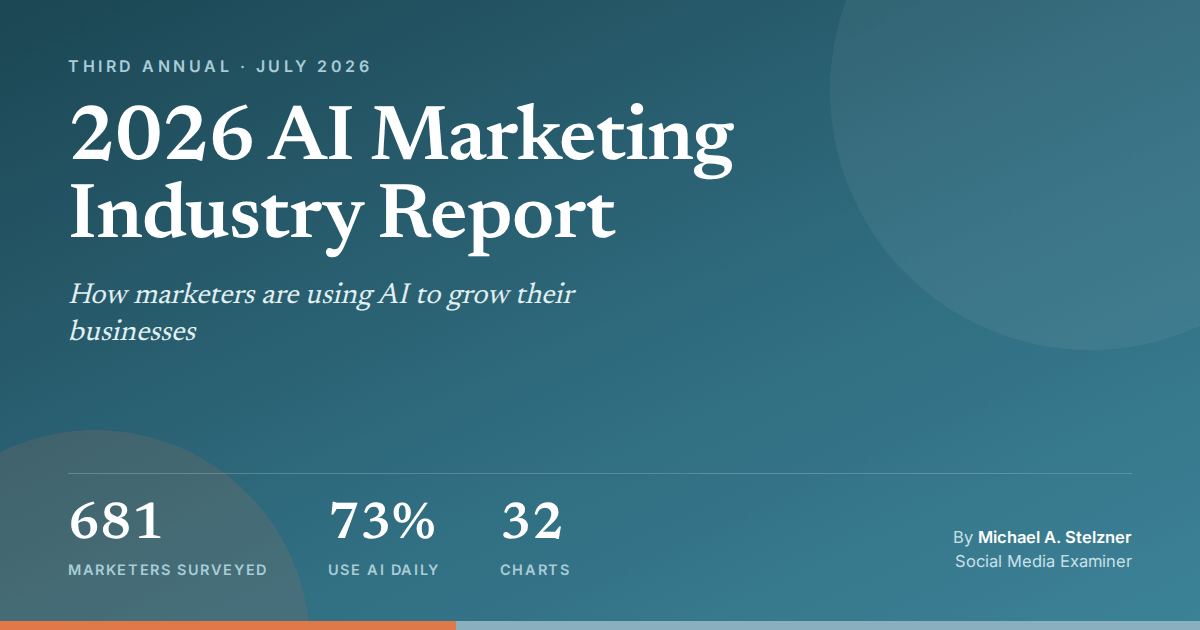
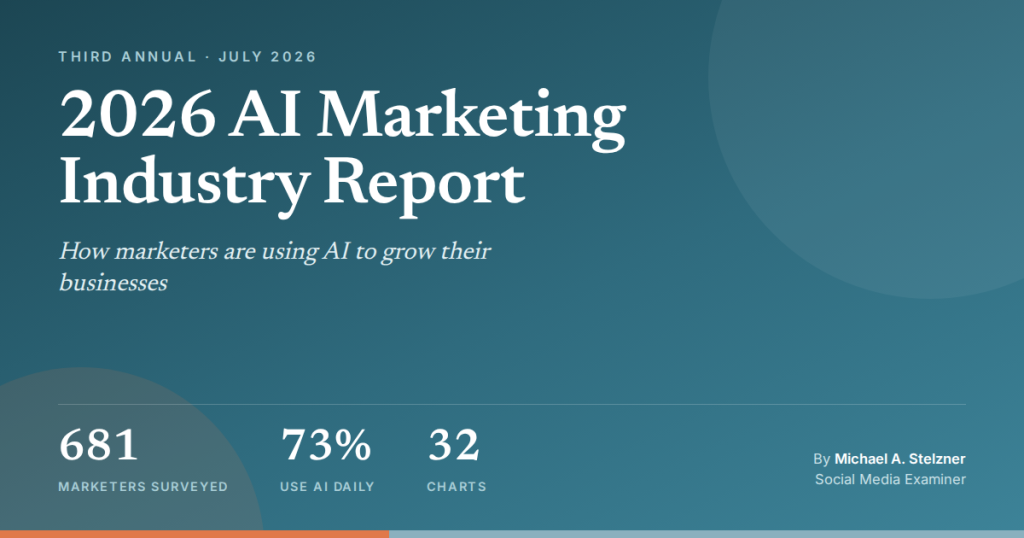
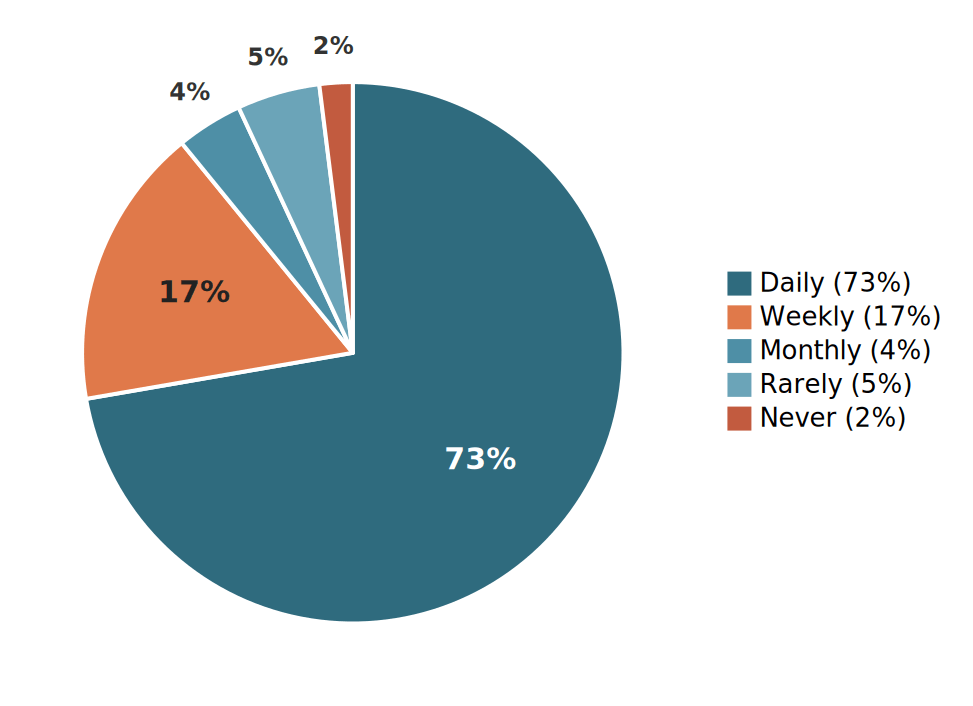
According to the newly released 2026 AI Marketing Industry Report by Social Media Examiner, nearly three out of four marketers now utilize AI on a daily basis. More importantly, this transformation is not being driven by multinational corporations with bloated technology budgets or specialized learning-and-development departments. It is being forged on the front lines by lean teams and independent entrepreneurs. With 60% of survey respondents hailing from organizations comprising 10 or fewer employees, this data paints a vivid portrait of how small businesses are harnessing AI to punch above their weight class.
Rather than waiting for executive mandates, small business owners are taking matters into their own hands—literally. The report highlights five eye-opening findings that dismantle common assumptions about AI adoption, revealing a landscape defined by rapid normalization, self-taught innovation, a persistent measurement gap, and emerging frontiers like video automation and autonomous AI agents. For small business owners standing on the sidelines, the data offers a clear directive: the window for passive observation is officially closed.
DETAILED CHRONOLOGY: THE RAPID ASCENT OF DAILY AI ADOPTION
To understand where the industry stands today, one must examine the velocity of its evolution. The integration of generative intelligence into daily workflows has not been a gradual, linear progression; it has been a seismic shift.
In 2024, only 37% of marketing professionals incorporated AI into their daily routines. It was an auxiliary tool—used for brainstorming or drafting occasional copy, but rarely trusted with core operational workflows. Fast forward to 2026, and that figure has nearly doubled to 73%.
The ripple effects of this shift are visible across the entire usage spectrum. Today, an astonishing 90% of marketers engage with AI tools at least on a weekly basis. Conversely, the segment of professionals who rarely or never touch artificial intelligence has plummeted from 23% in 2024 down to a negligible 7%.
This momentum shows no signs of plateauing. Eighty-four percent of surveyed professionals reported that their AI usage increased over the past twelve months, and 78% anticipate even greater integration in the year ahead. Yet, despite this widespread saturation, the foundational mechanics of how these tools are being adopted remain distinctly grassroots.
SUPPORTING CONTEXT & METRICS: FIVE PILLARS OF THE 2026 LANDSCAPE
A deep dive into the 32 charts comprising the 2026 AI Marketing Industry Report reveals critical nuances about how small businesses are navigating this technological wave.
1. The New Normal: AI Moves from Novelty to Necessity
The transition from a "nice-to-have" utility to an indispensable operational layer is complete. With 90% weekly utilization rates, artificial intelligence is no longer evaluated as a separate software category; it has become integrated into standard digital infrastructure. For small business owners, operating without AI is rapidly becoming equivalent to operating without email or cloud storage—a self-imposed handicap in a competitive marketplace.
2. The DIY Revolution: Bypassing Corporate Budgets
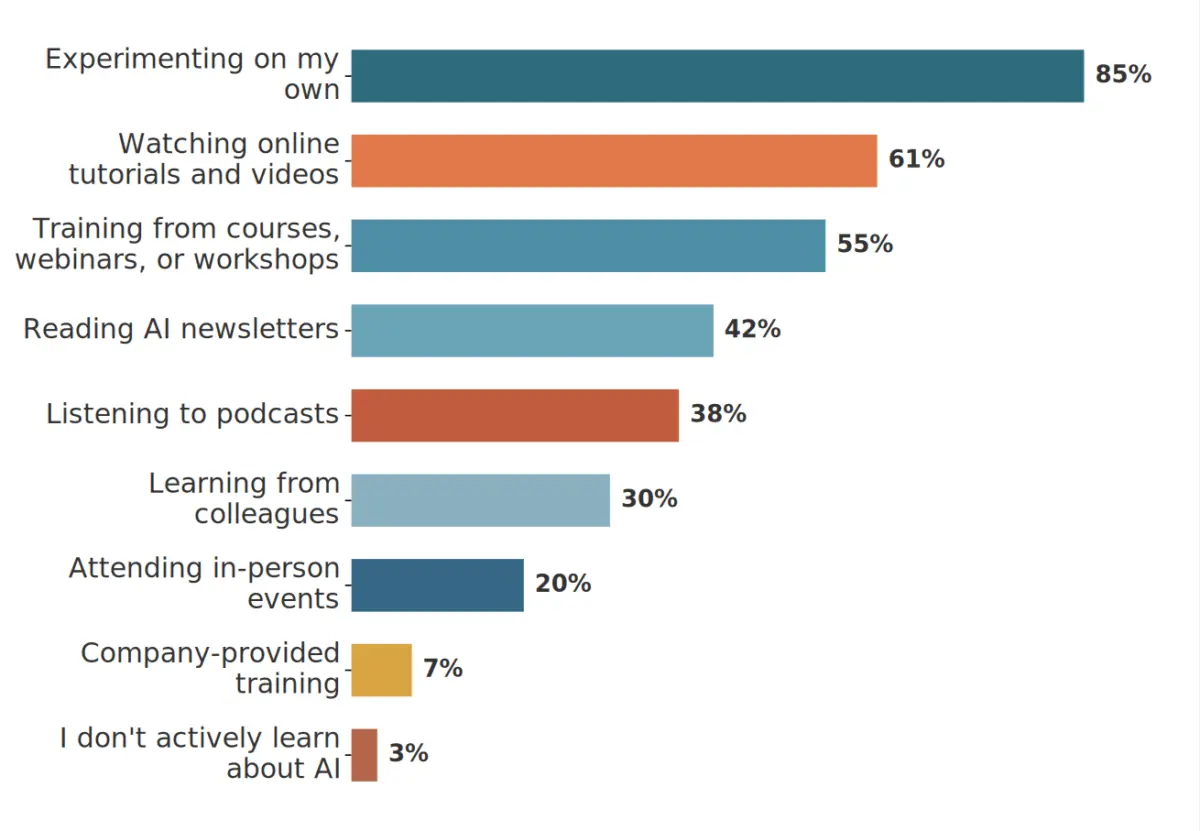
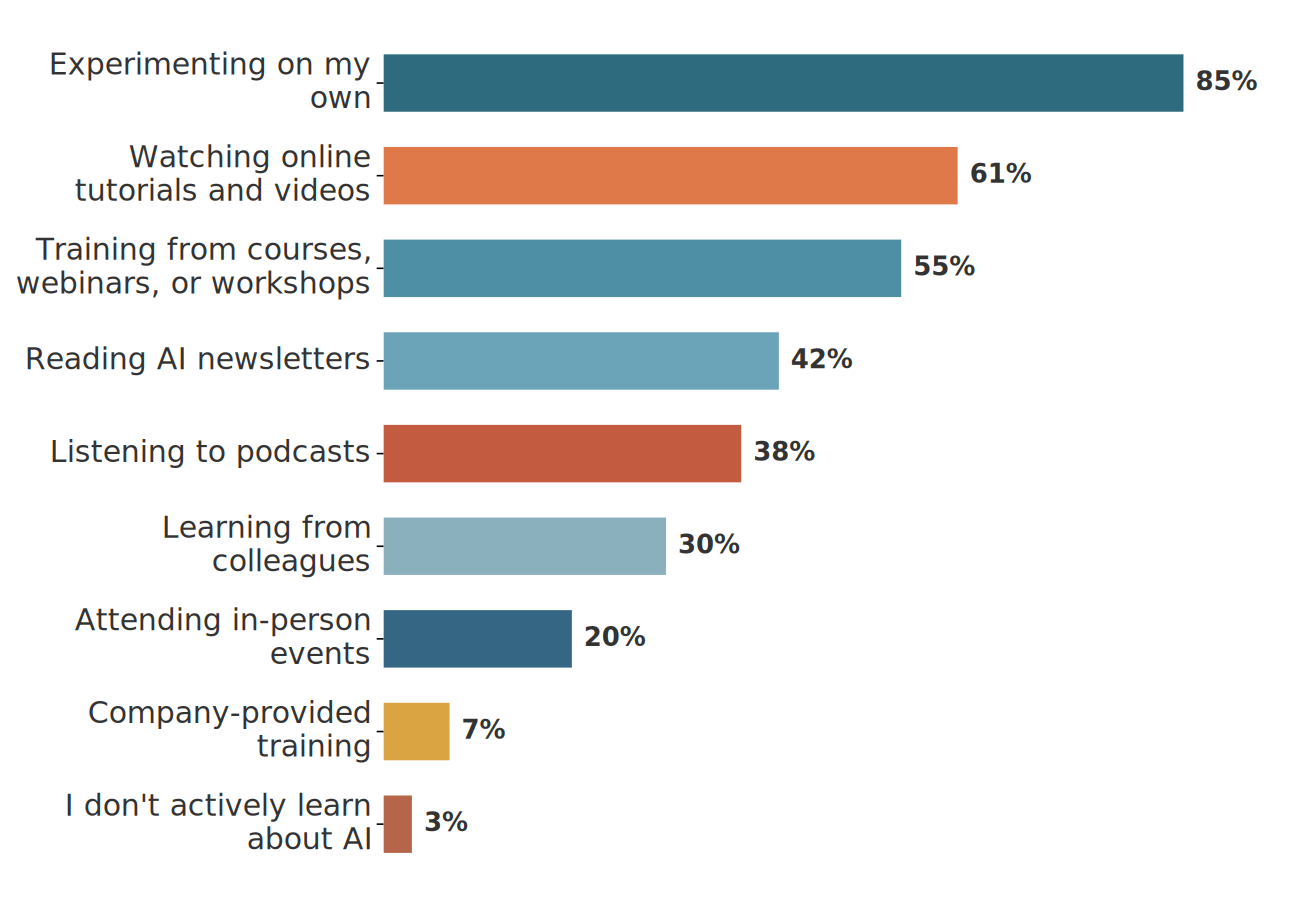
One of the most revealing insights of the 2026 data centers on how professionals are learning to wield these technologies. Corporate training programs are virtually absent from the equation: only 7% of marketers receive formal, company-provided training on AI tools.
Instead, 85% of professionals learn through pure experimentation—rolling up their sleeves and figuring it out on the fly. This DIY ethos extends directly to financial investment. More than half (53%) of marketers are paying for AI software out of their own pockets, while 85% contribute financially in some capacity. The era of relying exclusively on free software tiers is fading rapidly. When asked who spearheads AI adoption within their organizations, 55% of respondents answered simply: "Me." For small business owners, this autonomous, trial-and-error approach is not a bug; it is a familiar, battle-tested operational model.
3. The Measurement Gap: High Productivity, Low Metrics
Despite the widespread embrace of AI, a glaring paradox persists within the data. An overwhelming 86% of marketers agree that artificial intelligence saves them significant time, and an identical 86% report measurable boosts in day-to-day productivity.
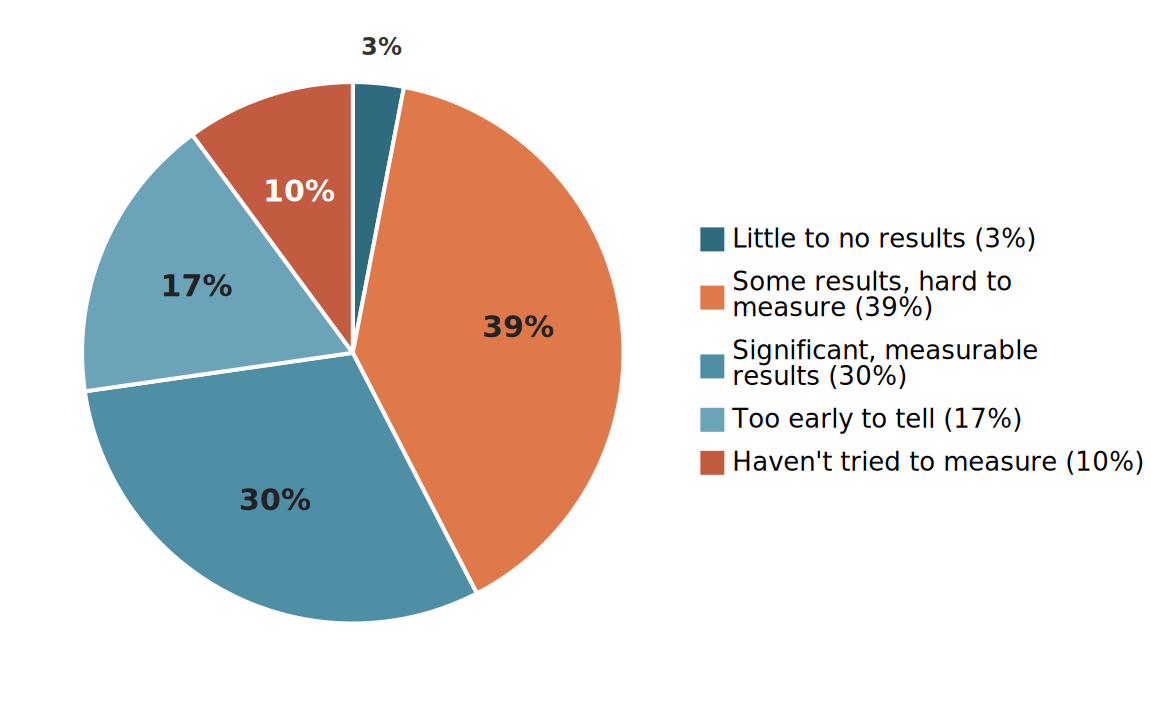
However, when asked to provide hard metrics proving the financial or strategic return on investment, a profound disconnect emerges. Only 30% of respondents can point to significant, quantifiable results. Another 39% acknowledge seeing positive outcomes but admit they cannot formally measure them, while 10% have abandoned any attempt at tracking altogether.
Rather than signaling a failure of the technology, this gap represents a massive competitive opportunity. Businesses that implement basic tracking frameworks—such as logging hours saved per week or measuring content output volume—will instantly position themselves ahead of the 70% of competitors who operate entirely on intuition.
4. The Video Frontier: The Largest Untapped Opportunity
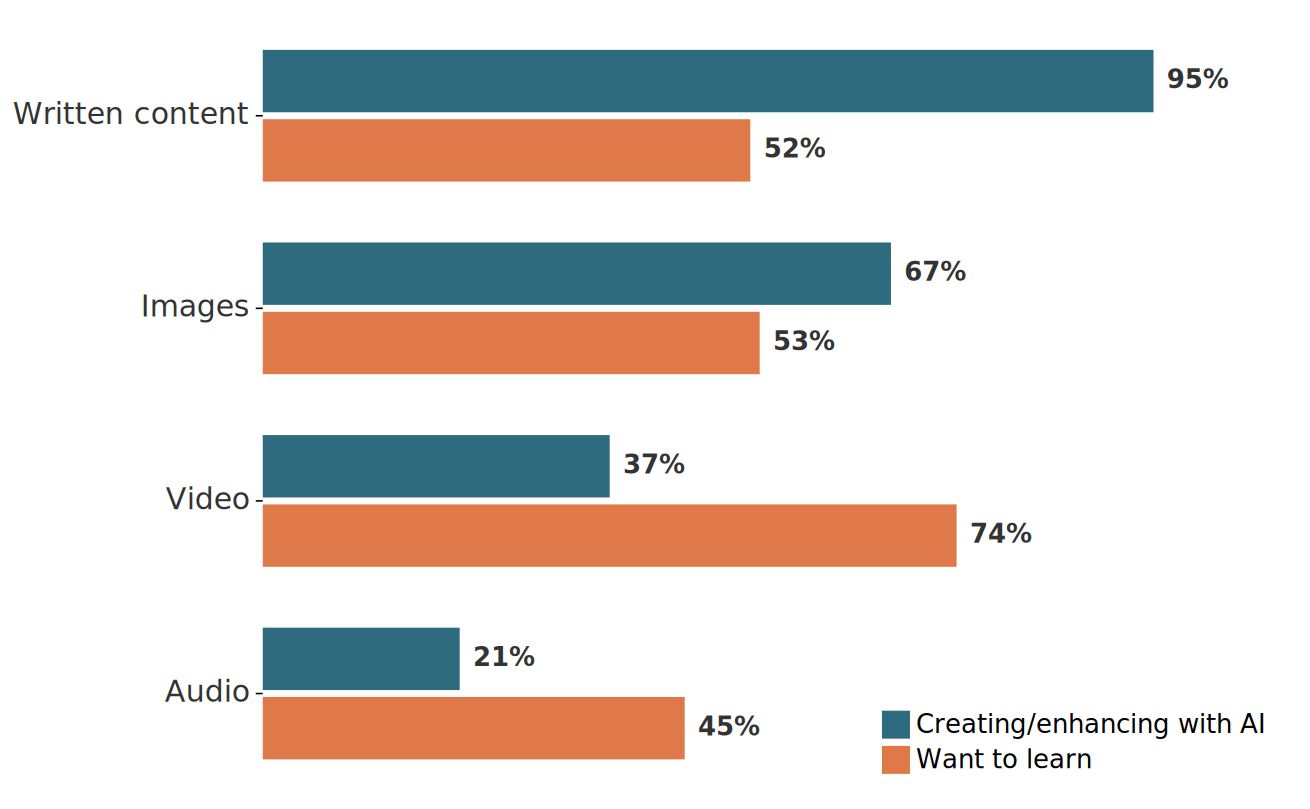
While text-based generation has achieved near-universal saturation—with 95% of marketers utilizing AI for written content—visual media tells a starkly different story.
Only 37% of professionals currently leverage AI for video production. Yet, video sits at the absolute pinnacle of educational demand: 74% of marketers express a strong desire to master AI-generated video. This creates a staggering 37-point gap between market demand and actual adoption—the widest disparity measured in the entire study. While image creation has surged dramatically (jumping from 39% to 67% adoption since 2024), video remains the final frontier. Early adopters who master basic AI video tools today will secure an outsized advantage over peers who remain intimidated by the medium.
5. Autonomous AI Agents: The Next Paradigm Shift
Introduced as a tracking metric for the first time in the 2026 report, autonomous AI agents are poised to redefine small-team efficiency. Unlike standard prompt-and-response interfaces, AI agents are capable of executing complex, multi-step workflows independently.
Presently, only 11% of marketers use AI agents regularly, with 24% actively experimenting. However, momentum is building: 44% of respondents plan to integrate agents into their workflows soon, bringing total current or planned adoption to 79%. Furthermore, mastering AI agents ranks as the number one educational priority for 74% of surveyed professionals.
OFFICIAL PERSPECTIVES AND INDUSTRY ANALYSIS
The findings of the 2026 report underline a fundamental democratization of advanced enterprise capabilities. For decades, deploying automated customer service sequences, continuous analytics monitoring, or multi-channel content pipelines required substantial capital and dedicated headcount.
Michael Stelzner, founder of Social Media Examiner and architect of the research, emphasizes that the report was designed to cut through industry noise and provide actionable ground truth.
"We surveyed marketers to find out how they’re actually using AI. Not the hype. Not the headlines. The real story," Stelzner notes. "Since 60% of our respondents come from businesses with 10 or fewer people, this isn’t enterprise research. This is your world. If you’re running a small business and trying to figure out where AI fits, this report will give you the clearest picture available of what your fellow marketers are actually doing."
Industry analysts point out that the democratization of AI acts as a great equalizer. When 85% of professionals are self-taught and funding tools independently, the playing field levels between massive conglomerates and solo entrepreneurs. The limiting factor is no longer capital availability; it is personal curiosity and strategic execution.
FUTURE OUTLOOK: WHAT SMALL BUSINESSES MUST DO NEXT
As the digital marketing landscape matures through 2026 and beyond, several clear trajectories are emerging.
First, platform preferences are shifting dramatically. The report highlights a notable migration away from legacy tools like ChatGPT toward sophisticated alternatives like Anthropic’s Claude, reflecting a growing demand for nuanced reasoning, superior writing capabilities, and specialized context handling.
Second, the operational weight of small businesses will increasingly shift toward intelligent automation. As AI agents evolve from experimental novelties into reliable digital assistants, solo operators and micro-teams will gain the equivalent operational leverage of departments three times their size. Managing routine email sequences, analyzing customer data trends, and fielding tier-one inquiries autonomously will no longer be luxuries reserved for well-funded enterprises.
For small business owners who have remained hesitant, the message of the 2026 data is definitive. The training wheels are off. Success in the modern market does not require corporate training seminars, enterprise software budgets, or a background in data science. It requires the willingness to roll up one’s sleeves, experiment relentlessly, and build structured habits in an automated world. Those who embrace this reality today will dictate the terms of competition tomorrow.