Executive Overview
The evolution of Cascading Style Sheets (CSS) has historically been defined by a tension between innovative specifications and the slow, fragmented reality of cross-browser support. Developers are frequently forced to choose between adopting cutting-edge features that streamline workflows or remaining tethered to legacy fallback patterns to ensure backward compatibility. Today, the maintainers of Fylgja CSS have taken a decisive step toward resolving this friction with the release of the attr() v2 polyfill.
This newly introduced extension bridges a critical gap in the web ecosystem, allowing developers to leverage the immense power of the CSS attr() v2 syntax today while gracefully falling back to static lists of generated values for older browsers. Rather than waiting for the global baseline standardization of CSS attr() v2—anticipated to reach widespread availability soon—this tooling enables engineering teams to build dynamic, data-driven CSS utilities immediately.
Designed with seamless developer experience (DX) in mind, the polyfill operates transparently behind the scenes. It scans codebases for modern attr() implementations and automatically compiles robust, backward-compatible fallback values. Furthermore, Fylgja has engineered first-class integrations for industry-standard build tools, including ViteJS, LightningCSS, and PostCSS, alongside flexible API and CLI options for bespoke architectures. As Fylgja prepares to integrate this polyfill as the default foundation for its upcoming utility packages, this release marks a pivotal moment in how modern CSS design systems are architected, deployed, and scaled.
Detailed Chronology: The Journey to attr() v2 and the Birth of the Polyfill
To fully appreciate the significance of Fylgja’s new polyfill, one must examine the trajectory of the attr() function within the CSS specification. In its original incarnation (Level 3), the attr() function was notoriously restricted. It could only return a string value, and its usage was strictly limited to the content property of pseudo-elements. This severely limited its utility for layout design, spacing systems, and dynamic styling, forcing developers to rely heavily on custom properties (CSS variables) injected via inline styles or heavy JavaScript runtimes to achieve dynamic behavior.
The introduction of CSS attr() Level 2 represents a paradigm shift. By expanding the function to accept type parsing—such as <number>, <length>, <color>, and <angle>—and permitting its use across any CSS property, attr() v2 transforms HTML data attributes into first-class citizens of the styling engine. Developers can now map HTML attribute values directly to styling properties through mathematical operations and CSS variables.
Recognizing the transformative potential of this specification, the Fylgja CSS team began exploring its application for dynamic design tokens and micro-utilities. In a previous architectural exploration titled Native CSS Utilities, the team detailed how attr() v2 could radically simplify utility-first CSS frameworks by eliminating the need to generate hundreds of rigid, pre-compiled classes for every conceivable spacing or sizing increment.
However, a persistent barrier remained: production environments cannot simply abandon legacy browsers overnight. While Chromium-based engines (Chrome and Edge) and experimental builds of Firefox and Safari have marched steadily toward full implementation, a production-ready baseline across the entire browser landscape has remained just out of reach. Faced with the choice of waiting years for universal adoption or finding a programmatic solution, the Fylgja maintainers chose the latter. The development of the attr() v2 polyfill represents the culmination of this effort—a compiler-level bridge designed to let developers write future-proof code today without sacrificing users on older browser versions.
Supporting Context & Metrics: The Current State of Browser Support
The timing of the Fylgja attr() v2 polyfill release coincides with a fascinating tipping point in browser interoperability. According to tracking data and compatibility metrics from resources like caniuse and browser vendor roadmaps, support for the enhanced attr() syntax is closer than ever, yet still fragmented enough to break enterprise-grade applications if left unmanaged.
+-------------------------------------------------------------------+
|               Browser Ecosystem Support for CSS attr() v2         |
+-------------------+-----------------------------------------------+
| Chrome / Edge     | Fully Supported (Baseline Milestone)          |
| Firefox           | Active Implementation / Experimental          |
| Safari            | Available in Technical Preview                |
+-------------------+-----------------------------------------------+
As of late 2026, mainstream engines like Google Chrome and Microsoft Edge have established solid baseline support for typed CSS attributes. Concurrently, browser engineering teams at Mozilla and Apple have prioritized the feature. Notably, technical insights shared by engineers such as Jake Archibald regarding Firefox implementations highlight a rapidly accelerating momentum across Gecko-based environments. Meanwhile, Safari—traditionally the final frontier for bleeding-edge CSS specifications—has introduced attr() v2 support within its Technical Preview channels, signaling that stable, production-ready releases for macOS and iOS are firmly on the horizon.
Despite this overwhelmingly positive outlook, web development cannot operate on probabilities. Enterprises, e-commerce platforms, and public-facing portals often support browser versions that lag behind the cutting edge by several years. For these organizations, relying on native attr() v2 support natively would mean alienating a measurable percentage of their user base.
The Fylgja polyfill addresses this fragmentation head-on. By processing the stylesheet at build time, the tool evaluates modern declarations—such as:

[data-py]
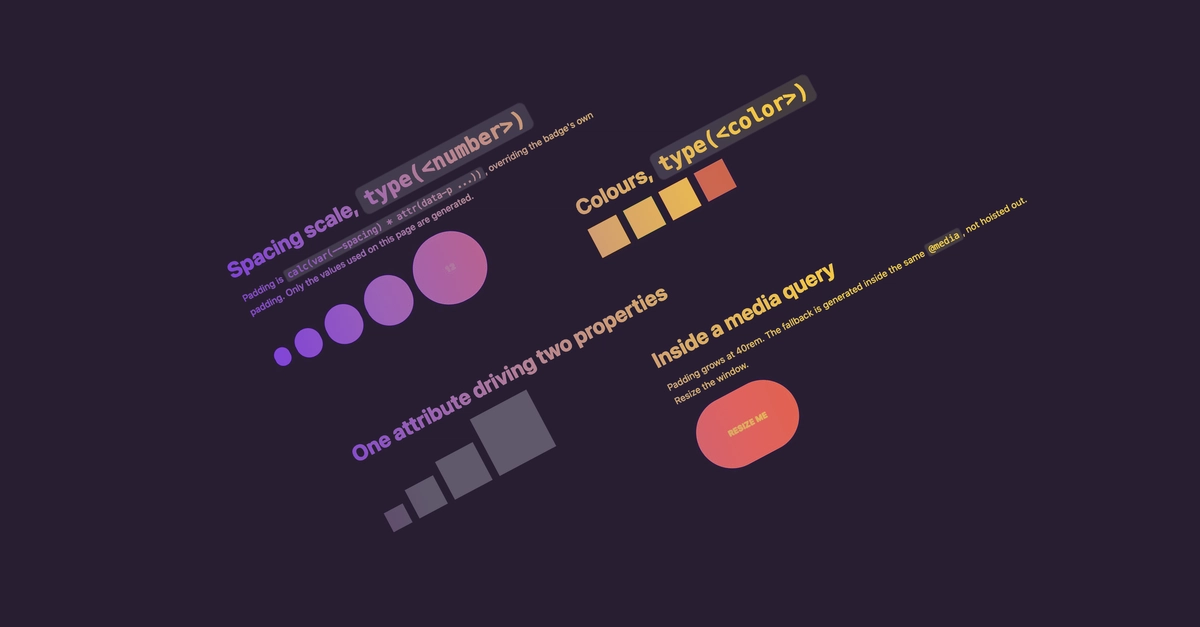
    padding-block: calc(var(--spacing) * attr(data-py type(<number>), 1));
…and automatically generates the necessary static fallbacks for older user agents. This ensures that a markup declaration like <div data-py="4"></div> renders with absolute visual fidelity across both modern, spec-compliant browsers and legacy environments that lack native typed attribute parsing.
Official Statements & Architectural Philosophy
The architectural philosophy underpinning the Fylgja ecosystem centers on developer ergonomics, progressive enhancement, and zero-runtime overhead. In official project communications, the maintainers articulated two non-negotiable requirements that guided the creation of the attr() v2 polyfill: seamless authoring syntax and deep build-tool integration.
Maintaining Authoring Purity
The primary directive was that adopting the polyfill should not require developers to alter how they write CSS or structure their HTML. The authoring experience must remain identical to the native specification. Developers continue to write standard CSS rules incorporating typed attribute fallbacks and default values, and they continue to consume those rules via clean, semantic HTML data attributes:
<!-- HTML Authoring Example -->
<div data-py="4"></div>
The polyfill’s engine acts as an intelligent intermediary. Rather than injecting heavy client-side JavaScript to polyfill DOM styling behavior at runtime—which would introduce performance penalties and layout thrashing—the Fylgja polyfill operates entirely during the build phase. It parses the source stylesheets, detects attr() v2 expressions, and outputs optimized static fallback rules alongside the modern syntax.
Universal Toolchain Integration
Recognizing that the modern frontend landscape is decentralized, the Fylgja team ensured that the polyfill is not locked into a single framework or bundler. First-class integrations have been forged for the industry’s leading compilation pipelines:
- ViteJS: For modern, lightning-fast Single Page Applications and multi-page builds.
- LightningCSS: For ultra-fast, Rust-powered CSS parsing, transformation, and minification.
- PostCSS: For maximum compatibility with legacy build pipelines and custom PostCSS plugin chains.
Furthermore, for teams operating outside traditional bundler environments—or those managing static sites with unique compilation needs—Fylgja provides a robust standalone API and a Command Line Interface (CLI). This ensures that whether a project utilizes a complex micro-frontend architecture or a simple static file server, the polyfill can be dropped into the workflow with minimal configuration.
Future Outlook: The Next Generation of Fylgja Utilities
The release of the attr() v2 polyfill is not merely a standalone utility drop; it serves as the foundational cornerstone for the upcoming evolution of the Fylgja CSS framework itself.
In upcoming releases, the core Fylgja Utilities package will transition away from legacy dynamic styling solutions, adopting the attr() v2 syntax and its companion polyfill as the default engine for generation. This shift promises to dramatically reduce the file size of compiled utility sheets, minimize build times, and grant developers unprecedented runtime flexibility through the native power of CSS custom properties combined with typed attributes.
Currently, while these capabilities are being finalized for general release, developers can experiment with the attr() v2 utilities today by utilizing Fylgja’s experimental import channels. This empowers early adopters to test, benchmark, and provide feedback on the system before it becomes the standard operating procedure for the framework.
As the web platform continues its march toward universal CSS attr() v2 baseline support, tools like Fylgja’s polyfill demonstrate the maturing capability of modern build tooling. By providing a bridge between the CSS of tomorrow and the browsers of today, Fylgja CSS ensures that developers no longer have to choose between innovation and compatibility—they can have both, right now.