
Executive Overview
In the high-stakes theater of modern cyber espionage, threat actors continually seek out structural vulnerabilities in the very infrastructure that powers the global internet. In 2017, investigative reports and cybersecurity disclosures brought to light a deeply concerning development: "Fancy Bear"—the state-sponsored Russian hacking syndicate also known as APT28, Strontium, and Sofacy—successfully weaponized Google’s Accelerated Mobile Pages (AMP) framework. By exploiting design choices within this mobile-optimization standard, the hackers executed sophisticated spear-phishing campaigns targeting investigative journalists, human rights researchers, and political critics.
The core vulnerability exploited by Fancy Bear did not stem from a traditional software bug or a coding error. Instead, it was rooted in a foundational design architecture: Google’s practice of hosting and pre-rendering third-party AMP content under legitimate google.com domain names. For years, cybersecurity experts have drilled a fundamental rule into the minds of internet users: always check the URL in the address bar before entering credentials. However, Google’s implementation of AMP allowed malicious phishing pages to display trusted google.com URLs to mobile users, circumventing decades of security conditioning.
Despite repeated warnings from developers, security researchers, and web publishing veterans, Google initially defended the protocol, dismissing the risks of user confusion. This report provides an in-depth examination of how Fancy Bear exploited the AMP standard, the real-world impact on high-profile investigative targets, the tech giant’s controversial response, and the broader implications for the security of the open web.
Detailed Chronology: The Anatomy of an AMP-Powered Phishing Campaign
The exploitation of Google’s AMP architecture by Russian-linked hackers highlights a calculated progression from crude phishing tactics to advanced, infrastructure-leveraging attacks. The timeline below traces the intersection of Google’s push for mobile performance and Fancy Bear’s targeting of independent watchdogs.
Late 2015 – 2016: The Rollout of AMP and Early Developer Warnings
Google introduced Accelerated Mobile Pages (AMP) in late 2015, heavily marketing it as an open-source initiative designed to make the mobile web faster and more accessible. To achieve instantaneous load times, Google began pre-rendering copies of AMP-enabled pages on its own servers, serving them directly to smartphone users via google.com URLs.
Almost immediately, technical critics raised red flags. Programmers and security-minded developers realized that the address bar—traditionally the ultimate arbiter of web authenticity—would display a google.com domain while the actual content source was obscured or entirely hidden upon scrolling.
By late 2016, independent developers formally reported these security implications to Google via GitHub. Web programmer Ray Etornam submitted a bug report highlighting how malicious actors could leverage AMP to achieve unearned legitimacy. Developer Christian Gloddy reinforced the warning, writing:
"The most common advice to avoid phishing and scams is ‘check the domain in the address bar.’ Not at the text that might be below the address bar."
Despite warnings from industry figures like John Pettitt—co-founder of payment processor CyberSource—who predicted the issue would "bite Google when least expected and in a very public and negative way," Malte Ubl, the tech lead for the AMP project, publicly dismissed the criticism, arguing that the attribution of the original domain at the top of the viewer was sufficient to prevent deception.

October 2016: The Escalation Against Aric Toler
While developers debated the theoretical risks, Fancy Bear was actively operationalizing them. A prime target was Aric Toler, a researcher and writer for Bellingcat, an investigative collective renowned for uncovering Russian military involvement in the downing of Malaysia Airlines Flight 17 over Ukraine in 2014.
Toler had been targeted repeatedly over a multi-year span. Earlier attempts utilized clumsy, easily identifiable tactics, such as URL shortener services like Bitly, which savvy internet users instantly recognize as red flags. However, recognizing Toler’s resistance, the attackers upgraded their tradecraft.
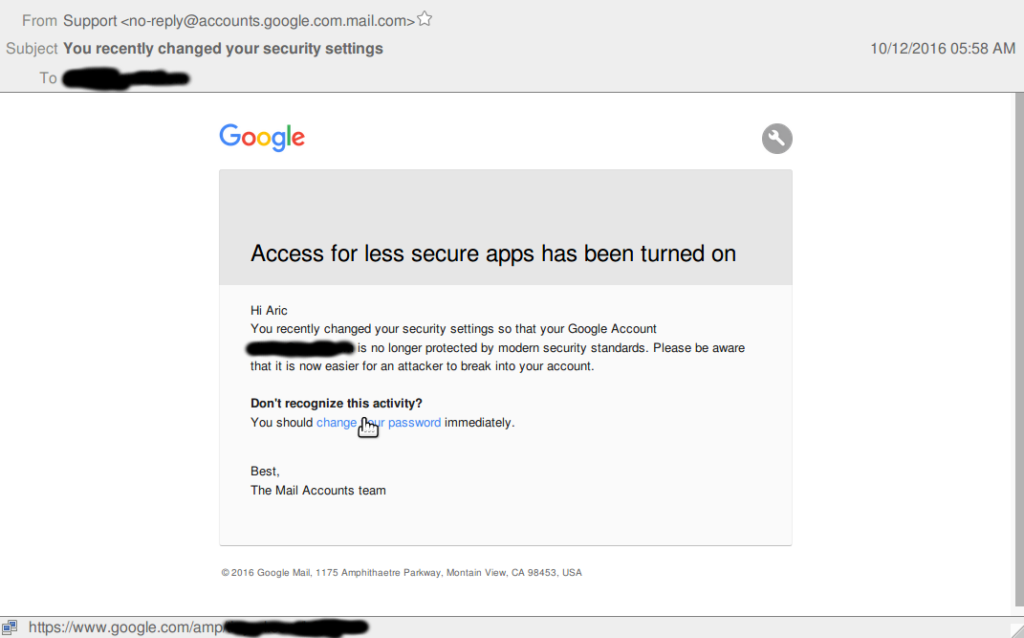
On October 12, 2016, Toler received a forged Gmail security alert warning that older email programs were accessing his account and that it was "now easier for an attacker to break into your account." The email directed him to click a link styled with a Google AMP URL. The next day—seemingly in response to a public tweet by Toler acknowledging a legitimate government-backed attack warning—the hackers escalated further. They sent a second spear-phishing email claiming government-backed actors were attempting to steal his password, again directing him through a malicious Google AMP redirection page.
ThreatConnect, a cybersecurity firm that analyzed the attack vectors, confirmed that the emails funneled targets toward a meticulously crafted fake Google login page. By routing these links through Google’s AMP services and link shorteners, the hackers successfully masked the true destination, providing mobile users with a false sense of security rooted in Google’s trusted domain.
Spring 2017: The Compromise of David Satter
While Bellingcat researchers successfully identified and deflected Fancy Bear’s AMP-based lures, other targets were less fortunate. David Satter, an American journalist and author who has written extensively on Russia and the Soviet Union, fell victim to an identical AMP phishing campaign originating from the same hacker-controlled infrastructure ([email protected]).
Upon entering his credentials into the fake Google login portal hosted via the compromised link, Satter’s Gmail account was fully breached. The attackers harvested his entire digital correspondence archive. Within weeks, the stolen files surfaced online via platforms like the Canadian research organization Citizen Lab, where portions of the data had been selectively altered and weaponized in disinformation campaigns designed to smear critics of Russian leadership.
Supporting Context & Metrics: The Mechanics of the Vulnerability
To understand why the Fancy Bear campaign succeeded where older phishing methods failed, one must examine the specific mechanics of the Google AMP caching model and the psychology of user trust.
The Domain Spoofing Dilemma
Phishing relies fundamentally on social engineering—tricking a victim into believing that a malicious entity is trustworthy. For decades, cybersecurity literacy campaigns relied on a simple maxim: Check the URL. If the browser address bar reads paypal.com, bankofamerica.com, or google.com, the user assumes they are interacting with the legitimate service.
Google’s AMP pre-rendering mechanism shattered this paradigm. When a smartphone user tapped an AMP link from search results:
- The browser loaded the page from a Google caching server.
- The browser’s native address bar displayed a
google.comURL. - The originating domain was relegated to a small visual indicator at the top of the content area—an indicator that routinely vanished as the user scrolled down the page.
Consequently, when a target received a password reset notification and tapped a link that resolved to a google.com/amp/... address, their foundational security instincts were neutralized. Even sophisticated web developers admitted that distinguishing a malicious AMP link from a benign one at a glance was exceptionally difficult.
The Broader Ecosystem Debate
Beyond security concerns, AMP faced sustained criticism from publishers, open-web advocates, and software architects. Critics argued that the framework:
- Obfuscated true internet architecture, concentrating traffic and user engagement within Google’s proprietary ecosystem.
- Enabled low-quality content farms and fake news sites to inherit the visual authority and high search rankings of legitimate journalistic outlets.
- Created a walled garden that discouraged users from ever leaving Google’s property.
Jason Kint, CEO of the digital publishing trade association Digital Content Next (representing organizations like The New York Times, The Washington Post, and major broadcast networks), underscored the systemic danger:
"This report of an ongoing security issue is troubling and exactly why consolidation of power and closed standards are problematic. The sooner AMP migrates to the open web and becomes less tied to the interests of Google, in every way the better."
Official Statements and Institutional Response
As public scrutiny intensified following the exposure of the Fancy Bear attacks, Google faced mounting pressure to address the structural flaws in its flagship mobile initiative.
Google’s Defense and Post-Hoc Adjustments
Initially, project leads like Malte Ubl defended the architecture, maintaining that the visual domain indicators were clear and that unsophisticated users were not uniquely vulnerable. However, as independent researchers documented successful state-sponsored exploits, the company quietly adjusted its security posture.
- Safe Browsing Integration: Google later asserted that its automated "Safe Browsing" technology had been applied to screen AMP URLs beginning in early January 2017. Under this system, security scanners theoretically evaluate AMP pages for malicious content prior to serving them.
- Redirect Notices: For un-indexed or un-screened external links, Google introduced a "redirect notice" warning users that they were departing the Google domain. Critics, however, pointed out that this notice relied on technical jargon that did little to educate novice users about active security threats.
- Silencing Debate: Amid inquiries from investigative journalists, project lead Malte Ubl drew sharp criticism for locking and disabling public comments on the original GitHub bug report (
ampproject/amphtml/issues/6210), shutting down external critique at the height of the controversy.
Future Outlook: Lessons for Web Standards and National Security
The exploitation of Google AMP by Fancy Bear serves as a watershed moment in the intersection of corporate web optimization and geopolitical cyber warfare. It demonstrated that state-sponsored actors are uniquely positioned to weaponize convenience-driven infrastructure against high-value targets.
- The Perils of Proprietary Standards: The incident remains a textbook case of the risks associated with centralized web standards. When a single corporate entity dictates both the indexing of the web and the rendering protocols for mobile devices, security flaws can have catastrophic, systemic consequences.
- The Evolution of Phishing Defense: Security awareness training must evolve beyond simplistic heuristics like "check the address bar." As browser vendors experiment with advanced rendering techniques, simplified URL displays, and abstracted navigation protocols, educational frameworks must adapt to account for modern UI/UX-based attack surfaces.
- Accountability in Tech Infrastructure: Tech giants that promote closed or semi-proprietary web standards carry an inherent duty of care. As demonstrated by the Fancy Bear campaign, dismissing external security warnings in favor of rapid product deployment can leave independent journalists, human rights advocates, and democratic institutions directly exposed to state-sponsored espionage.
Ultimately, the AMP phishing controversy forced a reluctant reckoning across the technology sector—proving that on the modern web, architectural convenience and uncompromising security remain locked in a perpetual, high-stakes tug-of-war.