Executive Overview
Artificial intelligence has officially crossed the threshold from experimental novelty to core operational infrastructure. Across the global technology landscape, modern enterprises are deploying autonomous digital workers to handle tasks that once required dedicated human teams. At SaaStr, for instance, 21 specialized AI agents now operate seamlessly in production environments. These systems book high-stakes meetings on Saturday nights, systematically resurrect dead leads that have sat untouched in CRMs for half a year, manage complex invoice and collection cycles, and update Salesforce records continuously without human oversight.
The operational efficiency delivered by these systems is staggering. Lean go-to-market (GTM) teams operating with roughly 1.5 human equivalents are now regularly out-producing legacy teams of six or more. Yet, despite this high-octane automation wave, the tech industry has run headfirst into a profound structural barrier.
While AI agents have successfully conquered the top of the funnel, streamlined lead qualification, optimized customer support deflection, and automated post-sale finance operations, there is one critical milestone they have yet to achieve: they cannot close a real, enterprise-grade deal.
As the software sector navigates the explosion of self-serve and agent-serve ecosystems, a hidden gap has emerged that most startup founders have entirely failed to price into their models. The market is saturated with competent AI SDRs and automated support bots, but a truly autonomous, reliable AI Account Executive (AE) remains missing in action.
Detailed Chronology: The Evolution of Autonomous GTM Operations
To understand the current impasse in AI-driven sales, it is necessary to examine how autonomous agents conquered the peripheral domains of the go-to-market engine before stalling at the negotiation table.
Phase 1: Top-of-Funnel Domination
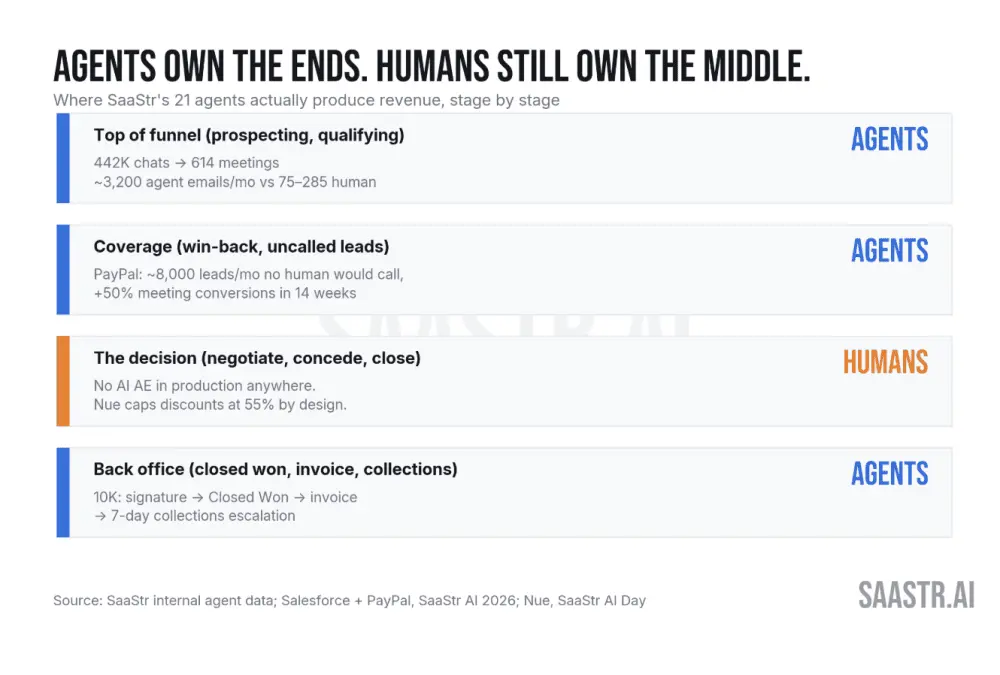
In the early iterations of generative AI sales tooling, deployment focused heavily on outbound prospecting and inbound triage. Companies quickly realized that LLMs could generate personalized, context-aware emails at a scale impossible for human development reps (SDRs). By late 2025 and into 2026, AI-native SDR layers routinely outputted upwards of 3,200 targeted emails per month—a volume vastly eclipsing the 75 to 285 monthly touchpoints typical of a human counterpart.
Concurrently, platforms like Qualified began handling millions of inbound chats, qualifying leads, mapping organizational hierarchies, and scheduling calendar slots with zero human intervention. For instance, inbound agents deployed at enterprise scale have successfully cleared over $1 million in sponsorship revenue simply by routing, qualifying, and booking hundreds of initial conversations without ever touching a rate card.
Phase 2: CRM Hygiene and Back-Office Automation
Following the conquest of initial prospecting, AI agents expanded downward into administrative workflows and post-signature operations. Modern AI "VP of Marketing" agents and RevOps integrations now manage the tail end of deals end-to-end.
When an electronic signature platform like PandaDoc signals a completed contract, automated agents instantly flip pipeline stages in Salesforce, append missing stakeholder contacts, generate and dispatch invoices via payment rails like Bill.com, and initiate automated collection reminders complete with multi-tier escalation timelines. Some advanced implementations have even taken over internal commission calculations.
Phase 3: The Mid-Funnel Stagnation
Despite these monumental strides in front-end prospecting and back-office accounting, the core of the sales cycle—the moment where a buyer decides to allocate capital—remains stubbornly human.
Data from major industry gatherings and tech benchmarks illustrate a clear pattern: AI agents excel at classification problems (qualification), scheduling problems (follow-up), and workflow problems (quote-to-cash). However, closing a deal is fundamentally a judgment problem operating under deep ambiguity, requiring emotional intelligence, real-time negotiation strategies, and institutional accountability. While agents have effectively absorbed the mechanical middle of the sales funnel, they leave behind the jagged edge of human skepticism, procurement roadblocks, and complex organizational politics.
Supporting Context & Metrics: Where the Data Points
The macroeconomic impact of AI agents on GTM organizational design is vividly captured in recent industry surveys and benchmark data from top-tier venture capital firms.
The Emergence of Leaner GTM Teams
According to data compiled by Emergence Capital from a survey of over 560 B2B companies, role compression across sales functions has been highly uneven:

- SDR and BDR Headcount: 36% of surveyed organizations reported a decrease in prospecting headcount—the highest reduction across any sales category.
- Sales Engineers (SEs): Only 14% reported a decrease in technical engineering talent, reflecting a rising demand for deep product expertise.
- Account Executives (AEs): Surprisingly, 28% of companies reported an increase in AE headcount.
Similarly, ICONIQ’s State of Go-to-Market report analyzes structural efficiencies across varying ARR bands. AI-forward companies operating in the $10M to $25M ARR bracket run lean GTM teams averaging roughly 20 full-time equivalents (FTEs), compared to 35 FTEs for lower-adoption peers—representing a 43% operational leanness while achieving comparable revenue milestones.
However, as companies scale, this efficiency gap steadily narrows:
- $25M to $100M ARR: 45 FTEs (AI-forward) vs. 65 FTEs (Traditional) — 31% leaner
- $100M to $250M ARR: 125 FTEs vs. 165 FTEs — 24% leaner
- $250M to $500M ARR: 275 FTEs vs. 350 FTEs — 21% leaner
This gradual convergence proves that while AI successfully compresses top-of-funnel labor requirements, it cannot substitute for the complex closing mechanisms required as deal sizes and organizational complexities scale upward.
Function-Level Adoption Breakdown
Daily utilization rates across departments further reinforce this reality. Enterprise data indicates that functional adoption of generative AI tools sits at:
- SDRs: 71% utilize AI daily (prep, drafting, research).
- Marketing: 65% utilize AI daily.
- Account Executives: 57% utilize AI daily (primarily for administrative prep and follow-ups, while human negotiation remains central).
- RevOps: 54% utilize AI daily.
- Account Management: 45% utilize AI daily.
- Customer Success: 41% utilize AI daily.
Official Statements & Industry Insights
Industry leaders navigating this transition have offered candid assessments regarding the illusion of the "self-serve" revolution and the evolution of the modern closer.
Addressing the rise of self-serve milestones, Anthropic’s Eleanor Dorfman restructured the organization’s sales architecture, noting that a significant majority of new enterprise logos were closing through self-service pathways. However, this shift did not eliminate the need for human sales professionals; rather, it automated transactions that were naturally transactional, while reserving human capital for complex enterprise engagements. Indeed, hiring data from mid-2026 showed traditional sales job openings representing approximately 20% of total job postings at leading AI-native labs, closely matching or exceeding core AI research openings.
Grant Lee, CEO and co-founder of Gamma, scaled his organization to $100 million in Annual Recurring Revenue (ARR) with virtually no traditional sales team. Reflecting on this hyper-growth, Lee noted that their reliance on product-led growth was largely reactive rather than meticulously planned, cautioning founders against assuming that enterprise software can scale universally without high-touch human intervention.
Meanwhile, industry experts emphasize that the definition of the Account Executive is undergoing a fundamental transformation. Rather than being replaced by passive chatbot agents, successful AEs are evolving into hyper-technical specialists. Sam Blond of Monaco highlighted that modern high-velocity closes depend heavily on "forward-deployed AEs"—technical professionals capable of deploying software directly for the client during the evaluation cycle. In these environments, the demo transitions from a theoretical promise to empirical proof, allowing sales and technical implementation to occur simultaneously.
Future Outlook: The Road to the First Autonomous AI AE
The current gap between automated qualification and human closure will not persist indefinitely. The technological building blocks required to construct a fully autonomous AI Account Executive are rapidly maturing:
- Contextual Mastery: Modern agents possess deeper, more granular product knowledge than many human sales representatives.
- Persistent Engagement: Their follow-up discipline exceeds that of any human workforce, operating across time zones without fatigue.
- Unified CRM Memory: They maintain access to comprehensive account histories that far surpass traditional human record-keeping.
Where Autonomous Closing Will Emerge First
Before complex, multi-stakeholder enterprise sales can be automated, AI AEs will likely establish a foothold in specific, highly defined commercial environments:
- Standardized SMB and Mid-Market SaaS: Transactions governed by clean, publicly available price books and standardized terms of service.
- Product-Led Expansion Loops: Upgrades within existing accounts where usage thresholds automatically trigger commercial expansion proposals over email or chat interfaces.
- Agent-to-Agent Commerce: As predicted by Stripe’s Maia Josebachvili, future B2B transactions may bypass human buyers entirely, with autonomous corporate agents transacting directly via standardized catalogs, policy guardrails, and automated payment rails.
Strategic Recommendations for Founders
For startup founders and GTM leaders building in the current landscape, operational strategy must align with current technological realities:
- Automate the Periphery: Aggressively deploy agents for top-of-funnel qualification, meeting scheduling, and post-signature invoicing.
- Upskill the Core: Retain human closers, but ensure they possess deep technical competence capable of proving value rather than merely pitching features.
- Avoid Premature Disintermediation: Do not dismantle complex sales teams prematurely under the assumption that AI can navigate custom security reviews, procurement friction, and executive-level negotiations.
Conclusion
AI agents have radically transformed the economics of software go-to-market operations, successfully absorbing the top of the funnel and the administrative back office. Yet, closing high-value commercial agreements remains an inherently human domain defined by judgment, empathy, and strategic negotiation. Until autonomous systems acquire the authority and emotional nuance required to navigate complex enterprise deals, the most successful GTM organizations will not be those that replace humans entirely, but those that pair elite technical closers with an unstoppable fleet of digital agents.