Executive Overview
In the fast-paced world of cloud computing, developer ecosystems are the lifeblood of technological innovation. Platforms that foster collaboration, lower barriers to entry, and provide hands-on experimentation environments are essential for shaping the next generation of engineers and cloud architects. On July 9, 2026, the AWS Builder Center officially marked its first anniversary, reflecting on an extraordinary inaugural year that transformed the platform from a modest community hub into a fully realized, enterprise-grade cloud ecosystem.
Launched originally in July 2025, the AWS Builder Center set out to solve a perennial challenge in the developer space: creating a centralized, frictionless environment where builders of all skill levels could share knowledge, vote on features, access robust toolkits, and collaborate seamlessly. Over the past twelve months, the platform has scaled dramatically. What began as a simple community repository has evolved into an expansive digital ecosystem featuring dedicated sandbox environments, curated interactive workshops, interest-driven "Spaces," and the comprehensive Builders’ Library.
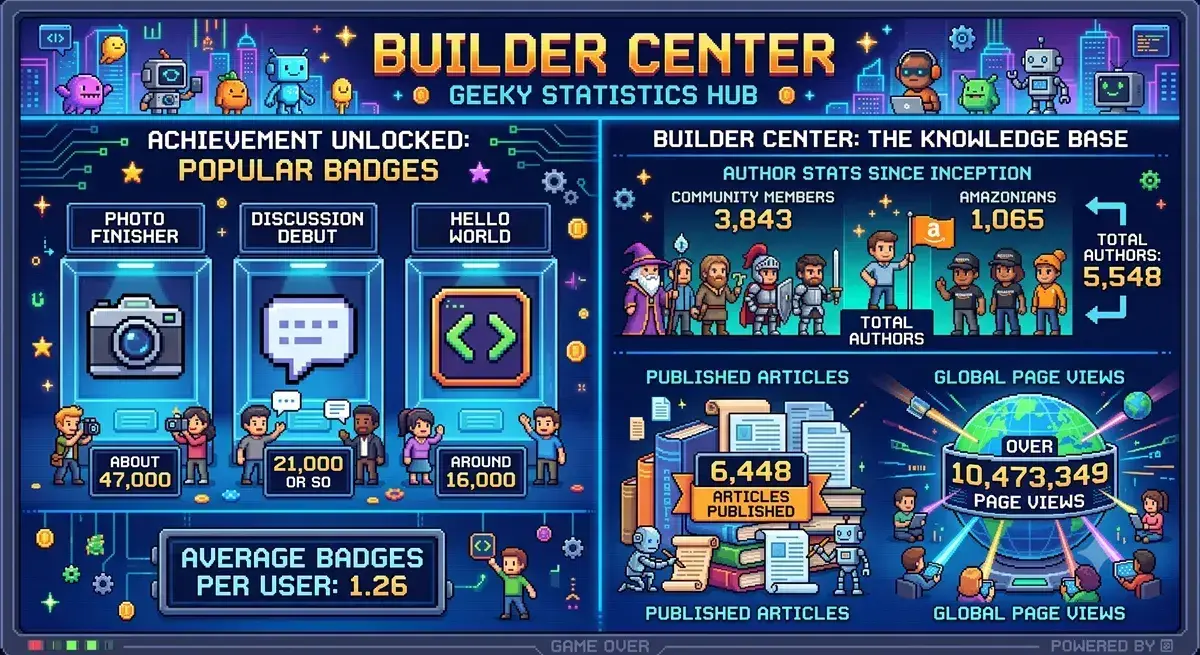
To commemorate this milestone, AWS leadership—including cloud veteran Jeff Barr and community product lead Rick Suttles—published comprehensive retrospectives detailing the platform’s rapid expansion. The numbers speak for themselves: over 5,500 authors contributing thousands of peer-reviewed technical articles, millions of aggregate page views, and the distribution of nearly 100,000 gamified achievement badges. Furthermore, the platform’s user-driven feature-voting mechanism has directly influenced the AWS product roadmap, turning community desires into production-ready features.
As the Builder Center steps into its second year, the release of fully integrated Sandbox Environments signals a new era of hands-on, frictionless learning. By eliminating financial barriers and administrative hurdles, AWS is cementing its commitment to democratizing cloud education. This report provides an in-depth examination of the Builder Center’s first-year trajectory, its quantitative milestones, its breakout community content, and the strategic implications of its latest ecosystem updates.
Detailed Chronology: A Year of Rapid Iteration and Feature Expansion
The velocity at which the AWS Builder Center has introduced new capabilities over the past year is a testament to the agile product philosophy driving the platform. To chronicle this evolution, Rick Suttles published an exhaustive feature timeline detailing every major milestone shipped between July 2025 and July 2026.
Phase 1: Foundation and Early Community Tools (Mid-2025)
When the platform first debuted in July 2025, its primary objective was to establish a foundational identity. Initial iterations focused on community profiles, Wishlist voting (allowing developers to petition for specific AWS features), and a centralized toolbox. The early days were characterized by active feedback loops, where developers could voice their infrastructure pain points directly to AWS engineering teams.
Phase 2: Expanding the Knowledge Base (Late 2025)
As user adoption gained momentum, the platform rapidly expanded horizontally. AWS introduced the Builders’ Library, structured article series, and engagement metrics such as view counts and saved-item bookmarks. To foster a richer global view of infrastructure availability, the platform rolled out AWS Capabilities by Region, a dynamic tracking tool providing visibility into more than 1,500 distinct AWS services distributed across 37 global Regions.
During this period, user accessibility was significantly enhanced with the introduction of flexible authentication options—allowing builders to sign in seamlessly using existing GitHub or Amazon credentials—alongside dedicated student status verifications and real-time availability notifications.
Phase 3: Gamification and Collaborative Spaces (Early 2026)
To encourage sustained engagement and reward technical contributions, March 2026 saw the introduction of a comprehensive gamification framework. The platform launched a badge and streak system, incentivizing consistent participation, article publishing, and workshop completion. Concurrently, AWS introduced Spaces—specialized, community-created groups designed to bring together developers with shared interests, such as serverless architecture, machine learning, and DevOps automation. Workshops were upgraded with advanced filtering mechanisms, enabling users to sort learning modules by category and technical complexity.
Phase 4: The Pinnacle Feature—Sandbox Environments (Mid-2026)
Culminating its first anniversary week, the AWS Builder Center rolled out its most anticipated feature to date: Sandbox Environments. Spearheaded by Rick Suttles, this release fundamentally alters how developers interact with workshop tutorials. Historically, users wishing to execute hands-on AWS tutorials were required to configure their own personal cloud accounts, input valid credit card billing information, and meticulously clean up resources afterward to avoid unexpected charges.
Sandbox Environments completely remove these friction points. By providing users with a free, pre-provisioned AWS account specifically tailored for workshop completion, the barrier to entry has dropped to absolute zero. Each sandbox remains active for a tightly controlled eight-hour window, after which the temporary account and all associated provisioned resources are automatically and securely de-provisioned. To ensure fair resource distribution across the global community, users are permitted one active sandbox at a time, with a request limit of one per week. Crucially, no personal AWS account, credit card data, or manual infrastructure teardown is required.
Supporting Context & Metrics: Quantifying Community Impact
In his official one-year retrospective, chief evangelist Jeff Barr highlighted the staggering scale and adoption rates that the AWS Builder Center has achieved since its inception. The platform has successfully transitioned from an experimental internal project into a vibrant, global technical nexus.
Quantitative Milestones (As of July 2026)
- Active Authors: 5,548 independent cloud builders, engineers, and architects have published content on the platform.
- Published Technical Articles: 6,448 peer-reviewed articles covering niche architectural patterns, migrations, and emergent AI workflows.
- Total Content Consumption: Over 10.4 million aggregate page views across the global readership.
- Gamification Engagement: 99,226 distinct badges earned by community members since the launch of the gamification framework in March 2026.
- Community-Driven Roadmapping: 565 feature wishes submitted by developers via the Wishlist voting portal. Out of these, 10 highly requested features have already been fully shipped, with another 20 firmly placed on the near-term development roadmap.
Breakout Community Content: The Million-View Era of Peer Learning
The core strength of the Builder Center lies in its decentralized knowledge-sharing model. While official AWS documentation remains the gold standard for foundational reference, community articles offer practical, real-world troubleshooting and creative architectural solutions forged in the trenches of production environments.
During the past year, several community-authored articles resonated deeply with the global engineering populace, crossing major readership thresholds:
- Building an AWS Study Buddy with MCP + Strands Agents SDK by Dineshraj Dhanapathy
- Readership: 50,000+ views
- Overview: This breakout technical deep-dive explored the intersection of generative AI and cloud education, detailing how to construct an intelligent, context-aware study assistant using the Model Context Protocol (MCP) and the Strands Agents SDK. It captured the imagination of developers looking to leverage multimodal AI agents for internal training and certification preparation.
- Migrating an End-of-Life (EOL) Linux Server to AWS in 8 Hours with Kiro by Chris Miller
- Readership: 45,000+ views
- Overview: Addressing a universal enterprise IT nightmare—migrating legacy, unsupported operating systems under tight regulatory deadlines—Miller provided a masterclass in rapid lift-and-shift operations utilizing automated migration toolsets and streamlined scripting.
- AIdeas: NeuroVoice – Multimodal AI for Early Screening of Neurological Diseases by Yash Aggarwal
- Readership: 38,000+ views
- Overview: Demonstrating the humanitarian and healthcare potential of cloud-native architectures, Aggarwal’s article showcased a multimodal AI system designed to assist clinicians in the early detection of neurological disorders through voice biomarker analysis, running entirely on scalable AWS serverless infrastructure.
Official Statements and Leadership Reflections
Reflecting on the platform’s trajectory, AWS executives emphasized that the Builder Center is not merely a publishing platform, but a fundamental pillar of AWS’s developer-first strategy.
In his anniversary retrospective, Jeff Barr noted:
"When we envisioned the Builder Center a year ago, our goal was simple: build a place where builders could connect, learn, and directly influence the tools they use every day. Seeing over 5,500 authors step forward to share their expertise, resulting in more than 10.4 million page views, has exceeded our most ambitious expectations. The platform is living proof that when you remove barriers between engineers, the entire cloud ecosystem accelerates."
Adding to these sentiments, Rick Suttles—whose recent contributions include both the comprehensive anniversary timeline and the launch of Sandbox Environments—stressed the psychological importance of frictionless experimentation:
"Innovation happens when engineers feel safe to fail, experiment, and test wild ideas without worrying about a surprise cloud bill at the end of the month. By introducing secure, temporary Sandbox Environments that self-destruct after eight hours, we are empowering every developer on the planet—regardless of budget or corporate backing—to complete complex workshops and master new AWS capabilities safely and effortlessly."
Community editorial leads, writing in their weekly community roundups, also echoed a sense of seasonal rejuvenation. Esra Kayabali, reflecting on the summer milestone and looking toward upcoming global autumn tech conferences, noted:

"Whether you’re building deep machine learning pipelines, studying for architectural certifications, or simply recharging your batteries during the summer months, the Builder Center remains your digital home. As we look ahead to the next twelve months of development, the roadmap is shaped entirely by your voices."
Future Outlook: What Lies Ahead for the AWS Builder Center
As the AWS Builder Center transitions into its second year of operation, its strategic roadmap points toward deeper ecosystem integration, expanded AI-assisted tooling, and broader global accessibility.
1. Accelerating Wishlist-Driven Development
The direct pipeline between community Wishlist voting and engineering execution has proven to be one of the platform’s most successful experiments. With 10 features already deployed and 20 more queued on the immediate horizon, AWS intends to formalize this feedback loop further. Future updates will likely introduce more granular telemetry on how community votes influence service feature prioritization in core AWS infrastructure products.
2. Deepening Hands-On Sandbox Capabilities
With the successful rollout of 8-hour sandboxes for workshops, AWS is actively exploring ways to expand sandbox utility beyond pre-scripted tutorials. Future iterations may allow community authors to attach custom sandbox templates directly to their published technical articles, enabling readers to test a peer’s architecture with a single click directly from the browser.
3. Fostering Hyper-Niche "Spaces"
As specialized domains such as quantum computing, edge IoT, and advanced generative AI workloads mature, the "Spaces" feature is expected to become the primary incubator for niche developer guilds. AWS plans to introduce enhanced moderation tools, localized translation features, and regional meetup integrations within Spaces to better serve its rapidly diversifying international audience.
4. Continuous Gamification and Global Recognition
The rapid adoption of the badge system—approaching 100,000 distributed achievements—indicates a strong appetite for professional recognition among cloud practitioners. Moving forward, AWS plans to tie certain Builder Center achievement tiers more closely with formal AWS certification pathways and career development networks, creating a seamless bridge between community contributions and professional advancement.
Conclusion
The first anniversary of the AWS Builder Center marks a defining moment in the evolution of cloud developer communities. In just twelve months, the platform has cultivated a thriving, self-sustaining ecosystem of over 5,500 expert authors, delivered millions of instructional resources, and redefined how developers experiment with cloud infrastructure through secure, zero-friction sandbox environments.
By listening intently to its user base—turning community wishes into production code and lowering financial barriers to hands-on learning—AWS has ensured that the Builder Center will remain an indispensable asset for cloud architects, software engineers, and students worldwide. As the platform embarks on its second year, the message to the global builder community is clear: the tools are ready, the sandboxes are open, and the future of cloud computing is yours to build.