Executive Overview
As artificial intelligence platforms become ubiquitous, the marginal cost of content generation approaches zero. Today, any professional, marketer, or business owner can spin up a hundred blog post ideas, draft a comprehensive business report, or generate marketing copy in a matter of seconds. However, this democratization of output has created a secondary, more profound crisis: the sea of sameness.
When everyone uses the same foundational models with standard prompts, the resulting output is inherently average. In a market flooded with generic, machine-generated noise, average carries zero value. Audiences, clients, and corporate leadership can instantly spot raw, unrefined AI text and imagery, leading to an immediate erosion of trust and perceived authority.
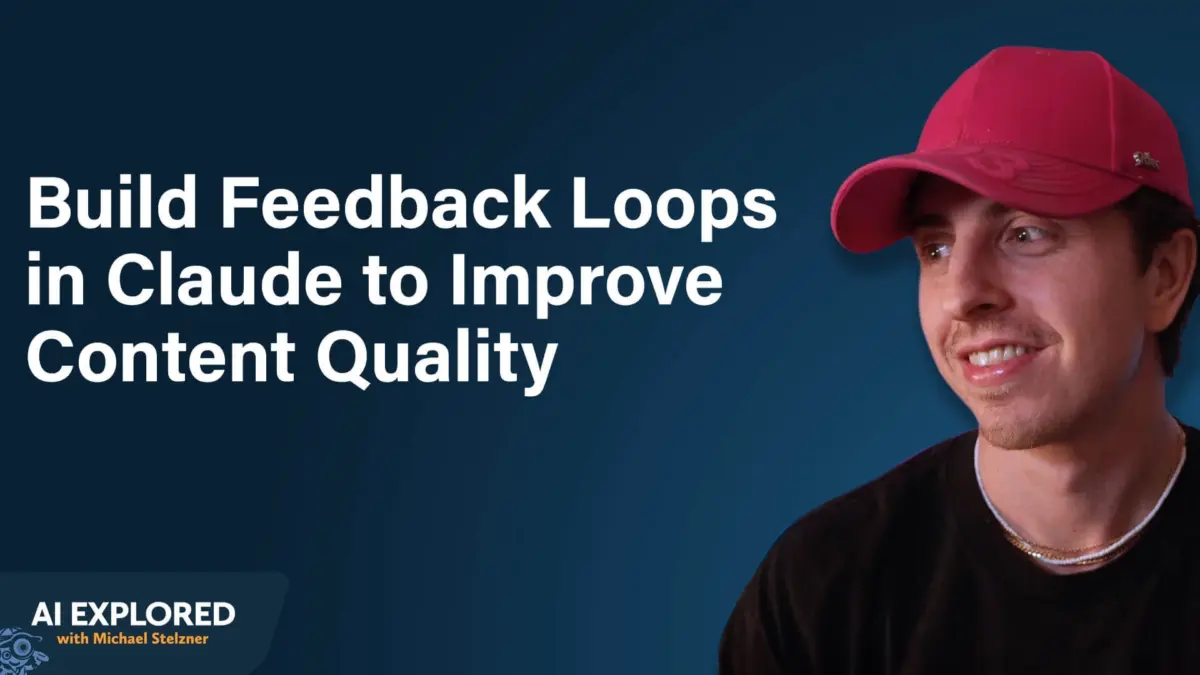
To break through this saturation, a paradigm shift is underway. The winning strategy is no longer about using AI to maximize quantity; rather, it is about leveraging artificial intelligence as a rigorous quality control mechanism. In a recent collaboration for the AI Explored podcast, co-creators Austin Marchese and Michael Stelzner detailed a transformative framework: building custom AI personas and iterative feedback loops. By creating hyper-accurate digital clones of real-world audiences and stakeholders, professionals can stress-test their deliverables behind closed doors—catching up to 100% of critical feedback before the work ever meets human eyes.
Detailed Chronology: Building the AI Quality Control Infrastructure
Moving from generic AI prompts to a sophisticated quality assurance system requires a deliberate, step-by-step technical setup. According to Marchese, this architecture is built on three foundational layers, designed to transition users from merely "renting intelligence" to completely "owning intelligence."
Phase 1: Establishing the Technical Foundation (Projects, Knowledge Bases, and Skills)
The journey to superior AI-generated outputs begins with proper environment configuration.
- The Claude Project Entry Point: For those starting out, dedicated workspace projects (such as those within Claude) offer an accessible entry point. Users upload raw data regarding their target audience, historical feedback, and communication styles directly into the project’s context. Conversations within this ecosystem continuously draw from that proprietary baseline. Marchese estimates this setup captures roughly 80% of the effectiveness of more advanced local integrations.
- Local File Structures and the "Wiki" Knowledge Base: For advanced workflows utilizing local environments (such as Claude Cowork or Claude Code), users can connect directly to local file structures on their machines. Drawing from a knowledge base architecture popularized by researcher Andrej Karpathy, information is bifurcated into two distinct directories: a "raw" folder containing unprocessed artifacts (e.g., raw call transcripts, customer service logs, and message exports), and a "wiki" folder holding AI-processed summaries and distilled psychological preferences. When an internal focus group skill runs, it prioritizes the processed wiki for speed, dropping down to the raw data only when looking for specific direct quotes or minute details.
- Owning Your Intelligence: This local-first data architecture ensures that all intellectual property—context, custom prompts, and persona parameters—resides locally on the user’s hard drive rather than being locked inside a proprietary cloud platform. If a user decides to migrate from Claude to an open-source model or competing ecosystem, their entire contextual apparatus travels with them.
- Programmable Skills: In advanced AI tooling, a "skill" functions as a reusable, standardized set of instructions that executes a complex workflow uniformly every time it is invoked. Instead of manually retyping multi-step operational prompts, a user packages the instructions into a single command.
- The Voice-Input Pro Tip: Rather than writing complex skills by hand, Marchese advocates for a frictionless approach: speaking directly to the AI using voice transcription tools (such as Claude’s native voice feature or dedicated software like Wispr Flow). Spoken communication captures human nuance, cadence, and contextual detail that typists routinely omit, resulting in vastly superior, highly nuanced prompt engineering.
Phase 2: Identifying High-Impact Force Multipliers (The 80/20 Rule)
Quality optimization cannot be applied uniformly across every task; trying to elevate everything at once guarantees failure. Professionals must apply the 80/20 rule to isolate the precise 20% of operational workflows where a leap from "good" to "great" creates 80% of the value.
- For YouTube creators, this might manifest as video packaging: meticulously refining titles and thumbnails.
- For corporate managers, it involves elevating the strategic rigor and clarity of weekly executive reports.
- For independent consultants, it centers on the polish and persuasiveness of client-facing deliverables.
Phase 3: Architecting AI Personas from Real-World Data
The core engine of this quality control framework is replacing slow, friction-heavy human feedback cycles with rapid, iterative human-to-AI-clone simulations.
Traditional workflows involve drafting a report, submitting it to a manager or client, waiting days for revisions, and suffering through rounds of corrections that tacitly communicate that the initial effort fell short. The AI persona methodology inserts a rigorous pre-flight quality assurance check.
To build an accurate clone, creators must feed the AI rich behavioral data sets. A manager persona is constructed using email threads, Slack communication logs, performance review notes, and historical feedback patterns. A consumer persona is fed direct messages, social media comment threads, and transcripts of direct conversations. The more granular the training data, the more surgically precise the AI clone’s critique will be.
Phase 4: Assembling the Internal AI Focus Group
Rather than relying on a single perspective, advanced practitioners build an internal AI focus group—a panel of distinct AI personas representing varied psychological archetypes within an audience (e.g., technical builders, risk-averse enterprise decision-makers, price-sensitive buyers, and visionary founders).
When a deliverable is generated, it is passed through this multi-persona panel. Marchese recommends having the AI format its critique into a structured matrix, scoring the work on a quantitative scale (such as 0 to 10) across each persona archetype. This establishes an objective, repeatable benchmark for content iterations.
Phase 5: Calibration and Iterative Alignment
An AI persona is only as good as its calibration. The true value of the system emerges during the iterative phase where digital simulations are tested against reality.
Marchese illustrated this process through his own workflow regarding YouTube content packaging. He would draft a title, run it through his AI persona ("Darren"), review the feedback, and then text the real Darren to cross-reference his reaction. If the AI’s critique mirrored the human’s response, the system was properly aligned. If a discrepancy arose, Marchese would screenshot the actual conversation, feed it back into the system, and issue a direct update command: "Based on this conversation, update the Darren skill so it doesn’t make this mistake again."
After just five or six iterative cycles of real-world cross-checking, the AI clone achieved such remarkable fidelity that Marchese completely stopped reaching out to his human counterpart—the digital feedback loop had successfully absorbed and automated the human’s evaluative framework.

Supporting Context & Metrics
The economic and professional implications of this operational shift are profound. As generative models lower the barrier to entry for content creation, the volume of digital noise is expanding exponentially.
- The Scarcity Premium: Economics dictates that as supply expands, value concentrates in scarcity. Because raw AI output is inherently average, authentic quality, deep personalization, and rigorous editorial standards have become the ultimate market differentiators.
- Measurable Growth: The efficacy of this methodology is not merely theoretical. Marchese reported a dramatic transformation in his own operational metrics: following the implementation of his multi-persona AI focus group system, his YouTube subscriber acquisition grew tenfold, with clear, traceable inflection points on his analytics dashboard directly corresponding to the deployment of his quality-control workflows.
- The Board of Advisors Expansion: Beyond immediate audience personas, advanced users are constructing strategic "boards of directors" by feeding public transcripts, books, and interviews of thought leaders (such as Seth Godin or Alex Hormozi) into localized knowledge bases. While audience personas evaluate tactical execution, these advisory personas provide high-level strategic challenges from distinct philosophical viewpoints.
Official Statements and Industry Insights
The insights driving this paradigm shift emphasize a vital philosophical distinction in how modern professionals should interact with technology:
"The goal isn’t to use AI to do more. The goal is to use AI to improve quality across every output that matters. The people who maintain their own thinking while using AI as a quality tool are the ones whose work stands apart."
— Austin Marchese, Co-Creator, AI Explored
This perspective directly challenges the prevailing corporate obsession with sheer volume. Rather than treating generative tools as automated factories designed to pump out endless streams of unedited copy, forward-thinking organizations are reframing AI as an uncompromising, tireless internal editor. By shifting the human labor from creation to curation and calibration, professionals ensure that every artifact leaving their desk meets an elite standard of excellence.
Future Outlook
As large language models and multimodal systems continue to evolve, the integration of autonomous quality control systems will transition from an "edge" productivity hack to a baseline professional competency.
- Hyper-Personalized Enterprise Workflows: We will soon see enterprise organizations maintaining comprehensive, proprietary knowledge bases of their entire client roster, allowing account teams to run deliverables past hyper-accurate AI clones of specific corporate clients before a single proposal is officially submitted.
- Autonomous Multi-Agent Collaboration: Future iterations of this technology will likely feature autonomous agent swarms where specialized personas (legal, financial, creative, and executive) debate the merits of a proposal in real-time, drastically compressing product development and review cycles.
- The Ultimate Human Advantage: Ultimately, the widespread adoption of AI quality systems reinforces the irreplaceable nature of human intuition. The foundational data that powers these personas—lived experiences, raw emotional responses, and genuine relationships—must still be captured and curated by human beings. Those who master the art of training their own digital critics will not only survive the coming wave of automated mediocrity; they will define the gold standard of their respective industries.