Executive Overview
In the fast-paced ecosystem of enterprise cloud computing, data agility is synonymous with business velocity. Organizations are under constant pressure to iterate quickly, test vigorously, and deploy applications without compromising production security or compliance guardrails. Recognizing these evolving operational challenges, Amazon Web Services (AWS) has announced a significant evolution in its storage portfolio: the introduction of cross-account copy capabilities for Amazon Elastic Block Store (Amazon EBS) Volume Clones.
Building upon the foundation laid by same-Availability Zone volume clones introduced last year, this latest enhancement breaks down traditional silos between disparate AWS accounts. Engineers, systems architects, and DevOps teams can now generate instant, point-in-time copies of their EBS volumes and seamlessly share them across multiple AWS accounts within an organization. Furthermore, this capability introduces optional re-encryption mechanisms using target-account AWS Key Management Service (AWS KMS) keys, ensuring that data governance and security are never sidelined for the sake of development speed.
For enterprises grappling with complex, multi-account environments—often structured around AWS Landing Zones or AWS Control Tower—this feature represents a paradigm shift. It streamlines how teams refresh staging, testing, and sandbox environments, allowing them to utilize live, production-grade application data while maintaining absolute operational isolation. By leveraging AWS Resource Access Manager (RAM) for secure sharing and integrating with modern AI-driven coding assistants via the AWS MCP Server, AWS is signaling a clear commitment to reducing friction in cloud infrastructure management.
Detailed Chronology: From Intra-Zone Clones to Cross-Account Capabilities
To fully appreciate the significance of cross-account EBS volume clones, it is essential to trace the developmental timeline of Amazon EBS snapshot and cloning technologies. For years, the gold standard for duplicating storage state relied heavily on Amazon EBS snapshots. While snapshots remain an invaluable tool for long-term backup, archival, and point-in-time recovery, they operate by asynchronously copying data to Amazon Simple Storage Service (Amazon S3). When provisioning a new volume from a large snapshot, users often encounter latency while blocks are lazily loaded from S3, which can impact performance-sensitive testing routines.
The Milestone: Same-Zone Volume Clones
Addressing the demand for rapid, high-performance data replication, AWS introduced Amazon EBS Volume Clones last year. This capability enabled users to generate instant, fully operational copies of existing EBS volumes within the same Availability Zone. Unlike traditional snapshots, volume clones operate directly on the storage architecture, providing immediate access to data without the warm-up delays associated with S3 restoration.
However, as organizations matured their multi-account strategies—embracing the principle of least privilege and strict workload isolation—a structural limitation became apparent. While intra-zone clones solved the speed issue, they remained trapped within the boundary of a single AWS account. If a development team working in Account B required a fresh, up-to-date copy of a production database volume residing in Account A, engineers were forced to jump through administrative hoops. This typically involved sharing snapshots across accounts, copying those snapshots locally, and finally provisioning new volumes—a multi-step, time-consuming workflow that slowed down the software development lifecycle (SDLC).

The Evolution: Cross-Account Copy Integration
Today’s announcement bridges that operational gap. By integrating EBS Volume Clones with AWS Resource Access Manager (RAM), AWS has effectively eliminated the friction of multi-account data provisioning.
The workflow is designed for operational elegance:
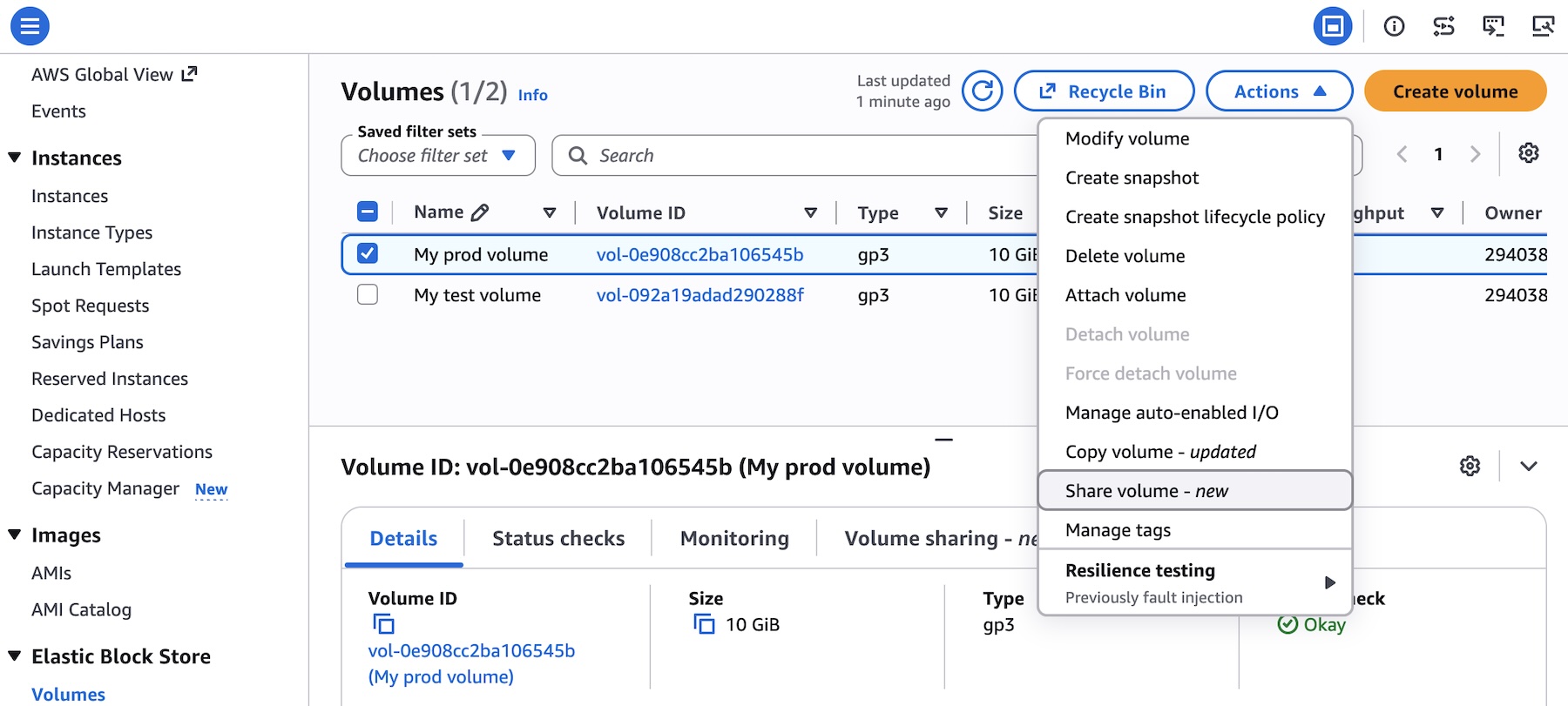
- Initiation: A volume owner navigates to the Amazon EBS console, selects the desired volume, and chooses the Share volume option.
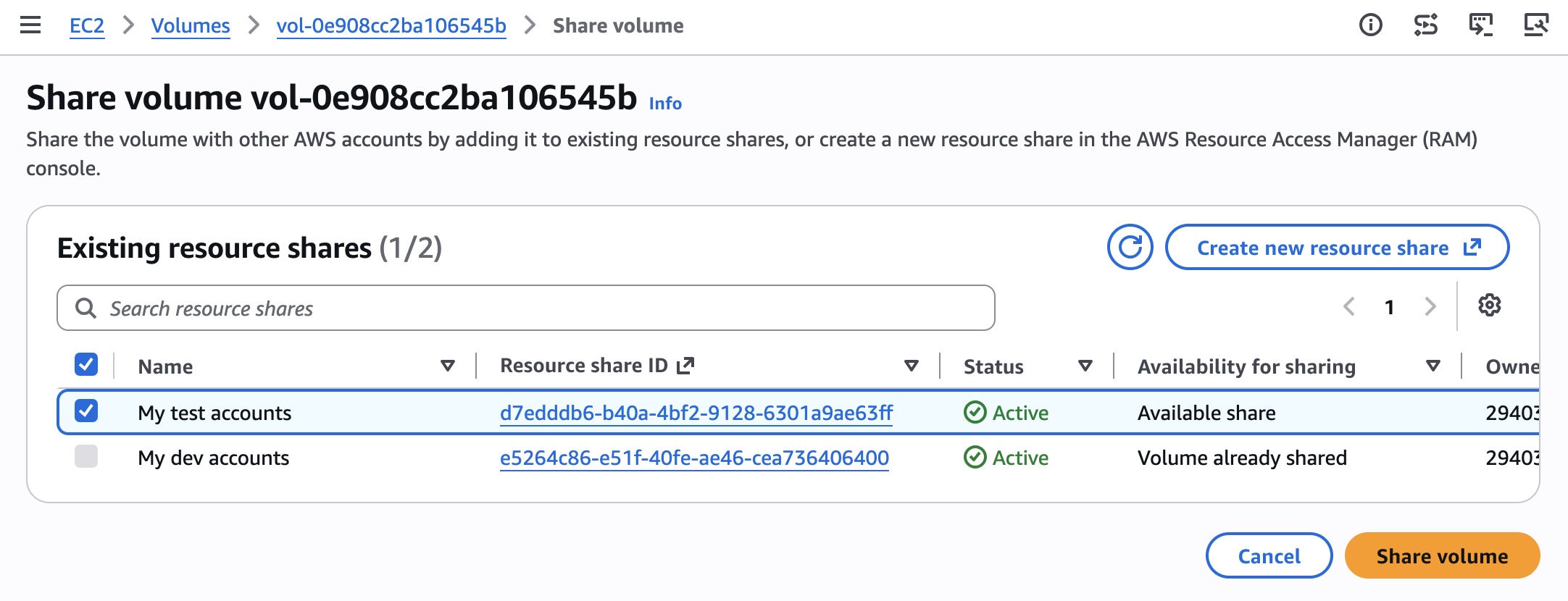
- Resource Sharing: Using AWS RAM, the owner shares the volume with specific AWS accounts or an entire AWS Organization.
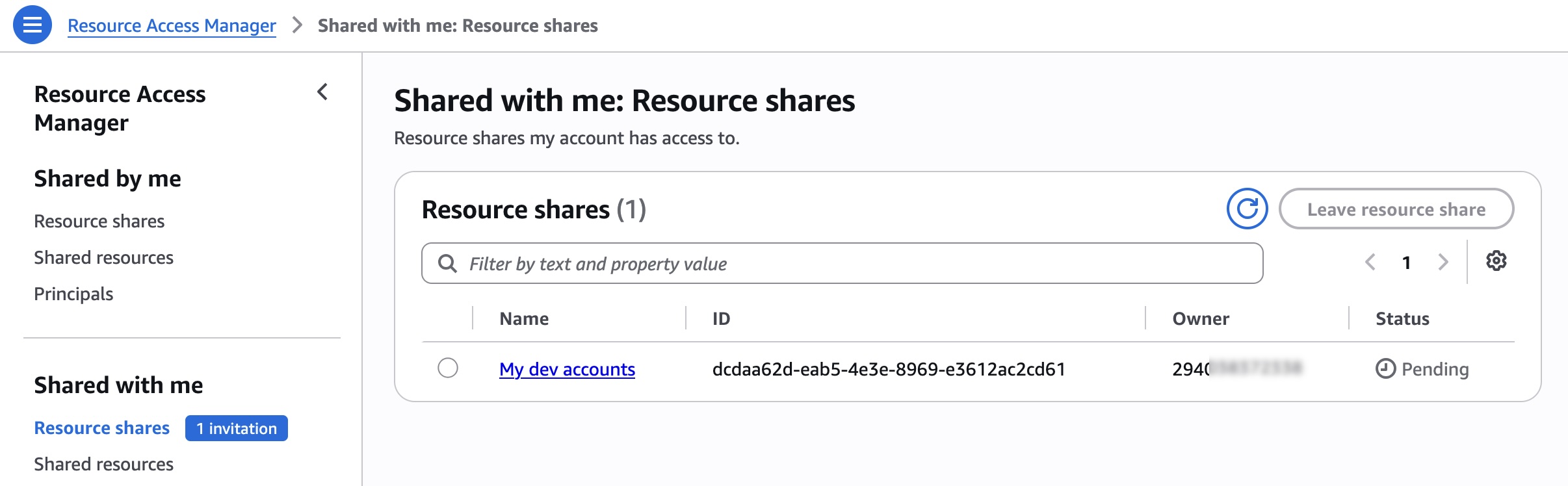
- Acceptance: The target account administrator logs into the RAM console, reviews the resource share, and accepts it.
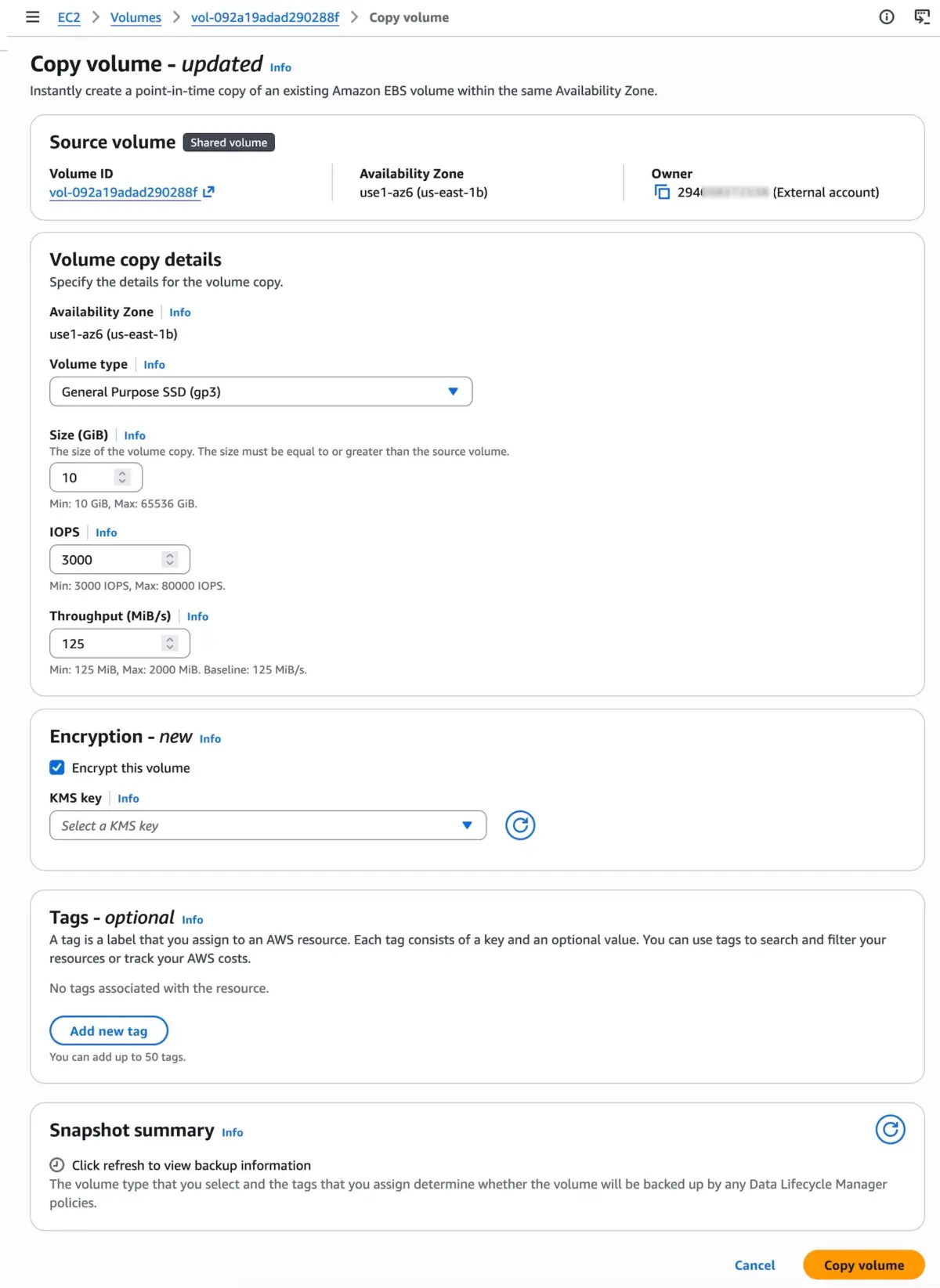
- Cloning and Re-encryption: Once accepted, the volume appears natively in the target account’s EBS console. The target user can then initiate a copy operation, optionally applying a local AWS KMS key to re-encrypt the volume, ensuring strict adherence to internal compliance policies.
Supporting Context & Metrics: The Multi-Account Paradigm and Developer Velocity
To understand why cross-account EBS volume clones matter, one must examine the modern architectural landscape of enterprise IT. Modern cloud governance frameworks heavily advocate for multi-account strategies. According to AWS architectural best practices, organizations should isolate workloads, environments, and business units into separate AWS accounts. This ensures robust security blast radiuses, simplified billing attribution, and granular access control via AWS Identity and Access Management (IAM).
The Bottleneck of Data Refresh Cycles
Despite its security benefits, a multi-account architecture introduces unique operational hurdles—specifically regarding data synchronization. Development and QA teams frequently require production-like datasets to accurately test software releases, execute database migrations, or run security vulnerability scans.
Historically, satisfying this requirement meant choosing between two imperfect paths:
- Synthetic Data Generation: Using scripts or tools to generate dummy data. While safe, synthetic data often fails to capture the edge cases, anomalies, and structural complexities of real-world production traffic, leading to bugs slipping past QA.
- Manual Snapshot Sharing: Copying production snapshots across accounts. While accurate, this process introduces storage overhead, incurs cross-region or cross-account data transfer costs, and suffers from latency penalties during volume initialization.
Unleashing Developer Velocity
By enabling instant, cross-account volume cloning, AWS directly addresses this friction. Because the underlying cloning mechanism is metadata-driven and instantaneous, developers can spin up exact replicas of multi-terabyte production databases in secondary accounts within seconds rather than hours.
Furthermore, this capability empowers specialized teams—such as data science groups or security auditing squads—to pull live data into isolated sandbox accounts. They can experiment, train machine learning models, or perform forensic analyses on realistic datasets without risking interference with live customer-facing workloads. The inclusion of target-account AWS KMS re-encryption ensures that even if production data is highly sensitive (containing Personally Identifiable Information, for instance), the secondary environment can comply with distinct regional or departmental encryption mandates effortlessly.
Technical Implementation and Programmatic Workflows
Executing cross-account volume clones requires a coordinated interaction between the source account owner and the target account administrator. AWS has streamlined this process through both the graphical user interface (Management Console) and programmatic interfaces.
Step-by-Step Execution via the Console
- Configuring the Source: In the Amazon EC2 and EBS console of the source account, the administrator selects the target volume and clicks Share volume.
- Integrating with AWS RAM: The console directs the user to AWS RAM, where the volume can be bundled into an existing resource share or a new one. Permissions are explicitly mapped to target AWS account IDs or organizational units.
- Target Account Acceptance: The recipient logs into the AWS RAM console within their respective target account, navigates to Resource shares, and accepts the pending invitation.
- Execution: The shared volume now populates within the target account’s EBS console. By selecting Copy volume, the target user initiates the creation of an independent clone, complete with options for specifying custom performance tiers (such as io2 Block Express or gp3) and applying destination-specific KMS encryption keys.
Programmatic Management and AI Tooling Integration
For organizations practicing Infrastructure as Code (IaC) or continuous integration/continuous deployment (CI/CD), manual console operations are insufficient. AWS has ensured that cross-account volume sharing and cloning can be fully automated using APIs, AWS Command Line Interface (CLI) scripts, and SDKs.

In a forward-looking addition for modern developers, AWS has highlighted integration with the AWS MCP (Model Context Protocol) Server and associated plugins. Developers utilizing AI-driven coding assistants and integrated development environments (IDEs) can now programmatically query documentation, write automation scripts, and manage complex cross-account EBS sharing workflows using natural language prompts. This lowers the barrier to entry for junior engineers and accelerates the writing of secure, compliant automation scripts.
Official Statements and Industry Implications
While specific executive soundbites from the AWS re:Post community and engineering leads emphasize user-centric design, the overarching industry response highlights a maturation in cloud data management.
Industry analysts point out that as cloud estates grow larger and more intricate, storage services must evolve from passive receptacles of data into active participants in the enterprise lifecycle. An EBS volume is no longer just a virtual hard drive attached to an Amazon EC2 instance; it is a dynamic asset that must flow securely across organizational boundaries.
By introducing granular cryptographic controls alongside cross-account sharing, AWS is addressing the dual mandate of modern enterprise IT: agility and governance. Development teams get the agility they need to move fast and test thoroughly, while Chief Information Security Officers (CISOs) retain strict governance over how data crosses account boundaries and how it is encrypted at rest.
Future Outlook: What This Means for the Future of Cloud Architecture
The release of cross-account Amazon EBS Volume Clones is a clear indicator of where cloud storage architecture is heading. We can anticipate several subsequent developments in the near future:
- Deeper Automation and Policy-Based Sharing: Future iterations may introduce automated policy engines where production environments automatically clone and push sanitized data subsets to testing accounts on a recurring schedule (e.g., every weekend) without human intervention.
- Cross-Region Expansion: While current volume clones operate within specific performance and availability parameters, extending these instant cloning mechanisms across disparate geographic regions remains a highly anticipated capability for global enterprises managing multi-region disaster recovery strategies.
- Enhanced Data Masking Integration: As data privacy regulations (such as GDPR, HIPAA, and CCPA) become more stringent, the ability to clone volumes across accounts may soon intersect more natively with automated data masking and anonymization services during the copy process.
Conclusion
Amazon Web Services has once again redefined the baseline for cloud storage utility. By marrying the speed and efficiency of EBS Volume Clones with the multi-account security framework of AWS RAM and KMS, AWS has removed a persistent operational roadblock for development and operations teams worldwide. As organizations continue to scale their cloud footprints, capabilities like cross-account volume cloning will transition from nice-to-have features to foundational pillars of efficient, secure, and agile enterprise software engineering.