Executive Overview
Few artistic creations in the history of print media have captured the volatile, unbridled imagination of youth quite like Calvin and Hobbes. Created by Bill Watterson, the strip chronicled the surreal, philosophical, and frequently chaotic adventures of a six-year-old boy named Calvin and his sardonic, sentient stuffed tiger, Hobbes. From its humble origins in just 35 newspapers on November 18, 1985, to its explosive syndication across more than 2,000 papers globally, the comic strip became a defining cultural touchstone of the late 20th century.
Yet, what cements Calvin and Hobbes in the upper echelons of literary and artistic history is not merely its meteoric rise, but its unprecedented conclusion. On December 31, 1995—at the absolute zenith of its commercial viability and cultural saturation—Bill Watterson walked away. While contemporaries like Charles Schulz’s Peanuts ran for decades until health forced their conclusion, and other legendary strips were endlessly handed off to ghostwriters and legacy syndicates, Watterson chose artistic integrity over perpetuity.
Decades after its final panel was drawn, the cultural footprint of Calvin and Hobbes remains remarkably intact. By refusing to stretch his creation into creative bankruptcy, Watterson preserved the magic of his characters. This retrospective examines the trajectory of the strip, the philosophy behind Watterson’s decision to leave the party early, and the masterclass in pacing and closure that culminated in one of the most poignant final panels in the history of visual storytelling.
Detailed Chronology: From Tuna Sandwiches to the Snowy Unknown
The journey of Calvin and Hobbes began long before its first publication date, rooted in Bill Watterson’s years as a struggling cartoonist navigating rejections from syndicates that failed to recognize his unique voice. Eventually, the Universal Press Syndicate saw potential in Watterson’s distinctive art style and sharp, socio-philosophical writing. On November 18, 1985, readers opened their morning papers to a fateful introduction.
The Inception: November 18, 1985
In the opening panel of the very first strip, a young Calvin, outfitted in an oversized safari helmet, turns to his father with an air of absolute mischief.
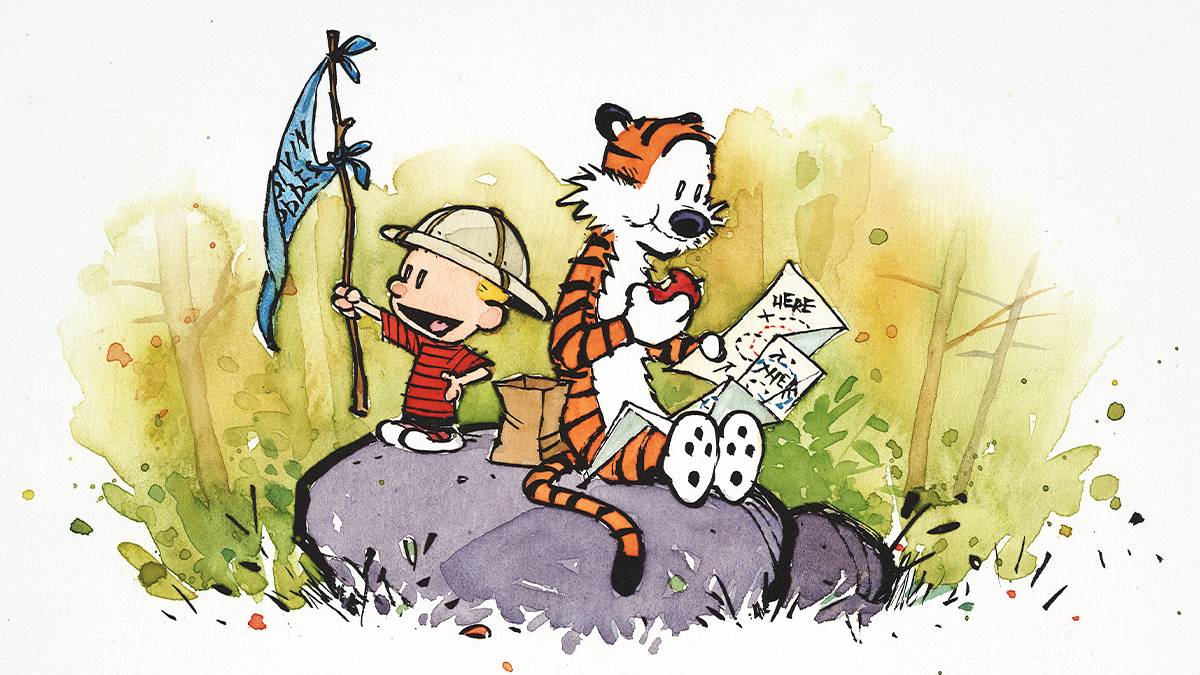
"So long, pop! I’m off to check my tiger trap!"
Calvin explains to his bewildered father that he has baited the trap with a foolproof device: a tuna fish sandwich, a delicacy no self-respecting tiger could ever resist. In the final panel, readers are introduced to Hobbes for the very first time—hanging upside down from a tree branch, completely unbothered, contentedly munching on the sandwich.
This inaugural strip established the dynamic that would fuel the comic for a decade: a blend of childlike overconfidence, parental exasperation, and the magical realism that allowed a stuffed animal to double as a razor-witted philosophical foil.
The Expansion and Golden Decade
Within a year of its debut, the strip’s subscriber count exploded from 35 newspapers to over 250. By the height of its syndication, it was printed in upwards of 2,000 newspapers worldwide. For ten years, Watterson maintained a grueling creative schedule, producing daily and Sunday strips entirely by hand. He notoriously fought with newspaper editors over the sizing and layout of his Sunday comics, eventually securing creative freedom that allowed him to experiment with panel grids, watercolors, and narrative pacing.
Despite having the infrastructure, demand, and cultural capital to continue running for another generation, Watterson grew increasingly weary of the commercial pressures of the syndication machine. He resisted the merchandising juggernaut that consumed other properties of the era—refusing to license Calvin and Hobbes for plush toys, lunchboxes, or television specials.
The Grand Finale: December 31, 1995
On the final day of 1995, Watterson published his last strip. Eschewing a traditional comedic punchline, he chose a cinematic, contemplative sequence. Calvin and Hobbes step out into a pristine winter landscape after a heavy snowfall. The strip features vast expanses of uninterrupted white space, evoking a sense of clean beginnings.
As the duo prepares for a day of sledding, Hobbes notes how the world looks brand-new. Calvin, recognizing the significance of New Year’s Eve, declares it a fresh start. In a quiet, fourth-wall-breaking moment, Hobbes remarks that it feels like having a blank sheet of paper to draw on. With a final, resonant line—"A day full of possibilities. It’s a magical world, Hobbes, ol’ buddy… Let’s go exploring!"—the pair launches down a snowy hill into the white unknown, vanishing from the page forever.
Supporting Context & Metrics: The Anatomy of a Cultural Phenomenon
To fully appreciate the magnitude of Calvin and Hobbes, one must analyze the landscape of the comic strip industry during the 1980s and 1990s. Long-form continuity and legacy syndication were the undisputed industry standards.
| Metric / Milestone | Calvin and Hobbes | Comparative Industry Standard (Peanuts) |
|---|---|---|
| Active Run Duration | 10 Years (1985–1995) | 50 Years (1950–2000) |
| Peak Newspaper Reach | Over 2,000 papers | Over 2,600 papers |
| Creative Continuity | Exclusively Bill Watterson | Handled by assistants/syndicates later (in various legacy strips) |
| Merchandising Volume | Zero official character merchandise | Massive global licensing empire |
| Format Innovation | Pioneered flexible Sunday layout rights | Traditional grid layouts for decades |
The table above illustrates the stark contrast between Watterson’s business model and the traditional newspaper syndicate model. While properties like Peanuts, Blondie, and Nancy became multi-generational institutions that outlived or were sustained long past their creators’ peak creative periods, Watterson treated Calvin and Hobbes as a finite, personal artistic statement.
Furthermore, the absence of commercial merchandise played a counter-intuitive role in preserving the strip’s dignity. While bootleg decals of Calvin urinating on various corporate logos littered the bumpers of trucks throughout the 1990s and 2000s—a practice Watterson openly despised—the lack of corporate dilution ensured that the characters never lost their literary integrity. The only official commercial extensions were the pristine paperback and hardcover collected editions published by Andrews McMeel Publishing, which continue to sell millions of copies to successive generations of readers.
Official Statements & Reflections: Why Watterson Walked Away
In the years following the conclusion of the strip, Bill Watterson became famously reclusive, granting very few interviews. However, in a rare 2010 interview with the Cleveland newspaper The Plain Dealer, he offered deep insight into his decision to terminate the strip at the ten-year mark:
"By the end of 10 years, I’d said pretty much everything I had come there to say," Watterson explained. "It’s always better to leave the party early. If I had rolled along with the strip’s popularity and repeated myself for another five, 10, or 20 years, the people now ‘grieving’ for Calvin and Hobbes would be wishing me dead and cursing newspapers for running tedious, ancient strips like mine instead of acquiring fresher, livelier talent. And I’d be agreeing with them."
Watterson’s foresight highlighted a profound awareness of artistic decay. Rather than succumbing to creative exhaustion—a trap that swallowed many pioneering cartoonists who felt tethered to their daily deadlines—he chose self-imposed retirement at the peak of his powers.
"I think some of the reason Calvin and Hobbes still finds an audience today is because I chose not to run the wheels off it," Watterson noted. "I’ve never regretted stopping when I did."
This perspective resonates deeply across modern entertainment media. Whether applied to television showrunners who stretch a narrative across unnecessary seasons or comic book publishers who reboot franchises ad nauseam, Watterson’s philosophy remains a gold standard for creative closure: knowing when the story has reached its natural conclusion is just as important as knowing how to begin it.

Future Outlook: The Enduring Legacy of the Blank Page
More than three decades after the final panel was inked, the cultural footprint of Calvin and Hobbes shows no signs of fading. In an era dominated by digital content, algorithmic feeds, and rapid-fire media consumption, the tactile, contemplative nature of Watterson’s work offers a comforting counterweight.
Libraries continue to report high circulation numbers for the collected volumes. Parents who grew up reading the adventures of the precocious six-year-old and his stuffed tiger eagerly pass their dog-eared paperbacks down to their children. The strip has transcended its origins as a daily newspaper feature to become a timeless piece of American literature, taught and analyzed for its deep philosophical underpinnings, its commentary on environmentalism and suburban life, and its mastery of watercolor illustration.
Moreover, the ending of the strip continues to serve as a masterclass in narrative design. By choosing an open-ended conclusion rather than a definitive closure (such as Calvin growing up or moving away), Watterson invited the reader to participate in the narrative’s eternal continuation. Calvin and Hobbes are not frozen in a museum exhibit; they are perpetually sliding down a snowy hill, forever racing toward a new horizon of imagination.
As we look back at the legacy sparked on November 18, 1985, Bill Watterson’s greatest gift to his readers was not just the decade of laughter he provided, but the enduring reminder left in those final panels: the world is a vast, magical wilderness, and the blank page of the future is always waiting for us to go exploring.