Executive Overview
As the crisp autumn air settles over New York City, bringing with it the familiar cadence of a bustling metropolis returning to full operational velocity, the enterprise technology landscape is experiencing a parallel surge of momentum. Mid-September has historically served as a critical inflection point for technological rollouts, and Amazon Web Services (AWS) is proving no exception to this tradition. This week’s launch calendar underscores a pivotal shift in how organizations leverage artificial intelligence, moving past experimental implementations into deeply integrated, mission-critical workflows.
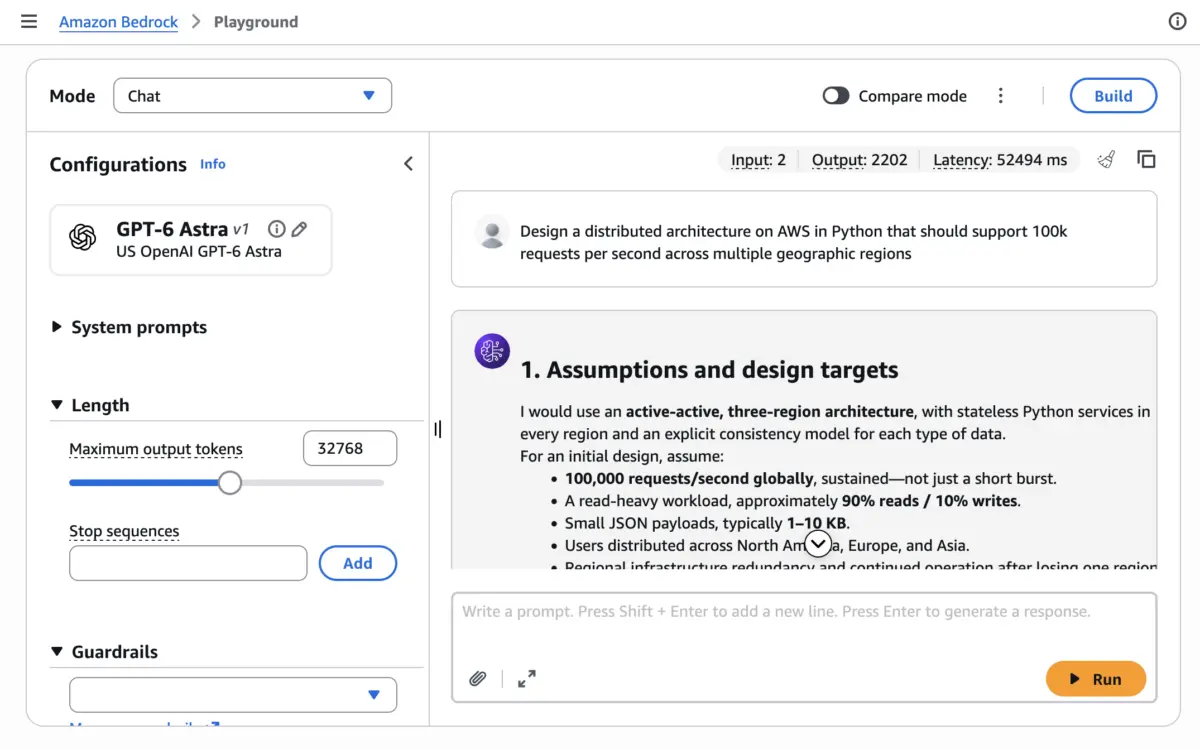
The centerpiece of this week’s announcements is the general availability of OpenAI GPT-6 Astra on Amazon Bedrock. Representing OpenAI’s most advanced foundational model to date, GPT-6 Astra brings unprecedented reasoning capabilities, professional-grade creative and technical output, and native computer-and-browser interaction models directly to AWS enterprise customers. Paired with a massive 1-million-token context window, robust security controls, and enterprise governance frameworks, this integration bridges the gap between frontier AI capability and corporate compliance.
Beyond the headline-grabbing arrival of GPT-6 Astra, the AWS ecosystem continues to expand horizontally and vertically. From streamlined desktop applications designed to boost developer velocity to evolving paradigms in how engineering teams collaborate with AI agents, the message from AWS is clear: the organizations realizing the greatest returns on their AI investments are not merely adopting superior tools—they are fundamentally restructuring their operational workflows.
Detailed Chronology of the Week’s Launches
The cadence of AWS updates this September reflects a deliberate strategy to address both macroeconomic enterprise needs and the micro-level friction points experienced by daily developers. Below is the chronological breakdown of the major developments shaping the cloud and AI sectors this week.
1. The Arrival of OpenAI GPT-6 Astra on Amazon Bedrock
The defining technological milestone of the week occurred with the official deployment of OpenAI GPT-6 Astra onto Amazon Bedrock. For months, enterprise architects have sought a seamless bridge between OpenAI’s cutting-edge reasoning engines and the stringent security, data privacy, and scalability parameters of enterprise cloud environments.
GPT-6 Astra directly addresses these requirements by introducing several breakthrough capabilities:
- Advanced Reasoning and Judgment: Designed to parse complex, multi-variable business problems, the model exhibits significantly reduced hallucination rates and enhanced logical consistency compared to its predecessors.
- Professional-Quality Generation: Whether synthesizing intricate legal contracts, authoring production-grade software architectures, or generating comprehensive enterprise design documents, the model operates at a professional standard.
- Native Computer and Browser Use: Astra can dynamically interact with web interfaces and software applications, executing complex, multi-step digital workflows autonomously.
- Massive Context Window: Supporting up to 1 million input tokens, the model can ingest entire legacy codebases, extensive multi-year financial portfolios, or vast libraries of regulatory documentation in a single prompt, allowing for holistic analysis and cross-document reconciliation.
2. Integration and Enterprise Ecosystem Extensions
To maximize the utility of GPT-6 Astra within existing corporate infrastructures, AWS and OpenAI have rolled out complementary integration pathways. Developers and administrators can invoke the model directly through supported Amazon Bedrock APIs, ensuring native compatibility with existing AWS Lambda functions, Amazon SageMaker pipelines, and custom application backends.
Simultaneously, OpenAI has introduced specialized enterprise plugins for ChatGPT Work and Codex. These plugins extend Astra’s advanced browser-use capabilities across standard enterprise software suites, allowing teams to automate data entry, report generation, and cross-platform synchronization securely. Crucially, AWS has reinforced its commitment to data privacy: inference data processed through Amazon Bedrock is strictly walled off and is never utilized to train underlying foundational models.
3. Developer Experience and Operational Velocity
In tandem with the Bedrock announcement, AWS has accelerated its push toward streamlined developer tooling. Mid-September releases highlight a growing emphasis on minimizing context switching for engineers. New desktop application integrations for Amazon Quick are rolling out to provide developers with instant access to documentation, resource monitoring, and deployment pipelines without requiring them to leave their local integrated development environments (IDEs).
Supporting Context & Metrics: The Economics of Enterprise AI
To fully contextualize the significance of OpenAI GPT-6 Astra on Amazon Bedrock, one must examine the broader economic and architectural shifts currently taking place within global enterprise IT budgets.
The Scale of the Context Window Revolution
For years, the token limitations of large language models acted as a severe bottleneck for enterprise adoption. Analyzing a 500-page regulatory compliance document alongside a 200,000-line software repository required complex Retrieval-Augmented Generation (RAG) architectures, vector databases, and multi-step chunking strategies.
With GPT-6 Astra’s 1-million-token context window, the architectural overhead required for massive document processing drops precipitously. Enterprise metrics indicate that native long-context models reduce data-retrieval latency by up to 65% in legal and financial compliance workflows, as the model maintains global awareness of an entire project’s state rather than relying on fragmented semantic search results.
+-----------------------------------------------------------------+
|                   Amazon Bedrock Architecture                   |
|                                                                 |
|  +--------------------------+     +--------------------------+  |
|  |     Enterprise Client    |     |  AWS Security & Controls |  |
|  | (API / ChatGPT Work/IDE) | --> | (IAM, CloudTrail, VPC)   |  |
|  +--------------------------+     +--------------------------+  |
|                 |                               |               |
|                 v                               v               |
|  +-----------------------------------------------------------+  |
|  |                  Amazon Bedrock Managed Plane             |  |
|  |       [ OpenAI GPT-6 Astra Model Inference Engine ]       |  |
|  |      (1M Token Context Window / Zero-Data Retention)      |  |
|  +-----------------------------------------------------------+  |
+-----------------------------------------------------------------+
Security, Governance, and Auditability
Security remains the primary gating factor for executive-level cloud adoption. AWS has positioned Amazon Bedrock as the gold standard for secure generative AI deployment by integrating foundational models directly into the core AWS governance framework:
- Identity and Access Management (IAM): Granular permission controls dictate precisely which users, roles, or microservices can invoke specific model endpoints.
- Audit Logging: AWS CloudTrail captures comprehensive invocation metrics, ensuring full compliance with corporate governance and regulatory mandates (such as GDPR, HIPAA, and SOC 2).
- Zero Data Retention: Enterprise payloads remain entirely within the customer’s virtual private cloud (VPC) boundary, satisfying the strict data residency requirements of financial institutions, healthcare providers, and government agencies.
Official Statements and Industry Perspectives
The convergence of OpenAI’s premier foundational model with AWS’s enterprise-grade infrastructure has elicited strong reactions from industry leaders, highlighting the transformative potential of this partnership.
"We are witnessing a structural evolution in how enterprises build software and process information," noted a senior AWS product lead during this week’s briefing. "By bringing OpenAI GPT-6 Astra to Amazon Bedrock, we are empowering developers and enterprise architects with a tool that transcends simple text generation. We are delivering an autonomous reasoning engine backed by the enterprise security, governance, and scalability that only AWS can provide."
Industry analysts have similarly echoed these sentiments, pointing out that the availability of high-capacity models via managed cloud services democratizes advanced artificial intelligence.
"The competitive advantage in enterprise AI no longer belongs solely to organizations with the capital to train proprietary models from scratch," states a prominent cloud infrastructure analyst. "It belongs to enterprises that can securely integrate frontier models like GPT-6 Astra into their existing data silos with minimal friction. The AWS and OpenAI integration on Bedrock is a masterclass in reducing that friction."
Furthermore, early enterprise adopters participating in the private preview of GPT-6 Astra on Bedrock reported significant gains in engineering efficiency. Software development leads noted that the model’s ability to reason across entire codebases simultaneously allowed teams to refactor legacy monolithic applications into microservices in a fraction of the historical timeline.

Future Outlook: The Next Frontier of AI-Driven Enterprise
As we look toward the remainder of the autumn launch season and the horizon of AWS re:Invent, the roadmap for cloud-based artificial intelligence is coming into sharper focus. The integration of OpenAI GPT-6 Astra on Amazon Bedrock marks the closure of the early experimental phase of generative AI and the opening of the operational maturity phase.
1. Autonomous Multi-Agent Workflows
The next 12 to 18 months will likely see a massive acceleration in multi-agent orchestration. With Astra’s advanced computer-use and browser-interaction capabilities, enterprises are moving past human-in-the-loop chat interfaces toward autonomous agent swarms. These systems will be capable of monitoring system health, diagnosing production anomalies, writing patches, testing them in sandboxed AWS environments, and deploying updates with minimal human oversight—all while adhering to strict governance boundaries enforced by AWS IAM.
2. Hyper-Personalization and Real-Time Reasoning
As context windows expand further and inference latency continues to drop, the line between static application logic and dynamic AI reasoning will blur. Applications built on AWS will no longer simply retrieve data; they will synthesize, reason, and adapt to user behavior in real time, transforming customer service, supply chain logistics, and software engineering.
3. Developer Workflow Redesign
As Micah noted in this week’s AWS Weekly Roundup, the developers reaping the greatest rewards from AI agents are those who are "working differently." The transition is no longer about writing faster code with autocomplete tools; it is about architectural supervision. Engineers are evolving from line-by-line coders into high-level system architects who manage fleets of autonomous AI agents.
Conclusion
The arrival of OpenAI GPT-6 Astra on Amazon Bedrock serves as a watershed moment for the cloud computing industry this September. By combining OpenAI’s most capable reasoning engine with the unmatched security, scalability, and governance of AWS, enterprises are equipped to tackle their most ambitious technological challenges.
As the AWS launch calendar continues to unfold through the autumn months, builders, architects, and enterprise leaders are encouraged to explore the AWS Builder Center, participate in upcoming community events, and leverage Amazon Bedrock to drive their next wave of innovation.
Check back next week for another comprehensive Weekly Roundup covering the latest news, announcements, and architectural insights from the world of AWS.