Executive Overview
When ServiceTitan abruptly cut off its integration with Podium after a nine-year partnership—leaving roughly 1,000 shared contractor accounts caught in the middle—most technology media framed the incident as a messy, high-profile corporate breakup. It was widely analyzed as a cautionary tale of platform consolidation and ecosystem politics.
However, looking at the episode solely through the lens of vendor drama misses the larger architectural and economic reality. The ServiceTitan-Podium split serves as an extraordinary real-world case study testing the limits of what a "System of Record" can and cannot achieve for a modern enterprise in the age of artificial intelligence.
By delisting a partner with $100 million in AI agent Annual Recurring Revenue (ARR), abruptly severing 1,000 shared accounts, and retaining virtually all of those customers, ServiceTitan proved the ultimate defensive power of holding the record. The contractors stayed because their jobs, invoices, customer histories, and technician schedules live securely within ServiceTitan. Podium, for all its utility, was the removable component.
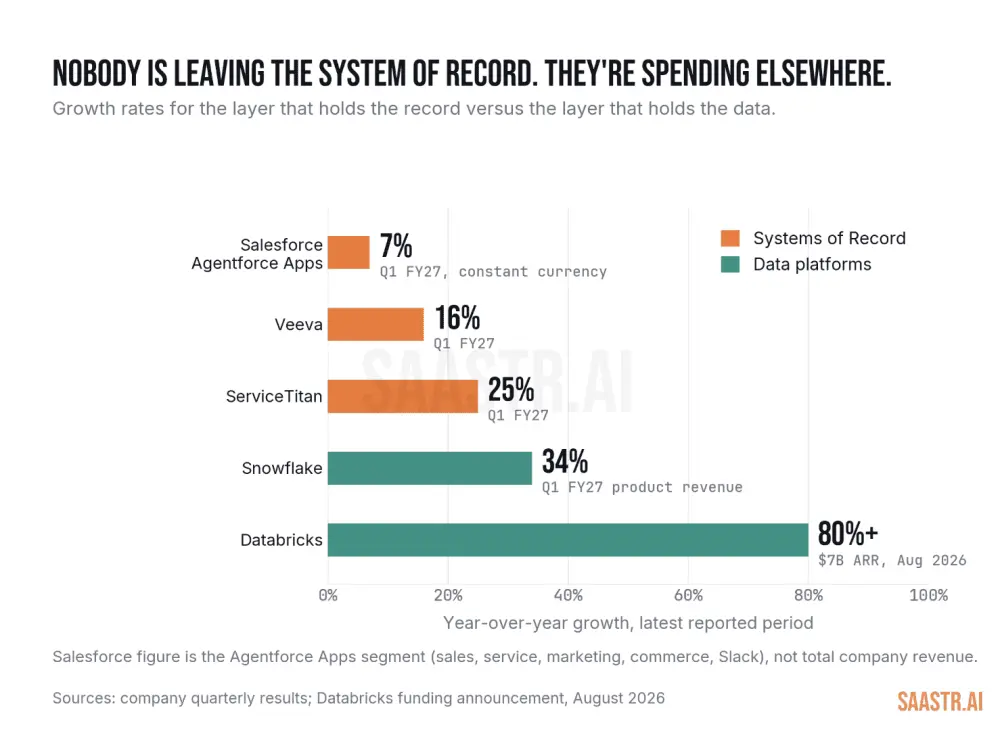
Yet, this defensive fortress tells only half the story. While owning the record guarantees high retention, pricing power, and net revenue retention (NRR) above 110%, it does not automatically translate into hyper-growth. ServiceTitan reported a healthy 25% growth rate last quarter—an impressive benchmark for a vertical System of Record, but starkly eclipsed by infrastructure and data layers like Snowflake (growing product revenue by 34% with a 126% NRR) and Databricks (crossing $7 billion in ARR while growing at over 80%).
As artificial intelligence agents and automated data lakes redefine enterprise architecture, the gap between retention assets and growth engines is widening. This investigation examines why being the System of Record is no longer enough to drive exponential growth, how legacy pricing and API models are buckling under agentic workloads, and why the tech industry is bracing for a profound unbundling of data storage and system control.
Detailed Chronology: The Anatomy of the Podium-ServiceTitan Split
To understand the mechanics of modern platform leverage, one must examine how the ServiceTitan-Podium friction escalated from routine partnership tension into a hard boundary.
For nearly a decade, the relationship was symbiotic. Podium provided localized messaging, webchat, and customer interaction tools, plugging seamlessly into ServiceTitan’s dominant operating system for home service contractors. But as both companies matured—and as Podium aggressively scaled its AI agent capabilities, hitting $100M in AI agent ARR—the lines of demarcation blurred. Podium’s autonomous features began encroaching on workflows that ServiceTitan viewed as core to its own long-term roadmap.
ServiceTitan’s response was swift and systemic. Rather than negotiating a middle ground, the company leveraged its structural position. Its Marketplace policy, solidified in mid-2026, draws a sharp line in the sand: competitive partners are welcome only if they do not use the partnership and its associated support infrastructure to gradually displace core ServiceTitan modules. Complementary API terms further restrict automated systems, barring external AI platforms from independently choosing endpoints or operating outside a predefined, certified scope.
When Podium crossed that perimeter, ServiceTitan pulled the plug on 1,000 shared accounts. The outcome was a masterclass in platform gravity. Contractors did not defect to competitors; they adapted. Why? Because ripping out ServiceTitan means rebuilding an entire operational nervous system—invoices, dispatch boards, customer databases, and historical job logs. Podium, by contrast, was an application layer built on top of that nervous system.
The move demonstrated the supreme defensive leverage of the System of Record. But it also laid bare a strategic asymmetry: cutting off Podium did not inject a single dollar of new top-line revenue into ServiceTitan. It merely defended existing turf. Retention is the floor, not the engine.
Supporting Context & Metrics: The Divergence of Record and Growth Layers
Across the broader software ecosystem, the bifurcation between the System of Record and the data/intelligence layer is becoming impossible to ignore. A side-by-side analysis of enterprise earnings reveals a striking divergence in growth vectors.
Salesforce: The Microcosm of Two Speeds
Consider Salesforce, one of the foundational Systems of Record in B2B software. In its fiscal Q1 earnings, Salesforce reported total revenue of $11.13 billion, up 13% (or roughly 8–9% organic growth when stripping out acquisitions like Informatica).
More revealing is how the company segments its performance. Its traditional application layer—comprising Agentforce Apps (sales, service, marketing, commerce) and Slack—generated $6.91 billion, growing at a modest 7% year-over-year in constant currency. Meanwhile, its data-centric initiatives (Data 360, Headless Platforms, and adjacent services) surged significantly faster. The record layer grew in the single digits; the data and integration layers expanded at a multiple of that rate.
Similarly, Veeva, widely regarded as one of the most deeply entrenched Systems of Record in the life sciences sector, posted a steady 16% growth rate last quarter while simultaneously orchestrating complex CRM migrations for its client base. Retention is holding firm, and customer attrition is low, but the core application layer is settling into a predictable, mature growth curve.
The Contrast with Data Infrastructure
Now look at the layer immediately underneath. Snowflake reported product revenue up 34% with a net revenue retention rate of 126%, remaining performance obligations (RPO) up 38%, and a massive base of 779 customers spending over $1 million annually. Databricks shattered expectations by crossing the $7 billion ARR milestone while maintaining an astonishing growth rate exceeding 80%.
The market signal is unmistakable: enterprise customers are not abandoning their Systems of Record—the switching costs remain prohibitively high—but they are routing their incremental technology dollars elsewhere. They are investing heavily in the data lakes, lakehouses, and agentic platforms where computational work actually happens.
The Economics of Scale: Why Systems of Record Are Too Expensive for AI
To understand why enterprise spending is migrating away from traditional application databases, one must look at raw economics. Systems of Record are structurally optimized for human data entry—a world where data volume is bounded by how fast a human can type, click, or log a customer service ticket.
When data volume is low, exorbitant storage pricing goes largely unnoticed. However, artificial intelligence agents break this economic model entirely.
The Storage Penalty
Consider Salesforce’s standard database pricing structure, where additional data storage commands roughly $125 per month for 500MB. That translates to:
- $250 per GB per month
- $3,000 per GB per year
By contrast, commodity cloud object storage (such as Amazon S3) sits at approximately $5 per GB per month ($60 per GB per year), with specialized analytical data stores offering even cheaper alternatives where 5GB of storage costs under $30 annually.
While enterprise software vendors rightly defend these premiums by pointing to governed access, multi-layered security, granular permissioning, and tightly integrated workflows, this defense collapses under agentic workloads.
The Exhaust of Agentic Workflows
Autonomous AI agents do not sleep, and they do not generate data at human speeds. A single production-grade agentic workload generates massive amounts of operational "exhaust":
- Tool call traces
- Intermediate reasoning loops
- High-dimensional vector embeddings
- Retrieval and context logs
- Scoring runs and multi-step evaluation metrics
- Failed execution attempts and automated retries
In a typical large-scale AI deployment—such as running scoring passes on tens of thousands of customer profiles—a single job can effortlessly write hundreds of thousands, or even millions, of rows. That data must be read, written, and re-read continuously.
When applied to real-world pipelines, the numbers are staggering. Salesforce’s internal metrics reveal that its platform has processed 28.6 trillion tokens (up 152% quarter-over-quarter) and delivered 3.8 billion Agentic Work Units (up 111% quarter-over-quarter), while its Data 360 ingestion engine processed 52 trillion records in a single quarter.
When data movement scales by triple-digit percentages while application-layer revenue grows at just 7%, a profound structural mismatch becomes clear. The database architecture designed for human-driven CRM simply cannot afford to store the operational output of its own native AI.
Official Statements and Strategic Shifts: The Rise of Zero Copy
Faced with the prohibitive costs of traditional database storage and the explosion of agent-generated data, the industry’s heavyweights are quietly executing a radical architectural pivot: they are stopping the data from living in the System of Record altogether.
The most telling metric in enterprise tech is the explosive adoption of Zero Copy architectures.
Out of the 52 trillion records ingested by Salesforce’s Data 360 platform, an astounding 35 trillion records—nearly 70%—arrived via Zero Copy, marking a 277% year-over-year surge. Under a Zero Copy framework, data does not actually move into the CRM. Instead, Salesforce registers external tables residing in Snowflake, Databricks, Google BigQuery, or Amazon Redshift, querying them dynamically in place. The CRM holds only the metadata and query path; the raw bytes remain securely in the customer’s cloud data lakehouse.
This is a profound concession. Salesforce willingly relinquishes storage rent and per-gigabyte pricing margins to preserve something far more valuable: control over the interpretation layer. By acting as the intelligent control plane where data is interpreted and acted upon, Salesforce retains its enterprise relevance without forcing customers to pay exorbitant database fees to house raw analytical exhaust.
A parallel convergence is happening from the opposite direction. Data infrastructure giants like Snowflake are expanding their ambitions upward. Sridhar Ramaswamy, Snowflake’s leadership, has explicitly positioned the company as the control plane for the "Agentic Enterprise"—bolstered by strategic acquisitions designed to govern agent behaviors across complex workflows.
The battle lines are drawn. On one side, storage giants are buying their way toward the record. On the other, Systems of Record are giving up physical data storage to remain the command center.
Future Outlook: Navigating the Post-Record Enterprise
As the software landscape settles into this new equilibrium, both platform providers and third-party application builders face stark strategic choices.
For Systems of Record Vendors
- Recognize the Limits of Moats: Logo retention provides a resilient floor, but it cannot substitute for a consumption- or usage-based growth engine.
- Re-architect Storage Pricing: Legacy per-gigabyte pricing models penalize agentic workflows. Vendors must build cost-effective, tiered storage options natively, or risk watching developers bypass their databases entirely.
- Avoid Over-Perimeter Defense: While protecting core data integrity from predatory partners is necessary, weaponizing API rate limits and draconian terms of service risks alienating developers. If the best AI agents live outside the walled garden, the System of Record risks transforming from a sticky retention tool into a legacy bottleneck that customers actively seek to route around.
For Application and AI Builders
- Decouple Working Data: Never store an AI agent’s working memory, intermediate reasoning traces, or vector embeddings directly inside a traditional System of Record. Read authoritative records from the CRM, write final summary results back via API, and keep high-volume working data in cost-effective environments like Postgres, S3, or modern lakehouses.
- Conduct Rigorous API Due Diligence: Review API terms with the same scrutiny traditionally reserved for security audits. Evaluate rate ceilings, seat-allocation bottlenecks, and vendor policies regarding autonomous AI endpoints.
- Understand Your Layer: If your software’s primary value proposition is holding the record, accept that you are operating in a high-retention, steady-growth enterprise business. If your value is activating data intelligently across disparate systems, you are running a high-velocity consumption business whose ceiling is determined by how efficiently you can process massive streams of information.
Conclusion: The Record Stays, the Rent Changes
Systems of Record are not disappearing. The authoritative, permissioned version of the customer, the contract, the job, and the invoice will continue to reside within their boundaries, and enterprises will continue paying healthy margins for that reliability.
However, the nature of enterprise software has irrevocably shifted. The data generated and consumed by modern AI agents operates at a scale 100 to 1,000 times greater than anything human workers ever produced. The traditional databases powering legacy Systems of Record are simply too expensive to sustain that volume.
The industry is resolving this tension through architectural pragmatism—embracing Zero Copy models, separating intelligence from storage, and forcing platform owners to compete on merit rather than monopolistic lock-in. Retention keeps a vendor in the game. But winning the agentic future requires far more than owning the record: it demands building a platform where customers want to spend, rather than merely one they cannot afford to leave.