Executive Overview
In an era defined by an insatiable hunger for the novel, humanity’s default approach to inspiration resembles a frantic global scavenger hunt. We book flights to distant horizons, enroll in elite innovation workshops, scour digital archives for hidden anomalies, and devour self-help literature detailing how to unlock the "next big idea." We operate under the stubborn assumption that creativity requires virgin territory—that fresh insights can only be mined from untouched landscapes, uncharted markets, or radical paradigm shifts.
Yet, a profound cognitive reorientation occurred in the historic halls of Venice’s Ca’ Pesaro International Gallery of Modern Art this past summer. Confronted by the vibrant, subversive portraiture of contemporary artist Hernan Bas, a seasoned traveler realized a counterintuitive truth: the pursuit of the "new" is frequently a distraction from our profound failure to actually observe the "familiar."
This feature-length investigation explores the intersection of aesthetic perception and cognitive psychology. By examining the mechanics of human vision through the lens of Daniel Kahneman’s dual-process theory—specifically the interplay between rapid heuristic processing (System 1) and deliberative analytical reasoning (System 2)—we dissect how culture shapes our blind spots. Furthermore, we evaluate how contemporary artists, designers, and thought leaders are weaponizing "the second look" to unearth extraordinary value in the mundane, the overlooked, and the seemingly exhausted.
Ultimately, this article posits that true innovation is not an act of radical invention, but an act of radical attention. By transforming how we interrogate our immediate environments, professionals across industries can unlock unprecedented reservoirs of creativity without ever packing a bag.
Detailed Chronology: The Venetian Epiphany
The Arrival: Navigating the Tourist Tableau
The journey began with the familiar sensory overload of high summer in Venice. Stepping off the vaporetto into the dizzying labyrinth of narrow alleyways and sun-drenched canals, the traveler—seeking a restorative jolt of artistic inspiration—initially deployed the defensive psychological armor common to modern tourism.
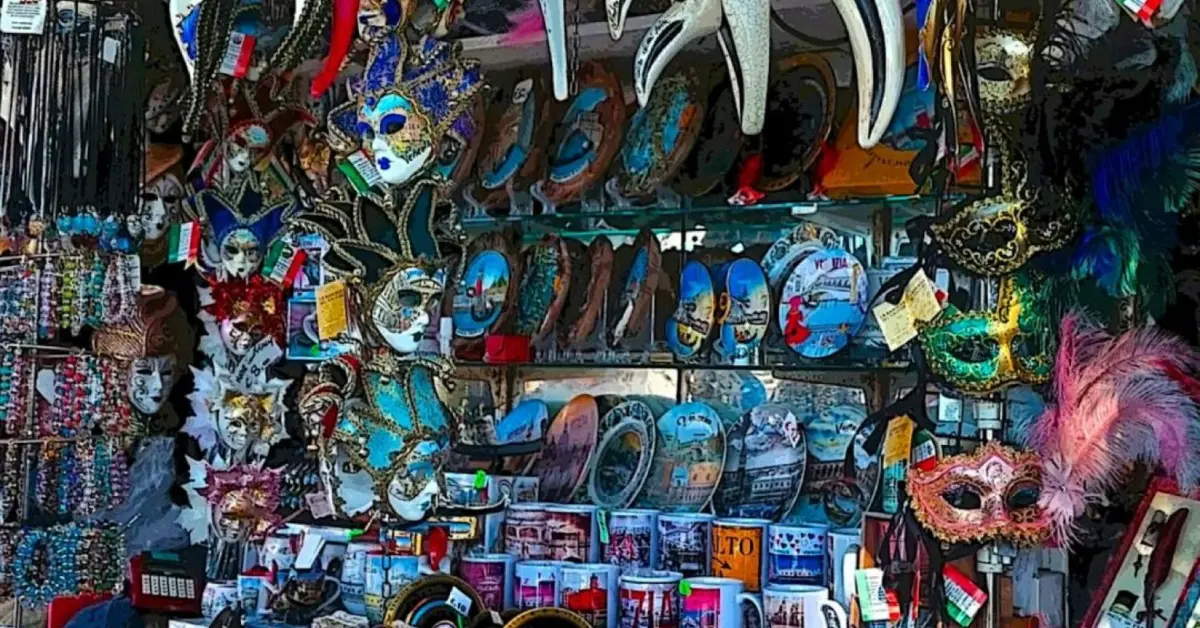
Hurrying past the bustling promenades of San Marco and the cascading displays of the Rialto, the gaze actively edited out the surrounding environment. Rows of gaudy souvenir stalls, stuffed to bursting with cheap plastic gondolas, glowing Venetian masks manufactured in overseas factories, and iridescent plastic trinkets, were instantly cataloged as visual noise. They were classified as commercial clutter, low-brow tourist traps designed to extract capital from the unwary—objects worthy only of active avoidance.
This instinctual dismissal was not born of cynicism alone, but of cognitive self-preservation. Venice in August is a sensory onslaught of noise, heat, and bodies. To survive the velocity of the modern urban experience, the human brain must mercilessly triage incoming data. The souvenir stalls were filed away under the mental heading of insignificant background noise.
The Catalyst: Inside the Ca’ Pesaro
The destination was specific: the Ca’ Pesaro International Gallery of Modern Art, situated majestically along the Grand Canal. The immediate objective was to view a much-anticipated exhibition by the celebrated American artist Hernan Bas, known for his intricate, narrative-driven compositions that often weave together historical references, subcultures, and contemporary youth aesthetics.
Historically, the traveler held a quiet, unexamined prejudice: that portraiture was a spent force. Centuries of oil on canvas, from the Renaissance masters housed throughout Italy to the bourgeois portraiture of the 19th century, suggested that the genre had exhausted its capacity to surprise. How much more could be said about the human face framed against a static background?
Bas shattered this assumption with calculated precision.
Upon entering the galleries, the traveler was met with large-scale canvases depicting contemporary tourists posed amid the very same class of cheap, mass-produced souvenirs that had been briskly ignored mere moments before on the walk to the museum. In Bas’s hyper-detailed, luminous works, plastic gondolas, flashing LED trinkets, and acrylic snow globes were not relegated to the margins as cheap clutter. Instead, they were elevated to central, vibrating subjects of intense aesthetic scrutiny.
The Reversal: A Walking Tour Transformed
The cognitive shift was instantaneous and disorienting. By rendering these discarded objects through the painstaking, deliberate medium of fine art, Bas forced a reckoning. He did not invent a new subject matter; rather, he welded two concepts the observer had independently dismissed as dull—traditional portraiture and tacky tourist souvenirs—and forged an entirely new lens of perception.
Exiting the Ca’ Pesaro and stepping back out into the sun-bleached labyrinth of Venice, the physical environment had fundamentally transformed. The very same souvenir stalls that had registered as visual pollution an hour prior now appeared charged with anthropological significance.
They no longer looked like mere collections of plastic; they appeared as miniature, open-air museums documenting human desire, aspiration, and cultural exchange. Those cheap trinkets stood as tangible proxies for complex psychological constructs: identity, place, memory, and nostalgia. What was once invisible became irresistible to explore. The city had not changed; the observer’s cognitive aperture had widened.
Supporting Context & Metrics: The Cognitive Architecture of Seeing
To understand why this Venetian epiphany occurred, we must step out of the art gallery and into the behavioral laboratory. Human beings do not experience reality as an objective, unfiltered stream of high-definition data. Instead, perception is an active, highly mediated construction engineered by millions of years of evolutionary pressure.
The Mechanics of Visual Triage
Human sensory organs are bombarded with roughly 11 million bits of information per second. However, conscious awareness can only process approximately 40 to 50 bits per second. To bridge this staggering operational chasm, the human brain functions as an aggressive reduction engine. It discards, distorts, and generalizes data before it ever reaches conscious awareness.
This process is governed by what Nobel laureate Daniel Kahneman and the late Amos Tversky categorized as System 1 and System 2 thinking.
| Cognitive System | Processing Speed | Energy Consumption | Primary Function | Vulnerability |
|---|---|---|---|---|
| System 1 | Fast, automatic, subconscious | Low | Heuristic sorting, pattern recognition, immediate survival responses | Cognitive biases, stereotyping, surface-level judgments, inattentional blindness |
| System 2 | Slow, deliberate, conscious | High | Complex problem-solving, deep analysis, logical deduction, metacognition | Mental fatigue, burnout, decision paralysis |
System 1: The Evolutionary Gatekeeper
System 1 is our default operational state. It is fast, intuitive, and operates without voluntary control. When walking through a bustling tourist market, System 1 instantly scans the horizon, categorizes a rack of plastic trinkets as "cheap souvenirs," and files them away under "ignore."
This is not a moral failing or a sign of intellectual laziness; it is a vital evolutionary adaptation. If our ancestors had stopped to deeply analyze every rustle in the bushes with System 2 deliberation, they would have been consumed by predators. System 1 keeps us moving, functioning, and safe from cognitive overload.
However, the evolutionary cost of System 1 efficiency is profound: inattentional blindness. By rushing to judgment to save cognitive energy, we blind ourselves to nuance, subtext, and latent value. We see what we expect to see based on past conditioning, rather than what is actually present in front of us.
System 2: The Deliberative Interruption
System 2 allocates attention to effortful mental operations that demand focus, including complex computations, moral evaluations, and—crucially—aesthetic breakthroughs. System 2 is activated when an individual experiences cognitive dissonance: a moment where reality actively contradicts the predictive models of System 1.
Hernan Bas’s artwork acted as a high-voltage jolt to System 2. By taking objects automatically categorized as "worthless" by System 1 and presenting them within the elevated cultural context of an international art gallery, Bas forced the viewer’s brain to re-evaluate its baseline assumptions.
This psychological friction is the fertile soil from which true creativity sprouts. As cognitive psychologists note, the first look provides an answer (a heuristic judgment designed to save time), while the second look provides a question (an invitation to inquiry).
Future Outlook: Operationalizing the "Second Look" Across Industries
If the genesis of creative breakthroughs lies in the friction between our automatic first impressions and our deliberate second glances, how can organizations, innovators, and knowledge workers systematically harness this phenomenon without needing a ticket to Venice?
1. Disrupting Corporate Heuristics
In modern business environments, System 1 thinking is often institutionalized under the guise of "industry best practices" and "rapid execution." Teams develop rigid mental models of what a product, a customer segment, or a market constraint looks like.
- The Audit of the Obvious: Forward-thinking organizations are beginning to implement "second-look audits." These exercises require cross-functional teams to take products, services, or internal processes that have been dismissed as "solved," "boring," or "legacy" and subject them to deliberate re-examination.
- Case Study in Redesign: Consider how the hospitality industry was entirely disrupted not by inventing a new form of real estate, but by taking the "boring" concept of a spare bedroom or air mattress and re-evaluating its potential through a peer-to-peer lens (Airbnb). Similarly, financial technology disruptors looked at the mundane, paperwork-heavy processes of traditional banking and reframed them as friction points ripe for seamless digital integration.
2. Cultivating Metacognition in Design and Engineering
In product development and software engineering, engineers frequently fall victim to confirmation bias—building features based on what they assume users want rather than observing actual behavioral nuances.
- Radical Observation: By slowing down the observation phase and implementing ethnographic research methods, product teams can catch themselves in moments of System 1 dismissal. What a user dismisses as an "annoying workaround" is often a rich signal of an unmet need or a brilliant latent behavior waiting to be productized.
- Embracing Constraints: Creativity thrives not when infinite paths are open, but when an innovator stops searching for an external silver bullet and instead gazes intensely at the immediate constraints on their desk. As the Venetian experience demonstrated, the most revolutionary ideas are rarely imported from the outside; they are harvested from the reframing of what is already in our hands.
3. The Personal Creative Habit: Shifting from Search to Sight
For the individual knowledge worker, the takeaway is deeply behavioral. The modern obsession with professional development—continually attending conferences, buying productivity software, and consuming endless media feeds in search of the next big framework—is often an avoidance strategy. It is an outward-bound panic fueled by the fear that we are missing something elsewhere.
The ultimate competitive advantage in an AI-saturated world, where generation is cheap and ubiquitous, is not the volume of information we consume, but the depth of attention we deploy.
- The Daily Practice of Re-examination: Choose one routine task, one discarded project, one "unimportant" administrative rule, or one overlooked communication channel in your daily workflow. Force yourself to apply System 2 attention to it. Ask the foundational question: "What am I actually seeing here, and what assumptions am I making about it that might be entirely wrong?"
Conclusion
We travel across oceans, scour digital networks, and exhaust ourselves chasing the horizon in a perpetual quest for inspiration. Yet, as Hernan Bas proved on canvas in the heart of Venice, the universe does not necessarily withhold its deepest secrets from those who lack access to exotic locales. Instead, it conceals them in plain sight, masked behind the efficient, protective blinders of our own cognitive wiring.
The first look gives us the world as we expect it to be. The second look gives us the world as it actually is—vibrant, layered, and teeming with unrealized potential.
The most profound creative act available to humanity requires no new frontiers, no radical technologies, and no distant journeys. It requires only the courage to pause, to quiet the rushing machinery of assumption, and to look again at what has been under our noses all along.