Executive Overview
The landscape of benefits administration has crossed a decisive operational and legal threshold. For years, the conversation surrounding automation in Human Resources (HR) centered primarily on efficiency: how quickly an algorithm could process a routine enrollment or how many hours an HR generalist could reclaim by deflecting repetitive employee inquiries to a chatbot.
By 2026, however, the calculus has radically evolved. The core debate is no longer whether automation can reduce administrative workloads, but rather whether employers can legally, technically, and operationally defend what an artificial intelligence system actually did when a benefits decision goes awry.
Recent legal analyses from mid-2026 highlight a sharp uptick in litigation and regulatory scrutiny targeting the deployment of autonomous systems in plan administration. When a catastrophic error occurs—such as a denied medical claim resulting from a misinterpreted plan document, a miscalculated payroll deduction, or an unexecuted life event change—regulators and plaintiff attorneys are no longer satisfied with the defense that "the software made a mistake." Employers must be able to trace, prove, and audit every step of the decision-making chain.
Amid this heightened legal risk, enterprise buyers are reassessing their purchasing criteria. Industry data from Software Advice reveals that robust architectural integrations heavily influenced 33% of recent benefits software purchases, while native AI capabilities directly drove 26%. This data underscores a fundamental truth of enterprise software procurement: system architecture and data interoperability have decisively eclipsed raw feature counts as the primary buying issue.
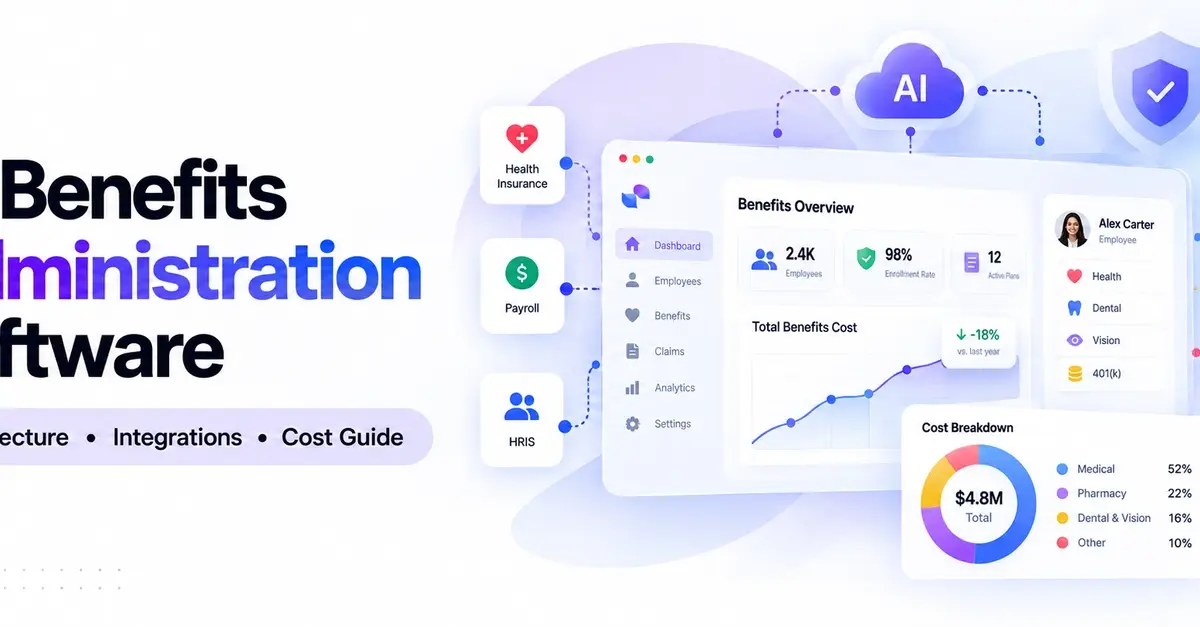
This comprehensive guide explores how modern enterprises must evaluate benefits administration software across critical dimensions, including AI design paradigms, system integrations, regulatory compliance, implementation lifecycles, and true Total Cost of Ownership (TCO).
Detailed Chronology & Industry Evolution
To understand how the benefits administration market reached this architectural crossroads in 2026, it is helpful to trace the technological and regulatory trajectory that preceded it.
- The SaaS Era (2010–2018): HR technology shifted rapidly from on-premise legacy mainframes to cloud-based Software-as-a-Service (SaaS) platforms. During this phase, the primary goal was digitizing paper forms, centralizing employee master data, and establishing foundational connections between HRIS platforms and basic payroll providers via batch processing and rudimentary file transfers.
- The Integration Boom & API Economy (2019–2023): As the ecosystem matured, companies demanded real-time connectivity. The rise of RESTful APIs, webhooks, and standardized data protocols allowed HR systems to talk more fluidly to third-party point solutions, such as COBRA administrators, Health Savings Account (HSA) custodians, and wellness platforms. However, carrier connectivity largely lagged behind, remaining anchored to legacy EDI (Electronic Data Interchange) formats like the EDI 834.
- The Generative AI Gold Rush (2023–2025): Following breakthroughs in Large Language Models (LLMs), the HR tech market experienced a massive influx of generative AI features. Vendors rushed to market with conversational agents designed to answer employee questions about medical plans, deductible thresholds, and flexible spending accounts. Unfortunately, many early deployments suffered from a critical design flaw: treating probabilistic AI models as authoritative systems of record, leading to "hallucinated" plan rules and unauthorized benefit elections.
- The Accountability & Litigation Era (2026 and Beyond): Entering 2026, the honeymoon period for unchecked enterprise AI has officially ended. High-profile compliance failures, ERISA audits, and complex litigation surrounding automated benefits denials have forced a market correction. Enterprises are no longer buying flashy AI assistants; they are demanding deterministic, auditable, enterprise-grade software architectures that strictly isolate probabilistic AI models from core business logic.
Supporting Context & Metrics: The Architecture-First Buying Criteria
The modern procurement process for enterprise HR technology is dictated by hard metrics and architectural rigor. According to recent market intelligence reports, the criteria influencing software selection have shifted significantly toward risk mitigation and integration resilience.
| Evaluation Dimension | Market Influence (%) | Key Operational Focus |
|---|---|---|
| System Integrations & Architecture | 33% | API reliability, EDI 834 reconciliation, data contracts, and seamless HRIS/payroll synchronization. |
| Native AI Capabilities | 26% | Grounded Q&A, document extraction, exception triage, and analytical summaries without system-of-record overreach. |
| Compliance & Security Frameworks | 21% | Audit logs, SOC 2 compliance, encryption standards, HIPAA/ERISA alignment, and BAA management. |
| Base Platform Usability & Cost | 20% | Employee/admin portal experience, mobile accessibility, and transparent PEPM (Per Employee Per Month) pricing. |
These figures demonstrate that buyers are prioritizing the structural integrity of their technology stack over superficial user-facing features. When evaluating software, organizations must understand what AI benefits administration actually entails from an engineering perspective.
What is AI Benefits Administration Software?
True AI benefits administration software combines a deterministic, rules-based benefits administration engine with governed artificial intelligence capabilities designed for employee support, plan guidance, document interpretation, workflow triage, anomaly detection, and predictive analytics.
The safest and most robust architectural design dictates that eligibility logic, deduction calculations, effective dates, and compliance checks remain strictly deterministic. Meanwhile, the AI layer acts as a supportive assistant—interpreting unstructured text, summarizing dense plan booklets, and routing exceptions—under strict access controls, comprehensive audit logs, validation rules, and human-in-the-loop review mechanisms.
+-----------------------------------------------------------------+
|                         EXPERIENCE LAYER                        |
|              (Employee/Admin Portals, Chat, Mobile)             |
+-----------------------------------------------------------------+
                                 |
+-----------------------------------------------------------------+
|                           AI LAYER                              |
|           (Grounded Q&A, Summaries, Triage, Retrieval)          |
+-----------------------------------------------------------------+
                                 |
+-----------------------------------------------------------------+
|                          RULES ENGINE                           |
|       (Deterministic Eligibility, Life Events, Deductions)      |
+-----------------------------------------------------------------+
                                 |
+-----------------------------------------------------------------+
|                         DATA & STORAGE                          |
|             (Encrypted Plan Data, Audit Logs, Lineage)          |
+-----------------------------------------------------------------+
This distinction is paramount. While employee benefits software can safely utilize an LLM to explain dense plan language in plain English, that same model must never be permitted to independently invent eligibility rules, override waiting periods, or silently modify a worker’s benefit election.
The 7-Layer Architecture Pattern
To achieve this level of separation, modern platforms rely on a rigorous 7-layer architectural pattern that isolates experience, rules, AI, data, and integrations so that each component can be tested, monitored, and audited independently.
- Experience Layer: Manages employee and administrator portals, conversational chat interfaces, and mobile applications with a focus on accessibility, role-aware rendering, and explainability.
- Identity Layer: Handles Single Sign-On (SSO), Multi-Factor Authentication (MFA), Role-Based Access Control (RBAC), and user consent via SAML/OIDC protocols enforcing the principle of least privilege.
- Rules Engine: Executes core business logic—such as eligibility determinations, life event qualifications, and deduction calculations—using deterministic, versioned, and thoroughly testable code.
- AI Layer: Powers natural language Q&A, recommendation engines, document summarization, and exception triage while remaining strictly grounded, bounded, and monitored.
- Workflow Engine: Manages complex enrollment sequences, managerial approvals, and exception handling through idempotent, retry-safe transaction pipelines.
- Integration Layer: Connects external HRIS, payroll systems, insurance carriers, and third-party vendors via robust REST APIs supplemented by EDI/SFTP fallback mechanisms.
- Data & Audit Layer: Manages plan data, transactional events, immutable audit logs, and operational metrics backed by end-to-end encryption, strict data lineage, and compliant retention policies.
Core Architectural Rules for Enterprise Teams
When building custom solutions or vetting third-party platforms, enterprise engineering and HR teams must adhere to two golden rules:
- Never Let a Model Become the System of Record: An AI model may recommend an action, flag an anomaly, or draft a communication, but the underlying benefits management software should only execute transactions after passing rigid policy checks, identity verifications, schema validations, and formal approval workflows.
- Secure Clean Data Foundations First: Trusted AI performance depends entirely on clean, governed employee and plan data. Implementing advanced machine learning models on top of fragmented, inconsistent eligibility data will only amplify operational errors at scale.
Official Industry Insights & Expert Perspectives
As organizations grapple with the complexities of deploying autonomous systems in high-stakes environments, industry analysts and engineering leaders emphasize the necessity of rigorous governance and transparent data pipelines.
According to enterprise architecture specialists, the primary vulnerability in modern HR tech stacks is not a lack of technological capability, but a deficiency in cross-system accountability. When a benefits administration platform interfaces with external insurance carriers, legacy payroll systems, and modern HRIS platforms, the potential points of failure multiply exponentially.
"A successful API call between a portal and a payroll provider is not proof that the underlying enrollment state is correct," notes enterprise integration literature from leading technical consultancies. "Organizations frequently suffer from a false sense of security because data moves back and forth, failing to realize that downstream reconciliation errors can quietly corrupt employee coverage records for months."
Furthermore, legal experts tracking 2026 benefits legislation emphasize that compliance is no longer a passive exercise solved by securing a generic SOC 2 report. Because benefit plans are governed by complex federal and state statutes—including ERISA, ACA, HIPAA, and COBRA—software vendors and employers alike face heightened scrutiny regarding how proprietary algorithms arrive at coverage decisions. If an automated triage tool improperly prioritizes a medical exception or misinterprets a qualifying life event window, the legal liability inevitably flows back to the plan sponsor.
Integration Complexity: What Must Connect?
Benefits administration software cannot exist as a siloed island. To function effectively, it must maintain continuous, synchronized data contracts with a wide array of internal and external enterprise systems.
| External System | Primary Data Exchanged | Common Integration Pattern | Crucial Buyer Question |
|---|---|---|---|
| HRIS | New hires, terminations, employment status changes, dependent demographics | REST API / Webhooks / Batch Sync | Which system acts as the absolute source of truth for each specific data field? |
| Payroll | Pre-tax and post-tax deductions, employer contributions, garnishments | Bi-directional API / Secure SFTP | Is data synchronization truly bi-directional, and how are payroll discrepancies flagged? |
| Insurance Carriers | Enrollments, terminations, medical/dental elections, life events | EDI 834 File Feeds / Direct APIs | How are carrier asynchronous acknowledgments (999/824 files) automatically reconciled? |
| Identity Provider (IdP) | User identity, authentication states, provisioning profiles | SAML / OIDC / SCIM protocols | Can user access and portal permissions be revoked instantly upon termination? |
| Third-Party Vendors | COBRA administration, HSA/FSA accounts, wellness incentives, voluntary benefits | Custom APIs / Encrypted Flat Files | Who provides frontline support and troubleshooting when automated data feeds fail? |
Carrier connectivity remains the most notorious bottleneck during platform implementations. While modern APIs are increasingly common, the industry remains deeply reliant on standardized EDI 834 data exchanges. Configuring, testing, and stabilizing these feeds often requires weeks of meticulous mapping and edge-case testing.
The Recommended Implementation Sequence
To mitigate deployment risks, enterprises should enforce a disciplined implementation sequence:
- Source-of-Truth Mapping: Establish unambiguous data ownership across the entire technology ecosystem before touching any code.
- Identity & Access Management: Secure SSO, MFA, and provisioning workflows to ensure secure user authentication.
- Payroll Synchronization: Connect and validate deduction engines and contribution calculators.
- Carrier Feeds & EDI Setup: Establish robust file transfer protocols and build automated acknowledgment reconciliation loops.
- AI Layer Integration: Layer conversational assistants and document interpretation tools only after core transactional stability is proven.
- Analytics & Reporting: Deploy dashboards and audit metrics to monitor ongoing system health.
Financial Analysis: Decoding Total Cost of Ownership (TCO)
When evaluating software pricing, procurement teams frequently fall into the trap of evaluating platforms based solely on headline Per Employee Per Month (PEPM) subscription fees. In reality, the true financial commitment of an enterprise benefits administration platform extends far beyond basic licensing costs.
Market benchmarks place base SaaS subscription pricing roughly between $4 and $15 PEPM, heavily influenced by company size, plan complexity, service tier, and included modules. However, first-year implementation expenses, custom data migration, and ongoing maintenance can drastically inflate the overall financial footprint.
Modeling the True TCO Formula
$$textAnnual TCO = textSubscription Fees + textImplementation Amortization + textIntegration Development + textCarrier Feed Maintenance + textAI Compute & Storage + textCompliance & Security Modules + textInternal Operating Labor$$
| Cost Driver | Primary Factors That Increase Financial Burden |
|---|---|
| PEPM Platform Licensing | Total employee head count, Tier of service level agreement (SLA), advanced functional modules. |
| Implementation & Migration | Historical data cleanup, legacy system extraction, custom plan architecture complexity. |
| Carrier Connectivity | High volume of distinct insurance carriers, custom mapping requirements, legacy EDI constraints. |
| AI Infrastructure | LLM token consumption, retrieval-augmented generation (RAG) pipelines, model monitoring, and safety evaluations. |
| Operational Labor | Internal HR and IT hours spent manually reconciling failed data feeds, auditing exceptions, and resolving user disputes. |
| Compliance & Security | Specialized audit controls, Business Associate Agreements (BAAs), rigorous penetration testing, and regulatory logging. |
Before committing to a platform based on an attractive PEPM quote, finance and HR leaders must model a comprehensive three-year TCO that accounts for their organization’s unique operational friction points.
Future Outlook
As we look beyond 2026, the trajectory of benefits administration software is unmistakably bound to advances in verifiable AI engineering and strict regulatory compliance. Several key trends will define the next generation of HR technology:
- Deterministic-Probabilistic Hybrids: The industry will move entirely away from monolithic black-box AI models. Future platforms will rely on hyper-modular architectures where lightweight, specialized AI agents operate strictly within hardcoded, auditable deterministic guardrails.
- Real-Time Carrier Interoperability: Pressure from regulators and employers will finally force legacy insurance carriers to abandon batch-based EDI 834 files in favor of standardized, real-time FHIR-inspired APIs, drastically reducing enrollment lag and reconciliation errors.
- Automated Regulatory Compliance: AI will increasingly be utilized not just for employee-facing chat, but for proactive regulatory monitoring—automatically scanning legislative updates across federal, state, and local jurisdictions to suggest mandatory plan design adjustments.
- Immutable Audit Trails: Built-in cryptographic logging and automated data lineage tracking will become standard baseline requirements, ensuring that employers can instantly produce a complete, unalterable audit trail for any historical benefits decision.
Conclusion
The defining characteristic of elite benefits administration software in the modern era is not the sheer volume of AI features listed on a marketing brochure. Rather, it is the platform’s uncompromising ability to prove its work: where data originated, which deterministic rule produced a specific outcome, what role an AI assistant played, how downstream systems were synchronized, how transaction failures were automatically reconciled, and what the organization pays to keep that entire operational chain secure and reliable.
Whether an enterprise chooses to buy a commercial SaaS platform, build a proprietary custom solution, or deploy a hybrid architecture, technical due diligence must extend far beyond polished user interface demonstrations. By prioritizing architectural integrity, rigorous integration testing, robust compliance frameworks, and realistic TCO modeling, organizations can successfully harness the power of automation while safeguarding their employees, their data, and their bottom line.