In the shifting landscape of digital cybersecurity, vulnerabilities often emerge not from outright software bugs, but from well-intentioned design choices pushed by tech monopolies. A striking example of this dynamic came to light when cybersecurity researchers and investigative journalists exposed a sophisticated exploitation of Google’s Accelerated Mobile Pages (AMP) framework.
The Russian state-sponsored cyber-espionage group known as Fancy Bear (also tracked as APT28, Sofacy, or Strontium) leveraged a fundamental architectural feature of Google AMP—the rendering of third-party content under trusted google.com URLs—to launch high-precision spear-phishing campaigns. Their primary targets: investigative journalists, researchers, and political dissidents exposing Russian state corruption and military actions abroad.
For years, cybersecurity best practices taught internet users a simple golden rule: always check the URL in the address bar. If a page began with https://google.com, users were conditioned to believe they were operating within a secure ecosystem managed by Google. However, Google AMP shattered this foundational heuristic. Because pre-loaded AMP links cache third-party content on Google’s own servers, malicious actors could construct convincing, credential-harvesting phishing sites that masqueraded as legitimate Google password-reset pages while displaying pristine, trustworthy google.com addresses in mobile web browsers.
Despite repeated warnings from developers, open-web advocates, and security researchers who flagged these dangers months prior, Google initially downplayed the risks. Internal resistance from project leads, coupled with opaque corporate communication policies, left high-profile targets vulnerable. The fallout included the compromise of prominent Russia analyst David Satter, whose leaked emails were subsequently weaponized and manipulated for disinformation campaigns. This incident ignited a fierce industry-wide debate over the consolidation of web standards, the hidden dangers of centralized content caches, and the responsibilities of tech giants acting as both infrastructure providers and arbiters of the open internet.
Detailed Chronology: The Anatomy of an AMP Exploit
The Genesis of AMP and Early Developer Warnings
Launched by Google in late 2015, the Accelerated Mobile Pages (AMP) standard was marketed as an open-source initiative designed to make the mobile web faster. By stripping down HTML, restricting JavaScript, and forcing developers to adhere to strict layout templates, AMP pages could load instantaneously on constrained mobile devices and slower data connections.
To achieve near-instantaneous load times from search results, Google introduced a pre-rendering mechanism. When a user queries a term on mobile search, Google pre-fetches and caches copies of participating AMP pages on its own servers. To ensure these pages render correctly and securely within the browser context, Google assigns them official google.com domains.
While the visible content area might display the originating publisher’s domain at the very top, the actual browser address bar stubbornly displays a google.com URL. As users scroll down, the subtle domain disclaimer disappears, leaving only the trusted Google address visible.
Tech-minded developers and web programmers immediately recognized the systemic threat. In November 2016, a web programmer named Ray Etornam filed a bug report on GitHub (ampproject/amphtml/issues/6210), highlighting how easily bad actors—ranging from fake news operators to sophisticated hackers—could exploit AMP to cloak malicious domains in unearned legitimacy.
Developer Christian Gloddy joined the thread, warning Google directly:
"The most common advice to avoid phishing and scams is ‘check the domain in the address bar.’ Not the text that might be below the address bar."
Despite a chorus of independent engineers predicting public relations disasters, Malte Ubl, the tech lead for Google’s AMP project, pushed back aggressively. Dismissing the critics, Ubl insisted that the Google Search viewer provided clear attribution and maintained that unsophisticated users would not be easily fooled.
Fancy Bear’s Campaign Against Aric Toler
While Google engineers defended the architecture on GitHub, APT28 (Fancy Bear)—a cyber-espionage unit widely attributed to Russia’s military intelligence agency, the GRU—began incorporating Google AMP URLs into their active operations.
One of their primary targets was Aric Toler, a lead researcher and writer for Bellingcat, an investigative collective famous for uncovering the truth behind the 2014 downing of Malaysia Airlines Flight 17 over Ukraine (MH17), as well as investigating Russian hybrid warfare and far-right extremist networks in Europe and North America.
Toler’s targeting was not accidental; it was the result of a multi-year, escalating campaign. In 2015 and 2016, Toler received a barrage of phishing emails designed to capture his Gmail credentials. Early attempts relied on crude, easily identifiable URL shorteners like Bitly—tactics easily spotted by tech-savvy web researchers.
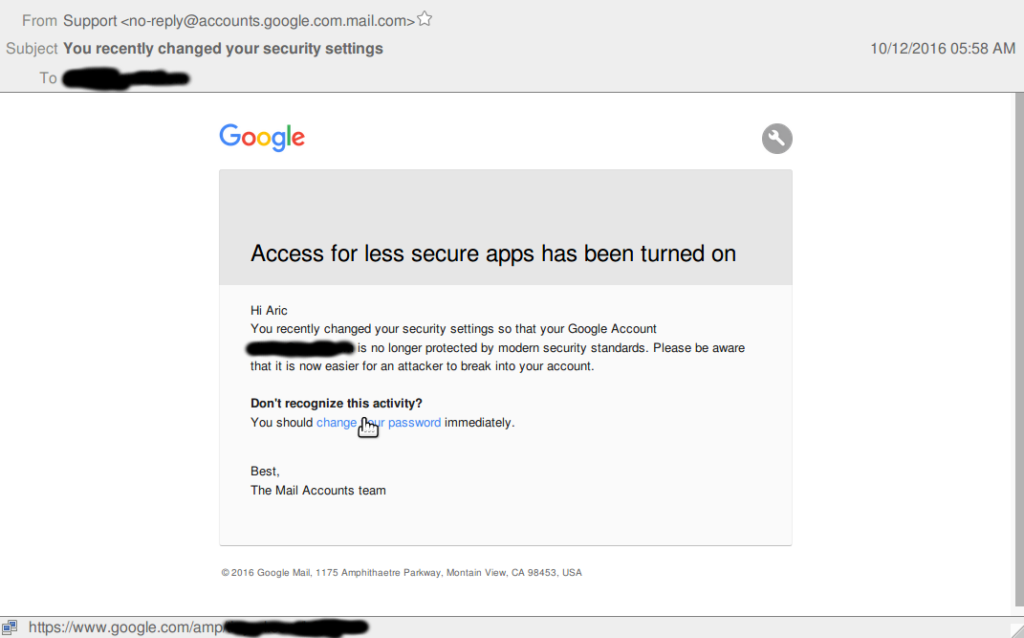
However, by late 2016, the hackers elevated their tactics to sophisticated spear-phishing. On October 12, 2016, Toler received an email purporting to be an official security alert from Google, warning that older email applications had gained access to his account. The malicious link redirected through a Google AMP wrapper to a pixel-perfect, forged Google login portal.
The very next day, following a public tweet by Toler acknowledging a legitimate security alert he had received from Google regarding "government-backed attackers," the hackers doubled down. They crafted a second, highly personalized spear-phishing email utilizing the exact same government-backed attacker warning framing, once again weaponizing a Google AMP URL to obscure their fraudulent infrastructure.
Forensic analysis conducted by cybersecurity firm ThreatConnect tied these emails directly to Fancy Bear. The hackers had reused a free email account ([email protected]) previously deployed in separate infrastructure operations cataloged in threat-intelligence databases. Fortunately, Toler and his Bellingcat colleagues recognized the anomalies and avoided the trap.
The Compromise of David Satter
Not all targets were as fortunate. David Satter, an American journalist, author, and senior fellow who has written extensively on Russian politics and the 1999 Russian apartment bombings, fell victim to the exact same attack vector.
Satter received an AMP-masked phishing message originating from the same [email protected] infrastructure. Believing the prompt to be a legitimate security intervention, he clicked through the trusted google.com address, visited the fraudulent portal, and entered his credentials.
Within moments of the compromise, automated scripts harvested his Gmail credentials, logged into his account, and scraped its entire contents. Weeks later, Canadian cybersecurity research group Citizen Lab documented how the stolen trove of documents was systematically leaked online and actively altered to fabricate disinformation, smear critics of Russian President Vladimir Putin, and discredit independent journalism.
Supporting Context & Metrics: The Architectural Flaw
To understand how a tech giant like Google could miscalculate the security implications of AMP, one must examine the intersection of web design, user psychology, and market dominance.
The Psychology of Trust: Security education across corporate and consumer sectors for over two decades has hammered home a single directive: Verify the URL. Users are trained to look for green padlocks and trusted domain roots. When an address bar displays google.com, the human brain lowers its guard.
The Scale of Adoption: Buoyed by Google’s search-ranking preferences—which implicitly favored or outright required AMP implementation for top-tier mobile visibility—publishers adopted the standard en masse. This massive proliferation conditioned billions of mobile users to interact daily with URLs that obfuscated true content origins.
The Phishing Success Rate: According to cybersecurity metrics from organizations like APWG (Anti-Phishing Working Group), credential harvesting remains the initial access vector in over 80% of targeted enterprise and personal breaches. By coupling spear-phishing with trusted infrastructure domains, adversaries effectively bypassed native browser warnings and heuristic filters.
Vector Characteristic
Standard Phishing URL
Google AMP-Masked Phishing URL
Address Bar Display
Suspicious / Unfamiliar Domain
Trusted google.com Domain
Bypass of User Heuristics
High failure rate among trained users
Low failure rate; exploits established trust
Caching Mechanism
Direct host connection
Pre-rendered server-side cache
Detection Difficulty
Easily flagged by security gateways
Often whitelisted due to Google origin
Official Statements and Corporate Response
As investigative journalists pressed Google for comment and the GitHub bug report gained explosive visibility, the corporation’s response evolved under public scrutiny.
Initially, project lead Malte Ubl maintained a defensive posture, attempting to close down public dissent. As the story neared publication, Ubl officially locked and blocked further public comments on the GitHub tracking issue (#6210), drawing sharp criticism from the developer community for stifling open discourse on a critical security flaw.
Concurrently, Google PR representatives issued statements asserting that AMP links were adequately protected by the company’s Safe Browsing infrastructure. However, conflicting internal timelines emerged:
Initial Claim: Google representatives initially argued that Safe Browsing covered all AMP permutations globally.
Revised Timeline: Following publication, Google clarified to reporters that automated Safe Browsing security screening of AMP addresses was only implemented in early January 2017—months after Fancy Bear began exploiting the vulnerability against journalists in late 2016.
Under the updated protocol, Google instituted an automated security scanner designed to visit AMP pages upon creation to verify the absence of malicious payloads. Furthermore, for pages that escaped pre-screening, Google introduced a "redirect notice" warning users that they were departing a Google-controlled property.
Critics, however, noted that the redirect notice was written in dense web-developer jargon, failing to explicitly articulate the security hazard to ordinary consumers seeking to reset compromised passwords.
Future Outlook: The Ongoing War for an Open Web
The exposure of the Fancy Bear AMP exploit catalyzed a broader, existential reckoning within the tech industry regarding the concentration of authority over web protocols.
Industry associations representing major news publishers—such as Digital Content Next (DCN), whose membership includes The New York Times, The Washington Post, and major U.S. broadcasting networks—voiced profound unease. DCN CEO Jason Kint sharply criticized the closed standards and consolidated power dynamics that made such vulnerabilities possible, arguing that open web standards should never be subordinated to the proprietary interests of a single corporate titan.
Although Google gradually rolled out patches, modified redirect warnings, and transitioned away from strict mobile search requirements for AMP in subsequent years, the episode left a permanent scar on the tech giant’s reputation for security stewardship.
The incident serves as a cautionary milestone in cybersecurity history: a stark reminder that when dominant technology platforms prioritize speed, caching convenience, and proprietary ecosystem control over transparent architectural design, they inadvertently construct powerful weapons for state-sponsored threat actors operating in the shadows of the digital realm.