Executive Overview
The digital landscape of the 21st century is littered with the ghosts of disruptive technologies that burned brightly before succumbing to legal battles, regulatory pressure, or technological obsolescence. Among the most evocative names from the early days of peer-to-peer (P2P) file sharing is LimeWire. Once synonymous with the chaotic dawn of digital music distribution in the 2000s, the brand has completed one of the most improbable pivots in tech history. Today, LimeWire has re-emerged not as a protocol for downloading pirated MP3s, but as a sophisticated, web3-integrated generative artificial intelligence platform and content-publishing ecosystem.
In its modern iteration, LimeWire is positioning itself at the lucrative intersection of generative AI, decentralized creator economies, and blockchain technology. By combining state-of-the-art neural networks—such as Stable Diffusion and DALL-E—with automated non-fungible token (NFT) minting, cryptocurrency monetization, and subscription-based community building, the platform seeks to solve one of the modern creator economy’s most persistent challenges: sustainable monetization.
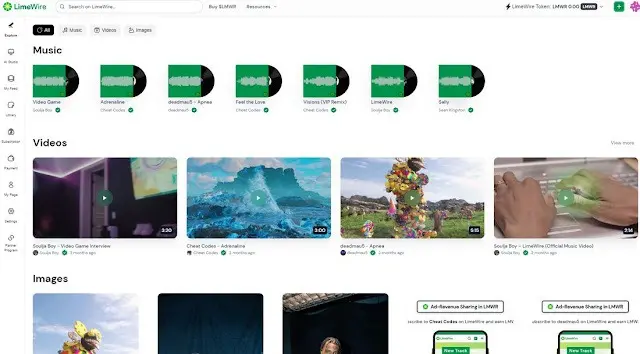
While the generative AI market is saturated with standalone art tools, LimeWire differentiates itself by focusing heavily on the business of creation. It transforms static prompts into ownable, tradeable digital assets. High-profile early adopters, including prominent musicians and public figures like Deadmau5, Soulja Boy, and Sean Kingston, have already experimented with the ecosystem, validating its hybrid model of art generation and digital asset distribution. This comprehensive report investigates LimeWire’s technological architecture, its innovative revenue-sharing models, the utility of its native LMWR token, and its strategic trajectory in an increasingly crowded AI-driven marketplace.
Detailed Chronology: The Evolution of a Digital Icon
To understand the weight of LimeWire’s current renaissance, it is essential to trace the arc of its corporate and technological lifecycle across two distinct eras of the internet.
[2000s: P2P Era] ──► [Legal Collapse] ──► [2022: Brand Acquisition] ──► [2023: AI Pivot & Studio Launch] ──► [Present: Multi-Modal Ecosystem]Phase 1: The P2P Era and Sudden Demise (2000–2010)
Founded in 2000 by Mark Gorton, LimeWire became the quintessential file-sharing client of the broadband revolution. Built on the Gnutella network, it allowed millions of users worldwide to search for and share music, movies, and software. At its peak, it was installed on millions of computers globally, commanding a massive share of internet traffic.
However, its decentralized nature made it a primary target for the Recording Industry Association of America (RIAA). Following a protracted legal battle that culminated in the landmark 2010 federal court ruling Arista Records LLC v. Lime Wire LLC, a U.S. district judge ordered the shutdown of the software’s core searching, downloading, and uploading functionalities. The brand effectively went dark, becoming a nostalgic artifact of early internet culture.
Phase 2: Acquisition and Strategic Re-imagination (2022)
More than a decade after its court-ordered shutdown, the LimeWire brand was acquired by Austrian entrepreneurs Julian and Paul Zehetmayr. Recognizing the enduring brand recognition—combined with a clean slate regarding its legal history—the new leadership sought to repurpose the name for the next major technological wave. Initially conceptualized as an NFT marketplace for digital art and music, the platform quickly recognized that static digital collectibles lacked broad engagement without an underlying content creation engine.
Phase 3: The Launch of LimeWire AI Studio (2023)
In early 2023, the platform pivoted aggressively toward generative artificial intelligence. By integrating advanced text-to-image models directly into its web interface, LimeWire transitioned from a passive marketplace into an active creation studio. Users were no longer just buying or selling digital art; they were empowered to generate it using natural language prompts. This phase also marked the introduction of the platform’s native utility token, LMWR, designed to govern transactions, reward engagement, and fuel platform-wide operations.
Phase 4: Expansion into Multi-Modal Generation (Present)
Today, LimeWire functions as an evolving multi-modal studio. While image generation remains the primary anchor of its current suite, the platform is actively rolling out tools for audio and video synthesis. By integrating automated blockchain minting on high-throughput networks like Polygon and Algorand, LimeWire has solidified its status as an end-to-end publishing house for the decentralized web.
Supporting Context & Metrics: Inside the LimeWire Studio Architecture
LimeWire’s technological infrastructure is built to cater to two distinct user segments: casual hobbyists exploring generative art and professional creators seeking robust monetization pipelines.
The AI Engine: Multi-Model Integration
Unlike closed ecosystems that lock users into a single proprietary model, LimeWire’s AI Studio acts as an aggregator of industry-leading open-source and commercial generative models. The platform supports:
- Stable Diffusion 2.1 and Stable Diffusion XL (SDXL): Providing exceptional detail, photorealism, and adherence to complex text prompts.
- DALL-E 2: Offering diverse conceptual interpretations and artistic variations.
Users can seamlessly switch between these models and apply distinct stylistic filters—including cinematic, digital art, pixel art, anime, and analog film—to tailor their outputs. Furthermore, advanced features such as samplers, negative prompting, and prompt guidance give creators granular control over the final visual asset.
The Creator Economy and Automated Minting
A defining feature of LimeWire Studio is how it handles the post-creation workflow. Once an image, piece of music, or video is finalized, the creator can publish it directly to their profile. Behind the scenes, LimeWire automates the process of minting the creation as a Non-Fungible Token (NFT) on either the Polygon or Algorand blockchain.
This automated process provides several distinct advantages:
- Authenticity and Provenance: Every piece of digital art receives a unique cryptographic signature, verifying its origin and ownership.
- Flexible Distribution: Creators can choose to release their work publicly—allowing anyone to view, collect, and trade the resulting NFTs—or restrict access exclusively to paying, subscription-based fans.
- Perpetual Royalties: When a user’s publicly traded NFT changes hands on secondary markets, the original creator automatically receives a 2.5% royalty fee, establishing a passive income stream rooted in smart contracts.
Revenue Models and Financial Frameworks
LimeWire departs significantly from traditional content platforms like Instagram, YouTube, or Patreon by leveraging web3 tokenomics and ad-revenue sharing directly integrated into the creation process.
The LMWR Token Economy
At the heart of LimeWire’s financial ecosystem is the LMWR token. Distributed monthly to creators based on platform engagement and ad views, LMWR serves as the primary medium of exchange.
- Liquidity and Tradeability: Earned tokens are not trapped within a walled garden; creators can withdraw their monthly LMWR earnings and trade them on major decentralized and centralized cryptocurrency exchanges, including Kraken, Bybit, and Uniswap.
- Platform Utility: Beyond cashing out, users can spend LMWR tokens directly within the platform to purchase additional credits for generative AI prompts, creating a closed-loop economy.
Ad Revenue Sharing
LimeWire implements a generous ad-revenue distribution model designed to rival traditional social media payouts. When other users view a creator’s published images, music, or videos on the platform, ad revenue is generated. Depending on the creator’s subscription tier, they are entitled to receive up to 70% of all ad revenue generated by their content.
Subscription Tiers and Pricing Structure
LimeWire operates on a freemium model designed to lower the barrier to entry while offering high-volume professionals the computational power and monetization splits they require.
| Tier | Monthly Price | Monthly Credits | Estimated Image Generation Capacity | Ad Revenue Share | Key Perks |
|---|---|---|---|---|---|
| Free | $0 | 10 Credits | Up to 20 images/day | 50% | Basic model access, community features |
| Basic | $9.99 | 1,000 Credits | Up to 2,000 images | 50% | Early access to models, ad-free browsing |
| Plus | $29.00 | 3,750 Credits | Up to 7,500 images | 60% | Pro profile badge, faster generation |
| Pro | $49.00 | 5,000 Credits | Up to 10,000 images | 70% | Full creation history, priority processing |
| Advanced | $99.00 | 11,250 Credits | Up to 22,500 images | 70% | Maximum throughput, VIP support |
Note: All paid tiers include a Pro profile badge, complete creation history access, expedited image generation queues, and an ad-free viewing experience.
Official Statements and Industry Reception
The strategic pivot of a legendary brand like LimeWire has attracted considerable attention from technology analysts, crypto enthusiasts, and traditional media outlets alike.
In statements released following the platform’s AI integration, co-founders Julian and Paul Zehetmayr emphasized that the goal was never to merely resurrect a dead brand, but to address the fundamental economic inequities plaguing modern content creators.
"The creator economy has historically forced artists to rely on ad-hoc sponsorships, inconsistent streaming royalties, or centralized platforms that take the lions share of revenue," representatives for LimeWire noted during the platform’s studio rollout. "By merging generative AI with blockchain-backed digital ownership and direct ad-revenue sharing, LimeWire provides a complete toolkit where creativity directly translates into sustainable, ownable financial assets."
The early endorsement of high-profile mainstream musicians—including electronic music pioneer Deadmau5, hip-hop artist Soulja Boy, and reggae-pop star Sean Kingston—has lent significant credibility to the platform’s utility as a publishing tool. By utilizing LimeWire Studio to drop NFT-based media directly to dedicated fan bases, these artists have helped validate the platform’s premise that blockchain integration can enhance, rather than complicate, the artist-fan relationship.
Future Outlook: The Road Ahead for LimeWire AI Studio
As the generative artificial intelligence market matures, platform longevity will depend heavily on continuous innovation, ethical content governance, and multi-modal expansion. LimeWire’s roadmap addresses these imperatives directly.
1. Proprietary AI Model Development
While current operations rely heavily on third-party models like Stable Diffusion and DALL-E, LimeWire is actively investing in the research and development of its own proprietary AI models. Developing an in-house model will allow the platform to offer unique aesthetic styles, reduce reliance on external API providers, and pass cost savings directly onto the consumer through improved credit efficiency.
2. Expansion into Music and Video Generation
The most anticipated milestone on LimeWire’s horizon is the rollout of native AI music and video generation tools. While the platform currently supports static image creation and multimedia publishing, the introduction of text-to-audio and text-to-video synthesis will unlock unprecedented creative potential. Musicians will be able to generate backing tracks, sound effects, and accompanying music videos within a single, unified workspace, instantly minting the resulting multi-media packages as tradeable NFTs.
3. Regulatory and Ethical Navigation
As with any platform operating at the intersection of generative AI and blockchain technology, LimeWire faces ongoing scrutiny regarding copyright, data scraping, and content moderation. The company has implemented reporting mechanisms and safety filters to prevent the generation of harmful or unauthorized likenesses, but maintaining a secure, legally compliant environment while scaling open-ended creation will remain a critical operational challenge.
Conclusion
LimeWire’s evolution from a controversial 2000s file-sharing client into a decentralized generative AI studio is one of the most fascinating corporate metamorphoses of the digital age. By identifying the limitations of traditional content-sharing sites and addressing the financial vulnerabilities of the modern creator economy, LimeWire has carved out a distinct and defensible niche.
Through its combination of accessible AI image generation tools, automated blockchain minting on Polygon and Algorand, a transparent ad-revenue sharing model, and the utility of the LMWR token, the platform successfully bridges the gap between artistic expression and digital ownership. Whether an amateur hobbyist experimenting with 10 free daily credits or a professional digital artist scaling production to 22,500 monthly generations, users find within LimeWire a comprehensive ecosystem designed for the future of decentralized creativity. As the platform prepares to launch its proprietary AI models and expand into music and video synthesis, LimeWire stands poised as a formidable force in the ongoing transformation of digital art and media distribution.