Role-playing games are structurally bound by enduring narrative traditions. Among the most reliable is the introduction of an off-stage, shadowy antagonist—typically a malevolent supernatural force or an ancient sovereign—who has been secretly manipulating continental affairs from the wings. Players routinely spend dozens of hours navigating tactical maps, managing interpersonal relationships, and debating philosophical quandaries about the nature of free will, only to ultimately confront this singular evil entity. Victory is traditionally achieved through a combined cocktail of unwavering camaraderie, legendary armament, and stylized character design.
Yet, Fire Emblem: Fortune’s Weave takes this time-tested trope and weaponizes it with startling narrative whiplash. After a leisurely, character-focused Act 1 dedicated to academy-style bonding, gift-giving, and nurturing tactical relationships, Act 2 violently pulls the rug out from under the player.
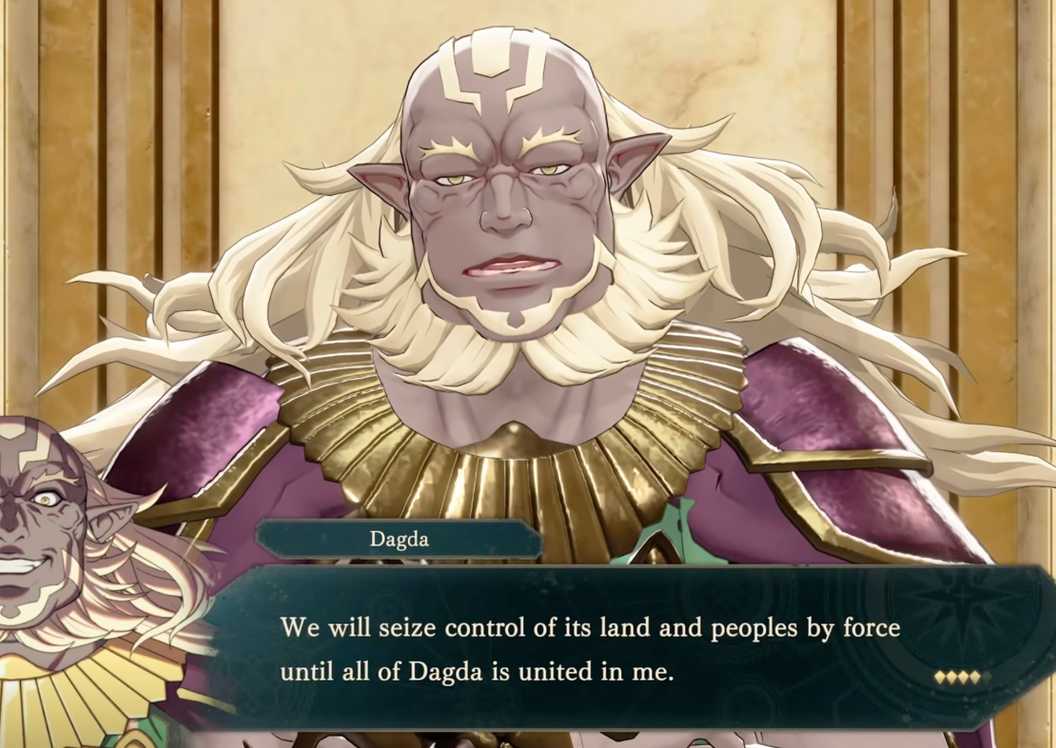
The catalyst for this tonal shift is the resurrection of Emperor Dagda, a terrifyingly visceral antagonist whose unmitigated malice makes previous series villains look almost quaint. Dagda’s sudden, brutal ascension serves as a masterclass in pacing, proving that traditional storytelling tropes remain profoundly effective when executed with uncompromising conviction. This comprehensive analysis explores the narrative mechanics, political parallels, and gameplay transformations that define the controversial and unforgettable War Arc of Fire Emblem: Fortune’s Weave.
Detailed Chronology: The Fall of Peace and the Rise of the Tyrant
To step into Act 2—known officially as the War Arc—players must interact with the ominous Strife Obelisk. While the vast majority of the player base encounters this narrative checkpoint organically after completing at least one of the four distinct Act 1 routes, speedrunners and seasoned tacticians can technically trigger the transition directly following the game’s prologue.
Once activated, the timeline jumps forward several months, leaving behind the pomp, circumstance, and athletic pageantry of the Heroic Games. It is during this fragile transitional period that the true mastermind of the continent’s underlying instability steps into the light. Raksha, the notoriously calculating, green-haired schemer previously obscured behind a cryptic wooden mask, successfully completes a forbidden ritual. She revives her father, Emperor Dagda, following a 500-year-long slumber.
Almost immediately upon reclaiming his throne, Dagda establishes a reign of terror defined by absolute cruelty and zero pretense of divine right or fair governance. To cement his authority, he executes his own son, Solel—a beloved, if dim-witted, character affectionately categorized by the community as a classic franchise "himbo." With domestic dissent instantly silenced through blood, Dagda declares a total "war of annihilation" against Saramis, the southern region of the continent. Geographically and culturally, Saramis serves as the home for many of Fortune’s Weave’s prominent characters of color, charging the imperial invasion with an overt, systemic racial animus.
The imperial capital of Dagsion suffers an immediate and devastating architectural and cultural erasure. Dagda orders the city’s historic, beloved arena torn down to its foundations, replacing the epicenter of public life with a monolith known simply as "the cauldron." The capital transforms rapidly from a vibrant, bustling metropolis into a totalitarian nightmare. Imperial troops routinely terrorize ordinary citizens, seizing food stores and private property to supply the war machine.
This grotesque overreach ultimately alienates key imperial loyalists. Disgusted by Dagda’s unrelenting sadism, several prominent factions defect, crossing enemy lines to join Theodora’s burgeoning resistance forces in Saramis. Faced with unexpected military resistance and humiliating battlefield defeats, Dagda resorts to an atrocity without precedent in modern tactical RPG history: he commands his forces to round up every single civilian in Dagsion—numbering approximately one million souls—and cast them directly into the cauldron.
The resulting process liquefies the bodies and souls of the entire civilian population into an arcane slurry known as flamma. Dagda consumes these "soul slurpees" by the bowlful, utilizing the harvested essence of his own subjects to restore his immortal youth, heal battle wounds, and fuel his bottomless rage.
Supporting Context & Metrics: Tropes, Parallels, and Gameplay Realities
The introduction of Dagda has sparked intense community discourse, largely due to the uncomfortable proximity between his fictional regime and contemporary real-world politics. Narrative analysts and fans alike have noted striking parallels between the Emperor of Dagsion and modern authoritarian figures:
Overt Xenophobia and Racism: Dagda’s targeted campaign against Saramis mirrors historical and modern nationalist campaigns aimed at ethnic erasure and territorial subjugation.
Capricious Militarism: Wars of annihilation are declared on a whim, unmoored from strategic necessity and driven entirely by ego and revanchism.
Incompetent Nepotism: Despite presiding over a bloodthirsty empire, Dagda’s lineage is defined by scheming yet remarkably inept offspring who rely on terror rather than competence.
Unbounded Greed: The systematic plundering of Dagsion’s citizens to fuel an elite ruling class creates an inescapable allegory for modern wealth inequality and state-sponsored extraction.
From a gameplay perspective, Act 2 represents a significant spike in both mechanical complexity and psychological weight. The leisurely pacing of Act 1—characterized by tea parties, lost item recovery, and tactical instruction—is entirely replaced by grueling, attrition-based warfare. Battles are noticeably longer, enemy reinforcements appear with punishing frequency, and map objectives demand absolute tactical precision.
The psychological toll of fighting through the ruined streets of Dagsion—knowing the fate that befell its citizens—infuses every tactical victory with a complex mixture of righteous satisfaction and profound melancholy. When players finally corner Dagda atop the highest peak in Dagsion, where he has transformed into an impervious, soul-gorged dragon after draining a million lives, the encounter serves as the ultimate test of the player’s carefully cultivated army.
The climax of the battle provides one of the most cathartic moments in modern gaming: after realizing conventional weaponry is entirely ineffective against the divine beast, the character Eshmel executes a cinematic, physics-defying flying kick directly to the dragon’s groin. This shatters Dagda’s impenetrable divine shield, leaving him vulnerable to a coordinated, multi-turn onslaught from the player’s battered party.
Official Statements and Developer Insights
In recent interviews discussing the narrative architecture of Fire Emblem: Fortune’s Weave, the development team addressed the conscious decision to construct an antagonist as unreservedly vile as Emperor Dagda.
"When designing the transition from the relatively peaceful academic and competitive structures of Act 1 to the grim reality of the War Arc, we knew we needed an antagonist who could not be reasoned with, negotiated with, or redeemed," lead scenario writers noted. "Modern RPGs often strive for moral grayness, giving every villain a tragic backstory or a misunderstood ideology. With Dagda, we wanted to deliberately subvert that trend. We wanted an antagonist whose malice is absolute, unapologetic, and overwhelming. The player needs to feel a visceral, burning need to see him removed from the board."
Furthermore, Nintendo’s localization and design teams emphasized that the architectural shifts in the capital city were designed to make the player feel the tangible cost of war.
"When you watch a vibrant hub world like Dagsion get systematically dismantled and replaced by an industrial horror like the cauldron, it personalizes the conflict," developers explained. "Dagda isn’t just threatening a continent on a map; he is actively destroying the spaces the player has spent dozens of hours learning to love. That personal stake is what makes his eventual defeat so profoundly rewarding."
Future Outlook: The Legacy of a Soul-Guzzling Tyrant
As players continue to dissect the branching narratives, hidden lore books, and alternative endings of Fire Emblem: Fortune’s Weave, Emperor Dagda occupies a fascinating space in the pantheon of tactical RPG villains.
Strictly speaking, Dagda’s time in the spotlight is relatively brief. Across multiple playthroughs and route variations, his reign of terror is contained largely within the mid-to-late segments of Act 2, eventually giving way to an even more ancient and complex cosmic threat that emerges in Act 3. Yet, despite his short tenure, Dagda leaves an indelible scar on the narrative landscape of the game.
By rejecting modern tropes of nuanced villainy in favor of pure, unadulterated malevolence, Fortune’s Weave proves that traditional narrative structures—when executed with bold pacing, striking visual metaphors, and uncompromising thematic weight—can still achieve maximum emotional impact. Dagda may ultimately fall from his mountain peak, humbled by a legendary boot to the groin and overwhelmed by the combined might of a united continent, but the memory of the soul-guzzling tyrant of Dagsion will undoubtedly haunt the tactical RPG genre for years to come.