Two years ago, artificial intelligence in marketing was largely defined by experimentation, corporate hesitation, and breathless media hype. Back then, roughly one-third of marketing professionals incorporated AI into their daily routines. Today, that figure has more than doubled, transforming from an innovative experiment into the foundational infrastructure of modern business operations.
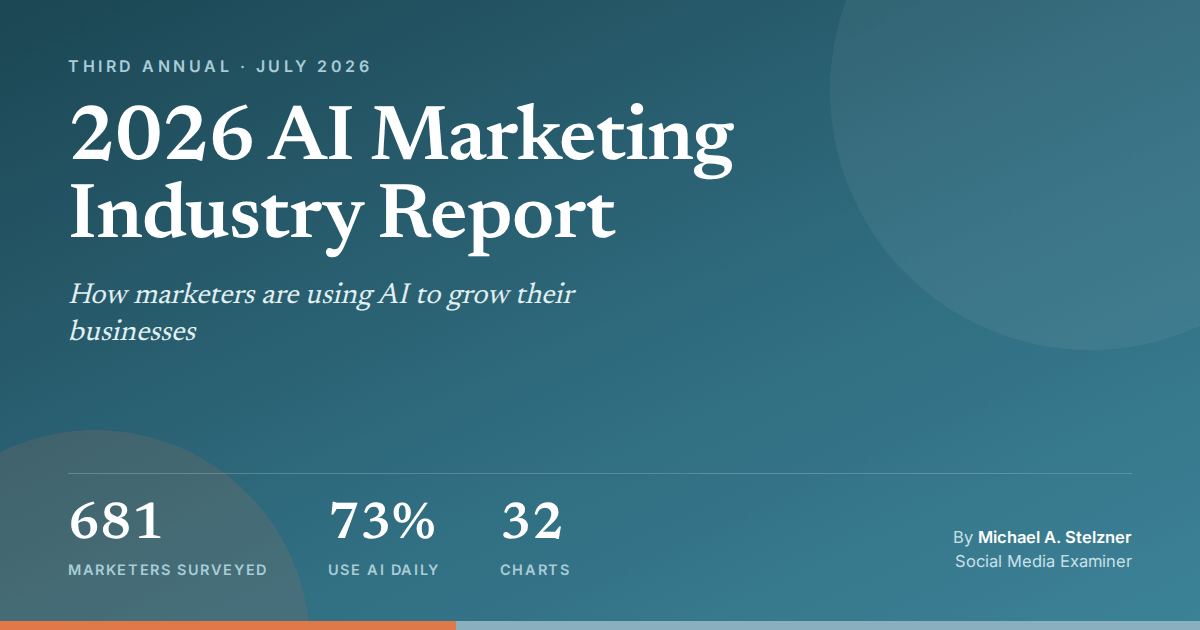
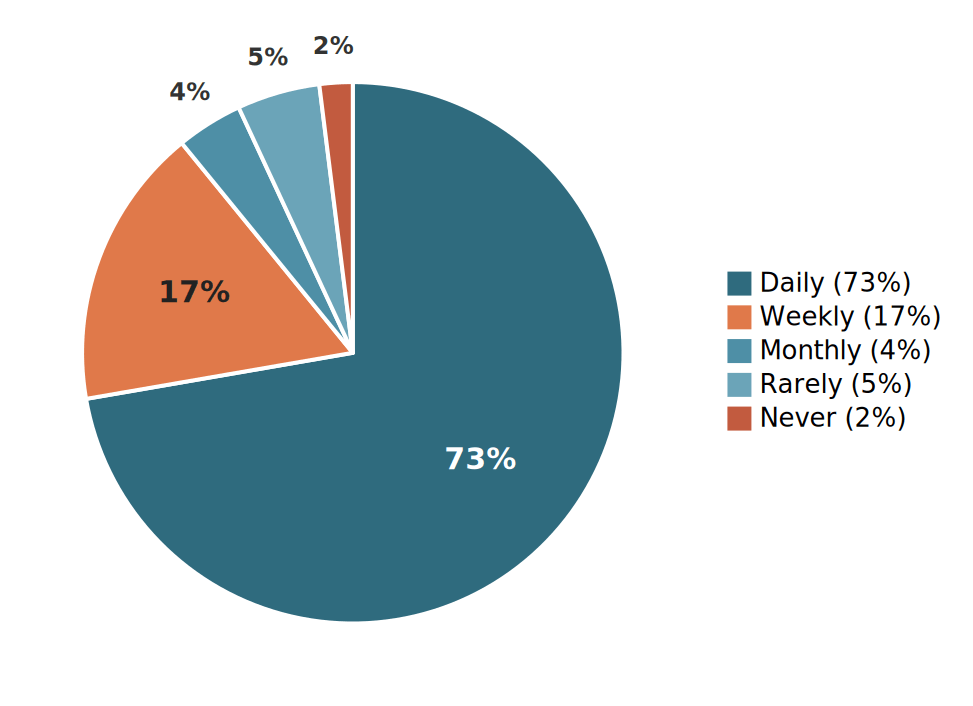
According to the comprehensive 2026 AI Marketing Industry Report released by Social Media Examiner, nearly three out of four marketers (73%) now use AI on a daily basis. More importantly, this data challenges the prevailing narrative that AI is exclusively the domain of deep-pocketed tech giants and enterprise corporations. With 60% of survey respondents operating within lean teams of ten or fewer people, this research serves as an unvarnished mirror reflecting the daily realities, triumphs, and blind spots of small business owners and independent entrepreneurs.
Rather than relying on speculative predictions, the report captures the grassroots adoption of artificial intelligence—revealing how small business operators are bypassing massive budgets and formal training programs to outpace traditional corporate constraints. Yet, the findings also uncover critical vulnerabilities: a widespread inability to quantify AI’s return on investment (ROI), massive untapped potential in video generation, and an impending wave of autonomous AI agents that promise to redefine lean workforce leverage entirely. For the small business owner navigating a tightening competitive landscape, these insights are no longer optional reading; they are an operational blueprint.
Detailed Chronology: The Rapid Acceleration of AI Adoption
To fully understand where small business marketing stands today, it is vital to examine the velocity of its integration over the past 24 months. The shift from a peripheral novelty to a centralized operational tool represents one of the fastest technological transitions in modern commercial history.
The 2024 Baseline: Experimentation and Hesitation
In the foundational era of generative text models, adoption was fragmented. Industry data from 2024 indicated that only 37% of marketers engaged with AI tools on a daily basis. At that stage, nearly a quarter of professionals (23%) rarely or never touched the technology, viewing it with a mixture of skepticism, ethical concern, and operational confusion. The free-tier era of large language models dominated workflows, and organizational structures lacked clear directives on how to safely or effectively deploy artificial intelligence.
The 2025 Tipping Point: Mainstream Integration
By the following year, the landscape shifted dramatically. As tools matured, interface designs improved, and early adopters demonstrated undeniable efficiency gains, resistance began to crumble. The percentage of daily users climbed steadily, while the cohort of total skeptics shrank into the single digits. Organizations began recognizing that treating AI as a passing trend carried far greater operational risk than diving in.
The 2026 Reality: The New Normal
Today, AI usage has achieved near-universal saturation across marketing workflows. The 2026 data reveals that 90% of marketers now use AI at least weekly, while daily users have surged to 73%. Meanwhile, the group of holdouts who rarely or never use AI has plummeted to just 7%.
Crucially, the momentum shows no signs of plateauing. 84% of respondents reported that their personal AI usage increased over the past year, and 78% expect it to accelerate further in the near future. For small business owners who have remained on the fence, the window to comfortably enter the market as an early adopter has officially closed. Survival now depends on optimization and mastery.
Supporting Context & Metrics: Five Eye-Opening Findings
The 2026 AI Marketing Industry Report breaks down the complex ecosystem of modern marketing into five distinct structural revelations. For lean teams, these metrics provide a roadmap for where to invest limited time and capital.
1. The Death of the "Nice-to-Have" Mindset
The primary takeaway from the latest data is that AI is no longer a supplemental utility; it is the core operating system of digital marketing. With 73% utilizing AI daily and 90% weekly, the technology has crossed the chasm from novelty to necessity. The data indicates that organizations failing to integrate AI into daily content creation, ideation, and data analysis are experiencing severe operational friction compared to their agile, AI-enabled competitors.
2. The Decentralization of Expertise: Bootstrapping Outpaces Corporate Training
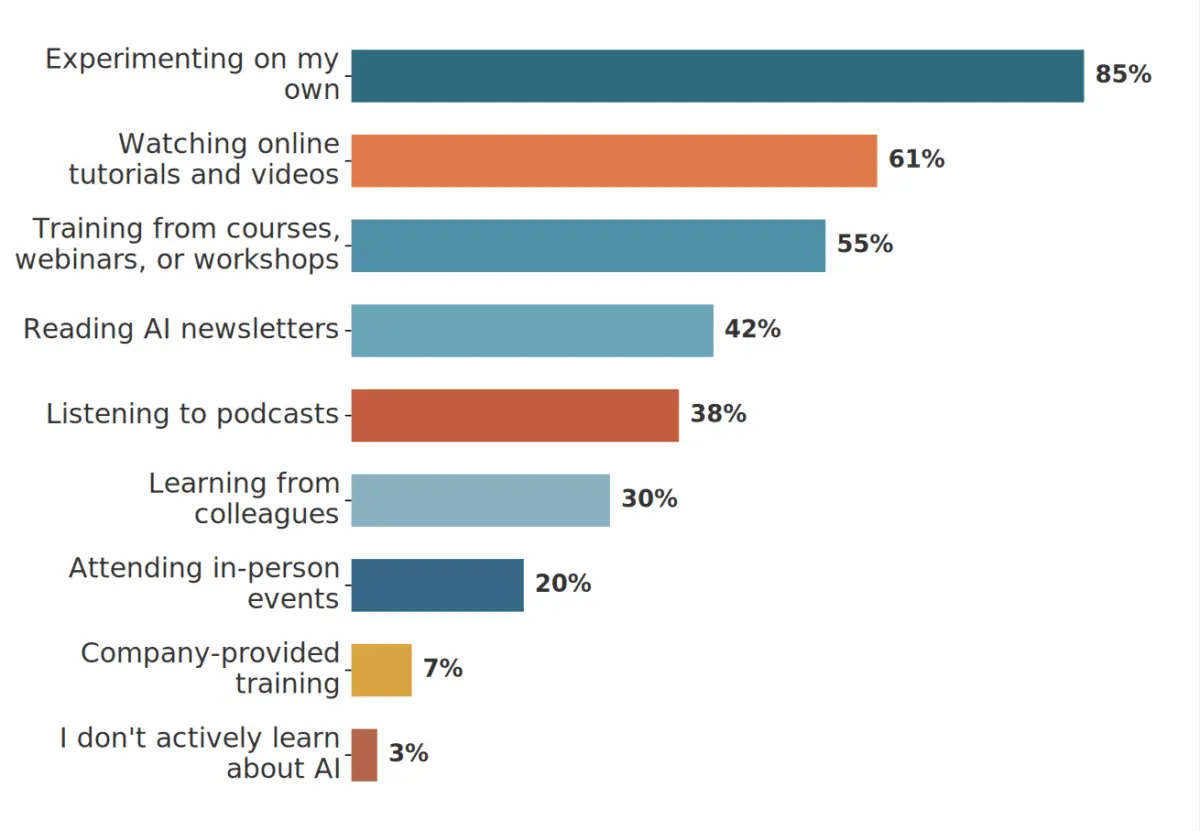
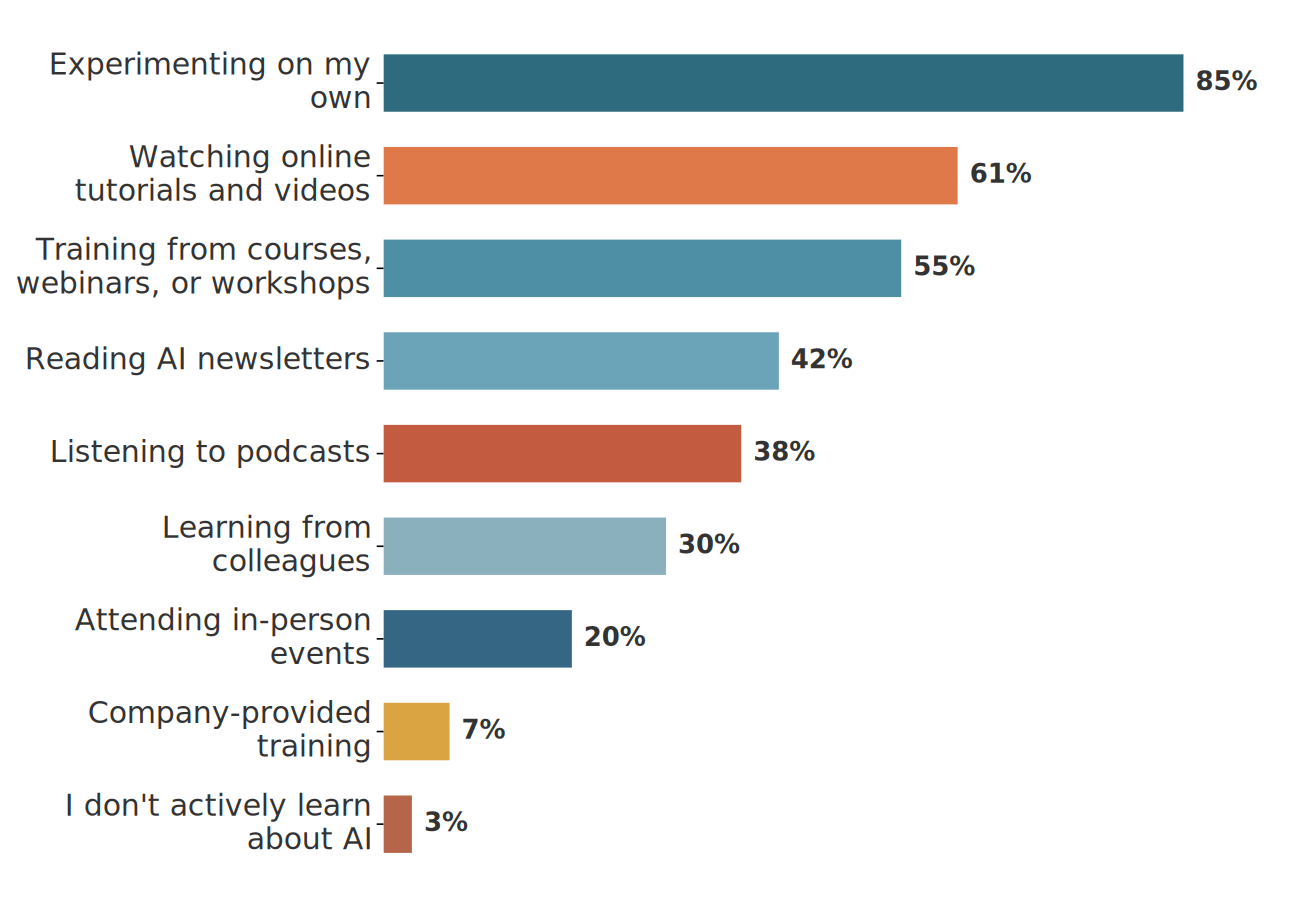
One of the most profound revelations for small businesses is how professionals are mastering these tools. Conventional wisdom suggests that successful technology adoption requires enterprise-grade training budgets and dedicated educational departments. The data completely shatters this assumption:
85% of marketers learn AI through self-directed experimentation.
Only 7% receive company-provided training.
53% are personally funding their own AI software subscriptions.
This is exceptionally encouraging news for independent entrepreneurs and small business teams. The vanguard of AI adoption did not reach their proficiency through expensive corporate seminars; they rolled up their sleeves and figured it out through trial and error. Furthermore, when asked who owns AI adoption within their companies, 55% of respondents answered simply, "Me." This decentralized, DIY ethos has always been the hallmark of small business survival. In the age of AI, the corporate world is finally adopting the scrappy methodology of the independent business owner.
3. The Measurement Paradox: High Satisfaction, Low Quantification
Despite the overwhelming daily reliance on AI, the report uncovers a glaring disconnect between perceived value and hard metrics.
86% of marketers strongly agree that AI saves them time.
86% agree that AI significantly boosts their overall productivity.
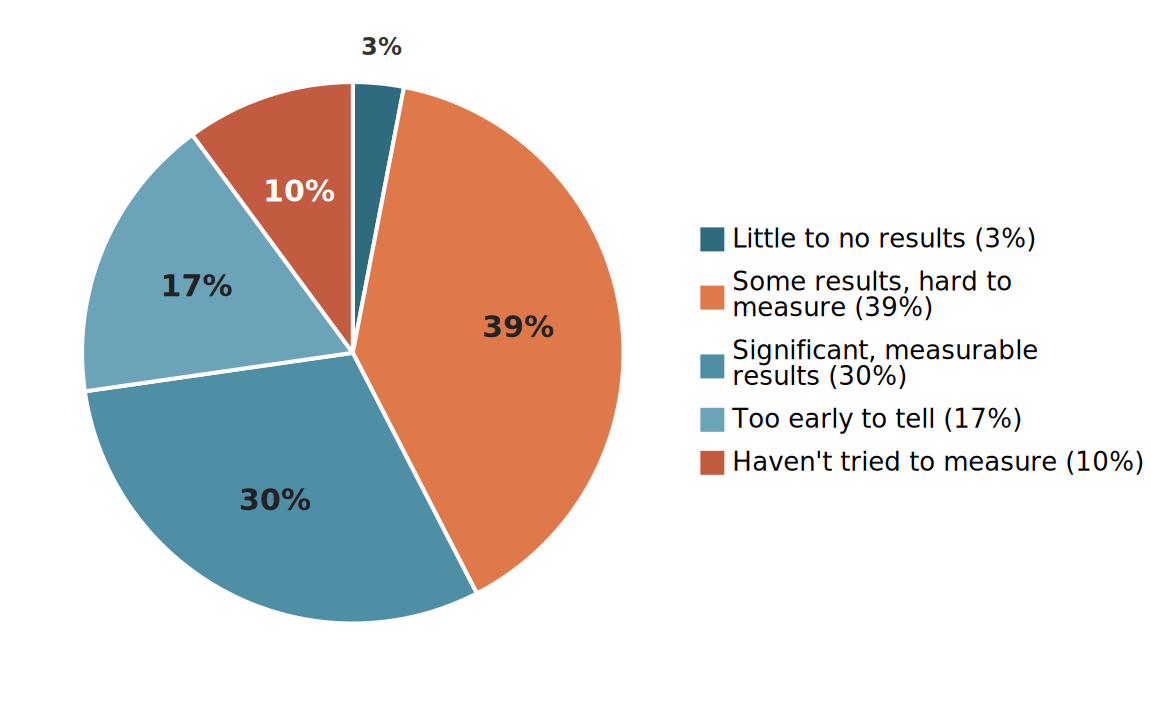
However, only 30% can point to concrete, measurable results.
An additional 39% report seeing positive outcomes but admit they cannot quantify them, while 10% have never attempted to measure AI’s impact at all. This "measurement gap" presents a massive competitive opportunity. Small business owners who implement basic tracking metrics—such as hours saved per week, reductions in content production costs, or output volume—will immediately outpace 70% of their competitors who are operating on intuition alone. Establishing clear KPIs for AI tasks allows businesses to direct their finite financial and temporal resources toward the highest-yielding applications.
4. The Video Deficit: The Largest Untapped Opportunity in Marketing
While written content generation has achieved near-universal saturation with 95% adoption, visual media tells an entirely different story.
Only 37% of marketers currently use AI for video creation.
Conversely, 74% of marketers state that video is the #1 content type they want to learn to create using AI.
This creates a staggering 37-point gap between market demand and actual adoption—the widest disparity measured in the entire study. While image generation has surged (jumping from 39% to 67% since 2024), video remains the ultimate frontier. Small businesses that master basic AI video tools today will secure an immediate, disproportionate advantage in capturing consumer attention across social media feeds, far ahead of peers who remain intimidated by the medium.
5. The Horizon of Autonomy: AI Agents and Small Team Leverage
Introduced as a core survey metric this year, autonomous AI agents represent the next seismic shift in digital marketing. Unlike standard conversational prompts that require step-by-step guidance, AI agents can execute complex, multi-step workflows independently.
Currently, 11% of marketers use AI agents regularly, while 24% are actively experimenting with them.
44% plan to adopt agents in the near future, bringing total current or planned adoption to 79%.
Furthermore, learning how to deploy AI agents ranks as the #1 educational priority for marketers (74%).
For small teams, the implications are revolutionary. Imagine possessing the operational capacity to have an AI system autonomously manage multi-channel email sequences, monitor real-time advertising analytics, and handle routine customer inquiries without human micromanagement. This level of automated leverage historically required expanding headcount and increasing payroll. AI agents democratize enterprise-level operational efficiency for solo founders and micro-businesses.
Official Statements and Industry Analysis
Michael Stelzner, founder of Social Media Examiner and the driving force behind the research, emphasizes that the report was designed to cut through industry noise and provide actionable clarity.
"We surveyed marketers to find out how they’re actually using AI. Not the hype. Not the headlines. The real story," Stelzner stated. Noting that the majority of survey participants represent lean organizations of ten or fewer people, he added, "This isn’t enterprise research. This is your world… I put this research together because I believe small business marketers deserve data they can act on. I hope it helps you make smarter decisions about AI in your business."
Industry analysts reviewing the 2026 data echo Stelzner’s sentiment, pointing out that the marketing sector is currently bifurcating into two distinct camps: those who utilize AI as an operational multiplier, and those struggling to keep pace with manual workflows. The structural evolution from basic text generation to autonomous multi-agent systems highlights that artificial intelligence is settling into its permanent role as the great equalizer for small-scale commerce.
Future Outlook: Navigating the Road Ahead
As the digital marketing landscape continues its rapid evolution, the insights from the 2026 AI Marketing Industry Report point toward several critical trajectories for small businesses over the next 12 to 18 months.
The Shift from Generalists to Curators: As AI tools become more integrated and capable of generating baseline content instantly, the value of human marketers will shift away from mechanical execution and toward high-level strategy, brand curation, and emotional resonance. Small business owners must focus on infusing their unique brand voice and localized expertise into AI-assisted workflows.
Platform Consolidation and Cost Management: With 85% of professionals now paying out-of-pocket or through business funds for premium AI software—and the free-tier era rapidly fading—business owners must carefully audit their software stack. Consolidating subscriptions around platforms that offer integrated writing, image, and emerging video capabilities will be vital for maintaining healthy profit margins.
Early Mastery of Agentic Workflows: The organizations that transition from simple prompt-and-response interactions to managing fleets of autonomous AI agents will unlock unprecedented productivity. Small businesses that begin experimenting with agentic tools today will establish structural efficiencies that make them impervious to traditional resource constraints.
Ultimately, the data proves that small businesses do not need massive corporate budgets, specialized training departments, or venture capital funding to win with artificial intelligence. What they need is curiosity, a willingness to experiment, and the discipline to measure what works. The tools are ready, the path is charted, and the opportunity is wide open for those willing to take the first step.