In the sprawling, hyper-accelerated ecosystem of internet subcultures, internet memes often arise from the unlikeliest of crucibles. Among these, few lineages are as peculiarly rich or enduring as those born from the early-2010s imageboards of 4chan. Far removed from the polished, algorithmically optimized viral content of contemporary TikTok or Instagram, the internet culture of a decade and a half ago thrived on chaotic, decentralized collaboration, intentionally low-fi aesthetics, and surreal humor.
Enter “My City Now”—a multifaceted internet phenomenon functioning simultaneously as an image macro, an exploitable template, a reaction image, and a ubiquitous catchphrase. Its roots stretch back to a crowd-sourced, deeply satirical, and grammatically mangled retelling of a critically acclaimed magical girl anime. What began as an anonymous forum shitpost in February 2011 has since metastasized across the digital landscape, migrating from the murky depths of 4chan’s /a/ (Anime & Manga) board to the aesthetic-driven microblogs of Tumblr, the sprawling discussion trees of Reddit, and fanfiction archives like Archive of Our Own (AO3).
Today, the phrase and its accompanying low-resolution image of the character Kyoko Sakura serve as a quintessential internet shorthand. Whether deployed to signify the isolation of being home alone, to mock the corporate appropriation of beloved entertainment franchises, or to champion the total rejection of established fictional canon in favor of personal headcanons ("Fuck Canon My City Now"), the meme has transcended its niche otaku origins. It has embedded itself deeply into the lexicon of digital natives.
This investigative report examines the genesis, evolution, cultural spread, and enduring legacy of “My City Now.” By tracing its trajectory from an obscure 2011 parody thread to a cross-platform staple of internet communication, we illuminate the peculiar mechanisms by which digital folklore propagates, mutates, and ultimately outlives its original context.
Detailed Chronology
2011: The Crucible of /a/ and the Birth of Meduka Meguca
To understand the genesis of "My City Now," one must first return to the winter of 2011. At the time, the anime series Puella Magi Madoka Magica, created by Studio Shaft and Magica Quartet, was airing in Japan and captivating global audiences with its dark, deconstructive take on the magical girl genre. The series quickly cultivated a passionate, obsessive following on 4chan’s /a/ imageboard.
On February 11th, 2011, an anonymous user initiated a thread that would inadvertently alter the course of internet meme history. This thread—and the four immediate successors that followed it—constituted a complete, scene-by-scene retelling of the Madoka Magica plot, executed through a lens of profound absurdity. Known colloquially as Meduka Meguca (derived from intentionally mangled phonetic spellings of the characters’ names), the project was a crowd-sourced masterpiece of ironic low-effort art.
Participants across the imageboard constructed the narrative using severely degraded, low-resolution animation frames borrowed directly from the anime, paired with dialogue characterized by intentionally atrocious spelling, absent punctuation, and broken grammar. Character names were routinely butchered, and complex philosophical concepts from the show were reduced to caveman-esque utterances.
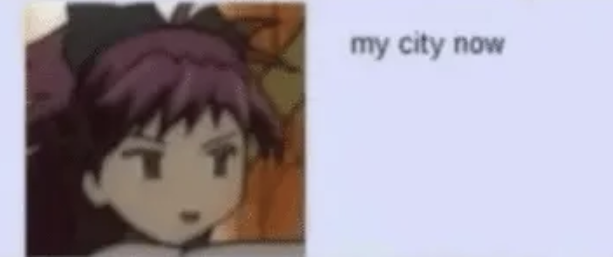
Amidst this chaotic flurry of poor syntax and artifacted JPEGs, one specific panel stood out. It featured a heavily compressed, low-quality image of the character Kyoko Sakura paired with the stark, assertive declaration: “my city now.”
Initially, the image functioned strictly within the insular ecosystem of the Meduka Meguca threads, serving as a humorous punctuation mark for a character seizing control of a narrative territory. However, the sheer absurdity of the visual—coupled with the deadpan economy of its phrasing—ensured that it would not remain confined to a single 4chan thread.
The Mid-2010s: Migration to Tumblr and the Mechanics of Decontextualization
As the Meduka Meguca threads faded into the archives of internet history, individual assets began to circulate independently. The primary vector for this second-wave distribution was Tumblr, a platform uniquely suited for the rapid recycling and recontextualization of reaction images.
By the mid-to-late 2010s, Tumblr users had begun stripping the "my city now" image macro entirely from its Madoka Magica context. Freed from the narrative constraints of magical girl trauma, the image transformed into a versatile reaction macro. It was increasingly utilized to denote a state of solitary dominion—most notably the classic "when you’re home alone and the house is entirely yours" scenario—or to playfully express an aggressive takeover of physical or conceptual spaces.
A pivotal moment in the meme’s mainstream migration occurred between 2016 and early 2017, when Tumblr user tempestrune captured a photograph of a fast-food restaurant sign reading, "GET BIG SANDWICH YOUR CITY NOW." Recognizing an organic alignment with the internet vernacular, tempestrune appended the "my city now" reaction image directly beneath the sign. The resulting post bridged the gap between absurd real-world signage and niche anime shitposting, generating over 115,145 notes and introducing the meme to thousands of users who had never heard of Madoka Magica.
2017–2020: Expansion Across Platforms and Conceptual Abstraction
Buoyed by its success on Tumblr, the meme rapidly breached other digital frontiers, most notably Reddit. On May 3rd, 2017, Reddit user u/TheCykaNeverStops posted the reaction image to the r/tumblr subreddit in a thread mocking actor Mark Hamill’s public relationship with the Star Wars franchise and his penchant for sharing elaborate, unofficial narrative concepts.
The meme’s utility lay in its inherent elasticity. It could be stamped onto almost any scenario where an individual, entity, or creature asserted dominance over a pre-existing domain.
- In evolutionary biology memes: Used to depict domestic cats and dogs casually bypassing the complex intellectual hurdles of human evolution to simply dominate human households ("my city now").
- In historical humor: Deployed by Tumblr user thoodleoo to encapsulate the ancient Roman approach to foreign religion—absorbing external deities into the Roman pantheon with an implicit, imperialist shrug ("my gods now").
- In pop culture commentary: Utilized by fans of media franchises to express the urge to completely rewrite poorly managed plotlines or character arcs.
2024: The AO3 Renaissance and the "Fuck Canon" Phenomenon
The most recent major evolution of the "My City Now" phenomenon occurred in April 2024, cementing its status as permanent digital folklore. Reddit user u/EvanTheTrashPanda sparked a viral discussion on r/AO3 (referencing Archive of Our Own, the world’s largest fanfiction repository) by inquiring about the meaning and origin of the recurring fanfiction tag: “Fuck Canon My City Now.”
The discussion thread quickly drew hundreds of replies dissecting the psychology of fandom culture. Contributors noted that the tag encapsulates the ultimate rejection of established authorial intent in favor of a creator’s personal headcanon. It represents a declaration of creative sovereignty: “I am taking this fictional universe over with my own ideas; the original text no longer binds me.”
Crucially, this 2024 Reddit thread also served an educational function for younger or less internet-history-versed users. Veterans of the web stepped forward to trace the tag’s lineage directly back to the 2011 Meduka Meguca thread, bridging a 13-year generational gap in internet culture and proving that memes born in the digital underground can successfully encode themselves into the permanent vocabulary of creative communities.
Supporting Context & Metrics
To fully grasp the cultural footprint of "My City Now," it is helpful to examine the quantifiable markers of its spread across major social platforms:
- Platform Versatility: While originating on 4chan, the meme achieved its highest engagement metrics on Tumblr and Reddit, where text-and-image pairing formats facilitate rapid reblogging and screenshot sharing.
- The AO3 Tag Economy: On Archive of Our Own, variations of "My City Now" appear as user-generated tags across thousands of individual fanworks, serving as a primary content-warning and thematic indicator for alternate universes (AUs) and heavy divergence from source material.
- Longevity Index: Surviving actively for over 13 years (2011–2024), "My City Now" represents an exceptionally rare longevity class for image macros, outliving countless flash-in-the-pan viral sensations due to its adaptability as a general reaction format.
Official Statements & Community Discourse
While "My City Now" is an organic, decentralized internet meme devoid of corporate ownership or official spokespersons, the community discourse surrounding its usage offers fascinating insights into modern digital literacy.
In various Reddit threads analyzing the meme’s resurgence—most notably the April 2024 r/AO3 discussions—community members frequently commented on the democratization of narrative spaces.
"It doesn’t have to mean canon was inherently garbage," noted one prominent commenter in the archival discussion. "Rather, the author is simply choosing to actively disregard established boundaries in favor of their personal vision. It’s the digital equivalent of ‘I reject your reality and substitute my own.’ When you see ‘My City Now,’ you know the creator is steering the ship."
Furthermore, digital anthropologists often point to phenomena like Meduka Meguca as early precursors to modern shitposting aesthetics. The intentional embrace of poor typography, deep-fried image compression, and absurd phonetic spellings—traits that define contemporary meme pages on Instagram and TikTok—were pioneered in spaces like 4chan’s /a/ board. "My City Now" stands as a preserved fossil of that transitional era, having successfully mutated from an insular injoke into a globally recognized symbol of creative takeover.
Future Outlook
As the internet continues to evolve away from static image boards toward short-form video algorithms and heavily moderated corporate platforms, the future lifespan of text-and-image macros like "My City Now" faces unique pressures. Yet, its deep entrenchment in robust subcultures—particularly creative writing and fanfiction communities—guarantees its survival for the foreseeable future.
The phrase has achieved the ultimate evolutionary milestone for digital folklore: it has become decoupled from its source material. Very few users typing "my city now" or tagging a story with "Fuck Canon My City Now" in 2024 possess any conscious awareness of Kyoko Sakura or the 2011 Meduka Meguca threads.
Instead, the meme operates as autonomous linguistic currency. It is a testament to the resilience of internet culture, proving that when communities are given the tools to collaboratively mock, distort, and rebuild the media they consume, they can forge enduring cultural artifacts that outlast the very platforms and franchises that inspired them.