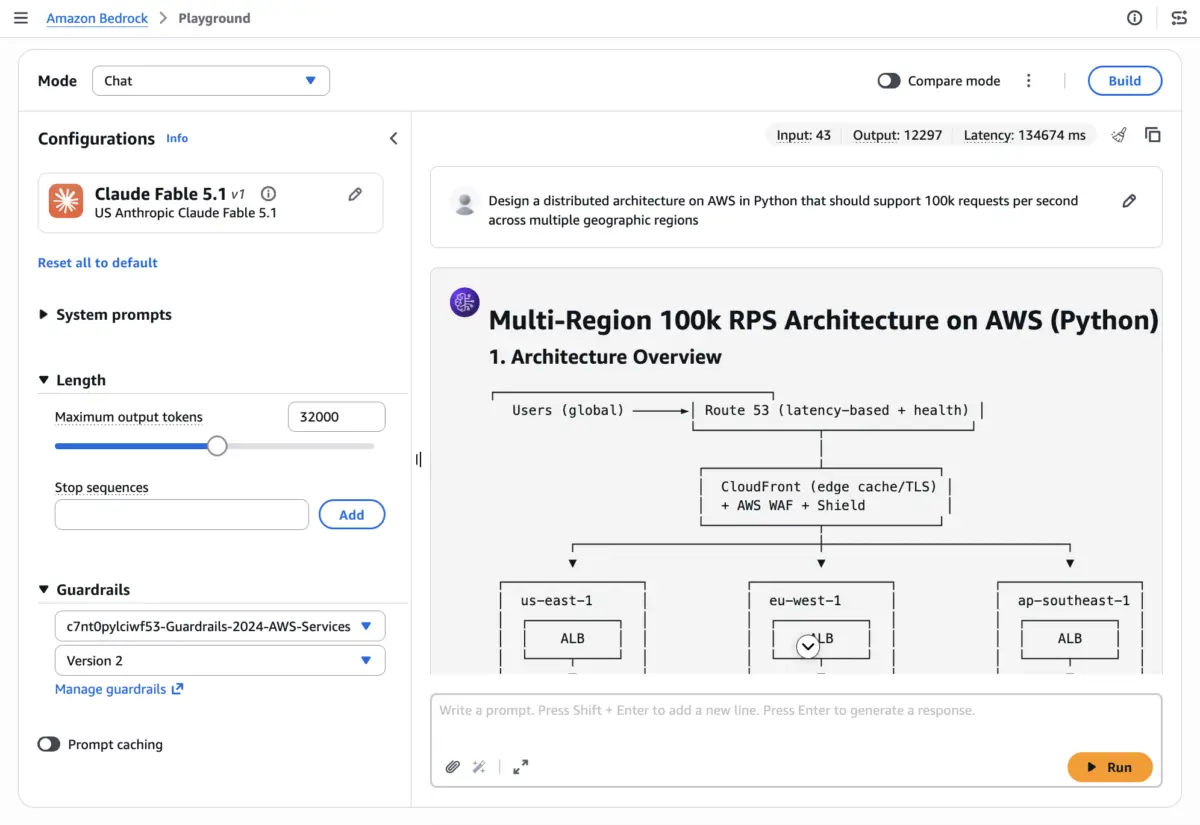
The landscape of enterprise artificial intelligence shifted significantly last week with the official availability of Claude Fable 5.1 on Amazon Web Services (AWS). Developed by Anthropic and integrated seamlessly into the AWS ecosystem, Claude Fable 5.1 arrives as a purpose-built solution designed to handle "frontier intelligence" tasks. Unlike smaller models optimized for quick question-and-answer interactions or single-turn prompts, Fable 5.1 is explicitly engineered for long-running, high-stakes operational workflows that span multiple hours and integrate across vast applications.
For enterprise architects, software engineering leads, and data science teams, the arrival of Claude Fable 5.1 represents a massive leap forward. The model is capable of operating autonomously over extended periods—owning large portions of complex software projects, executing features across an entire codebase, conducting rigorous code reviews, and performing intricate performance optimizations.
However, alongside these advanced cognitive capabilities comes a vital paradigm shift in data governance and security. Anthropic has categorized Fable 5.1 as a "Covered Model," a designation that introduces specialized data retention protocols, mandatory safety reviews, and rigid access policies. Through a collaborative effort between AWS and Anthropic, the release also debuts the new aws_review data retention mode and Enterprise Frontier Safeguards (EFS). These features ensure that organizations can harness the bleeding-edge intelligence of high-stakes models while maintaining strict control over their proprietary corporate data within secure, compliant cloud boundaries.
As developers and enterprises evaluate the dual access pathways—Amazon Bedrock and the Claude Platform on AWS—this integration marks a watershed moment in how foundational AI models are deployed, governed, and scaled in enterprise environments.
Detailed Chronology & Technical Integration
The deployment of Claude Fable 5.1 on AWS is the culmination of months of engineering collaboration aimed at closing the gap between general-purpose language models and specialized, autonomous enterprise agents.
The Operational Scope of Claude Fable 5.1
Historically, enterprise deployment of Large Language Models (LLMs) has been bottlenecked by context limitations, drift during multi-hour tasks, and a lack of holistic codebase comprehension. Claude Fable 5.1 addresses these structural limitations head-on.
According to technical briefs released by Anthropic and AWS, Fable 5.1 delivers frontier-tier intelligence optimized for three primary pillars of complex work:
Advanced Software Engineering: The model can ingest and reason over multi-repository codebases. It is built to maintain context across extended engineering sessions, allowing it to plan, write, test, and debug features spanning an entire software project rather than isolated functions.
Scientific Research: In domains requiring deep multi-step logic—such as parsing extensive clinical trial data, synthesizing complex chemical literature, or formulating research hypotheses—Fable 5.1 maintains sustained reasoning chains without degrading in output quality.
Enterprise Workflows: For large-scale business operations that require synthesizing unstructured data from diverse software applications over hours or days, Fable 5.1 acts as a persistent cognitive engine.
Dual Access Pathways on AWS
To ensure flexibility for developers and enterprise IT administrators, AWS has made Claude Fable 5.1 available via two distinct, deeply integrated pathways:
Amazon Bedrock: The fully managed AWS service that makes foundation models accessible via an API. By integrating Fable 5.1 into Bedrock, AWS allows organizations to build generative AI applications using familiar tools, serverless architectures, and robust security frameworks without managing underlying infrastructure.
Claude Platform on AWS: Designed for power users and organizations seeking direct, specialized environments optimized explicitly for Anthropic’s model architecture, offering streamlined deployment configurations and fine-grained control.
Supporting Context, Security Metrics, and Governance
Deploying frontier-intelligence models in enterprise settings inherently introduces complex security and compliance challenges. Because models like Claude Fable 5.1 possess advanced reasoning capabilities capable of handling sensitive, high-stakes data, governance cannot be an afterthought.
The "Covered Model" Framework
Anthropic has designated Fable 5.1 as a Covered Model. This classification applies to a select tier of models that carry enhanced regulatory scrutiny, safety compliance policies, and tailored data handling requirements regardless of the deployment venue.
To operationalize this safely within enterprise cloud architectures, AWS and Anthropic have introduced robust governance mechanics:
The aws_review Data Retention Mode: Under this newly introduced configuration within Amazon Bedrock, user prompts and model outputs are securely retained for up to 30 days to facilitate human safety reviews conducted exclusively by authorized Amazon personnel. This mode is designed to catch edge-case safety violations, hallucinations, or harmful outputs in high-stakes operational environments.
Legacy vs. Modern Protocols: AWS explicitly separates this workflow from legacy models. The older provider_data_share mode is now legacy, reinforcing the security guarantee that Amazon Bedrock does not share customer data with external model providers for training or unvetted analysis. All data handling under the aws_review mode remains strictly governed within the secure perimeter of the AWS cloud boundary.
Enterprise Frontier Safeguards (EFS): Developed jointly by AWS and Anthropic, EFS is a breakthrough security layer. It enables eligible enterprise customers to leverage Covered Models like Fable 5.1 while ensuring that their proprietary data never leaves an environment under their direct administrative and cryptographic control. EFS provides the auditing, residency, and encryption controls required by heavily regulated industries such as finance, healthcare, and government defense.
Official Statements and Industry Impact
Industry analysts and engineering leaders have quickly recognized the significance of the Fable 5.1 launch. The convergence of Anthropic’s model capability with AWS’s unmatched cloud infrastructure signals a maturing market where enterprise AI is moving past experimental chatbots into deeply integrated autonomous workflows.
In technical release communications, AWS product leads emphasized the transformative nature of long-running agentic workflows:
"Enterprise customers are no longer looking for models that can simply answer a prompt in isolation. They are demanding systems that can reason across massive codebases, maintain context over hours of complex problem-solving, and operate reliably within strict security parameters. The launch of Claude Fable 5.1 on Amazon Bedrock, backed by our collaborative safety frameworks, delivers precisely that capability."
Anthropic representatives echoed this sentiment, highlighting the importance of the Covered Model governance structure:
"As models grow more autonomous and capable of handling ambitious enterprise tasks, the partnership between model developer and cloud provider must evolve. By working closely with AWS on Enterprise Frontier Safeguards and the aws_review mode, we are ensuring that organizations can push the boundaries of software engineering and scientific research without compromising on trust, safety, or data privacy."
Early adopters in the software development and financial technology sectors have reported significant productivity gains during initial beta testing. Engineering teams noted that Fable 5.1’s ability to autonomously manage multi-file code refactoring and comprehensive peer reviews has drastically reduced the manual overhead traditionally associated with massive technical migrations.
Future Outlook: What This Means for Builders and Enterprises
The integration of Claude Fable 5.1 on AWS is not merely a routine model update; it is a foundational milestone that points toward the future of software development and enterprise automation.
As organizations transition from proof-of-concept AI implementations to mission-critical production deployments, several trends are poised to accelerate:
The Rise of Autonomous Agentic Workflows: With models capable of sustaining multi-hour logical execution, software teams will increasingly delegate repetitive, complex engineering chores—such as exhaustive test-suite generation, legacy code modernization, and continuous security auditing—to AI agents running on AWS.
Stricter Compliance-First AI Adoption: The pioneering framework established by the aws_review mode and Enterprise Frontier Safeguards will likely become the benchmark for enterprise AI. Organizations will demand transparent, auditable boundaries where advanced intelligence does not come at the expense of data sovereignty.
Deepened Ecosystem Synergy: As AWS continues to expand its generative AI portfolio, developers can expect tighter integrations between Claude Fable 5.1 and native AWS services like AWS Lambda, Amazon CodeWhisperer (or its successor environments), and advanced vector databases like Amazon OpenSearch Serverless.
Furthermore, builders are encouraged to connect with peers, share innovative architectures, and explore hands-on labs at upcoming industry events, including AWS re:Invent, regional AWS Summits, and local AWS Community Days. Joining the AWS Builder Center provides an immediate avenue to collaborate with fellow engineers who are actively deploying frontier models into production.
As the generative AI landscape continues its rapid ascent, tools like Claude Fable 5.1 on AWS demonstrate that the future of enterprise technology belongs to systems that combine raw cognitive power with uncompromising security and governance.