Executive Overview
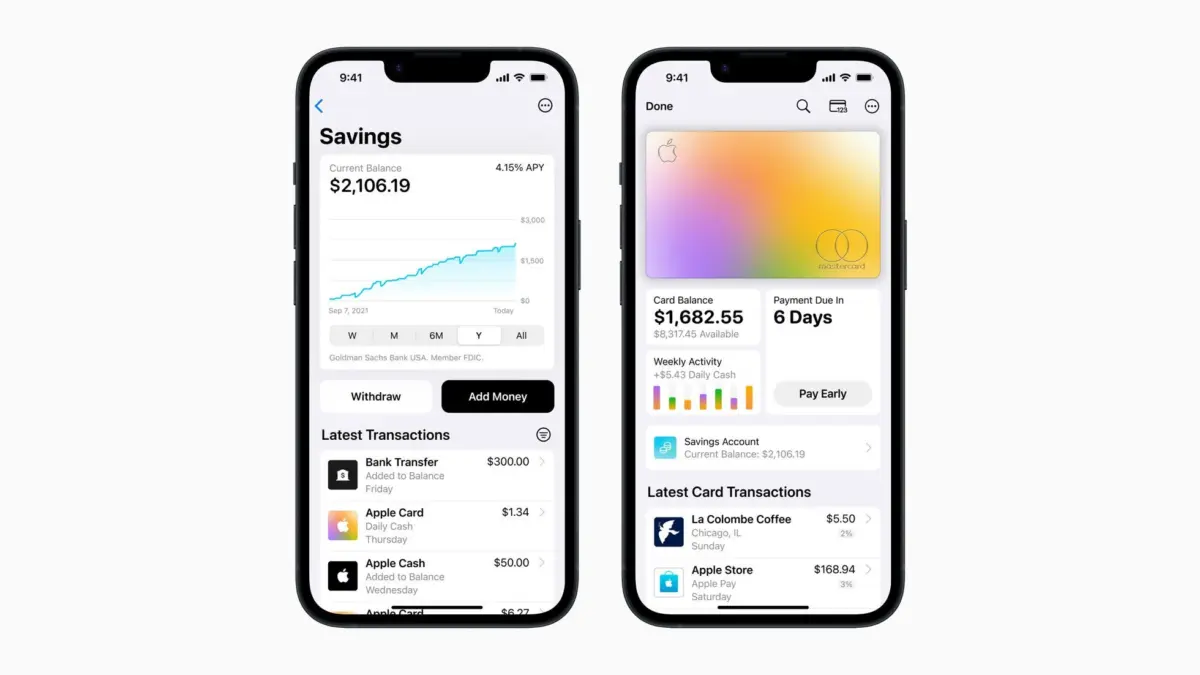
In a strategic maneuver that further blurs the traditional boundaries between Silicon Valley and Wall Street, Apple—in tandem with its banking partner Goldman Sachs—officially launched a high-yield savings account tailored specifically for Apple Card holders. Announced on a Monday morning that sent ripples through both the fintech and traditional banking sectors, the new offering allows users to deposit and grow their funds at a striking Annual Percentage Yield (APY) of 4.15%.
This development is far more than a mere perk for loyal Apple ecosystem consumers; it represents a calculated escalation in Apple’s broader crusade to dominate personal finance. By bridging the gap between everyday consumer spending and wealth accumulation, Apple is positioning the iPhone not just as a communication and entertainment hub, but as the primary dashboard for an individual’s financial life.
At launch, the core utility of the account centers on "Daily Cash"—the rewards program native to the Apple Card that pays users a percentage of their purchases back in cash. Historically, these rewards accumulated in a digital card balance or were applied as a statement credit. Now, users can automatically route their Daily Cash directly into the newly introduced high-yield savings vehicle, watching passive rewards compound at a rate that dwarfs the national average.
However, the ambitions of Apple and Goldman Sachs extend well beyond micro-savings derived from morning coffee runs and grocery trips. The platform permits users to deposit external funds directly from linked traditional bank accounts, up to a maximum balance of $250,000, fully insured by the Federal Deposit Insurance Corporation (FDIC) through Goldman Sachs Bank USA.
While a 4.15% APY is not the absolute highest yield obtainable in the hyper-competitive contemporary high-yield savings market—where several online-only neo-banks and credit unions push past the 5% threshold—the seamless integration within the iOS Wallet app introduces an unprecedented level of frictionless convenience. This launch arrives on the heels of other aggressive financial rollouts, most notably the "Apple Pay Later" service introduced just weeks prior. Together, these initiatives signal a systemic shift in how consumers interact with their money, posing a formidable challenge to legacy financial institutions that have long relied on customer inertia and microscopic interest rates to protect their profit margins.
Detailed Chronology
To fully understand the weight of Apple’s entry into high-yield savings, it is necessary to examine the meticulous, multi-year chronology that laid the groundwork for this announcement. Apple’s transition from a hardware and software titan into a consequential financial services player has been methodical, patient, and deliberate.
The Genesis: Apple Pay and the Credit Card Ambition
The foundation was laid in October 2014 with the rollout of Apple Pay. Initially met with skepticism by legacy retailers and traditional banks, Apple Pay gradually transformed contactless mobile payments. It familiarized hundreds of millions of consumers with the concept of storing sensitive financial credentials securely within the secure enclave of an iPhone.
Once consumer trust in mobile transactions was established, Apple took the next logical leap. In March 2019, during a special event at the Steve Jobs Theater, the company unveiled the Apple Card, engineered in collaboration with Goldman Sachs and backed by Mastercard. Released later that summer, the card discarded traditional credit card tropes: it featured no late fees, no annual fees, no international fees, and introduced a minimalist titanium physical card alongside a deeply integrated digital card managed entirely within the iOS Wallet app. Crucially, the card introduced Daily Cash, an instant gratification reward system that paid users back immediately rather than forcing them to wait for a monthly billing cycle.
Expanding the Ecosystem: Installments and BNPL
With the Apple Card firmly established as a lifestyle accessory and a viable credit product, Apple began weaving more financial utility into the operating system. In 2020, the company introduced Apple Card Monthly Installments, allowing users to purchase Apple hardware—such as iPhones, Macs, and iPads—interest-free over a 12-month period, charged directly to their card.
This philosophy of flexible, consumer-friendly credit culminated in March 2023 with the launch of "Apple Pay Later." Designed to compete directly with established Buy Now, Pay Later (BNPL) giants like Klarna, Affirm, and Afterpay, this feature allowed users to split purchases into four payments spread over six weeks, entirely free of interest and hidden fees. Integrated smoothly into the checkout flow of participating merchants, Apple Pay Later demonstrated Apple’s capacity to handle complex underwriting and short-term lending at scale—all managed through its proprietary infrastructure, dubbed Apple Financing LLC, a wholly-owned subsidiary responsible for handling state licenses and lending decisions for the BNPL product.
The Savings Account Debut
The logical culmination of accumulating Daily Cash and expanding credit offerings was a dedicated repository where funds could grow. Rumors of an Apple-branded savings account had circulated in tech and financial circles for over a year, following Apple’s acquisition of Credit Kudos, a UK-based open banking startup, in early 2022.
On a Monday morning in April 2023, the speculation ended. Apple officially flipped the switch on the high-yield savings account feature for U.S. Apple Card holders. By allowing Daily Cash to be swept directly into the new account, and simultaneously permitting external Automated Clearing House (ACH) transfers from outside bank accounts, Apple effectively transformed the iPhone Wallet app into a hybrid checking, credit, and savings ecosystem.
Supporting Context & Metrics
The timing of Apple’s high-yield savings account launch is not accidental. It arrives during a unique macroeconomic period characterized by high interest rates, aggressive monetary tightening by the U.S. Federal Reserve, and a shifting consumer mindset regarding where and how to store cash.
The Macroeconomic Environment and the War on Low Yields
For over a decade following the 2008 financial crisis, interest rates hovered near historic lows. During this epoch of cheap capital, traditional brick-and-mortar banks felt little pressure to compete for deposits. Consequently, retail banking behemoths accustomed consumers to insultingly low yields—frequently hovering around 0.01% APY on standard savings accounts.
However, as inflation surged in 2022 and 2023, the Federal Reserve aggressively hiked its benchmark interest rate, driving the cost of borrowing up. While online neo-banks and specialized fintech platforms rapidly raised their savings rates to attract liquidity, traditional high-street banks dragged their feet, pocketing the widening net interest margin—the spread between what they pay depositors and what they earn by lending money out.
Apple’s 4.15% APY exposes this chasm starkly. To put the figure into perspective:
- Bank of America (Standard Savings): 0.01% APY
- Chase Bank (Standard Savings): 0.01% APY
- Wells Fargo (Standard Savings): 0.01% APY
- Apple / Goldman Sachs High-Yield Savings: 4.15% APY
A consumer keeping $10,000 in a traditional Bank of America savings account would earn a paltry $1.00 over the course of a year. That same $10,000 deposited into the Apple Card high-yield savings account yields approximately $415 over the same timeframe. While macroeconomic conditions mean that Apple’s 4.15% APY is variable and subject to change at any moment based on Federal Reserve policy shifts, the immediate disparity sent shockwaves through the retail banking sector.
The Mechanics of the Partnership: Apple and Goldman Sachs
It is crucial to dissect the operational architecture behind this product. Apple is not a chartered bank; legally, it cannot hold deposits or issue loans under its own banking license in the United States. To circumvent this regulatory hurdle, Apple relies on Goldman Sachs Bank USA as the issuing bank.
For Goldman Sachs, this partnership represents a cornerstone of its consumer banking pivot, branded under Marcus by Goldman Sachs. While Goldman’s high-end investment banking division remains its traditional bread and butter, the firm has sought stable, low-cost retail deposits to fund its broader operations. Partnering with Apple grants Goldman access to the ultimate funnel: hundreds of millions of affluent, highly engaged consumers carrying iPhones in their pockets.
However, this partnership has not been without its operational friction. Reports have occasionally surfaced regarding the complex regulatory and technological integrations required to marry Goldman’s legacy banking infrastructure with Apple’s pristine, user-centric software design. Despite these behind-the-scenes challenges, the synergy between Apple’s front-end user experience and Goldman’s back-end banking license has yielded one of the most frictionless onboarding processes in the history of retail finance.
Limits, Protections, and the Competitive Landscape
To ensure regulatory compliance and manage risk, Apple and Goldman Sachs established clear guardrails for the account:
- Deposit Limits: Users can deposit up to $250,000 into the savings account.
- FDIC Insurance: Because the funds are held by Goldman Sachs, they are protected by the Federal Deposit Insurance Corporation up to the standard statutory limit of $250,000 per depositor.
- No Fees: In true Apple Card fashion, there are no monthly maintenance fees, no minimum balance requirements, and no minimum deposit requirements.
While 4.15% is an attractive yield, it is worth noting that it does not claim the absolute crown in the broader savings market. At the time of the rollout, top-tier competitors such as Wealthfront, Betterment, Ally Bank, and various credit unions offered APYs fluctuating between 4.50% and 5.25%.
Yet, financial analysts emphasize that yield is only one variable in consumer decision-making. Friction is often a greater barrier to financial optimization than interest rates. Millions of Americans park their money in low-yield accounts simply because moving funds between institutions feels tedious, requiring account numbers, routing numbers, micro-deposits, and multi-day waiting periods. By placing the savings account two taps away inside the iOS Wallet app, Apple eliminates the psychological and logistical friction that keeps capital trapped in legacy banks.
Official Statements
The strategic intent behind the product was articulated clearly by Apple’s executive leadership during the launch window.
Jennifer Bailey, Apple’s vice president of Apple Pay and Apple Wallet, framed the initiative as a public service designed to improve consumer financial wellness through design integration:
"Our goal is to build tools that help users lead healthier financial lives, and building Savings into Apple Card in Wallet enables them to spend, send, and save Daily Cash directly and seamlessly — all from one place."
This statement underscores Apple’s core philosophy: ecosystem lock-in achieved not through restrictive barriers, but through unmatched convenience and user experience. By framing financial management as a matter of "health"—echoing the language Apple uses for its Apple Watch health and fitness tracking features—the company seeks to position itself as a benevolent guardian of the consumer’s economic well-being.
Goldman Sachs executives similarly championed the partnership, emphasizing how the collaboration marries institutional financial strength with consumer-facing technological innovation. Harit Talwar, then-head of Goldman Sachs Consumer Business, previously noted that the collaboration aimed to deliver transparent, consumer-centric financial products that challenge antiquated banking norms.
Future Outlook
As the dust settles on the initial launch, industry watchers and financial analysts are casting their gaze forward. What does the introduction of an Apple-branded high-yield savings account portend for the future of banking, technology, and consumer behavior?
The Threat to Legacy Retail Banks
For decades, legacy financial institutions enjoyed a structural monopoly on consumer deposits. Checking and savings accounts served as sticky anchors; once a consumer established a primary checking account with a bank like Chase, Wells Fargo, or Bank of America, they rarely left, enduring meager interest rates and hidden fees out of sheer habit.
Apple’s high-yield savings account, combined with the Apple Card and Apple Pay Later, systematically dismantles this inertia. If a consumer realizes they can earn 4.15% on their liquid cash while managing it through the same interface they use to board flights, unlock hotel rooms, and pay for groceries, the psychological pull of the traditional brick-and-mortar branch weakens significantly.
While Apple is currently restricted to the United States, the playbook is infinitely scalable. Should regulatory approvals and banking partnerships clear in international markets across Europe, Asia, and Latin America, the implications for global retail banking would be profound.
The Evolution of Super-Apps in the West
In Asian markets, particularly China, "super-apps" like WeChat and Alipay have long integrated social networking, messaging, e-commerce, and robust financial services—including wealth management, loans, and savings—into single, unified applications.
Western technology companies have long coveted this level of integration, but regulatory fragmentation, consumer privacy concerns, and entrenched legacy systems have slowed adoption. Apple, however, is uniquely positioned to forge a Western super-app disguised as an operating system. By controlling both the hardware (iPhone) and the software layer (iOS, Wallet, Apple Pay), Apple can embed financial services natively into the daily digital routines of over a billion active users.
Potential Roadblocks and Scrutiny
Despite the glowing initial reception, Apple’s deepening foray into financial services will not go unchallenged. Regulatory scrutiny is intensifying globally. Antitrust regulators in the United States and the European Union are closely examining whether Apple leverages its control over the iPhone’s near-field communication (NFC) chip and the iOS App Store to stifle third-party financial competitors. Furthermore, as Apple handles larger volumes of financial transactions and savings deposits, it may find itself subject to the same rigorous, heavy-handed regulatory compliance frameworks that govern traditional tier-one financial institutions.
Additionally, the sustainability of high interest rates remains tied to macroeconomic policy. Should the Federal Reserve pivot toward monetary easing and interest rate cuts in the coming years, high-yield savings rates across the board will inevitably decline, testing whether consumers remain loyal to the Apple ecosystem when the yield differential narrows.
Conclusion
Apple’s introduction of a 4.15% APY high-yield savings account in partnership with Goldman Sachs is much more than a spring product update. It is a calculated, structural chess move in the ongoing convergence of big tech and global finance. By offering an interest rate that shames traditional banks, backed by the frictionless security of the iOS Wallet app, Apple has once again demonstrated its mastery of ecosystem design.
For consumers willing to step outside the archaic comfort of legacy banking, the choice is clear. For Wall Street and Silicon Valley alike, the message is unmistakable: the future of money management belongs to those who control the interface, and Apple has just captured prime real estate in the palm of your hand.