Executive Overview
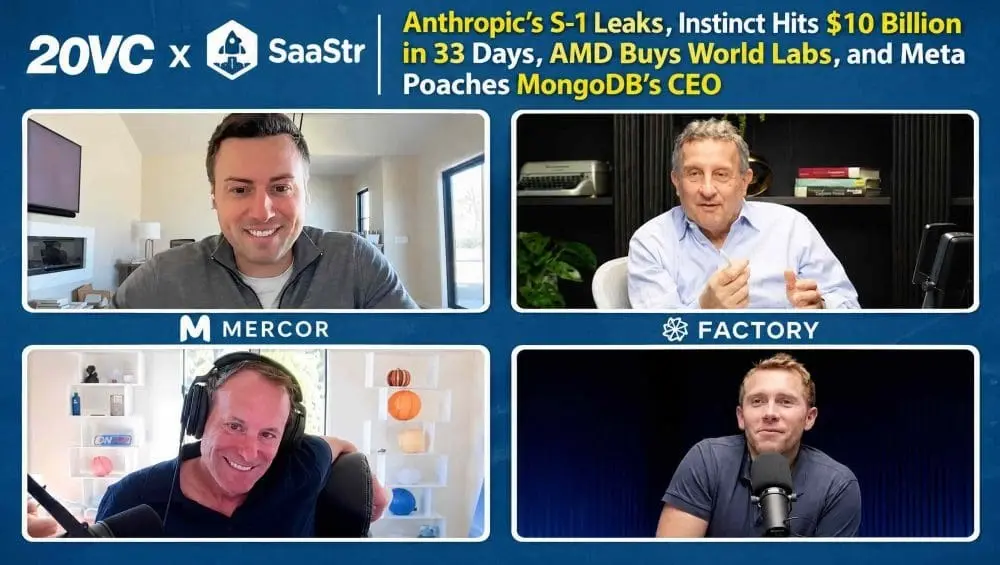
The venture capital and technology landscapes are experiencing a period of unprecedented acceleration, characterized by astronomical valuations, compressed funding timelines, and high-stakes market maneuvers. In a recent, highly anticipated crossover episode of the 20VC x SaaStr collaboration, host Harry Stebbings welcomed a heavy-hitting panel: Jack Altman (General Partner at Benchmark), Rory O’Driscoll (Partner at Scale Venture Partners), and Jason Lemkin (Founder of SaaStr).
With Benchmark having recently co-led a staggering $1 billion funding round into consumer AI agent platform Instinct at a $10 billion valuation—just 33 days after a $2.5 billion valuation milestone—the panel brought insider perspectives to the macroeconomic forces reshaping technology investing.
The discussion traversed a volatile news cycle: Anthropic’s leaked draft S-1 revealing jaw-dropping compute commitments and operating losses; AMD’s landmark $8.2 billion acquisition of Fei-Fei Li’s World Labs; Meta poaching MongoDB’s CEO to lead its enterprise AI division; Oura pulling its highly anticipated IPO two days before pricing; and Nubank’s rumored pursuit of UK neobank Monzo.
This analytical deep-dive unpacks the core themes, financial metrics, and strategic debates dominating the venture ecosystem as the industry navigates a paradigm where early-stage risk commands growth-stage capital.
Detailed Chronology: Key Industry Shocks and Strategic Debates
1. Anthropic’s Leaked Draft S-1: Scale, Losses, and Compute Commitments
Anthropic’s leaked draft S-1 prospectus revealed a company operating at an unprecedented scale. For 2025, the AI pioneer projected $4.6 billion in revenue against an $8 billion operating loss, while amassing a jaw-dropping $518 billion in projected cloud, compute, and infrastructure commitments. Concurrently, reports indicate that the company is delaying its public offering, likely waiting until after the U.S. midterm elections.
The panel debated the implications of these figures:
- The Optics vs. Fundamentals Divide: Rory O’Driscoll noted that the staggering net losses are largely non-cash accounting items, with the core operating reality matching expectations: roughly $4.5 billion in revenue, $8 billion in compute, and $5 billion in other expenses. A critical new data point revealed that two customers accounted for 25% of revenue—translating to roughly half a billion dollars spent by a single entity.
- Public Perception and Regulatory Risk: Jason Lemkin expressed concern over public optics, warning of a potential Facebook-style IPO trajectory—oversubscribed at pricing, followed by a post-debut drift downward amid anti-AI sentiment and data center backlash. O’Driscoll added that while the general public may harbor skepticism toward data centers, institutional growth funds drive public market pricing. However, he flagged that internal disclosures warning of existential safety risks provide state attorneys general with legal footholds for future litigation.
2. Instinct’s Meteoric Rise: $1B at $10B Valuation
Consumer agent platform Instinct captured industry-wide attention by raising $1 billion at a $10 billion valuation led by Sequoia Capital, Benchmark Capital, and Coatue—merely 33 days after securing a round at a $2.5 billion valuation. Having launched its invite-only service as recently as August 2026, the company is already pacing toward $1 billion in annual transactions, with travel accounting for over 50% of volume.
Benchmark General Partner Jack Altman articulated the thesis behind the check: consumer agents acting across the entire third-party internet represent a paradigm shift on par with chat interfaces and coding assistants. As AI transitions from a conversational novelty to an execution engine, multiple winners will inevitably emerge.
The panel debated the "all-day usage" test. Lemkin emphasized that enduring agent categories must integrate into daily workflows—similar to how developers utilize coding agents for ten hours a day. Harry Stebbings admitted to shifting his daily life management entirely to Instinct, underscoring how rapidly form factors can cannibalize traditional chat interfaces as screen time remains a zero-sum game.
3. AMD Acquires World Labs for $8.2 Billion
In the first major exit for a "neolab," semiconductor giant AMD announced the acquisition of Fei-Fei Li’s World Labs for $8.2 billion in stock, roughly two and a half years after its founding.
O’Driscoll highlighted the historic trajectory of Dr. Fei-Fei Li, whose foundational work on ImageNet in 2012 catalyzed the deep learning revolution. Lemkin contextualized AMD’s financial positioning: with its stock surging 279% over the year to reach a roughly $1 trillion market cap, spending less than 1% of its valuation to secure world-class technical talent and remain competitive against Nvidia represents a calculated, highly strategic capital deployment.
4. The Structural Transformation of Seed and Growth Funding
A central macroeconomic debate centered on the near-total disappearance of traditional $3 million to $6 million seed checks in mainstream AI lanes.
- The Death of Traditional Seed Rounds: Jack Altman argued that two forces have dismantled the traditional seed round: foundational labs requiring minimum capital outlays north of $200 million, and hyper-connected founders bypassing traditional smaller rounds to raise $50 million out of the gate.
- The Sizing Dilemma: O’Driscoll framed modern venture dynamics as a cycle of "early-stage risk requiring super late-stage capital." Altman outlined Benchmark’s dual constraints when writing checks into ballooning rounds: maintaining adequate fund diversification (floors on shots on goal) while deploying sufficient capital to retain meaningful ownership (ceilings on ownership).
5. Meta Recruits MongoDB CEO, Sparking Stock Volatility
MongoDB shares plunged nearly 20% in morning trading following the departure of CEO Chirantan "CJ" Desai, who left the database provider to spearhead Meta’s newly formed enterprise AI division. Meta intends to commercialize its comprehensive technology stack—including the Muse AI model, Meta Business Agent, Muse API, and Muse Code—directly to businesses and developers. MongoDB swiftly appointed Dev Ittycheria as interim CEO and reaffirmed its financial guidance.
The panel characterized the move as a testament to the gravitational pull of current AI momentum. O’Driscoll noted that public company CEOs rarely step down to run business units unless incentivized by transformative compensation packages and alignment with the cultural zeitgeist.
Supporting Context & Metrics: Market Data at a Glance
To fully grasp the velocity of the current market cycle, consider the following data points and valuation milestones discussed by the panel:
| Company / Entity | Recent Milestone / Transaction | Key Financial & Strategic Metrics |
|---|---|---|
| Anthropic | Draft S-1 Leaked | Projected 2025 revenue of $4.6B; $8B operating loss; $518B in compute commitments. |
| Instinct | $1B raised at $10B valuation | Raised 33 days after a $2.5B valuation round; approaching $1B in annual transactions. |
| World Labs | Acquired by AMD for $8.2B | Exit realized roughly 2.5 years post-founding; strategic stock-based transaction. |
| TypeSafe AI (Jev) | Exploration of $1B round at $10B valuation | Seed-funded at $200M just weeks prior; inference priced at $0.042/M tokens. |
| Modal & Baseten | Valuation surges | Modal tripled to $15B; Baseten in discussions at a $26B valuation. |
| Oura | IPO pulled 2 days prior to pricing | Planned to raise $2.2B at a $15.62B valuation (range $40–$44/share). |
| Bessemer Venture Partners | Fresh capital deployment | Raised $5.75B, including a dedicated $1.75B seed fund. |
Official Statements and Quotable Insights
The discourse was punctuated by candid, highly quotable admissions from some of venture capital’s most influential voices:
-
Jack Altman on Investment Velocity:
"We’re definitely not investing at the right speed. We are either investing way too fast or way too slow. When both sides of the equation are this out of whack, the odds of having it right are zero."
-
Rory O’Driscoll on Capital-Risk Mismatches:
"In this cycle we’ve had investments with early-stage risk that require super late-stage capital, which is just definitionally a strange time to be playing."
-
Jason Lemkin on Enterprise Adoption Realities:
"No one wants to run on open-weight models on the floor at Dreamforce. Not a single customer I talked to is comfortable with it. I think open source has reached its maximum as a market share."
-
Harry Stebbings on Round Frequency:
"This is not the round that worries me. What worries me is when you have three rounds in three weeks with no material movement in between and no data suggesting anything is different."
Future Outlook: What Lies Ahead for Venture Capital and AI
As the industry looks toward 2027 and beyond, several structural trajectories are becoming clear:
- The Inevitability of M&A over Public Debuts for Neolabs: With tech giants possessing massive market capitalizations and eager to defend their moats against specialized competitors, $10 billion-plus corporate acquisitions are emerging as a faster, less friction-heavy liquidity alternative to traditional IPOs.
- The Maturation of Inference Clouds: While foundational labs control massive compute resources, infrastructure players specializing in inference—such as Modal and Baseten—are acting as essential index bets on the broader application ecosystem as enterprises increasingly post-train and optimize open-weight models.
- Heightened Public Market Scrutiny: High-profile IPO delays, such as Oura’s eleventh-hour withdrawal, and the complex public narratives surrounding Anthropic’s draft S-1 indicate that public investors will demand rigorous line-of-sight to unit economics, sustainable customer acquisition costs, and clear paths to profitability.
The intersection of astronomical capital formation and technological disruption guarantees that the venture ecosystem will remain volatile, intensely competitive, and defined by paradigm-shifting bets for the foreseeable future.