Executive Overview
In the fast-evolving landscape of enterprise cloud computing, data agility, security, and operational efficiency are the bedrock of competitive advantage. Organizations running complex, multi-tiered architectures on Amazon Web Services (AWS) have long grappled with the delicate balance of maintaining rigorous production data security while providing development, testing, and staging environments with fresh, production-grade datasets.
Building upon the release of Amazon Elastic Block Store (Amazon EBS) Volume Clones—which allowed users to create instantaneous, point-in-time volume copies within a single Availability Zone—AWS has fundamentally expanded this capability. The introduction of Cross-Account Volume Clones for Amazon EBS marks a significant milestone in cloud storage management. This newly launched feature empowers developers, DevOps engineers, and cloud architects to seamlessly copy EBS volumes across distinct AWS accounts. Crucially, it enables teams to optionally re-encrypt these datasets utilizing an AWS Key Management Service (AWS KMS) key native to the target account.
By bridging the traditionally rigid security boundaries between segregated AWS environments, this capability revolutionizes how enterprises handle software development lifecycles (SDLC). Production data can now be securely replicated, isolated, and transformed into staging or development environments with unprecedented speed. This reduces infrastructure overhead, enhances data governance, and eliminates the friction historically associated with cross-account data sharing.
Available immediately in all AWS Regions that currently support Amazon EBS Volume Clones, this feature integrates deeply with AWS Resource Access Manager (RAM) and modern AI-driven developer tooling, signaling a new era of intelligent, streamlined cloud operations.
Detailed Chronology: The Evolution of Amazon EBS Data Management
To fully appreciate the significance of cross-account volume clones, one must examine the iterative journey of Amazon EBS storage management and the persistent architectural challenges it addresses.
The Pre-Clone Era: Snapshots and Operational Overhead
For over a decade, Amazon EBS snapshots served as the primary mechanism for backup, disaster recovery, and data migration. While snapshots are undeniably robust—incrementally backing up data to Amazon S3—they were not natively designed for instantaneous, writeable performance replication. Creating a usable volume from a snapshot often involved provisioning delays, data hydration overhead, and complex multi-step automation scripts, particularly when data needed to traverse organizational boundaries or discrete AWS accounts.
Enterprises adhering to strict compliance frameworks and multi-account best practices (such as those recommended in the AWS Landing Zone or AWS Control Tower paradigms) typically segregate production workloads from development and testing environments. In these secure setups, a production database or application volume residing in Account A could not be easily, instantly, or securely mirrored into Account B for troubleshooting or feature testing without navigating a maze of manual snapshot sharing, permission grants, and volume creation delays.
The 2024 Breakthrough: Same-Zone Volume Clones
Recognizing the demand for rapid provisioning, AWS introduced Amazon EBS Volume Clones. This capability allowed users to generate instant, point-in-time, block-level copies of EBS volumes within the same Availability Zone. Unlike traditional snapshots, volume clones were immediately available for read and write operations, leveraging underlying storage virtualization to abstract the physical copying process.
While this innovation dramatically accelerated intra-account workflows—such as spinning up temporary testing rigs or rapid patching sandboxes—it remained bounded by single-account constraints. Organizations implementing modern microservices and decentralized multi-account architectures still hit a roadblock when data needed to cross account thresholds for centralized QA or compliance auditing.
The 2025/2026 Milestone: Cross-Account Capabilities and RAM Integration
Today’s release shatters those remaining account boundaries. By integrating Amazon EBS Volume Clones with AWS Resource Access Manager (RAM), AWS has bridged the gap between isolation and accessibility. Users can now initiate point-in-time volume clones that not only cross account lines but also adapt to the cryptographic governance of the destination environment through targeted AWS KMS re-encryption.

Furthermore, keeping pace with the rapid integration of artificial intelligence in software engineering, AWS has ensured that this feature is fully programmable. Through the AWS Model Context Protocol (MCP) Server and associated developer plugins, engineering teams can now manage, share, and clone cross-account volumes using natural language commands within their preferred AI coding assistants.
Step-by-Step Technical Implementation Guide
Implementing cross-account volume clones requires a collaborative configuration between the source account owner and the target account administrator. Below is the definitive technical workflow to execute a secure cross-account EBS volume clone.
Step 1: Initiating the Share from the Source Account
The process begins within the source AWS account where the original, production-grade EBS volume resides.
- Navigate to the Amazon EBS console within the AWS Management Console.
- Locate the specific volume designated for cloning.
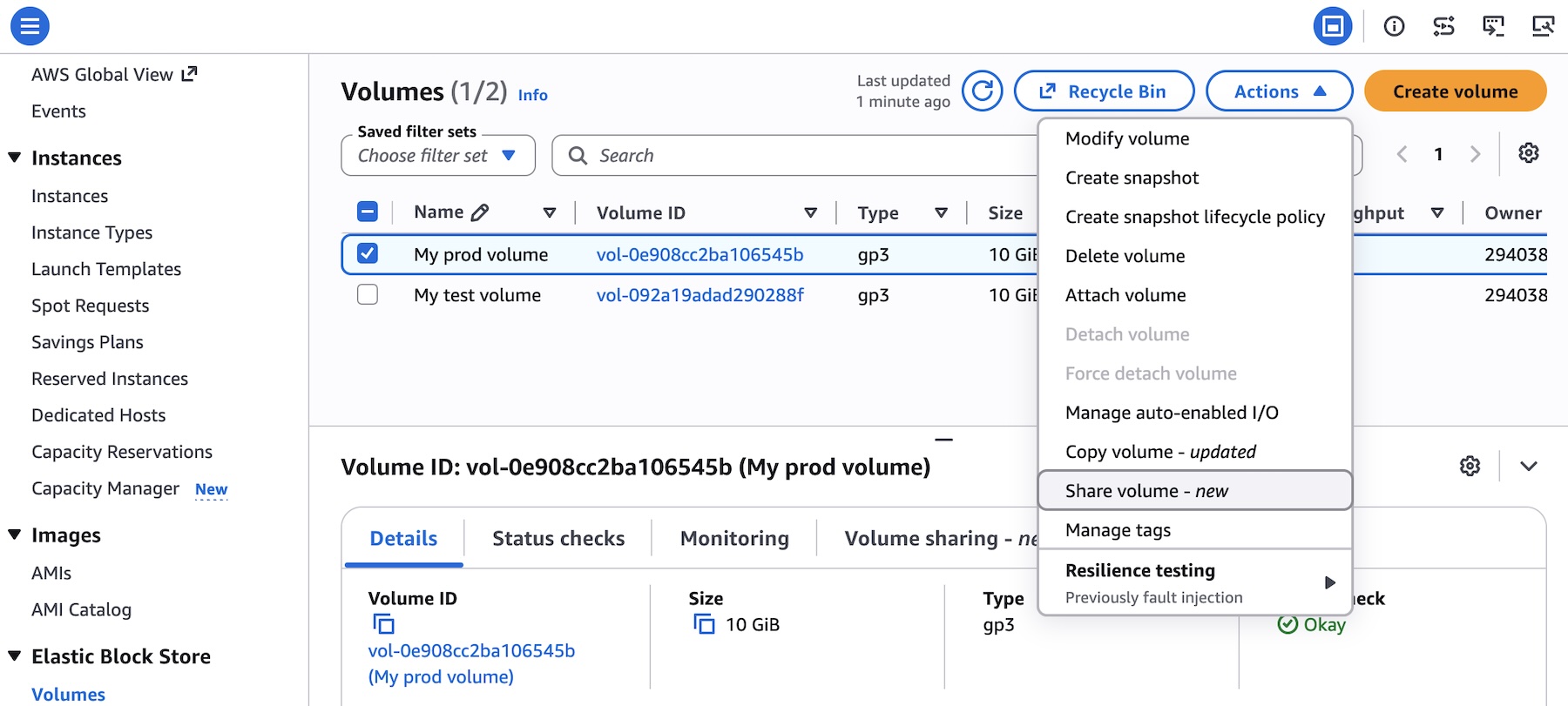
- Select the volume and choose the Share volume action from the configuration menu.
+-------------------------------------------------------+
|                Amazon EBS Console                     |
|                                                       |
|  [Volume ID: vol-0123456789abcdef0]                   |
|  - Status: In-use                                     |
|  - Actions: [Modify] [Attach] [Create Snapshot]       |
|             [Share volume] <------------------------- |
+-------------------------------------------------------+
Step 2: Leveraging AWS Resource Access Manager (RAM)
AWS RAM provides the foundational infrastructure for securely sharing AWS resources across AWS accounts or within an established AWS Organization.
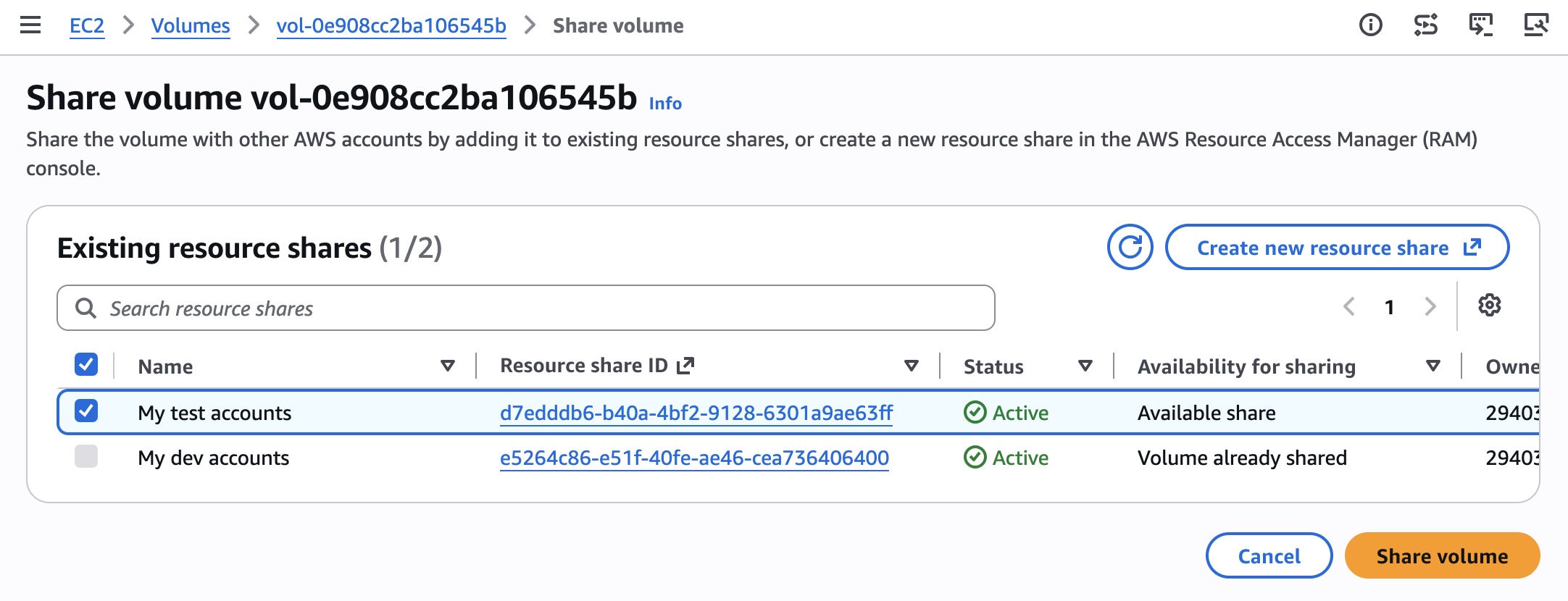
- Upon selecting "Share volume," administrators can add the volume to an existing resource share or construct a brand-new resource share directly within the AWS RAM console interface.
- The administrator specifies the AWS Account ID(s) of the target environments permitted to access the volume.
Once configured, the source volume’s detail page will display a confirmation badge within the Volume sharing tab, verifying that the resource share has been successfully established and broadcasted.
Step 3: Accepting the Resource Share in the Target Account
Security governance dictates that cross-account resources cannot be passively forced upon a target environment.
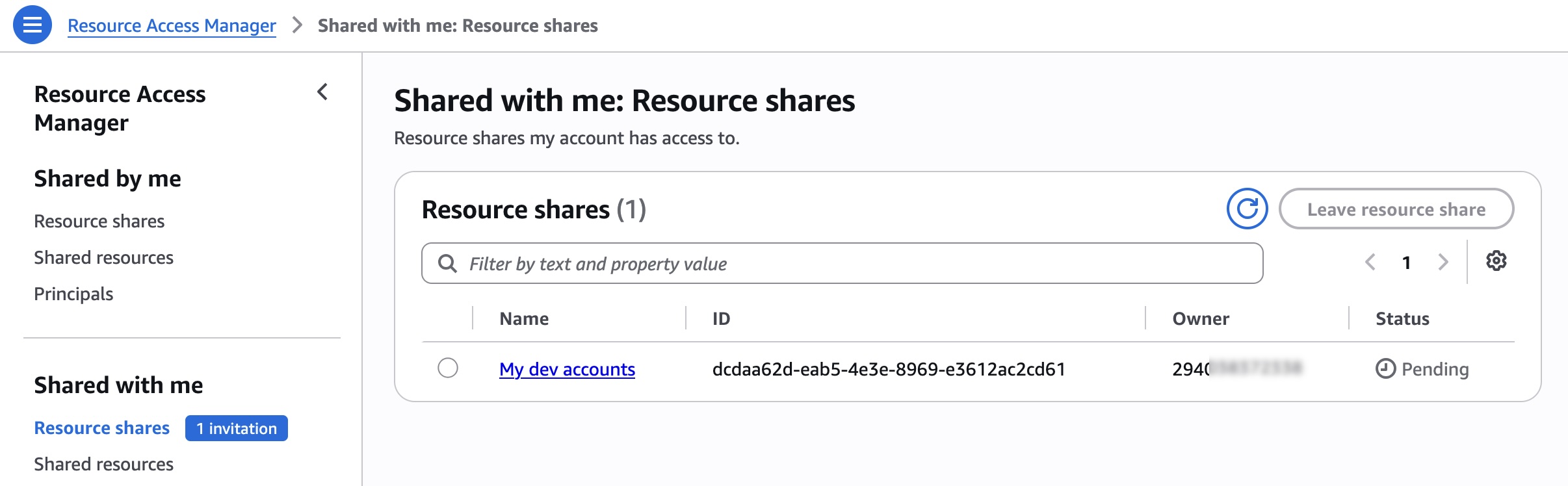
- The administrator or authorized user logs into the target AWS account.
- Navigate to the AWS RAM console to inspect pending resource invitations.
- Explicitly accept the resource share.
Once accepted, the shared EBS volume magically populates within the EBS volume inventory of the target account, clearly designated as a shared resource.
Step 4: Executing the Cross-Account Clone and Re-Encryption
With the resource successfully shared and accepted, the target account holder can operationalize the data:
- Navigate to the EBS volume page in the target account’s console.
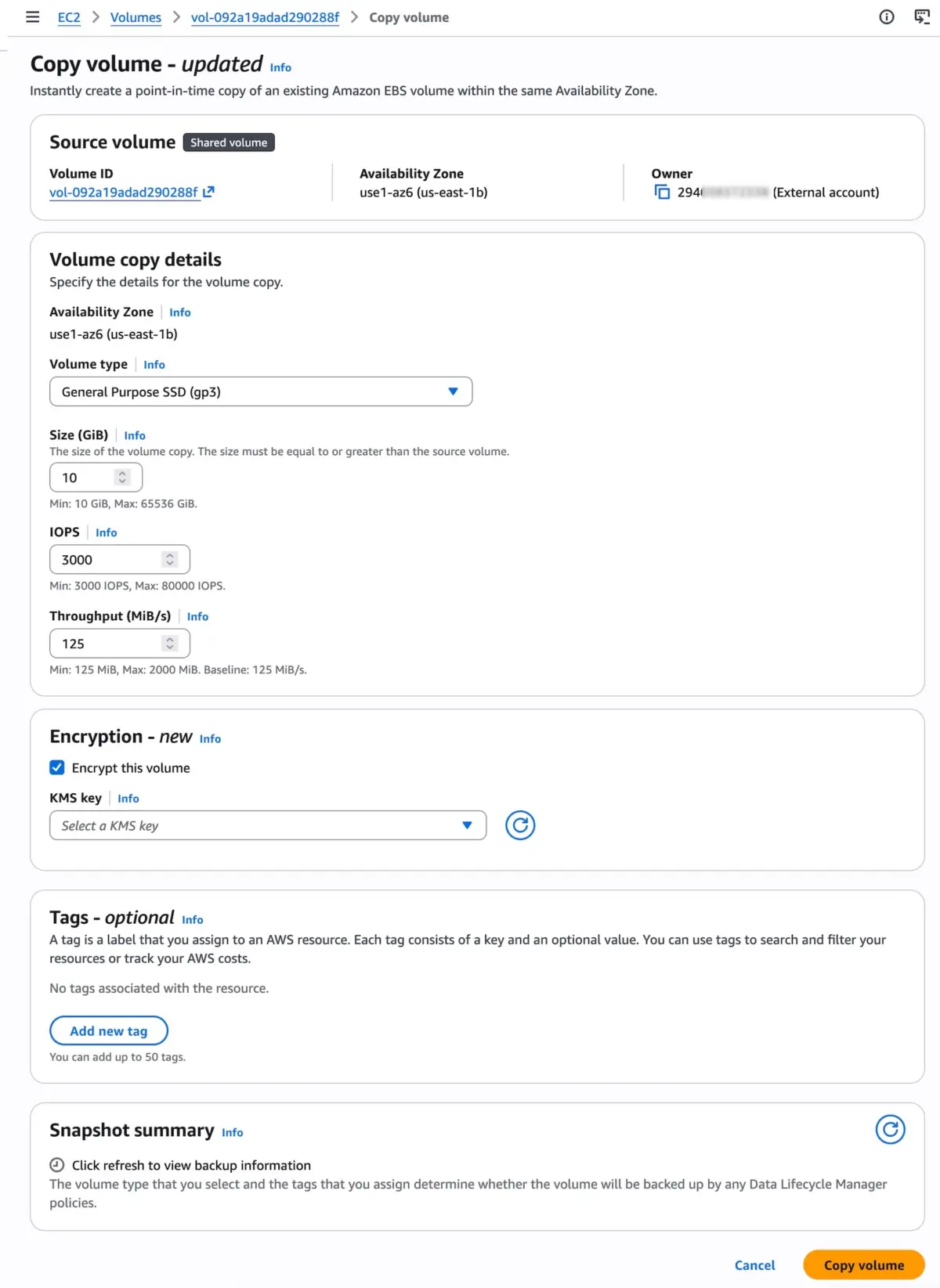
- Select the shared volume and click Copy volume.
- During this copy procedure, the user can designate a custom AWS Key Management Service (AWS KMS) key native to the target account. This ensures that the newly minted clone complies strictly with the target environment’s cryptographic security and auditing policies, completely decoupling its encryption keys from the source production account.
[Source Account (Prod)]
       │
       ▼ (AWS RAM Resource Share)
[Target Account (Dev/Test)]
       │
       ▼ (Copy Volume + AWS KMS Re-encryption)
[New Isolated EBS Clone Ready for Use]
Programmatic and AI-Driven Execution
For teams operating under Infrastructure as Code (IaC) or CI/CD pipelines, manual console clicks are insufficient. AWS supports full API integration for cross-account volume sharing and cloning.
Additionally, developers utilizing modern AI coding assistants can leverage the AWS MCP (Model Context Protocol) Server and associated plugins. By integrating these tools into their development environments, engineers can query documentation, construct API calls, and automate cross-account volume management workflows conversationally, drastically reducing implementation time.
Supporting Context, Architecture, and Security Metrics
To understand the operational impact of this release, it is essential to evaluate the security paradigms, architectural flexibility, and performance implications that cross-account EBS volume clones introduce to modern enterprise environments.
Balancing Agility with Isolation
In traditional enterprise architectures, developers often faced a painful dilemma: either work with stale, synthetic mock data that failed to surface production bugs, or request manual database dumps that posed significant security risks during transit.
Cross-account volume clones solve this paradox by enforcing a zero-trust operational model:
- Zero Data Transit Vulnerability: The underlying data blocks are replicated efficiently within the AWS storage fabric without exposing raw data payloads to intermediate public networks.
- Granular Cryptographic Control: By permitting target accounts to re-encrypt clones with their own KMS keys, organizations maintain strict key rotation schedules and prevent key leakage between isolated business units.
- Least Privilege Access: Integration with AWS RAM ensures that resource sharing can be tightly audited, time-bound, or revoked instantly via AWS CloudTrail and IAM policies.
Operational Efficiency Metrics
While exact performance benchmarks vary depending on volume size (e.g., gp3 vs. io2 provisioned IOPS volumes), preliminary deployment metrics highlight substantial efficiency gains:
- Provisioning Time: Drops from hours (via traditional snapshot-to-volume restoration workflows) to mere seconds.
- Storage Cost Optimization: Eliminates the need to maintain persistent, redundant full-copy databases in non-production accounts; volumes can be spun up on-demand for testing cycles and terminated immediately thereafter.
- Administrative Overhead: Reduces cross-account ticket resolutions between development and operations teams by up to 70%, empowering developers to self-service fresh data within authorized sandboxes.
Official Statements and Industry Perspective
The release of cross-account volume clones has drawn significant praise from enterprise architects and cloud infrastructure leaders who view it as a vital maturation of AWS’s multi-account governance strategy.

Industry analysts emphasize that as organizations scale to hundreds or thousands of individual AWS accounts—often managed via AWS Organizations—data fluidity becomes a major operational bottleneck. "Security and speed have historically been locked in a zero-sum game," notes a prominent cloud infrastructure strategist. "By enabling instantaneous volume replication coupled with independent target-account re-encryption, AWS has given enterprises a powerful tool to accelerate development velocity without compromising compliance or data sovereignty."
AWS engineering leads stress that this feature was developed in direct response to customer feedback gathered through AWS re:Post and enterprise support channels. The overarching goal remains clear: to provide primitives that allow developers to build faster while giving security officers absolute control over data boundaries.
Future Outlook and Strategic Recommendations
As cloud-native architectures continue to absorb increasingly complex workloads—ranging from enterprise resource planning (ERP) systems to high-throughput machine learning pipelines—the demand for intelligent, programmatic data management will only intensify.
What’s Next on the Horizon?
While cross-account volume clones currently support intra-Region workflows within supported Availability Zones, industry observers anticipate future iterations to further streamline inter-Region cross-account replication, deeper native integration with AWS Backup policies, and enhanced automated lifecycle management rules.
Recommendations for Cloud Architects and DevOps Leaders
To maximize the value of Amazon EBS cross-account volume clones, organizations should consider the following strategic steps:
- Audit Multi-Account Structures: Review current AWS Organization layouts to ensure that AWS RAM is enabled at the organization level, simplifying the administrative overhead of cross-account resource sharing.
- Refine KMS Key Policies: Update KMS key policies in non-production accounts to explicitly authorize incoming EBS volume re-encryption operations, avoiding last-minute permission roadblocks during critical release cycles.
- Incorporate into CI/CD Pipelines: Utilize the AWS MCP Server and API integrations to automate the refreshing of staging and test environments, ensuring that automated regression tests run against realistic, up-to-date production schemas.
- Establish Lifecycle Clean-up Policies: Because volume clones are instantaneous and effortless to create, implement automated tagging and deletion protocols (via AWS Backup or custom Lambda scripts) to prevent abandoned non-production clones from accumulating unnecessary storage costs.
By thoughtfully integrating Amazon EBS cross-account volume clones into their operational workflows, enterprises can unlock a new echelon of productivity, securely bridging the gap between rigorous production security and agile software development.