Executive Overview
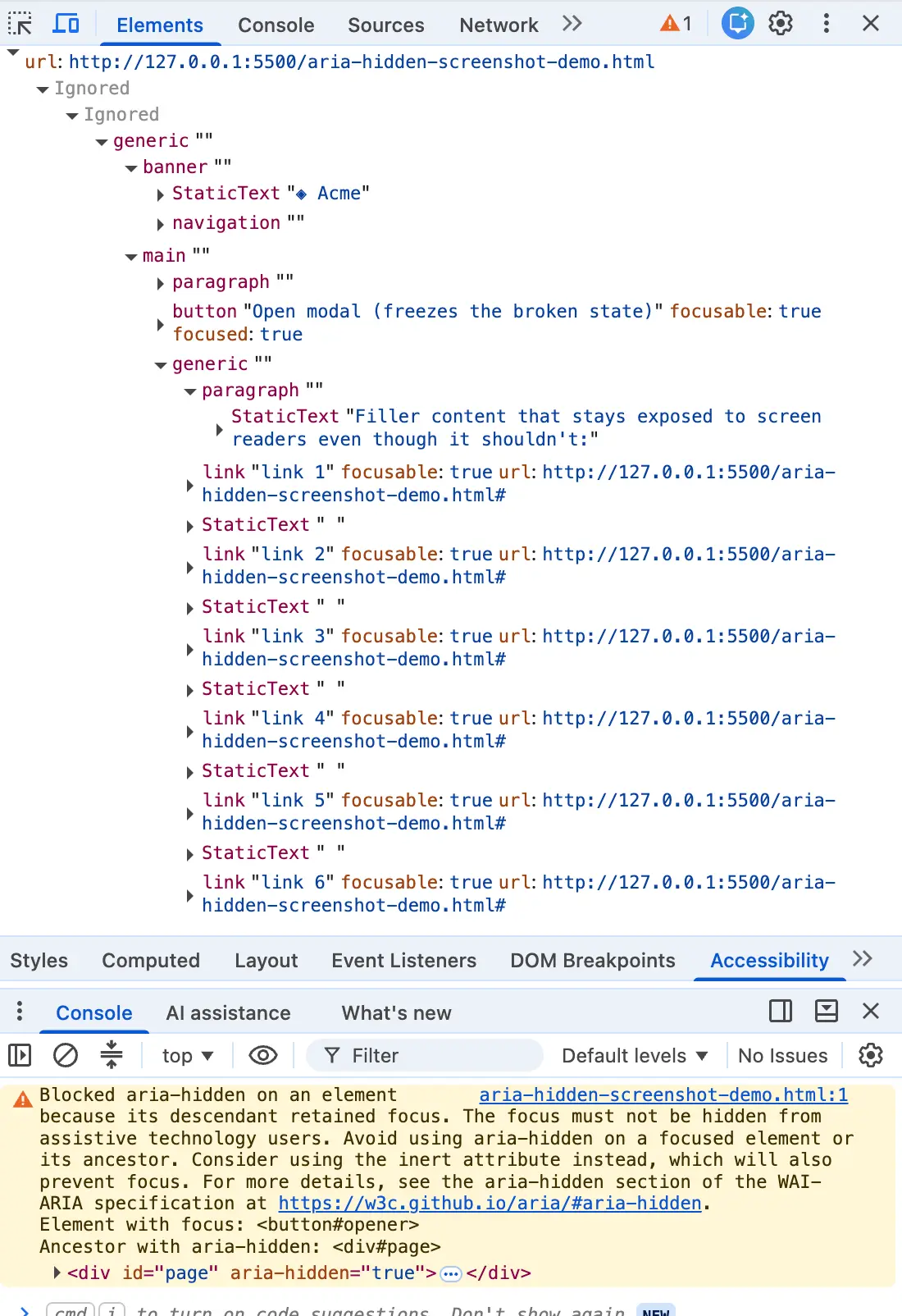
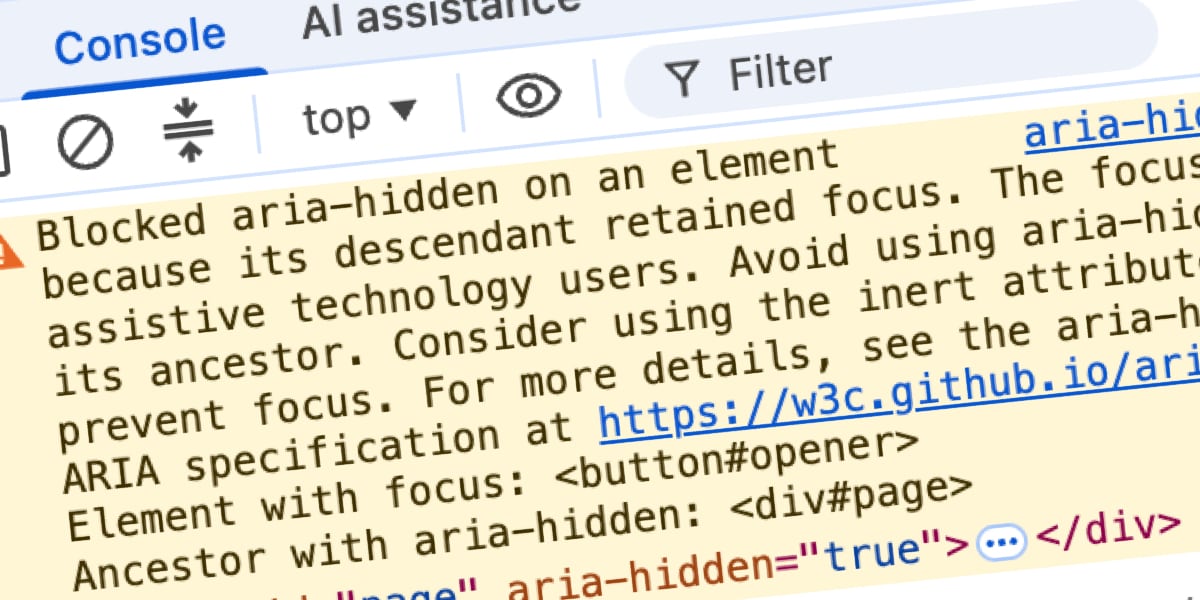
You close a modal dialog, and your browser console flashes a sharp, angry shade of yellow. Highlighting the error message, you drop it into a search engine, only to find yourself alongside half the front-end internet. This exact string—a warning about a focused element inside a hidden region—appears identically whether you are building with Angular, Bootstrap, Ionic, or managing data grids via phpMyAdmin.
Here is the inconvenient truth that top search results routinely bury: the browser is right. There is a real person on the other side of that warning—someone using a screen reader whose focus is about to drop into a profound accessibility black hole.
For months, the front-end community has chased quick fixes: the blur() one-liner, the setTimeout wrapper, or the blunt-force extraction of aria-hidden attributes. Each of these remedies silences the console while quietly harming the exact user the browser was trying to protect. If you have already shipped one of these workarounds, you are in massive company. You were failed by your search results, not by your own carelessness.
However, looking at this problem merely as a console noise nuisance misses the forest for the trees. This is an architectural indictment of how component libraries handle the delicate choreography of focus management and state transitions.
Detailed Chronology: The Anatomy of a Browser Overrule
To understand why this issue has suddenly flooded developer consoles worldwide, we have to look at how modern browser engines handle the asynchronous gap between DOM mutations and accessibility trees.
The Evolution of Chromium’s Enforcement
Chromium has been quietly patching focusable aria-hidden nodes for years, but the warnings we see today arrived in distinct, highly disruptive waves:
- The Open-Time Inversion (Summer 2024): Around Chrome 127, developers began noticing warnings triggered the exact instant a modal opened. Issues clustered across major repositories like MUI (
#43106), Ant Design (#50170), and Flowbite (#943). This occurred because a background element still held focus momentarily after the backdrop was markedaria-hidden="true". - The Close-Time Race (Late 2024): With the rollout of Chrome 131, a second wave hit. This time, the warning focused on "retained focus" during teardown. Bootstrap issue
#41005and Angular issue#30187documented how fading out a modal while the close button still owned focus created a transient illegal state.
The Paradox of aria-hidden
The fundamental root of this crisis lies in a baked-in architectural paradox: aria-hidden removes content from the accessibility tree, but it does not remove that content from the keyboard focus order.
These are two entirely separate systems in the browser, and historically, nothing kept them synchronized. An element can be fully focusable by a keyboard user while being completely imperceptible to a screen reader. The instant a user tabs onto that element, ghost focus is born:
- The screen reader fires a focus event for a node it was explicitly told does not exist.
- The assistive tech looks up the node, finds nothing it is allowed to describe, and goes completely silent.
From the user’s perspective, they pressed a key, the machine acknowledged nothing, and they are left stranded in a virtual room the map insists is empty. Chrome’s console warnings are not stylistic nitpicking; they are the browser engine overruling your markup to prevent this exact usability disaster.
Supporting Context & Metrics: The Four Traps That Trap Developers
Debugging this issue requires diagnosing which of the four distinct failure modes your codebase is experiencing.
[Modal Close Triggered]
       │
       ├──> Trap 1: Hidden Mid-Goodbye (Close-Time Race)
       ├──> Trap 2: The Trigger Left Behind (Open-Time Inversion)
       ├──> Trap 3: Turf Wars (Nested Composition Conflicts)
       └──> Trap 4: The User Walked Out (Focus Leaves Page)
1. Hidden Mid-Goodbye (The Close-Time Race)
Accounting for roughly 70% of reported incidents, this occurs when a modal begins its CSS fade-out transition. For the duration of those 200 milliseconds, the close button still holds focus, yet it sits inside an overlay that the library just marked hidden. The code executes a top-to-bottom narration of closing the modal, but the browser applies the hide synchronously before the next line’s focus-shifting code can execute.
2. The Trigger Left Behind (Open-Time Inversion)
This is the inverse mirror image. An overlay opens, and the library marks the background aria-hidden="true". However, the trigger button the user just clicked is still housed in that background for a split second before focus successfully moves into the dialog.
3. Turf Wars (Nested Composition Conflicts)
Picture a <select> dropdown nested inside a custom <dialog>. The user selects an option, and the dropdown closes. Suddenly, two distinct component primitives—each believing they are the "one true modal layer"—begin fighting over who gets to hide the rest of the page. Under React 19, this shifts from an annoyance to a fatal focus freeze due to updated unmount timing protocols.
4. The User Walked Out (Focus Leaves the Page)
Nothing in your application changed, but the user hit Alt + Tab or switched browser tabs with an active menu open. The focus bookkeeping stranded an aria-hidden state on teardown, proving that even major design systems (such as Material Web issue #5760 and Ionic issue #30240) struggle with asynchronous state reconciliation.
Official Statements & The Danger of Folk Remedies
When developers encounter these warnings under intense deployment pressure, they routinely reach for popular search engine shortcuts. Unfortunately, nearly every top-ranking fix makes the underlying accessibility problem worse:
- The
blur()One-Liner: Droppingdocument.activeElement.blur()into a global hide handler clears the console by dumping focus directly onto the<body>element. For a keyboard user, this means their nextTabpress forces them to navigate from the very top of a massive page all over again—a direct violation of WCAG 2.4.3 (Focus Order). - The
setTimeoutShim: Wrapping focus calls in a timer is an exercise in false hope. On a fast device, it works; under heavy CPU load, concurrent rendering, or low-end mobile hardware, it fails intermittently, introducing unpredictable race conditions. - Stripping
aria-hidden: Using mutation observers to brutally rip the attribute away keeps the console clean by sacrificing the modal’s primary security contract: allowing users to tab straight out of the modal and into background content.
As web accessibility expert Scott O’Hara and the MDN documentation have long emphasized, the correct architectural instrument for managing inert states is the native inert attribute (or native <dialog> elements via .showModal()), not improvised hacks with aria-hidden.
Future Outlook & The Correct Teardown Contract
Resolving this crisis permanently requires abandoning the pursuit of a "clean console" and instead mastering the Teardown Contract: Focus must leave a closing region before that region becomes hidden or inert.
Whether working in vanilla JavaScript or complex component frameworks like React, your teardown sequence must obey four unyielding steps:
- Un-inert the background first (so trigger targets can actually receive focus).
- Move focus synchronously back to the originating trigger element.
- Apply
inertand pointer-events suppression to the dying shell while it fades out. - Unmount the component only after transition animations safely conclude.
The React Implementation Strategy
In component-driven ecosystems, you must actively fight the batching behavior of modern schedulers:
const close = useCallback((setExiting) =>
  // Step 1: Hand the page back
  if (backgroundRef.current) backgroundRef.current.inert = false;

  // Step 2: Move focus home synchronously before state commits
  triggerRef.current?.focus();

  // Step 3: Commit the exiting state
  setExiting(true);
, []);
Conclusion: Beyond the Console
The console warning is not a piece of bureaucratic noise standing between you and a green CI build. It is an empathetic early-warning system representing real people navigating your application via assistive technologies.
As the World Wide Web Consortium (W3C) and browser vendors continue standardizing accessibility heuristics, the era of masking structural focus bugs with hasty JavaScript workarounds is coming to a close. By respecting the strict chronology of DOM focus management, developers can finally build interfaces that satisfy both automated browser diagnostics and the human beings relying on them.