
Executive Overview
In the modern digital threat landscape, cyberespionage groups are constantly searching for novel ways to bypass user vigilance and exploit foundational web infrastructure. A glaring example of this dangerous intersection between web design standards and state-sponsored cyberattacks unfolded when researchers and cybersecurity firms uncovered that the notorious Russian cyber-espionage collective known as Fancy Bear (also tracked as APT28, Sofacy, or Strontium) weaponized a high-profile web standard: Google’s Accelerated Mobile Pages (AMP).
Designed with the noble intent of accelerating web browsing speeds for mobile users, AMP instead provided an insidious attack vector for threat actors. By leveraging the mechanics of Google’s pre-rendering and caching system, the hackers were able to disguise malicious spear-phishing web pages behind authentic, trusted google.com domain names. For investigative journalists—who are perpetually trained to scrutinize hyperlinks and domain strings for signs of tampering—the structural design of AMP rendered traditional security instincts effectively obsolete.
This investigative report examines how state-sponsored operators transformed Google’s performance-boosting technology into a high-precision phishing weapon. It details the vulnerabilities inherent in the AMP framework, documents specific campaigns against prominent journalists, analyzes Google’s institutional response, and weighs the broader implications of centralized web technologies on digital security.
Detailed Chronology: The Weaponization of AMP
The exploitation of Google’s Accelerated Mobile Pages framework by state-backed actors did not happen in a vacuum. It was the culmination of a technical oversight that was repeatedly flagged by web developers, dismissed by Google leadership, and ultimately capitalized upon by sophisticated cyber-criminals.
The Mechanics of the Vulnerability
Introduced by Google in late 2015, AMP was marketed as an open-source initiative designed to make web pages load instantaneously on mobile devices by stripping them down to simplified code and pre-loading cached copies through Google’s own servers. To achieve this instantaneous loading experience, Google displayed these pre-rendered pages utilizing official google.com URLs in the mobile browser’s address bar.
While the true originating domain was displayed in a small informational header at the top of the content area, this visual disclaimer would reliably vanish as the user scrolled down the page. Meanwhile, the trusted google.com address remained fixed at the very top of the screen.
For the average internet user—and even for technically proficient web developers—this optical illusion was dangerously misleading. Cybersecurity orthodoxy has long dictated a single, fail-safe rule for avoiding credential harvesting: always check the domain in the address bar. Google’s AMP implementation directly subverted this golden rule, transforming what should have been a red flag into an authoritative green light.
Developer Warnings Ignored
Months before the attacks against journalists came to light, independent web developers and security researchers recognized the structural danger of this design.
In November 2016, web programmer Ray Etornam filed a bug report on GitHub (ampproject/amphtml/issues/6210), drawing attention to how malicious actors and fake news publishers could exploit AMP to manufacture false legitimacy. Another developer, Christian Gloddy, added urgent warnings to the thread, emphasizing the fatal flaw in Google’s user-interface logic:

"The most common advice to avoid phishing and scams is ‘check the domain in the address bar.’ Not the text that might be below the address bar."
Despite a chorus of warnings from industry professionals—including software developer John Pettitt—Malte Ubl, the Google employee leading the AMP project, pushed back aggressively against the criticism. Ubl insisted that the Google Search viewer clearly attributed the original domain at the top, writing that he did not agree "that an unsophisticated user could be fooled by this." Subsequent events would prove this defense to be dangerously naive.
The Campaign Against Aric Toler
While Google’s engineers defended their software architecture in developer forums, Fancy Bear operatives were actively operationalizing the flaw. Their primary targets were investigative journalists covering Russian state corruption, cyber-operations, and foreign policy.
One primary target was Aric Toler, a lead researcher and writer for Bellingcat, an investigative collective famous for uncovering that Russian-backed separatists were responsible for shooting down Malaysia Airlines Flight 17 (MH17) over Ukraine in 2014.
The campaign against Toler unfolded systematically over several years:
- Early Phases (2015–2016): Initial credential-harvesting attempts relied on crude tactics, such as basic URL shorteners (e.g., Bitly links) pointing to generic login pages. These crude vectors were easily recognized and ignored by a security-conscious researcher.
- Escalation (October 2016): Recognizing that standard phishing links were failing, the threat actors upgraded their tactics, integrating Google AMP URLs into highly targeted spear-phishing emails.
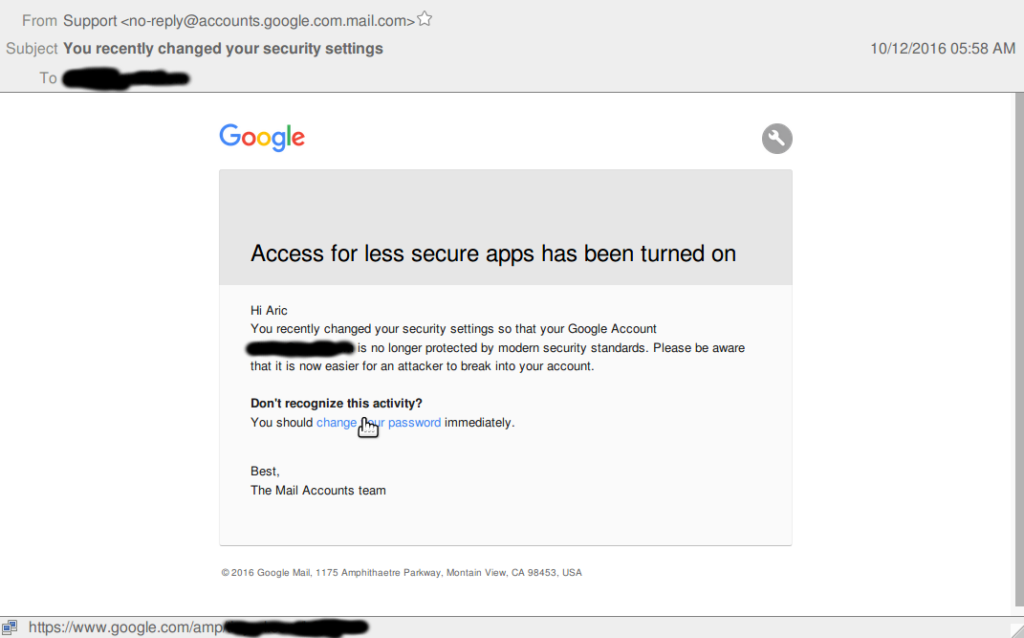
- The First Strike (Oct. 12, 2016): Toler received an email disguised as a security alert from Google, warning that older email applications had been granted access to his account and claiming it was now easier for attackers to break in. The embedded link utilized a Google AMP URL that seamlessly redirected to a sophisticated, pixel-perfect fake Google login portal.
- The Second Strike (Oct. 13, 2016): Just one day after Toler posted a public tweet about receiving a legitimate security warning from Google regarding "government-backed attackers," the hackers pivoted instantly. They dispatched a second forged email explicitly warning him about "government-backed attackers" trying to steal his password—complete with a malicious AMP link designed to capture his credentials.
The Compromise of David Satter
While Toler and his colleagues successfully identified and evaded the AMP-based phishing traps, other high-profile targets were less fortunate.
David Satter, an American journalist and author who has written extensively and critically about Russia and President Vladimir Putin, fell victim to an identical AMP phishing email. Sent via the exact same threat-infrastructure email account ([email protected]), the malicious link tricked Satter into entering his credentials.
Within moments of entering his password, automated systems controlled by Fancy Bear accessed his Gmail account, exfiltrated its entire contents, and weaponized the data. Over the following weeks, Canadian research organization Citizen Lab documented how the stolen documents were systematically leaked online, altered, and manipulated to generate disinformation designed to smear critics of the Kremlin.
Supporting Context & Metrics: Attribution and Operational Security
Attribution in cyberspace is notoriously difficult, but digital forensics firms and intelligence analysts linked the AMP phishing campaign definitively to Fancy Bear (APT28).
Forensic Traceability
The cybersecurity firm ThreatConnect conducted an in-depth forensic analysis of the infrastructure utilized in the Bellingcat and Satter attacks. Their findings linked the operation directly to the Russian threat group:
- Infrastructure Reuse: The hackers repeatedly utilized the free email registration
[email protected]across multiple, distinct campaigns. This specific handle had previously been cataloged by threat intelligence databases in connection with past APT28 operations. - Tactical Evolution: ThreatConnect noted that the threat actors systematically layered Google AMP services and commercial URL shorteners to mask non-legitimate destinations, optimizing the user interface specifically for mobile devices where address bars are compact and obscured.
- The Microsoft Assessment: According to Microsoft Executive Vice President Terry Myerson, Fancy Bear had historically deployed more zero-day exploits and novel evasion techniques than any other documented cyber-espionage syndicate, illustrating their penchant for abusing foundational software frameworks.
The Macro Impact on the Open Web
Beyond state-sponsored cyberespionage, the widespread adoption of AMP drew sharp criticism from digital publishing trade associations and tech critics.
Critics argued that AMP represented a profound overreach by a tech monopoly, forcing publishers to surrender control of their mobile web traffic to Google’s servers. Jason Kint, CEO of the digital publishing trade association Digital Content Next (representing major outlets like The New York Times, The Washington Post, and major U.S. television networks), voiced deep concern:
"This report of an ongoing security issue is troubling and exactly why consolidation of power and closed standards are problematic. The sooner AMP migrates to the open web and becomes less tied to the interests of Google, in every way the better."
Official Statements and Institutional Response
As public pressure mounted following disclosures by media outlets and security researchers, Google enacted retroactive security patches while managing public relations damage.
The Evolution of Google’s Defenses
Initially, project lead Malte Ubl maintained a defensive posture, arguing that the technical UI safeguards were sufficient. However, as evidence of actual exploitation mounted, Google quietly altered its security posture:
- Safe Browsing Integration: Google initially claimed that AMP URLs were shielded by its overarching Safe Browsing technology. It was later clarified that automated scanning of AMP addresses by Safe Browsing protocols was only fully implemented in early January 2017—months after the vulnerabilities were first weaponized against journalists.
- Implementation of Redirect Notices: For un-cached or un-screened external links, Google introduced a explicit "redirect notice" page. This interstitial page informs users when they are navigating away from the Google ecosystem and offers an opportunity to abort the navigation.
- The Critique of Usability: Security experts pointed out that while the redirect notice was a step forward, it was written in dense developer jargon that did little to warn non-technical users about active phishing threats.
Furthermore, as inquiries from investigative journalists intensified, project lead Malte Ubl drew sharp criticism for closing public discourse, abruptly locking and blocking further commentary on the critical GitHub bug report thread (#6210).
Future Outlook: Lessons in Centralized Infrastructure Security
The exploitation of Google AMP by Fancy Bear serves as a watershed moment in cybersecurity, offering sobering lessons for software architects, policymakers, and digital users alike.
- The Danger of Trust Consolidation: When foundational technology providers like Google embed their brand equity (
google.com) into third-party content rendering, they inadvertently create high-value assets for threat actors. Security systems must be designed under the assumption that attackers will abuse user trust in well-known brands. - The Obsolescence of Traditional User Education: Telling users to "check the address bar" is no longer an adequate cybersecurity baseline when modern browser UIs abstract, obfuscate, or overlay domain names. User interfaces must evolve to provide unmistakable, un-spoofable indicators of true destination origins.
- The Necessity of Transparent Patching: Google’s initial reluctance to acknowledge structural flaws, paired with its insular communication style regarding security patches, highlights a systemic accountability gap among major technology platforms. True security requires collaborative peer review rather than corporate defensiveness.
As state-sponsored espionage groups continue to evolve their methodologies, the line separating web optimization from cyber-weaponry grows increasingly thin. Securing the future of the open web will require platforms to prioritize user safety over proprietary performance metrics, ensuring that tools built to accelerate the internet do not inadvertently accelerate state-sponsored surveillance and credential theft.