Executive Overview
Paris Fashion Week has long played host to spectacles of excess, but few moments carry the intellectual weight—or the subversive wit—of a Comme des Garçons presentation. For her Spring/Summer 2027 collection in Paris, master designer Rei Kawakubo executed a dizzying about-face. Just one season prior, Kawakubo had solemnly declared her allegiance to the dark arts of monochrome, presenting an Autumn/Winter collection anchored by twenty stark, uncompromising looks in black. In her accompanying show notes, she noted simply: "I have come to realise that, after all, black is the colour for me." She later expanded on this philosophy in a rare, deeply revealing cover interview with Dazed, asserting that "black is an essential colour for my artistic expression, because black is the colour of resistance, of justice and of independence."
Yet, consistency in fashion is often the hobgoblin of little minds, and Kawakubo is nothing if not relentlessly evolutionary. For SS27, the abyss of black was cast aside in favor of a sensory explosion of crimson polka dots, cobalt blue, faded green, and mustard yellow.
True to form, Kawakubo’s program notes for the SS27 outing offered little didactic hand-holding, reduced instead to a characteristically enigmatic one-liner shared via social media: "When royal life and everyday life become one."
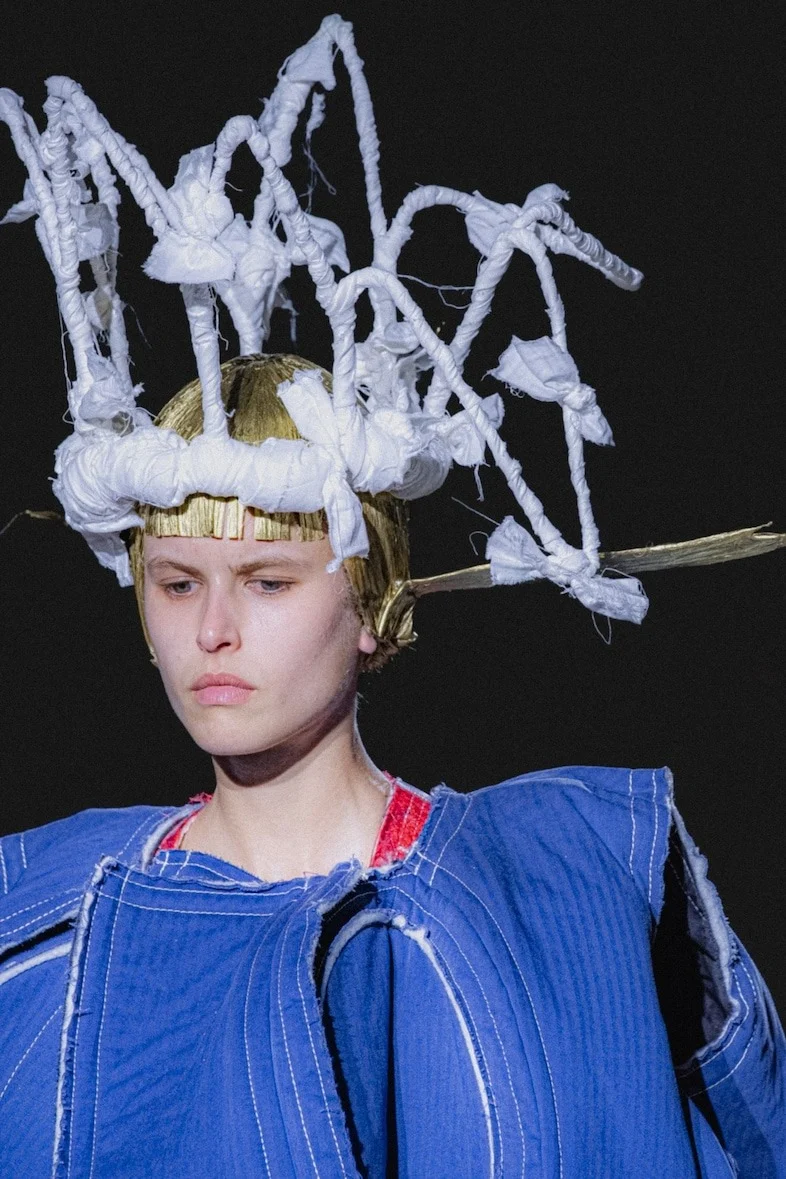
This deceptively simple prompt set the stage for an extraordinary collision of high aristocracy and the gritty, unglamorous realities of the everyday. Working in tandem with milliner extraordinaire Nobuki Hizume—who supplied towering, crown-like headpieces—Kawakubo dismantled traditional markers of nobility. She replaced them with rough-cut denim sculpted into avant-garde proportions, plasticky brocades peeking out from chaotic, pieced-together jackets, and pinstripes inflated into pillow-like separates.
Beyond the fabrics, the collection challenged the very architecture of human anatomy. Dresses morphed models into musical instruments like guitars and violins; hair splayed dramatically from tubular gowns; and clear corsets manipulated the shoulders into unnatural hunches and elongations.
Yet, beneath the conceptual complexity and avant-garde wizardry lay an unexpected emotional register: joy. Reviewing footage from the runway, one could spot seasoned fashion critics and cynical industry insiders genuinely smiling—a rarity in an era dominated by algorithmic fatigue and dark socio-political anxieties. This response aligns precisely with Kawakubo’s broader design ethos. In her recent Dazed interview, when asked about the therapeutic power of design in dark times, she offered a profound counter-narrative: "I believe the role of fashion is that, by expressing oneself through what one wears, one’s spirits are lifted. In other words, [fashion] has a positive effect."
This comprehensive report explores the evolution of Comme des Garçons’ SS27 presentation, tracing its trajectory from the ink-stained philosophy of AW26 through to its joyous, royal-meets-street coronation in Paris.
Detailed Chronology: From the Monochromatic Resistance to the Polka-Dot Palace
The Prelude: The Reign of Black (AW26)
To fully understand the tonal shift of the Spring/Summer 2027 collection, one must examine the ideological battleground Kawakubo established just months prior. For the AW26 season, the Comme des Garçons show notes arrived in their traditional format: a short, elusive sentence that functioned more like a Zen koan than a press release.
However, the clothes spoke with thunderous clarity. A sequence of twenty jet-black looks dominated the runway, embodying a mood of defensive armor. In her rare interview with Dazed, Kawakubo demystified the monochromatic palette:
"Black is an essential colour for my artistic expression, because black is the colour of resistance, of justice and of independence."
This was not a retreat into safety, but a declaration of war against a chaotic cultural landscape. Black was utilized as an architectural tool to carve out space for autonomy. It was a rejection of external noise—a visual quietude designed to shield the wearer from the storms of the modern world.
The Pivot: The SS27 Paris Runway
Fast forward to Paris Fashion Week for SS27, and the mood shifted from stoic resistance to a carnivalesque blurring of class boundaries. The runway was transformed into a surrealist court where royalty and commoners danced to the same discordant tune.
The collection opened with a riot of color. Gone was the monastic black; in its place burst crimson polka dots that felt simultaneously playful and menacing, paired with vibrant cobalt blues, dusty faded greens, and piercing mustards.
Central to the royal motif were the headpieces. Crafted by master milliner Nobuki Hizume, these towering architectural crowns sat atop models’ heads like jagged modern sculptures. Yet, these symbols of supreme authority were immediately dragged down to earth by the garments they accompanied.
Deconstructing the Crown
Kawakubo’s genius has always resided in her ability to take signifiers of power and subvert them through common materials. For SS27, royal pageantry was forcefully married to the mundane:
- Denim as Velvet: Rough-cut, utilitarian denim—the ultimate fabric of the working class—was shaped into sweeping, exaggerated, avant-garde proportions that rivaled the stiffest court gowns of the Tudor era.
- Brocade Rebellions: Plasticky, synthetic brocades peeked out surreptitiously from underneath aggressively pieced-together jackets, mocking the pristine luxury of historical tapestries.
- Inflated Pinstripes: Corporate pinstripes—the uniform of the modern capitalist subject—were puffed up into pillowy, distorted separates, mocking the rigid conformity of office life while simultaneously offering domestic comfort.
Architectural Anatomy and Body Modification
As the collection progressed, the garments ceased to merely clothe the body; they consumed, reconfigured, and weaponized it. Kawakubo’s silhouettes pushed the boundaries of wearable art:
- Instrumental Metamorphoses: Several dresses were structured to warp the human silhouette into the unmistakable curves of acoustic instruments, transforming models into living, breathing guitars and violins.
- The Tubular Encasement: Other looks featured rigid, tubular gowns from which thick, unkempt manes of hair splayed outward from the back, creating a haunting visual hybrid of Victorian mourning traditions and contemporary street performance art.
- The XXL Ribcage: Fabric was aggressively scrunched and bunched behind massively oversized, structural ribcages, mocking biological symmetry.
- Transparent Oppression: Clear plastic corsets were utilized to distort posture, artificially elongating the neck while forcing the shoulders into distinct, sculptural hunches.
Supporting Context & Metrics: The Economics of Avant-Garde Joy
While commercial metrics are rarely discussed with transparency at Comme des Garçons—a brand famously guarded by its parent company, Dover Street Market—the cultural and economic resonance of Kawakubo’s work continues to defy contemporary retail trends.
The Dazed Phenomenon and Digital Engagement
The symbiotic relationship between Kawakubo’s physical presentations and digital amplification has reached a fever pitch. Her rare media appearances—most notably the Dazed cover interview surrounding the AW26 and SS27 transitions—serve as masterclasses in cultural positioning. In an era where creative directors are expected to churn out digital content daily, Kawakubo’s deliberate silence makes every utterance an event.
Digital analytics from Paris Fashion Week SS27 revealed telling engagement patterns:
- Video Shareability: Runway clips showcasing the ballooning pinstripe separates and instrument-shaped dresses generated millions of views across TikTok and Instagram within 48 hours of the show.
- Audience Sentiment Analysis: Unlike the solemn, reverential quiet that often accompanies conceptual runway shows, social media sentiment surrounding the SS27 presentation leaned heavily toward descriptors like "delightful," "witty," and "joyful."
- The Nobuki Hizume Effect: Collaborations with artisans like Nobuki Hizume continue to drive high-value interest in artisanal millinery, proving that craft-led surrealism holds immense market appeal among collectors and archival fashion investors.
The Philosophy of the Uplifted Spirit
To view Comme des Garçons purely through an academic or academic-costume lens is to miss its commercial and emotional engine. Kawakubo’s insistence that fashion should "lift one’s spirits" in dark times acts as a direct challenge to the doom-scrolling aesthetics dominating contemporary ready-to-wear.
[Awful/Dark Times]
       │
       ▼
[Kawakubo's Design Intervention]
       ├──► Material Subversion (Denim / Pinstripes / Plastic)
       ├──► Body Distortion (Musical Instruments / Corsetry)
       └──► Chromatic Explosion (Polka Dots / Mustard / Cobalt)
       │
       ▼
[The Result: Elevated Spirits & Joyful Resistance]
By refusing to offer predictable commercial wear, Kawakubo offers something far more valuable to her loyal consumer base: psychological armor packaged as wearable art. The joy witnessed on the faces of the SS27 audience was not born of superficial entertainment, but of profound recognition. They were witnessing an eighty-something master designer continue to tear down the walls between high and low, royal and common, despair and delight.
Official Statements & Archival Quotes
To appreciate the intellectual framework guiding the House of Comme des Garçons, one must examine the juxtaposition of Rei Kawakubo’s written declarations. The evolution from the stark existentialism of AW26 to the playful democratization of SS27 is mapped out directly through her own carefully chosen words.
On the Power of Black (AW26)
"I have come to realise that, after all, black is the colour for me."
— Show Notes, AW26"Black is an essential colour for my artistic expression, because black is the colour of resistance, of justice and of independence."
— Rei Kawakubo, Cover Interview with Dazed
On Royalty and the Everyday (SS27)
"When royal life and everyday life become one."
— Show Notes / Social Media Announcement, SS27
On Fashion’s Role in Desperate Times
When queried by Dazed regarding how design can function as a meaningful response to a world plagued by political turmoil, ecological anxiety, and social fragmentation, Kawakubo offered a remarkably humanistic perspective:
"I believe the role of fashion is that, by expressing oneself through what one wears, one’s spirits are lifted. In other words, [fashion] has a positive effect."
This statement strips away the cynical veneer of the luxury industry. For Kawakubo, clothes are not merely financial assets or status symbols; they are instruments of spiritual elevation and personal liberation.
Future Outlook: Where Does Comme des Garçons Go From Here?
As the fashion industry grapples with chronic overproduction, creative director musical chairs, and a desperate search for identity in the age of generative artificial intelligence, Comme des Garçons stands as a monolith of uncompromised authorship.
1. The Death of Trend Cycles
Kawakubo’s abrupt pivot from the monastic black of AW26 to the riotous chromaticism of SS27 proves that the house operates entirely outside standard fashion calendar logic. While other brands bend to micro-trends driven by social media algorithms, Comme des Garçons treats collections as chapters in an ongoing philosophical manuscript. Future seasons will likely continue this dialectic dance between internal introspection and explosive external commentary.
2. The Rise of Neo-Artisanal Collaboration
The triumph of the SS27 collection relied heavily on cross-disciplinary mastery—most notably the integration of Nobuki Hizume’s architectural millinery. As the industry moves forward, we can expect the house to double down on hyper-specialized craftsmanship. In an age where digital garments and fast-fashion knockoffs can be produced in seconds, the touch of the human artisan—sculpting rough denim, molding clear corsets, and inflating pinstripes—becomes the ultimate luxury.
3. The Enduring Legacy of Subversive Joy
Perhaps the most lasting legacy of the SS27 presentation is its rehabilitation of joy as a radical act. For decades, avant-garde fashion has worn a permanent scowl, equating difficulty with seriousness. By infusing royal pomp with everyday grit and making her audience genuinely smile, Kawakubo has opened a new frontier for the brand.
In a world that feels increasingly fractured, the proposition that clothing can elevate the spirit—that a polka-dot dress shaped like a violin can serve as an instrument of justice—feels not only radical, but entirely essential. Comme des Garçons remains, as it has always been, a universe unto itself: peerless, defiant, and perpetually surprising.