By the Technology & Culture Desk
Published: Investigative Feature
Executive Overview
Five years ago, Alexandr Wang was crowned the world’s youngest self-made billionaire at age 24, following a staggering $7.3 billion valuation for his data-labeling startup, Scale AI. Back then, Wang fit the Silicon Valley casting call to the letter: an unbuttoned popped collar, a crisp crew cut, and the eager, wide-eyed earnestness of a mathematical prodigy. He was the poster child for a new wave of tech wunderkinds, even as his company faced scrutiny for its reliance on underpaid and overworked international contract workers to feed the sprawling data appetites of the artificial intelligence boom.
Fast forward to today. Now 29 and serving as a high-ranking AI executive at Meta—following a massive $14.3 billion capital integration that brought him and his tech into Meta’s ecosystem—Wang’s aesthetic has undergone a radical, perplexing transformation.
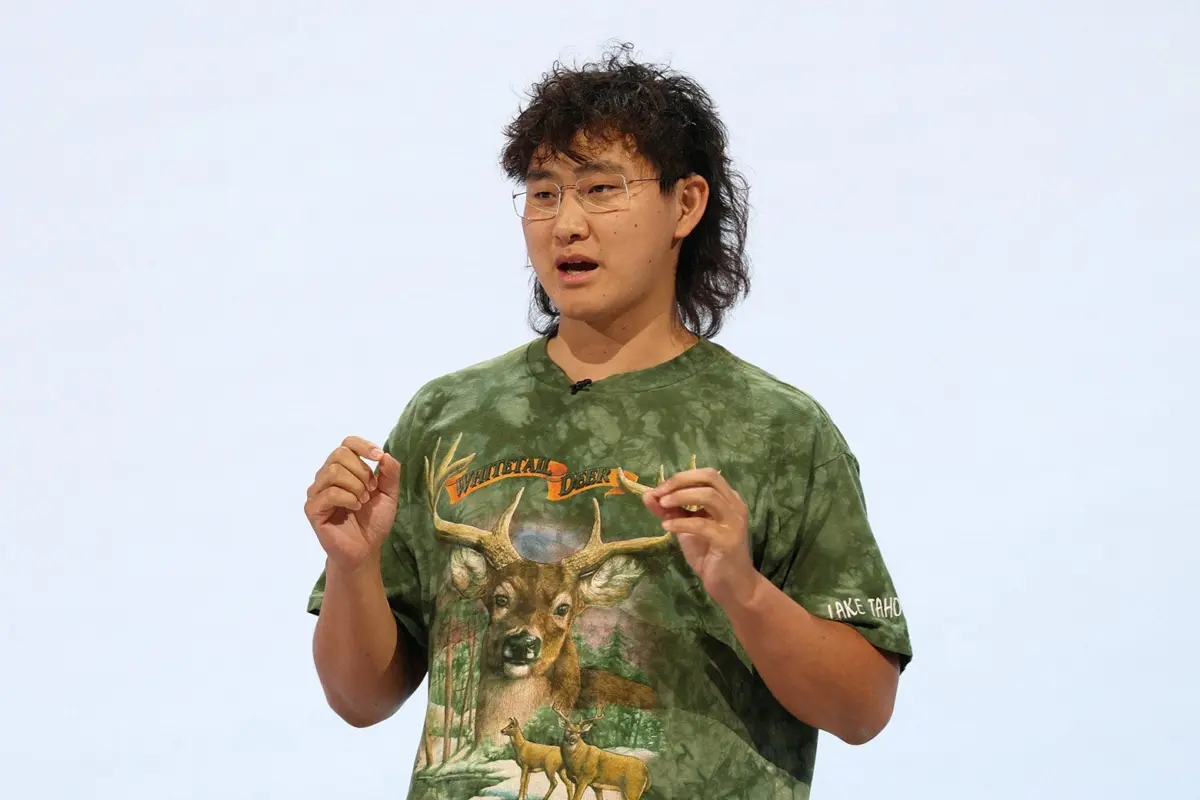
Taking the stage at the recent Meta Connect conference, Wang stepped into the spotlight sporting a shaggy, loosely styled mullet, Reneé Rapp-style wire-framed glasses, black joggers, Realtree camo Crocs, and a thrifted graphic T-shirt reading "Lake Tahoe." Gone was the pristine tech-bro uniform. In its place was the distinct visual vernacular of a precariously employed indie-rock DJ or a burnout college dropout with a penchant for cheap menthol cigarettes.
When online commentators immediately jumped to conclusions—speculating that the eccentric outfit was actually a high-fashion statement costing upwards of $3,500 in designer Balenciaga Crocs and Prada trousers—Wang rushed to X (formerly Twitter) to correct the record. Posting an annotated, tongue-in-cheek graphic breaking down his budget, he insisted his shirt was a $30 thrift find and his underwear were $5 Calvin Kleins. "Excuse me, I must correct the record on this slander," he quipped.
Yet, beneath the ironic internet humor lies a calculated sociological phenomenon. Wang’s makeover is not an isolated incident; it is part of a broader, systemic trend across Silicon Valley. From Mark Zuckerberg’s transition into oversized Amiri tees and "Hillsong pastor" slogan shirts to Jensen Huang’s eternal black leather jacket and Palmer Luckey’s perpetual Hawaiian-shirt-and-cargo-shorts uniform, the tech elite have discovered a powerful psychological truth: There is no better shield against public skepticism than looking completely, disarmingly harmless.
Detailed Chronology: The Evolution of Technocratic Counter-Signaling
To understand the current era of "casual tech," we must examine how the aesthetic armor of Silicon Valley leadership has shifted in response to rising public distrust.
Phase 1: The Corporate Uniform (The 2010s)
For over a decade, tech founders patterned themselves after Steve Jobs’ minimalist turtleneck or Mark Zuckerberg’s unrelenting Brunello Cucinelli gray T-shirts. This aesthetic was designed to project operational discipline, hyper-focus, and monastic dedication to scaling products. It signaled that these individuals were too busy optimizing the globe to care about fashion. However, as these companies ballooned into trillion-dollar monopolies facing antitrust lawsuits, algorithmic radicalization scandals, and severe labor disputes, the ascetic uniform curdled into something colder: the look of corporate autocracy.
Phase 2: The Soft-Launch Makeover (2023–2025)
As generative AI moved from niche academic laboratories into the daily lives of billions, public unease reached a fever pitch. Concerns regarding data privacy, job displacement, autonomous warfare, and the erosion of human creativity created a massive PR liability for tech titans.
This is when the stylistic pivots accelerated:
- Mark Zuckerberg quietly retired his austere gray tees, replacing them with luxury streetwear drops and custom-sloganed statement shirts ("Building is my love language"), deliberately curating a warm, approachable family-man persona.
- Jensen Huang leaned entirely into his rockstar leather jacket persona, turning Nvidia hardware keynotes into stadium concerts that masked the terrifying implications of accelerated machine intelligence.
- Palmer Luckey, co-founder of defense tech giant Anduril—which builds autonomous battlefield systems and AI drones for the Pentagon—strictly maintains a uniform of Hawaiian shirts and cargo shorts. It is the ultimate exercise in counter-signaling: how can a man drinking out of a coconut shell while wearing palm trees possibly be orchestrating the automated future of modern warfare?
Phase 3: The "Indie Slacker" Era (Present Day)
Alexandr Wang’s Meta Connect appearance represents the bleeding edge of this strategy. By dressing like a thrift-store aficionado in Realtree camo Crocs, Wang performs a masterclass in anti-elitism. He is worth billions, commands the architecture behind Meta’s sweeping AI initiatives (including Meta Muse and their wearable smart glasses), and oversees technologies with immense surveillance capabilities. Yet, his visual presentation communicates: "Look at me, I’m just a messy, relatable kid who loves cheap clothes. You can trust me."
Supporting Context & Metrics: The Stakes of Perception
The multi-billion-dollar investments driving these aesthetic choices are grounded in stark financial realities. The technology being peddled is no longer confined to background servers; it is intimate, pervasive, and invasive.
- The Scale AI Integration: Meta’s $14.3 billion partnership with Scale AI brought Wang directly into the fold to spearhead the infrastructure powering Meta’s expansive AI ecosystem. This includes open-source coding models, next-generation AI glasses, and the aggressive rollout of Meta Muse, Meta’s direct competitor in the race for personal AI agent dominance.
- The Personal Agent Wars: OpenAI and Meta are currently locked in a fierce battle to deploy personal AI assistants into every smartphone and desktop. Tellingly, both companies have deliberately packaged these powerful, data-harvesting algorithmic entities inside kid-friendly, glossy cartoon mascots (such as Meta’s mascot, "Jolly").
- The Surveillance Reality: During his Meta Connect presentation, Wang showcased updates to Meta Muse, casually tossing out bizarre anecdotes about tracking user searches—such as a user searching for ways to replace a broken family heirloom or planning a secret vacation. The casual delivery of total behavioral visibility stood in stark contrast to his disarming, slacker aesthetic.
When a corporation possesses unprecedented capability to monitor human habits, moods, and social graphs, the presentation of the executive matters immensely. An executive in a bespoke Italian suit screams corporate dominance and predatory capitalism. An executive in $60 Realtree camo Crocs and a $30 thrifted tee feels like someone you would share a blunt with behind the bleachers.
Official Statements and Industry Reactions
The public reaction to the new wave of tech styling has oscillated between bemused mockery and sharp, critical analysis.
When social media users attempted to decode Wang’s outfit value, estimating thousands of dollars in hidden luxury items, Wang’s rapid-fire engagement on X highlighted the acute sensitivity tech leaders have regarding their public image. By publicly itemizing his $30 thrifted shirt and $5 underwear, Wang actively participated in the myth-making of his own down-to-earth persona.
Industry analysts, however, are unimpressed by the charm offensive.
"We are living through an era of mask-off technocratic rule," notes one tech culture observer. "We know precisely how much leverage these companies hold over civic discourse, labor markets, and global infrastructure. Dressing like an Oberlin theater major doesn’t sanitize the weaponized data pipelines or the multi-billion-dollar defense contracts."
The juxtaposition was further underscored at the same Meta Connect keynote, where Zuckerberg took the stage wearing a custom T-shirt emblazoned with the phrase: "Building is my love language." The convergence of pastoral branding and aggressive algorithmic expansion illustrates a cohesive industry strategy: wrap ruthless monopolistic growth in the warm, fuzzy blanket of emotional vulnerability.
Future Outlook: The Mask and the Machine
As we look toward the latter half of the decade, the integration of artificial intelligence into daily civic and personal life will only deepen. Personal AI agents will transition from novelties to indispensable digital gatekeepers, managing our schedules, finances, communications, and media consumption.
Consequently, the public relations machinery of Silicon Valley will continue to refine the art of the stylistic decoy. The billionaire in Crocs is not an accident of poor styling or youthful eccentricity; it is a calculated marketing triumph designed to disarm critical oversight.
When the architects of our automated future look like harmless, awkward millennials rather than cold technocrats, it becomes infinitely easier for society to lower its guard. But as Meta Muse, autonomous defense systems, and hyper-personalized data collection continue to expand unchecked, consumers would do well to remember a foundational rule of the digital age: Never judge an AI titan by his thrifted T-shirt.