Executive Overview
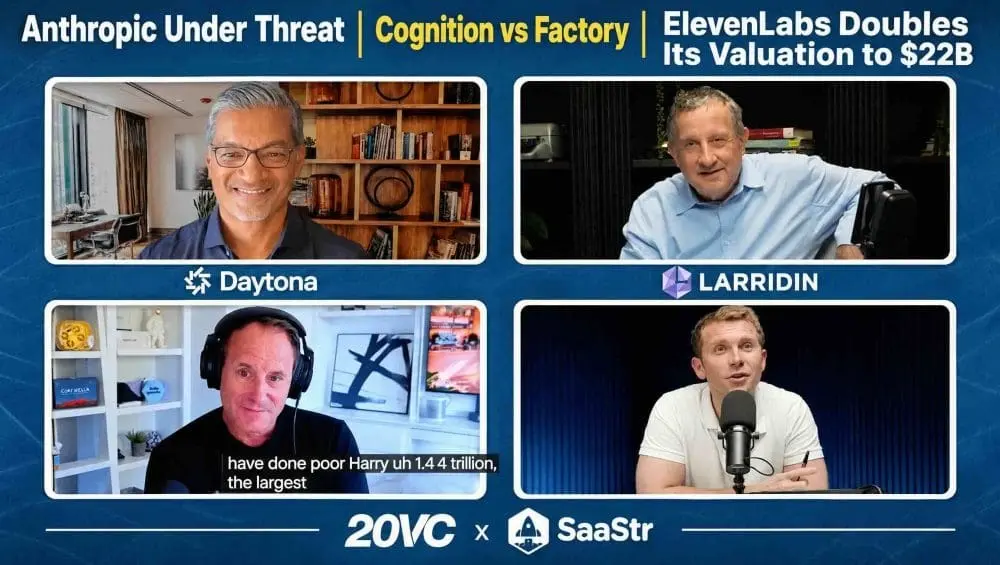
The intersection of enterprise software, artificial intelligence, and private-equity-scale venture capital has rarely witnessed a week as tumultuous as the one dissected in the latest collaborative briefing between 20VC’s Harry Stebbings and SaaStr’s Jason Lemkin, joined by venture veteran Rory O’Driscoll and special guest Dev Ittycheria. Freshly reinstated as the CEO of MongoDB—having stepped back into the hot seat just seven days prior following CJ Desai’s departure to Meta—Ittycheria brought a battle-tested enterprise perspective to a panel grappling with unprecedented market acceleration.
From OpenAI hurtling toward a $70 billion annualized revenue run rate and prepping a $30 billion funding bridge at a staggering $1.4 trillion valuation, to the explosive boardroom drama surrounding Factory, Chris Degnan, and Vinod Khosla, the tech landscape is undergoing tectonic shifts. Meanwhile, massive M&A deals—such as Salesforce snapping up Listen Labs for $2 billion—and an unexpected IPO pull by Oura highlight a paradoxical market: astronomical AI growth paired with jittery public market realities.
This comprehensive report synthesizes the panel’s rigorous analyses, breaking down the numbers, corporate fallout, and emerging structural rules defining the modern technology sector.
Detailed Chronology & Segment Breakdown
1. OpenAI’s Meteoric Rise and the Evolving LLM Wars
OpenAI’s annualized revenue is charging toward an astonishing $70 billion, marking an over 70% increase since the beginning of the third quarter. Enterprise sales have more than doubled in the same timeframe, signaling a massive corporate pivot toward AI deployment.
- Jason Lemkin’s Take: The story is pure velocity. While agentic coding initially favored Anthropic earlier in the year, October has seen portfolio companies aggressively swapping out models because solutions like Sol and Luna have proven to be faster, better, and cheaper.
- Dev Ittycheria’s Take: Having spent over a decade selling to developers, Ittycheria notes a distinct lack of brand loyalty in that demographic. Developers switch tools instantly or run them concurrently. True stickiness resides in the enterprise—multi-year contracts, mass employee training, and entrenched workflows where CIOs obsess over token budgets and data governance.
- Rory O’Driscoll’s Take: Pointing out that OpenAI grew a modest 18% quarter-over-quarter from Q1 to Q2 (under 100% annualized) while Anthropic grew at an explosive 10x clip—briefly capturing an $11 billion GAAP revenue lead over OpenAI’s $6.8 billion in Q2—O’Driscoll sees this new 60%–70% quarterly bounce as a narrative reset. It also provides critical financial relief against OpenAI’s massive forward commitments for compute, data centers, and Virginia land parcels.
2. Mega-Valuations: OpenAI’s $1.4T Bridge vs. Anthropic’s Imminent IPO
Whispers of OpenAI seeking at least $30 billion at a $1.4 trillion pre-money valuation as a bridge to an eventual public offering coincide with Anthropic targeting a mid-November public debut at a jaw-dropping $1.8 trillion to $2 trillion valuation.
- The Scale of Capital: O’Driscoll notes that a private round above one trillion dollars represents a staggering three-orders-of-magnitude leap from the first billion-dollar private rounds in the mid-1990s.
- Liquidity vs. Hold: When evaluating whether institutional investors should buy OpenAI privately at $1.4T or Anthropic publicly at $2T, O’Driscoll stresses a lean toward liquidity. In an era of intense unknowns, investors must either hold liquid stock or reconcile themselves to multi-year lockups.
3. The Factory, Chris Degnan, and Cognition Boardroom War
On September 30, Factory CEO Matan Grinberg publically fired board advisor Chris Degnan, accusing him of leaking confidential information to direct competitor Cognition. Merely two hours later, Degnan announced his appointment as Cognition’s Chief Revenue Officer. Degnan—formerly Snowflake’s CRO and a Factory advisor for a year—strenuously denied sharing any secrets, a denial echoed by Cognition.
The incident sparked a heated debate among the panel:
- Dev Ittycheria: As a Factory angel investor and partner to Cognition, Ittycheria drew a sharp line based on proximity to the tent. A casual advisor vetting European hires is one thing; an insider privy to product roadmaps, financials, and board strategy jumping to a direct competitor destroys reputational trust.
- Jason Lemkin: Offered a pragmatic counterpoint, suggesting 95% of CROs would view this as standard career mobility, noting that Degnan was an advisor rather than an operational employee.
- Rory O’Driscoll & Harry Stebbings: Disagreed, arguing that a board observer consumes panoramic strategic data across every functional silo, making an immediate leap to a rival fundamentally different from a siloed employee changing jobs. Lemkin further noted that AI-era talent turnover has shattered traditional loyalty paradigms, with massive employee exoduses now standard during executive departures.
4. Vinod Khosla’s Public Outburst Against His Own Portfolio Company
Adding fuel to the fire, Khosla Ventures’ Vinod Khosla publicly sided with Degnan, accused CEO Matan Grinberg of dishonesty, and labeled Factory a “struggling second tier competitor”—despite KV partner Keith Rabois having led Factory’s $110 million Series C in April and sitting on its board. Rabois publicly defended Factory.
- The Panel’s Reaction: Ittycheria called the tweet a tactical disaster that hands rival VC firms an easy weapon to use against Khosla Ventures. O’Driscoll deemed it a rare, regrettable failure of venture diplomacy, reiterating the golden rule: "Praise in public, chastise in private."
5. Reflection AI Drops "Beam": The Open-Weight Challenger
Reflection AI launched Beam, a 501-billion-parameter open-weight model claiming parity with Z.ai’s GLM-5.2 on reasoning benchmarks while consuming three to four times less inference compute.
- Enterprise Impact: Ittycheria highlighted that a near-frontier U.S. model removes hesitation for regulated industries wary of Chinese open-source options. By covering 90% of enterprise use cases at a fraction of the cost, it triggers the Jevons paradox—driving massive expansion in total token consumption rather than a zero-sum market split.
6. ElevenLabs Reaches a $22B Valuation via Employee Tender
Voice AI leader ElevenLabs completed a $300 million employee tender offer led by Wellington and T. Rowe Price, doubling its valuation to $22 billion in just months.
- Investment Thesis: Lemkin championed the voice workload as one where model quality is non-interchangeable. When an automated agent handles flower shop or customer service calls with zero latency and absolute accuracy, mid-market enterprises happily pay hundreds of thousands annually, insulating the business from pure commodity pricing pressures.
7. Salesforce Acquires Listen Labs for $2 Billion
Signaling the ferocious appetite for agentic applications, Salesforce agreed to acquire three-year-old AI research startup Listen Labs for roughly $2 billion. Listen Labs reportedly walked away from a $125 million Series C term sheet at a $1.5 billion valuation, boasting around $30 million in ARR.
- The Numbers & The Philosophy: Harry Stebbings calculated a stellar ~25x return for Sequoia on seed/Series A capital and a 4x return for Ribbit Capital in just eight months. While Lemkin questioned whether tens of millions in revenue truly moves the needle for a $50 billion behemoth like Salesforce, Ittycheria emphasized that foundational AI app startups must prioritize proprietary data loops to build durable, acquisition-grade moats.
8. Vercel’s Agentic Shift and the Death of Traditional SEO
Vercel revealed that autonomous agents now trigger more than 50% of its deployments, up from under 3% previously, powering a business scaling toward an immense ARR run rate.
- The New Digital Real Estate: Ittycheria and Lemkin noted that just as marketers spent 25 years optimizing for Google’s first page, they must now ensure that autonomous AI agents can seamlessly discover, interpret, and integrate their APIs and documentation. Being omitted from an agentic query is the modern equivalent of digital invisibility.
9. The Groq-Nvidia Talent & License Deal Faces a Delaware Lawsuit
Two former Groq engineers filed a Delaware Chancery Court lawsuit challenging Nvidia’s estimated $20 billion transaction—comprising a $17 billion non-exclusive license and $3 billion in RSUs distributed among 150 to 200 transitioning engineers.
- Legal & Structural Fallout: O’Driscoll explained that Delaware law strictly enforces equal treatment for holders of the same security class, making pre-packaged talent-and-license deals vulnerable when former employees holding legacy shares are left out of equity allocations.
10. Meta’s Muse vs. OpenAI’s Dots
Meta’s AI-powered app Muse claimed the top spot on the U.S. free iPhone charts within 10 days of its launch, outperforming ChatGPT. Meanwhile, OpenAI countered by launching Dots, an always-on persistent agent tied to Codex.
- Execution Wins: O’Driscoll praised Mark Zuckerberg and Alexandr Wang for disciplined execution and raw compute resourcing, proving that shipping great consumer product experiences trumps pure technical posturing.
11. Oura Pulls Its $2.2B IPO Despite Heavy Over-subscription
In a cautionary tale for tech liquidity, smart-ring pioneer Oura abruptly postponed its planned $2.2 billion Nasdaq IPO—despite books being four times oversubscribed and revenue growing 74% to $1.21 billion over the first nine months.
- Market Reality Check: Lemkin labeled the pull a red flag for venture liquidity, while Ittycheria and Oura’s syndicate discussions pointed to classic underwriting friction: aggressive banker valuation pitches clashing with public market pricing realities and large secondary sell-downs.
Supporting Context & Key Metrics
To fully appreciate the scope of the trends discussed by the panel, consider the following data points highlighted across the session:
- OpenAI Run Rate: Approaching $70B annualized, up 70%+ since Q3.
- Anthropic Q2 Revenue: Reached roughly $11B GAAP, outpacing OpenAI’s $6.8B during that specific window.
- ElevenLabs Valuation: Doubled from $11B (Feb) to $22B following a $300M employee tender.
- Listen Labs Acquisition: Salesforce acquired the 3-year-old startup for $2B on ~$30M ARR.
- Vercel Deployment Shift: Autonomous agents now drive over 50% of total platform deployments (up from <3%).
- Oura Financials: First nine months revenue hit $1.21B (up 74% year-over-year) prior to shelving its IPO.
Memorable Quotables
Dev Ittycheria on Venture Diplomacy:
"I was just totally flummoxed by that tweet. It basically handed every other firm a weapon when they’re competing on deals: is this the partner you want when things go bad?"Jason Lemkin on AI-Era Shifts:
"In the AI age, the definition of loyalty has changed. I think it’s changed permanently."Rory O’Driscoll on Enterprise Token Economics:
"I don’t care that it’s easier to just use Anthropic, dude. We need to shave $3 million off this token bill."Harry Stebbings on Consumer Hardware Exits:
"I would have hit the bid. Look at the consumer hardware companies that have gone before, from your Jawbones to your Pelotons. Hit the bid at 13 and take it out already."
Future Outlook
As the technology sector navigates the final stretch of the year, several macro trajectories are clear:
- The Infrastructure-to-Application Convergence: As frontier labs cement their astronomical revenue run rates ($70B+), the focus shifts rapidly to downstream enterprise efficiency. Companies that master token optimization and localized open-weight routing (such as Reflection AI’s Beam) will capture the bulk of non-frontier workloads.
- The Maturation of Agentic Workflows: With platforms like Vercel reporting that over half of all operations are agent-driven, enterprise software architecture is rewriting itself around automated consumers rather than human users.
- Regulatory and Legal Reckoning: High-profile legal challenges—from the Groq-Nvidia talent acquisition lawsuits to boardroom whistleblower wars—signal that the freewheeling, rapid-fire dealmaking of the early generative AI boom is bumping hard against strict corporate governance and Delaware legal frameworks.
This report is part of the ongoing 20VC x SaaStr partnership featuring Harry Stebbings, Rory O’Driscoll, Jason Lemkin, and special guest Dev Ittycheria.