Executive Overview
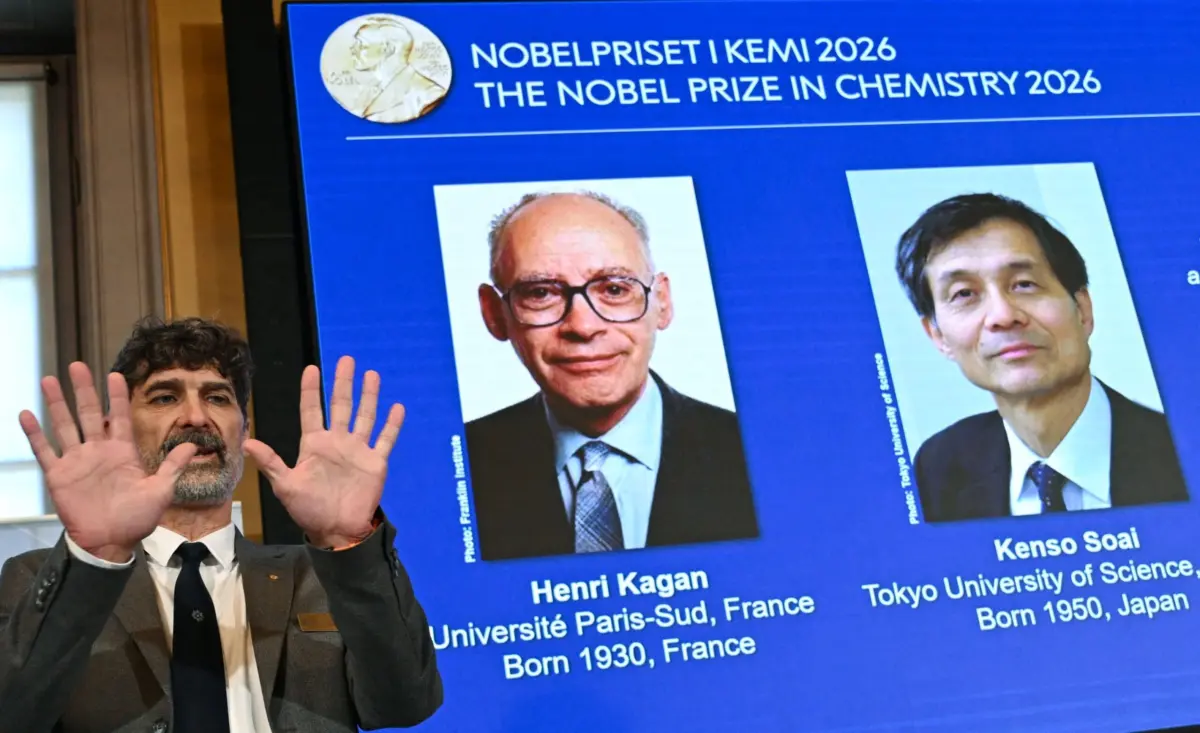
The 2026 Nobel Prize in Chemistry has been awarded to Henri Kagan and Kensō Soai for solving one of the most profound and enduring mysteries in the natural sciences: the origin of chemical asymmetry. Life on Earth is fundamentally right- or left-handed. From the DNA that stores our genetic code to the amino acids that build our proteins, biological systems rely on a phenomenon known as homochirality—the exclusive use of a single mirror-image molecular form over its counterpart.
For centuries, this molecular bias baffled scientists. In non-living chemical synthesis, reactions typically produce equal quantities of both left- and right-handed versions of a molecule, a 50-50 racemic mixture. Replicating nature’s selective preference in a laboratory setting—forcing a chemical reaction to yield exclusively one specific enantiomer—has long been a "holy grail" of organic chemistry.
Kagan and Soai independently unlocked this puzzle through groundbreaking work spanning decades. Henri Kagan discovered the "nonlinear effect" in asymmetric catalysis, proving that catalysts composed of mixed enantiomeric ratios do not behave linearly, thereby opening entirely new pathways to manipulate reaction outcomes. Building upon this theoretical and practical foundation, Kensō Soai achieved what no chemist had done before outside of living biology: he engineered an asymmetric autocatalytic reaction where a minute, chance initial imbalance snowballed into near-absolute purity, dominating up to 99.99 percent of the final product.
This breakthrough reshapes the foundations of pharmaceutical manufacturing, materials science, and our understanding of the origin of life itself. By mastering molecular asymmetry, science has moved closer to mirroring nature’s most sophisticated architectural blueprint.
Detailed Chronology: From Pasteur to the 2026 Nobel Breakthrough
To understand the magnitude of Kagan and Soai’s achievements, one must trace a historical thread that winds through more than a century and a half of chemical inquiry.
The 19th Century: Pasteur and the Discovery of Chirality
The story of molecular asymmetry begins in the mid-1800s with the pioneering French chemist Louis Pasteur. While examining crystals of tartaric acid derived from wine production, Pasteur made a startling observation. He noticed that the crystals existed in two distinct physical forms that were non-superimposable mirror images of each other—much like a human pair of hands.
When Pasteur exposed solutions of these separate crystal forms to bacteria, the microorganisms selectively consumed only one version, leaving the other untouched. This was the first empirical proof that molecules could possess handedness, a property later termed chirality (from the Greek word for hand, cheir). Molecules that are non-superimposable mirror images of each other are called enantiomers.
While enantiomers share identical physical properties—such as melting points, boiling points, and densities—they can interact dramatically differently with polarized light and biological receptors. The Nobel Committee famously illustrated this with a locksmith analogy:
"A locksmith can create two mirror-image keys, but only one of them fits the lock—and the lock can be damaged if your customers try to unlock it with the other key."
In modern pharmacology, this distinction is a matter of life and death. For instance, when designing drugs based on chiral building blocks like amino acids or sugars, one enantiomer often delivers the desired therapeutic payload, while its mirror-image twin can trigger adverse, toxic, or completely useless side effects. Controlling which enantiomer emerges from a synthesis has historically been one of organic chemistry’s greatest hurdles.
Early 20th Century: Willy Marckwald and the First Asymmetric Steps
For decades following Pasteur’s discovery, scientists attempted to recreate homochirality in the laboratory to understand its spontaneous emergence in nature and to harness it for synthetic chemistry. Early experiments invariably produced racemic mixtures—equal parts left- and right-handed molecules—failing to replicate nature’s selective bias.
At the dawn of the 20th century, German chemist Willy Marckwald achieved a modest breakthrough. He designed an asymmetric reaction capable of yielding a slightly greater amount of one enantiomer over the other. Marckwald utilized a chiral catalyst—a substance that accelerates a chemical reaction without being consumed by it, while preferentially guiding the formation of one specific enantiomer. Although Marckwald’s reaction shifted the balance, the numerical advantage was vanishingly small, proving that traditional catalytic models were insufficient to explain or achieve true homochirality.
1953: Charles Frank’s Mathematical Blueprint
The theoretical foundation for solving the problem arrived in 1953, when British theoretical physicist Charles Frank published a landmark mathematical model. Frank proposed that reproducing homochirality required three strict conditions:
- Asymmetric Amplification: There must be an initial reaction capable of slightly favoring one enantiomer over the other.
- Amplification of Imbalance: A mechanism must exist to exponentially amplify that initial, minute imbalance.
- Autocatalysis: The reaction itself must produce the very catalyst that drives it, establishing a positive feedback loop.
Under Frank’s model, a tiny initial advantage causes one variant to assemble at an accelerating rate until it entirely dominates the reaction vessel. For decades, Frank’s model remained an elegant mathematical abstraction—until Henri Kagan and Kensō Soai brought it into reality.
The 1980s: Henri Kagan and the Discovery of the Nonlinear Effect
Beginning in the early 1980s, French chemist Henri Kagan focused his research on refining asymmetric reactions by taking a closer look at the catalysts driving them.
At the time, standard chemical consensus held that asymmetric catalysts—typically composed of a metal atom acting as the reaction engine paired with a chiral molecule ensuring asymmetry—behaved in a strictly linear fashion. Chemists assumed that if they fed a catalyst mixture containing equal amounts of left- and right-handed chiral molecules into a reaction, the output would be a predictably balanced, linear result.
Kagan questioned this assumption. He hypothesized that the central metal atom did not interact with just a single enantiomer independently; rather, it interacted with both simultaneously.
By mixing enantiomer A and enantiomer B, Kagan realized three distinct combinations could form within the catalytic pool: A-A, B-B, and A-B. While A-A and B-B were mirror-image homodimers, the hetero-combination (A-B) behaved entirely differently during the catalytic cycle. Kagan discovered that the A-B combination could act as a molecular brake, drastically slowing down specific pathways and indirectly favoring the production of one final product over the other.
This phenomenon was christened the "nonlinear effect." It proved that the relationship between the optical purity of a catalyst and the optical purity of the resulting product is not always a straight line. Kagan’s discovery provided chemists with an entirely new paradigm and tool for manipulating and understanding reaction mechanisms.
2003: Kensō Soai and Absolute Asymmetric Autocatalysis
Inspired by Kagan’s groundbreaking insights on nonlinear effects, Japanese chemist Kensō Soai set out to realize Charles Frank’s theoretical framework of asymmetric autocatalysis.
Soai experimented with a specialized organic compound known as 5-pyrimidylalkanol. In his initial experiments, he introduced a starting mixture where one enantiomer held a minuscule 2 percent abundance advantage over its mirror image. As the reaction progressed, that slight edge exploded. By the end of the chemical synthesis, the advantage had surged to 87 percent.
Pushing his research further over the next two decades, Soai refined the process. Finally, in 2003, he achieved the definitive milestone: he engineered a reaction utilizing starting substances with no initial chiral orientation whatsoever.
As the substances reacted, a microscopic, random fluctuation by pure chance favored one enantiomer by an infinitesimal amount. That tiny statistical anomaly triggered a powerful autocatalytic feedback loop. The preferred molecule catalyzed the creation of more of its own kind at an exponential rate. Ultimately, that single form dominated the reaction vessel, accounting for a staggering 99.99 percent of the final product.
In effect, Soai’s reaction manufactured only one of the two possible mirror-image molecules from achiral starting materials. As the Nobel Committee noted in its official citation: "Other than life itself, no one had previously achieved this feat."
Supporting Context & Metrics: The Mechanics of Molecular Handedness
To fully appreciate the weight of the 2026 Nobel Prize, it is necessary to examine the underlying chemical mechanics and metrics governing chirality and its applications in the modern economy.
| Scientific Milestone / Concept | Key Figure / Contributor | Decade / Year | Impact / Significance |
|---|---|---|---|
| Discovery of Chirality | Louis Pasteur | 1848 | Proved that molecules can exist as non-superimposable mirror-image enantiomers. |
| First Asymmetric Catalyst | Willy Marckwald | Early 1900s | Demonstrated that chiral substances could influence product ratios, though with low yields. |
| Autocatalytic Framework | Charles Frank | 1953 | Formulated the mathematical conditions required for spontaneous homochirality. |
| The Nonlinear Effect | Henri Kagan | 1980s | Proved catalytic dimers (A-B combinations) alter reaction stereoselectivity nonlinearly. |
| Absolute Autocatalysis | Kensō Soai | 2003 | Engineered a reaction achieving 99.99% enantiomeric purity from achiral beginnings. |
Why Chirality Matters in Modern Industry
The implications of mastering asymmetric synthesis extend far beyond academic curiosity. In the multi-trillion-dollar global pharmaceutical industry, enantiomeric control is an absolute operational requirement.
- Drug Efficacy and Toxicity: Regulatory agencies such as the U.S. Food and Drug Administration (FDA) mandate rigorous testing of individual enantiomers. Historically, racemic drugs were marketed as a 50-50 mix of both hands. Today, the inactive or toxic enantiomer is viewed as chemical baggage that increases metabolic strain on patients. Kagan and Soai’s methodologies allow chemical engineers to synthesize single-enantiomer drugs with surgical precision.
- Agrochemicals and Materials: Beyond medicine, chiral synthesis dictates the potency of pesticides, herbicides, and liquid crystals used in modern digital displays. In each case, one enantiomer delivers the intended agricultural or electronic performance, while the other is frequently inert or ecologically problematic.
Official Statements and Expert Reactions
The announcement of the 2026 Nobel Prize in Chemistry sent ripples through the global scientific community, prompting praise from leading institutions and organic chemistry authorities.
In its official press release, the Nobel Committee for Chemistry emphasized the philosophical and practical weight of the laureates’ achievements:
"The enigma of nature’s chemical asymmetry has challenged generations of thinkers. By proving that nonlinear catalytic effects can govern reaction pathways and by demonstrating absolute asymmetric autocatalysis, Henri Kagan and Kensō Soai bridged the gap between sterile laboratory chemistry and the dynamic homochirality of living systems. Other than life itself, no one had previously achieved this feat."
Highlighting the analytical utility of Kagan’s work, José María Andrés García, a professor in the Department of Organic Chemistry at the University of Valladolid, noted in a statement distributed by SMC Spain:
"In addition to their practical interest, nonlinear effects are a very valuable tool for studying reaction mechanisms and the nature of catalytically active species. Kagan transformed how we look at the microscopic choreography inside a reaction vessel."
Future Outlook: The Next Frontier in Asymmetric Chemistry
As the scientific community digests the monumental achievements of Henri Kagan and Kensō Soai, attention is rapidly shifting toward how these discoveries will shape the future of technology, synthetic biology, and space exploration.
1. AI-Driven Asymmetric Synthesis
The intersection of artificial intelligence and machine learning with asymmetric catalysis represents the next great leap in chemistry. As highlighted in modern computational drug discovery frameworks, machine learning algorithms are now being trained on Kagan’s nonlinear effect models to predict how complex catalytic mixtures will behave before a single beaker is touched. By automating the screening of chiral ligands, researchers can drastically shorten the time required to bring single-enantiomer therapeutics to clinical trials.
2. Unlocking the Origin of Life (Astrochemistry)
Soai’s work on absolute asymmetric autocatalysis has breathed new life into astrobiology and the study of abiogenesis—how non-living chemicals transformed into living organisms. One of the greatest unanswered questions in science is why terrestrial life settled exclusively on left-handed amino acids and right-handed sugars.
Some astrobiologists hypothesize that extraterrestrial influences, such as circularly polarized ultraviolet light from distant stars or interactions with chiral magnetic minerals in early planetary environments, provided the initial minuscule 2 percent bias. Soai’s experiments prove that once a tiny chiral imbalance exists, autocatalytic positive feedback loops can rapidly scale that anomaly up to absolute purity. This provides a concrete, physically plausible mechanism for how early Earth could have transitioned from a racemic soup to a homochiral biosphere.
3. Advanced Materials and Nanotechnology
In materials science, homochirality is increasingly recognized as a key design principle for developing advanced optical switches, chiral polymers, and nanomaterials with unique electronic properties. As manufacturers adopt the principles laid down by the 2026 laureates, the fabrication of highly specialized, structurally pure materials will transition from an empirical art form into a precise, predictable science.
Ultimately, the 2026 Nobel Prize in Chemistry honors two scientists who dared to ask why nature writes its biological code in a single handwriting style. In decoding that mirror-image mystery, Henri Kagan and Kensō Soai have given humanity the ultimate tools to rewrite the future of molecular manufacturing.