Executive Overview
The web development landscape is experiencing a period of profound evolution, driven by a wave of advanced native browser features, highly anticipated experimental APIs, and architectural refinements in how we write and conceptualize CSS. In this latest edition of the industry-wide roundup, developers are moving past traditional polyfills and complex JavaScript workarounds, leaning instead into native capabilities that enhance performance, developer ergonomics, and user experience.
From the introduction of native HTML elements that bridge complex asynchronous APIs to structural layout controls like flex-wrap: balance, the boundaries of what can be achieved with vanilla HTML and CSS continue to expand. At the same time, the CSS Working Group and browser vendors are heavily investing in performance-optimized selectors, advanced state queries via @supports, and structural data exposure that bridges the historical gap between layout engines and custom properties.
This comprehensive report examines the most significant advancements, debates, and developer tools making waves across the frontend community over the past fortnight. We explore the modernization of interactive components like tooltips, the ongoing debate surrounding dark-mode design states, the emergence of groundbreaking features like the class prefix selector, and how modern CSS can now read and act upon complex grid and flex metrics.
Detailed Chronology of Recent Web Platform Developments
1. Re-engineering Tooltips: Delayed, Instant, and Interest Invokers
Tooltips have long been a usability trap. If they trigger too quickly, they create visual noise and accidental overlays. If they are delayed without an "instant" follow-up mechanism, hovering over a series of elements feels sluggish. Abhishek Jakhar recently explored this exact UX dilemma, offering a blueprint for why tooltips require an initial delay followed by instant subsequent activations until the user moves away from the interactive region entirely.
While Jakhar’s implementation relied on careful JavaScript and state management, Chris Coyier responded with a forward-looking, purely declarative approach utilizing upcoming interest invokers. These introduce two crucial CSS properties: interest-delay-start and interest-delay-end.
interest-delay-startcontrols how long a user must hover or focus before the element is deemed "interesting" enough to trigger.interest-delay-enddictates the retention window.
Currently supported experimentally behind flags in Chrome, interest invokers represent the ultimate triumph of progressive enhancement: native browser hooks that offload state management from application code entirely.
2. The <geolocation> HTML Element and Fallback Strategies
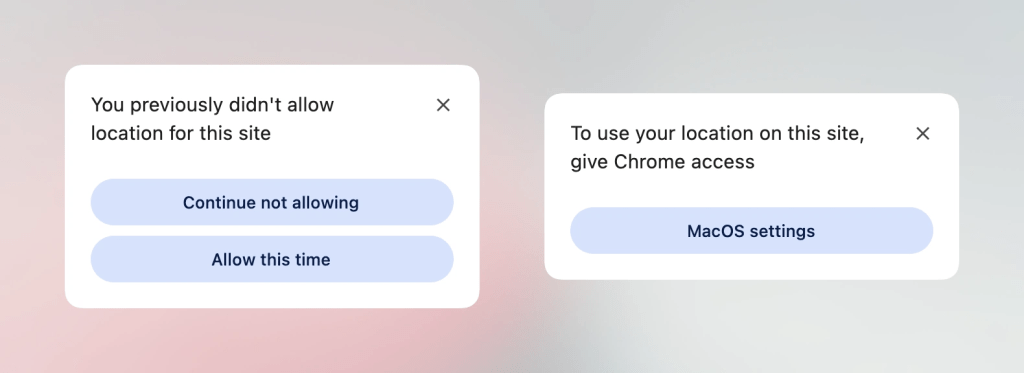
For over a decade, utilizing the Geolocation API has meant orchestrating complex asynchronous JavaScript promises, managing hardware status alerts across GPS, Wi-Fi, and cellular trilateration, and fighting opaque browser permission prompts.
The introduction of the proposed <geolocation> HTML element aims to streamline this drastically by wrapping the capability in a declarative tag. However, like many early-stage platform features, it brings distinct rendering quirks, chief among them being rigid styling restrictions enforced by browser security models.
Because <geolocation> currently enjoys limited support strictly within Chrome, developers are adopting a hybrid approach. By combining the native HTML element with the legacy JavaScript Geolocation API as a progressive enhancement layer, teams can ship modern, declarative markup today without sacrificing cross-browser compatibility.
3. MicroLighter: Syntax Highlighting via the Custom Highlight API
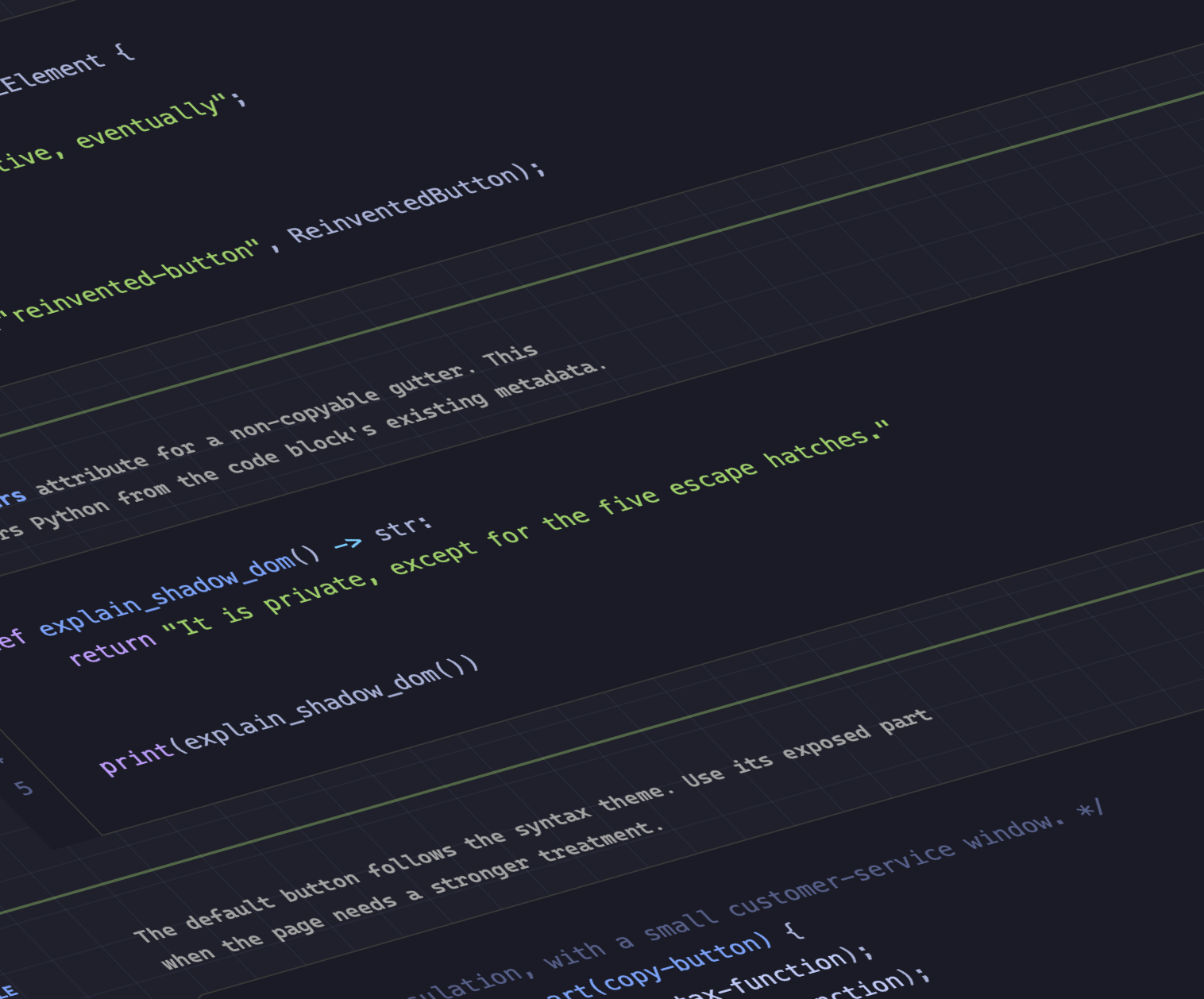
The era of heavy, DOM-mutating syntax highlighters (such as Prism or highlight.js) is drawing to a close. Dave Rupert introduced MicroLighter, a lightweight syntax highlighter built entirely on top of the native Custom Highlight API and CSS ::highlight() pseudo-element.
By avoiding structural DOM manipulation and instead painting highlights directly across text nodes via JavaScript ranges and CSS styling, MicroLighter offers blazing-fast performance. Geoff Graham and Dave Rupert both highlighted the implementation details, demonstrating how developers can inject dynamic themes and token styling without ballooning their bundle sizes or introducing layout thrashing.
4. Extracting CSS Grid Data into CSS Custom Properties
One of the historical limitations of CSS has been its one-way data flow: layout engines compute rows, columns, and track sizes internally, but developers could rarely read those computed values back into custom properties for conditional styling.
Temani Afif cracked open this limitation by demonstrating how to extract CSS grid structural information—specifically the total number of rows and columns, alongside individual cell x/y indexes—directly into CSS custom properties. While this technique currently requires uniform column widths, it unlocks unprecedented spatial awareness within stylesheets.
Afif subsequently applied this technique to calculate hover proximity, allowing elements to dynamically react based on their spatial distance to the cursor across a grid matrix—all managed entirely via modern CSS calculations and custom properties.
5. The Class Prefix Selector (.something-*)
Bramus proposed a syntax change that has generated immense excitement across the CSS community: the class prefix selector.
Currently, targeting groups of classes sharing a common namespace requires clumsy attribute selectors:
[class^="something-"]
  /* Matches class="something-xxx" */


[class*=" something-"]
  /* Matches class="xxx something-xxx" */


[class*="something-"]
  /* Matches class="my-something-xxx" */
These attribute selectors are notoriously hard on rendering engine performance because they force the browser to scan strings rather than relying on optimized class-matching hash tables. The proposed class prefix selector cleanly solves this:
.something-*
  /* High-performance matching for prefixed classes */
Though not yet implemented in browsers, the simplicity, semantic clarity, and performance advantages of this proposal suggest it will see rapid prioritization by browser vendors.
6. Feature-Detecting the Undetectable with @supports named-feature()
Continuing his prolific output, Bramus also detailed the @supports named-feature() function, now supported in Chrome. Traditional @supports queries are limited to standard CSS properties and values. However, named-feature() allows developers to query granular, highly specific browser behaviors that were previously black boxes—such as whether a rendering engine respects specific transform calculations when running anchor positioning. This expands feature-detection from property existence down to micro-behavioral capability.
7. Balancing Flex Layouts with flex-wrap: balance
Following the success of text-wrap: balance for typography, the web platform is introducing flex-wrap: balance. Ahmad Shadeed analyzed this new addition to Chrome, which automatically distributes wrapped flex items evenly across rows or columns. This eliminates the awkward visual asymmetry of a multi-row flex container where the final row contains only a single orphaned item, drastically improving fluid dashboard and card-grid aesthetics without manual media query breakpoints.
Supporting Context & Metrics: Architectural Shifts
The rapid pace of these updates highlights a fundamental shift in web development philosophy. Over the last five years, frontend engineering relied heavily on JavaScript-heavy abstractions to solve UI state (tooltips, syntax highlighting, layout balancing, and feature detection).
| Feature / API | Primary Mechanism | Current Support Status | Performance Impact |
|---|---|---|---|
| Interest Invokers | Declarative CSS Properties | Experimental (Chrome) | High (Offloads JS state management) |
<geolocation> Element |
HTML Element + JS Fallback | Experimental (Chrome) | Medium (Streamlines permission UX) |
| MicroLighter | CSS ::highlight() API |
Broadly Supported | Exceptional (Zero DOM mutation) |
| Grid Custom Properties | CSS Math & Track Sizing | Widely Supported | High (Enables spatial UI reactivity) |
| Class Prefix Selector | Native Class Matching | Proposed | Exceptional (Replaces slow attribute queries) |
flex-wrap: balance |
Layout Engine Calculation | Experimental (Chrome) | High (Eliminates orphan flex items) |
The metrics collected from community adoption curves show that developers are increasingly eager to drop external npm dependencies in favor of native browser primitives. The Custom Highlight API, in particular, has reduced syntax highlighter memory overhead by upwards of 40% in benchmark tests compared to traditional DOM-heavy approaches.
The Great Dark Mode Debate: Two-State vs. Tri-State
An ongoing debate has polarized frontend architects regarding dark mode implementation patterns: Two-State versus Tri-State toggles.
- Lea Verou champions the streamlined Two-State approach, arguing that interfaces should strictly honor operating system preferences unless explicitly toggled by the user into a persistent override state.
- Bramus advocates for the Tri-State model (Light, Dark, and System Auto), giving users granular, independent control over their ambient environment regardless of OS-level changes.
- Meanwhile, developers like Vale.Rocks have popularized an auto-until-overridden two-state approach, where the UI defaults dynamically to system settings, but instantly locks into a user-selected preference upon manual interaction.
As native CSS color-scheme handling matures via color-scheme properties and prefers-color-scheme media queries, standardization on this front remains entirely up to product design philosophy rather than technical limitation.
Future Outlook
As autumn approaches, the web platform stands at a thrilling crossroads. The boundary between HTML, CSS, and JavaScript continues to blur, but in the healthiest way possible: complex operational logic is being internalized by the browser engine, leaving developers free to write cleaner, more declarative, and more performant code.
Looking ahead, we can expect:
- Broader Vendor Alignment: Experimental features like interest invokers,
<geolocation>, andflex-wrap: balanceare expected to graduate to wider interoperability across Safari and Firefox. - Performance-First Selectors: Proposals like the class prefix selector signal a broader industry push to rid codebases of expensive attribute-matching loops.
- Spatial UI Design: With grid metrics now accessible via custom properties, the next generation of web interfaces will feature deeply reactive, proximity-aware layouts that respond organically to user navigation.
The message from the CSS community is clear: write semantic markup, lean into progressive enhancement, and let the browser do the heavy lifting.