Executive Overview
In an era dominated by hyper-engagement metrics, infinite vertical scrolls, and screen-time anxiety, a new breed of technology is quietly emerging with a counterintuitive thesis: the best screen is the one you put away.
Enter EcoQuest, an open-source progressive web application (PWA) developed for the Hacktoberfest 2026 Open-Source AI Challenge Week 1: Touch Grass. Conceived by developer alsvader, EcoQuest flips the traditional digital engagement model on its head. Instead of demanding more of a user’s visual attention, the application actively encourages them to pocket their devices, explore physical spaces, and engage deeply with the natural world.
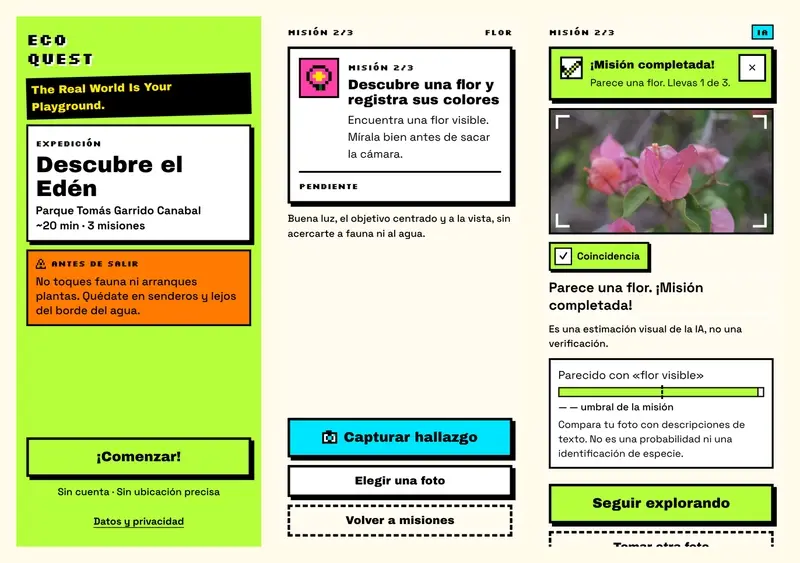
At its core, EcoQuest utilizes an open-weight vision-language model (SigLIP2) to gamify and validate real-world outdoor explorations. The application guides users through curated, bite-sized physical expeditions—such as its pilot mission, «Descubre el Edén» (Discover Eden) in the lush Parque Tomás Garrido Canabal of Villahermosa, Tabasco, Mexico. By combining privacy-first architecture, local-first data storage, and zero-shot open-source AI, EcoQuest demonstrates how modern machine learning can serve as a bridge to physical reality rather than a barrier to it.
Detailed Chronology: From Concept to Containerized MVP
The development of EcoQuest represents a masterclass in rapid, purpose-driven minimum viable product (MVP) engineering. Designed specifically under the constraints and themes of the Hacktoberfest "Touch Grass" challenge, the project moved rapidly from conceptualization to a fully functional, containerized local deployment.
Phase 1: Conceptualization and Privacy-First Architecture
The project began with a fundamental design philosophy: ask as little attention and data from the user as possible. Most modern outdoor utility applications rely heavily on continuous location tracking, aggressive push notifications, mandatory user accounts, and telemetry clouds. EcoQuest deliberately discards all of these paradigms.
- No user accounts are required.
- No continuous GPS tracking occurs in the background.
- The camera interface is locked down, opening only when a user actively declares they have found a mission-critical item.
Phase 2: Building the Inference Engine
With the interaction model established, the next architectural hurdle was building a robust validation engine. The creator chose Google’s SigLIP2 (google/siglip2-base-patch16-256) as the core cognitive engine. Running zero-shot classification, the model evaluates whether a captured user photo aligns with specific mission text prompts while carefully vetting against distractor prompts (such as buildings, human figures, open sky, or smooth palm trunks) to minimize false positives.
The inference service was wrapped in a lightweight FastAPI application. Crucially, the system design prioritizes absolute data minimization: images submitted for validation are processed entirely in memory. They are never written to disk, nor are they logged to external servers.

Phase 3: PWA Implementation and Local-First State
To ensure seamless mobile usability without requiring native app store downloads, the client-side experience was engineered as a Progressive Web Application (PWA).
- Client-side downscaling: Mobile photos are compressed and downscaled directly on the device before transmission to minimize bandwidth and processing overhead.
- IndexedDB storage: All session logs, progress metrics, and captured photos are stored locally on the user’s device via IndexedDB, granting the user absolute ownership and the ability to export or wipe their data instantly.
Phase 4: Containerization and Testing
To ensure reproducibility, the entire stack was containerized using Docker. The inference engine and PWA can be spun up locally with a single command:
git clone https://github.com/alsvader/ecoquest.git
cd ecoquest
docker compose up --build -d
As of its current milestone, the project boasts rigorous testing routines: 27 dedicated tests for the inference service and 36 integration tests for the mobile web application flow.
Supporting Context & Metrics: Under the Hood of EcoQuest
To truly understand EcoQuest’s technical achievement, one must examine its performance characteristics, technology stack, and operational footprint.
The Technology Stack
- Front-End: Modern mobile web PWA built with responsive design principles (v2 interface).
- Back-End / Inference: FastAPI service running on Python, leveraging Hugging Face Transformers.
- Core AI Model:
google/siglip2-base-patch16-256(Open-weight vision-language model, licensed under Apache-2.0). - Storage: Client-side IndexedDB for zero-cloud footprint session logging.
- Orchestration: Docker and Docker Compose, supporting cross-platform local execution.
Performance Benchmarks & Resource Footprint
During local performance profiling on an Apple Silicon Mac via Docker Desktop, the inference container demonstrated remarkable efficiency:
- Memory Limits: The service is safely capped, triggering containment policies if memory boundaries are crossed at 640 MB, while running comfortably and stably within a 2 GB allocation.
- Inference Speed: Averaging roughly 0.5 seconds per photo utilizing just 2 vCPUs, the system delivers near-instantaneous validation for users in the field.
- Initialization Cost: The initial Docker build requires downloading approximately 1.5 GB of model weights, resulting in a first-run build time of roughly 8 minutes.
The Pilot Expedition: «Descubre el Edén»
The application’s flagship test case is designed for real-world execution in Villahermosa, Tabasco, Mexico:
- Location: Parque Tomás Garrido Canabal.
- Duration: Approximately 20 minutes.
- Structure: A sequential 3-mission format focused on gentle, mindful observation of local flora and environmental textures rather than rapid-fire gamified collecting.
Official Statements and Architectural Philosophy
The philosophy driving EcoQuest is rooted in a broader industry critique of attention-economy software. In technical documentation and public repository notes, the project’s creator emphasizes that open-source AI should be utilized to empower human autonomy rather than extract it.

"Most ‘outdoor’ apps ask you to look at your screen more. EcoQuest does the opposite. You pick an expedition, put your phone in your pocket, walk, and take a photo only when you find something."
— alsvader, Project Creator
This philosophy extends to how the application handles computational uncertainty. Recognizing that computer vision models are probabilistic engines rather than infallible taxonomic experts, EcoQuest deliberately avoids over-engineering claims of intelligence:
- No Species Identification: The model does not claim to identify specific botanical or biological species; it merely evaluates semantic similarity.
- No Confidence Percentages: The user interface intentionally strips away distracting probability percentages.
- Human-in-the-Loop Fallbacks: If the AI inference engine fails or returns an inconclusive result, users retain the agency to manually mark a mission complete. These manual overrides are explicitly flagged everywhere—including in the final session badge—as «Unverified», ensuring absolute intellectual honesty in the user’s exploration record.
Future Outlook: Challenges and Next Steps
While EcoQuest has successfully crossed the threshold of a functional Minimum Viable Product, the developer is transparent about the milestones that remain before the application reaches production maturity.
1. Real-World Field Testing
To date, the application’s matching thresholds have been calibrated primarily against 42 curated Wikimedia Commons reference photos (such as Kailash Easterling’s CC BY 4.0 close-up of a Bougainvillea flower). The critical next phase involves executing live field tests in Parque Tomás Garrido Canabal, capturing natural variations in lighting, weather, and mobile phone camera sensors.
2. Threshold Tuning and Cross-Platform Optimization
The current validation thresholds are provisional. Real-world deployment will require iterative fine-tuning based on empirical field data. Furthermore, while local deployment has been extensively validated on arm64 architectures (such as Apple Silicon), broader stress-testing across x86_64 hardware and commercial cloud hosting providers remains on the roadmap.
3. Expanding the Open-Source Ecosystem
By releasing the project under the permissive MIT License and publishing multilingual documentation (English and Spanish for Mexico), EcoQuest lays the groundwork for a community-driven expansion. Future contributors can easily spin up alternative regional expeditions, tailoring missions to urban parks, botanical gardens, and wilderness trails across the globe.
Conclusion
EcoQuest stands as a refreshing reminder of what can happen when artificial intelligence is deployed with intentional restraint. By leveraging open-weight models like SigLIP2, respecting user privacy through local-first architecture, and treating the physical world as the primary interface, EcoQuest successfully redefines the boundaries of outdoor tech. It proves that technology doesn’t have to keep us tethered to our screens—sometimes, with the right open-source tools, it can gently nudge us to touch grass.