Executive Overview
At its landmark MAX convention in Miami, Adobe announced an aggressive expansion of artificial intelligence capabilities across its flagship Creative Cloud suite, including Photoshop, Premiere Pro, Illustrator, InDesign, and Lightroom. Far from incremental adjustments, this product release marks a structural pivot toward agentic workflows, cross-platform interoperability, and enterprise-grade generative video and design automation.
Central to Adobe’s announcements is the rollout of a Model Context Protocol (MCP) architecture, enabling external Large Language Model (LLM) agents—such as OpenAI’s ChatGPT, Anthropic’s Claude, and Google’s Gemini—to programmatically execute commands within Adobe desktop applications. Simultaneously, the company is directly encroaching on competitive turf with the launch of "Builder," a private-beta prototyping environment within the Firefly ecosystem designed to rival tools like Figma. Combined with native integrations of third-party models, deep video creation pipelines, and newly integrated assets from its Topaz Labs acquisition, Adobe is laying out an ambitious vision: transforming its tools from static software into proactive, context-aware co-creators.
Detailed Chronology & Core Platform Updates
The Miami announcements span nearly every facet of Adobe’s product line, dividing updates into flagship desktop software updates and broader web-first, platform-wide capabilities within the Firefly umbrella.
                      +-------------------------------------------------------+
                      |                 ADOBE MAX MIAMI ANNOUNCEMENTS         |
                      +-------------------------------------------------------+
                                                  |
       +------------------------------------------+------------------------------------------+
       |                                          |                                          |
       v                                          v                                          v
+-------------------------------+      +-------------------------------+      +-------------------------------+
|     CREATIVE CLOUD APPS       |      |       FIREFLY ECOSYSTEM       |      |     PROTOCOL & INTEGRATIONS   |
+-------------------------------+      +-------------------------------+      +-------------------------------+
| • Photoshop: Relighting,      |      | • Builder (Figma competitor)  |      | • Local Model Context         |
|   generative style sliders    |      | • Timeline-based Video        |      |   Protocol (MCP) release      |
| • Premiere Pro: Object removal|      |   Assembly Tool               |      | • Third-party LLM access      |
|   & modern color grading      |      | • Always-on Ambient Agent     |      |   (ChatGPT, Claude, Gemini)   |
| • Lightroom: Eye-blink        |      | • Isolated Object Editing     |      | • Topaz Labs updates          |
|   correction, blemish removal |      | • On-brand Graph Generator    |      |   (Wonder 4, ImageHDR)        |
+-------------------------------+      +-------------------------------+      +-------------------------------+
1. Flagship Creative Cloud Enhancements
Adobe continues to embed specialized machine learning algorithms directly into its legacy desktop suite, aiming to reduce manual labor in intensive post-production tasks.
- Photoshop: Introduces an advanced AI Relighting feature that re-calculates volume, depth, and dynamic range to alter scene lighting post-capture without requiring complex 3D rendering pipelines. Alongside relighting, new prompt-driven Generative Style Sliders grant fine-grained control over aesthetic transformations, replacing blunt text-to-image prompts with granular visual controls.
- Premiere Pro: Gains a sophisticated video-based Object Removal tool powered by spatial-temporal generative modeling, alongside a rebuilt Professional Color Grading System designed to streamline color workflows for cinematic editors.
- Lightroom: Focuses on portrait precision with automated Eye-Blink Correction, which synthesizes natural eye detail from reference photos to fix closed eyes, alongside an intelligent Blemish Removal engine that preserves sub-surface skin texture.
- Illustrator & InDesign: Continue to expand upon previously integrated AI Assistant capabilities, introducing deeper vector manipulation and automated layout optimization tools built for print and digital publishing pipelines.
2. Firefly Ecosystem & "Builder"
The stand-alone Firefly web and web-adjacent applications received significant structural updates aimed at capturing end-to-end ideation workflows:
- Firefly Builder (Private Beta): Marking a direct entry into interface design and ideation space traditionally dominated by Figma, Builder allows creators to construct visual prototypes, pitch decks, and dynamic wireframes directly within Firefly.
- Generative Video Assembly Engine: A unified workspace where users can assemble complete video narratives by combining video clips, static imagery, audio tracks, and sound effects using timeline-driven AI composition.
- Isolated Object Editing: Enables creators to modify specific, targeted visual elements within an image while leaving background textures, shadows, and surrounding geometry untouched.
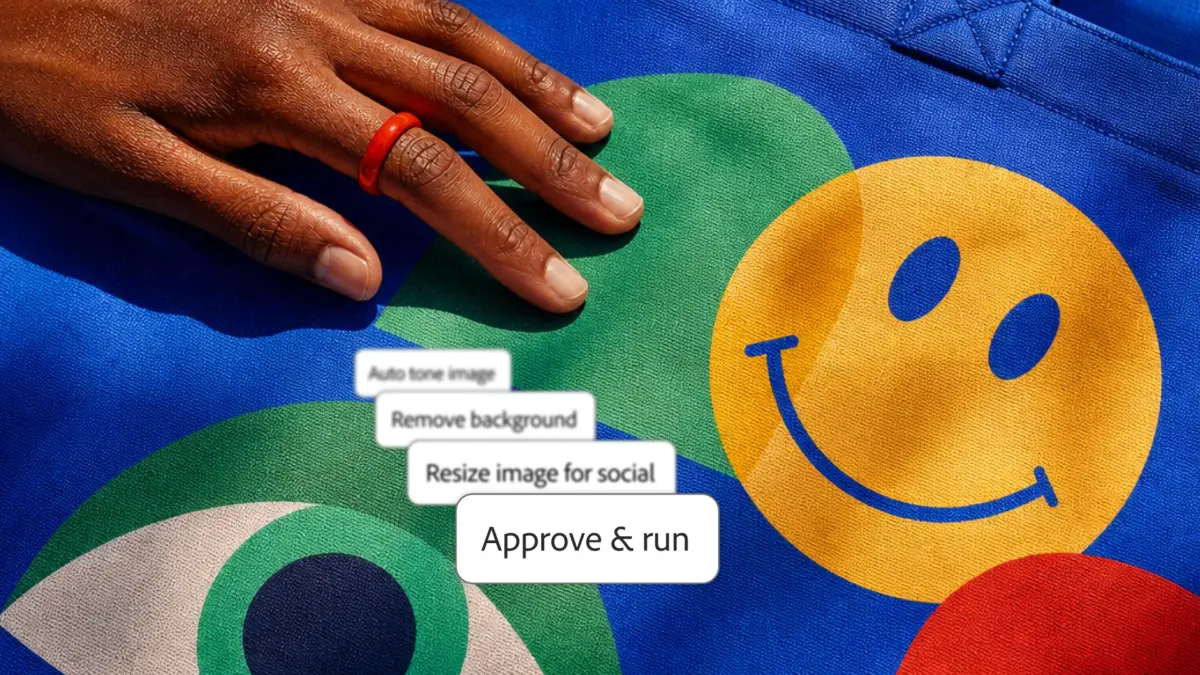
- Always-On Ambient AI Agent: Adobe is transitioning its software assistant from an on-demand chat window to a persistent background service. This proactive agent monitors active workspace context, anticipating next steps and offering one-click micro-actions like instantaneous background removal or automated video thumbnail generation.
- On-Brand Data Visualization: A smart design tool for auto-generating charts, graphs, and infographics that strictly adhere to predefined corporate brand identity kits.
Supporting Context & Industry Metrics
Adobe’s announcement takes place in an evolving competitive landscape. Rather than isolating its creative applications within a closed system, Adobe is building an agnostic platform model that bridges proprietary creative tools with third-party generative models and external agentic frameworks.
The Multi-Model Strategy & Topaz Labs Acquisition
Adobe continues to position Firefly as an orchestration layer for third-party AI models. Rather than relying solely on in-house architectures, the platform currently incorporates or integrates outputs from key industry developers, including Google, OpenAI, Runway, ElevenLabs, Black Forest Labs, Kling, and ByteDance.
+-----------------------------------------------------------------------------------+
|                        ADOBE MULTI-MODEL ORCHESTRATION LAYER                      |
+-----------------------------------------------------------------------------------+
|  In-House Models:   Firefly Image, Firefly Vector, Firefly Video                  |
+-----------------------------------------------------------------------------------+
|  Acquisitions:      Topaz Labs (Wonder 4 Upscaling/Denoising, ImageHDR Conversion) |
+-----------------------------------------------------------------------------------+
|  Partner Models:    OpenAI, Google, Runway, ElevenLabs, Black Forest Labs,        |
|                     Kling AI, ByteDance                                           |
+-----------------------------------------------------------------------------------+
This multi-model strategy is further bolstered by newly integrated technology from Adobe’s acquisition of Topaz Labs. At the MAX event, Topaz Labs unveiled two new image processing engines:

- Wonder 4: A model optimized for raw image upscaling, detail restoration, and complex noise reduction.
- ImageHDR: An algorithm engineered to automatically re-map standard dynamic range (SDR) photography into rich High Dynamic Range (HDR) assets.
The Model Context Protocol (MCP) Integration
The key architectural pivot announced at MAX is Adobe’s adoption of a local Model Context Protocol (MCP). Developed as an open standard to bridge LLMs with local applications, MCP acts as an API layer that translates natural language intent from external chatbots into system-level commands across desktop applications.
Under this implementation, an external agent running in ChatGPT, Claude, or Gemini can call native functions across:
- Adobe Photoshop
- Adobe Illustrator
- Adobe After Effects
- Adobe Premiere Pro
By opening application endpoints to third-party models, Adobe allows users to automate complex visual assembly directly from external conversational interfaces.
Official Statements & Competitive Counter-Narratives
The integration of open agentic standards like MCP has sparked a strategic debate among software platforms, illustrating differing philosophies on how software should interface with frontier AI labs.
Adobe’s Perspective: Open Endpoints for Workflow Sovereignty
Speaking to TechCrunch at the event, Deepa Subramaniam, Vice President of Product Marketing at Adobe, highlighted the company’s intent to provide broad access without prematurely constraining how creators automate their pipelines.
"We are still figuring out where and when and how to draw the line. What we’re putting out there is a number of endpoints and capabilities across Illustrator, Photoshop, After Effects, and Premiere. We’re just going to see how people use it, what they’re trying to do, and keep showing more," Subramaniam stated.
"We don’t have any need or desire to sort of limit what the MCP endpoint can expose. What we really want to do is to support that creative workflow, how you choose to do it."
Subramaniam’s comments signal an open architectural strategy: rather than locking users into a closed, end-to-end environment, Adobe is betting that keeping its application endpoints open will retain Creative Cloud’s status as the core visual rendering engine, regardless of which third-party AI orchestrates the task.

The Industry Counter-Perspective: Figma’s Skepticism
Adobe’s push into open MCP endpoints stands in contrast to opinions voiced elsewhere in the design software industry. Recently, Dylan Field, co-founder and CEO of competitor Figma, expressed skepticism regarding the current state of open protocol implementations.
Speaking at an industry gathering in India, Field argued that MCP is far from an ideal standard in its current iteration, asserting that open context protocols disproportionately empower frontier LLM developers (such as OpenAI and Anthropic) while diminishing the proprietary user-interface value of specialized design tools.
This debate highlights a fundamental strategic divide in software design:
- Adobe’s Approach: Position software tools as headless execution engines that can be commanded by external AI agents, third-party models, or internal suites alike.
- Alternative Platform Approach: Protect application boundaries, prioritizing proprietary user interfaces and controlled environments over open LLM execution interfaces.
Strategic Implications & Future Outlook
Adobe’s MAX announcements illustrate how established creative software providers are adapting to a landscape increasingly shaped by generative AI.
1. The Blurring Boundary Between Creative and Prototyping Suites
With the introduction of Firefly Builder, Adobe is re-entering the digital interface and design prototyping arena. By embedding prompt-driven generation directly into design systems and pitch materials, Adobe aims to shorten the path between initial concepting and functional production. This move intensifies competitive dynamics with specialized canvas and UI tools like Figma, Canva, and Miro.
2. The Shift to Ambient, Agentic Creative Environments
The move away from isolated AI dialog boxes toward an always-on ambient agent represents a broader shift toward proactive computing. If creative applications can independently track working context—identifying asset gaps, suggesting composition balances, or pre-rendering routine exports—the primary role of the designer shifts from operational tool usage to creative direction, curation, and quality assurance.
3. Open Protocols vs. Ecosystem Lock-In
By opening its internal APIs through local MCP implementations, Adobe acknowledges that the primary interface for software execution may increasingly move toward conversational or agentic LLMs. By ensuring Photoshop, After Effects, and Premiere Pro serve as the underlying rendering standard for these agents, Adobe positions its software ecosystem to remain central to professional media pipelines, regardless of how design tasks are initiated.