In a major development for cloud-native data architecture, Amazon Web Services (AWS) has announced the general availability of native vector search capabilities within Amazon DynamoDB. This release allows organizations to store vector embeddings directly alongside their standard operational data within DynamoDB tables, eliminating the architectural overhead of replicating data to specialized, standalone vector databases.
By integrating high-performance similarity search natively into a globally trusted NoSQL database, AWS is redefining how developers build modern artificial intelligence applications. The new service supports single-digit millisecond latency at scale, maintains a 99%+ recall rate, and handles workloads spanning up to trillions of vectors.
Crucially, this capability removes the friction traditionally associated with Retrieval-Augmented Generation (RAG), semantic memory for autonomous AI agents, personalized recommendation systems, and real-time anomaly detection. Because the feature is fully serverless, it inherits DynamoDB’s pay-per-request pricing model and zero-maintenance architecture, sparing engineering teams from the burdens of provisioning clusters, managing infrastructure patches, or engineering complex synchronization pipelines.
Detailed Chronology & Technological Evolution
The Architectural Pain Point of Traditional RAG and AI Workloads
For years, the rapid maturation of generative AI and Large Language Models (LLMs) created a distinct engineering paradox. Operational data—user profiles, product catalogs, transactional records, and inventory logs—lived primarily in high-throughput NoSQL databases like DynamoDB or relational systems. However, enabling semantic or natural language search over that data required generating vector embeddings (dense numerical representations of text, images, or audio) and shipping them out to dedicated vector stores.
This decoupled architecture introduced significant friction:
Data Movement Costs: Streaming data continuously between operational databases and vector indexes increased network overhead and cloud expenditure.
Synchronization Pipelines: Maintaining consistency between primary operational data and secondary vector databases required custom-built change data capture (CDC) pipelines, increasing system complexity and vulnerability to drift.
Latency and Scale Constraints: Ensuring predictable, single-digit millisecond latency while scaling to billions or trillions of vectors across distributed systems often degraded under heavy read/write contention.
The Engineering Breakthrough: Native Serverless Vector Search
Recognizing these pain points, AWS engineered a native indexing mechanism directly into DynamoDB’s serverless core. Instead of introducing a brand-new data type, the service leverages DynamoDB’s existing List data type. Developers can store float values representing embedding vectors—generated by models such as Amazon Bedrock Titan Text Embeddings, Cohere Embed, or OpenAI embedding models—using standard PutItem or UpdateItem operations.
Upon storing these arrays, engineers can create a specialized vector index on the embedding attribute. This index operates seamlessly within DynamoDB’s existing infrastructure, scaling horizontally as data volumes expand without arbitrary storage ceilings.
To execute queries, the newly introduced SearchVectors API accepts a query vector, a defined top-K result count (up to 100), and optional inline filter conditions. The database computes similarity scores against the index and returns the closest matches alongside the item’s operational attributes in a single, cohesive response.
Step-by-Step Implementation Guide
To illustrate the practical implementation of this new capability, AWS outlined a reference architecture utilizing an online sporting goods store’s product catalog (ProductCatalog).
Step 1: Preparing the DynamoDB Table
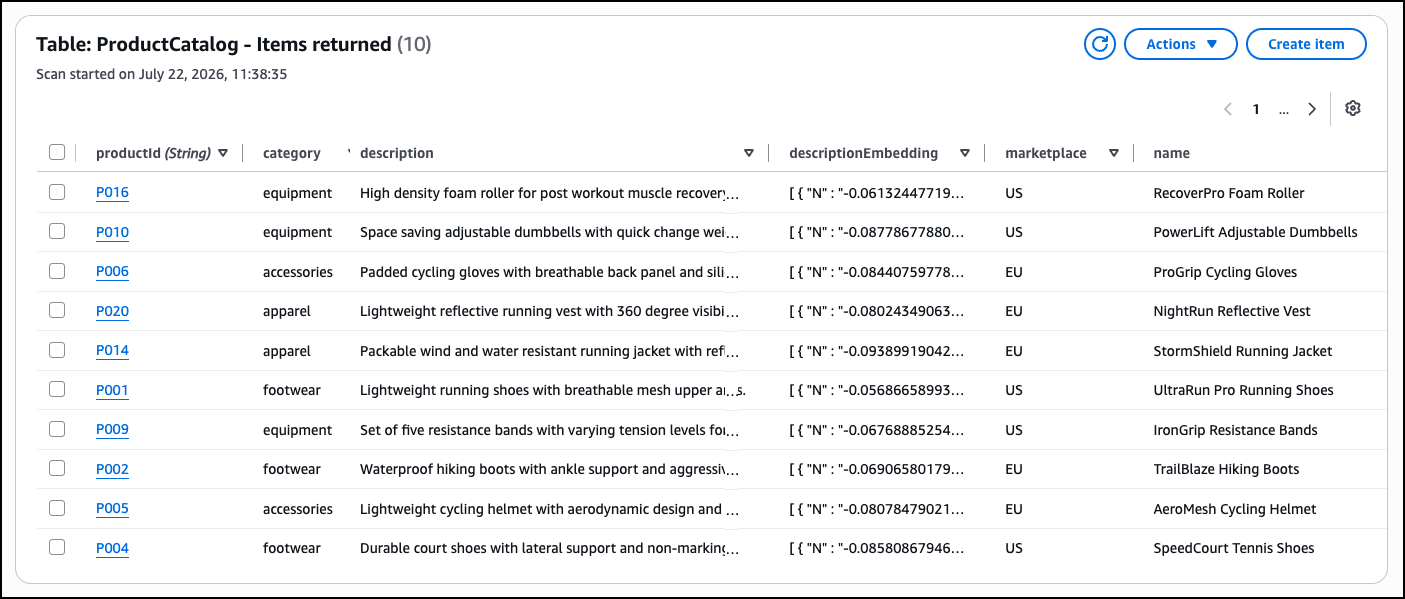
In a traditional migration or enhancement workflow, an existing table containing operational attributes—such as productId, category, description, marketplace, name, and price—is augmented with semantic properties.
Generating Embeddings: Product descriptions are passed through an embedding model (e.g., Amazon Bedrock Titan Text Embeddings) to produce multi-dimensional numerical vectors capturing semantic meaning.
Storing Vectors: Using an UpdateItem API call, these vectors are appended to each product item as a new attribute named descriptionEmbedding. Because DynamoDB natively supports List types containing numeric float values, no schema restructuring or migration downtime is required.
Step 2: Creating the Vector Index
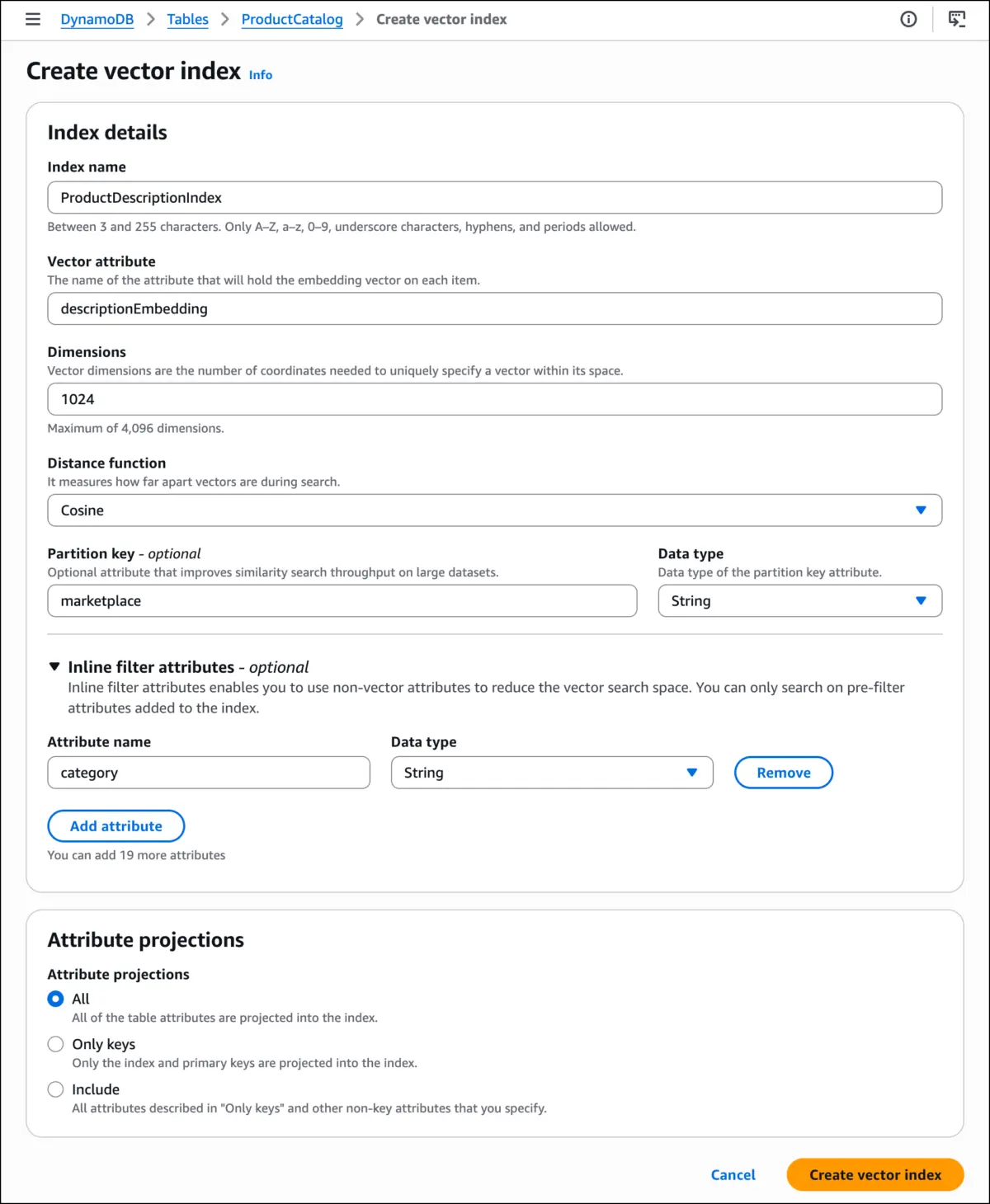
Navigating to the DynamoDB console or utilizing Infrastructure-as-Code (IaC) tools such as AWS CloudFormation or the AWS CLI, developers create a vector index with specific configuration parameters:
Index Name:ProductDescriptionIndex
Vector Attribute:descriptionEmbedding
Dimensions: Configured to match the output dimensions of the chosen embedding model. DynamoDB natively supports up to 4,096 dimensions.
Distance Function: Selection of Cosine, Euclidean, or Dot Product. Cosine similarity is typically chosen for text embeddings as it evaluates the angle between vectors rather than magnitude.
Partition Key: The marketplace attribute can be designated as a partition key. This partitions vectors across the index, ensuring that searches target specific subsets of data (e.g., searching strictly within the US marketplace inventory) rather than scanning the entire index, guaranteeing high performance at scale.
Inline Filter Attributes: Non-vector attributes like category can be designated for exact-match filtering at query time, refining result sets instantly.
Step 3: Executing Vector Searches
Once active, natural language queries—such as "lightweight running shoes for summer"—are converted into query vectors using the same machine learning model.
[ Natural Language Query ]
          │
          ▼
[ Embedding Generation Model ]
          │
          ▼
[ SearchVectors API Call ] ──> (DynamoDB Vector Index + Inline Filters)
          │
          ▼
[ Ranked Results + Operational Attributes (Name, Price, Category) ]
By querying the ProductDescriptionIndex via the DynamoDB console or SDKs, setting the partition key to US, and applying an inline filter for category = footwear, the system returns the top 5 most semantically relevant products. Crucially, the response includes both the similarity ranking score and the complete operational record (pricing, inventory status, SKU IDs) in one atomic payload.
Supporting Context & Technical Metrics
The technical specifications of DynamoDB’s vector search underscore its readiness for enterprise production workloads:
Latency and Recall: Designed to deliver single-digit millisecond latency while maintaining a recall accuracy of 99% or higher.
Scale: Capable of handling arbitrary data growth with zero storage limits, scaling horizontally to accommodate trillions of vectors.
Distance Metrics Supported:
Cosine Distance: Measures vector angles; ideal for semantic text similarity.
Euclidean Distance: Measures straight-line distance in vector space.
Dot Product: Measures magnitude and direction alignment.
Operational Simplicity: Zero server provisioning, zero maintenance windows, no software patching, and absolute zero-downtime maintenance.
Pricing Model: Fully aligned with DynamoDB’s existing serverless pay-per-request model, ensuring organizations only pay for the storage and compute resources consumed.
Official Statements and Industry Implications
The release of native vector search in Amazon DynamoDB represents a pivotal shift in cloud database design. Industry analysts note that by collapsing the boundary between transactional databases and vector databases, AWS is streamlining the modern AI application stack.
"With vector search built directly into Amazon DynamoDB, developers no longer need to compromise between operational speed and semantic intelligence," noted technical leadership close to the release. "Your vectors and your operational data share the exact same serverless infrastructure, the same security posture, and the same pay-per-request pricing model. This drastically reduces the total cost of ownership for AI-driven applications."
By removing the architectural tax of data duplication, engineering teams can now focus entirely on building sophisticated retrieval-augmented generation (RAG) pipelines, context-aware AI agent memory, and hyper-personalized e-commerce experiences without managing brittle data synchronization infrastructure.
Future Outlook & Availability
Vector search in Amazon DynamoDB is generally available today across all commercial AWS Regions, including AWS GovCloud (US) Regions.
For organizations eager to test and integrate these capabilities, AWS provides comprehensive support tools. Developers can interact with vector search APIs and documentation programmatically using the AWS MCP Server and associated plugins within their preferred AI coding environments.
As enterprises increasingly transition from experimental generative AI pilots to enterprise-grade production deployments, the ability to unify structured operational data with unstructured semantic vectors on a proven, serverless foundation establishes a new benchmark for cloud application architecture. Teams can review regional rollouts via the AWS Capabilities by Region portal, consult the Amazon DynamoDB Developer Guide, and share feedback directly through AWS re:Post.