Executive Overview
The high-stakes ecosystem of global cybercrime experienced a dramatic structural fracture following the detention of Saif Al-din Khader, an Amman-based teenager known in underground circles by the handle “Rey.” Long identified by cybersecurity researchers as a central figure operating behind the prolific and destructive data extortion banner ShinyHunters, Khader’s arrest by Jordanian authorities—and his subsequent cooperation with the Federal Bureau of Investigation (FBI)—marks a watershed moment in the ongoing international war against decentralized ransomware franchises.
Khader’s capture did not occur in a vacuum. It unfolded precisely as the modern iterations of ShinyHunters were aggressively mounting an extortion campaign against Jeppesen ForeFlight, a navigation and digital aviation unit recently divested by aerospace titan Boeing. This targeting of an aviation-adjacent entity carried intense irony: investigative trails strongly suggest that Khader’s father is employed by Royal Jordanian Airlines, a carrier heavily reliant on long-haul Boeing fleets, and that the family’s computing environment had previously been compromised by password-stealing malware.
The fallout from Khader’s detention exposes a rapidly evolving cybercriminal underworld characterized by franchise-style brand adoption, zero-day mass exploitation, and internal paranoia. Compounding the chaos are explosive developments in Europe, where Dutch authorities arrested and subsequently charged a prominent, ostensibly "reformed" cybercriminal, Pepijn van der Stap (formerly known as "Umbreon"), not merely with data theft, but with orchestrating a plot involving contract murder-for-hire.
As the ShinyHunters infrastructure buckles under FBI pressure, darknet portals go offline, and rival hacking factions trade doxing leaks on Telegram, this comprehensive investigation examines the chronology, technical vectors, geopolitical fallout, and shifting mechanics of one of the decade’s most notorious cyber extortion syndicates.
Detailed Chronology of an Escalating Crackdown
The sequence of events leading to the collapse of the modern ShinyHunters command-and-mail structure accelerated dramatically throughout the late summer and early autumn of 2026.

June–July 2026: The PeopleSoft Zero-Day Campaign
The technical foundation of ShinyHunters’ 2026 offensive relied on the mass exploitation of a critical vulnerability (CVE-2026-35273) residing within Oracle PeopleSoft, a widely deployed enterprise software-as-a-service (SaaS) platform utilized for human resources, payroll, and recruitment administration. Initially deployed as a zero-day in June 2026, the exploit permitted the hackers to siphon sensitive data across a vast spectrum of industries, including technology, healthcare, higher education, government, and agriculture.
According to communications intercepted by security analysts at Mandiant and the Google Threat Intelligence Group (GTIG), the primary objective of these initial PeopleSoft intrusions was to breach the FBI’s own internal recruitment and personnel databases. While early attempts faced friction, the group later bypassed Mandiant-issued web application firewall (WAF) mitigations by employing sophisticated URL-encoding tricks.
May–October 2026: The FBI Breach and Retaliatory Flash Notices
The operational friction between ShinyHunters and federal law enforcement reached a boiling point following a May 15, 2026, FBI Flash Notice advising organizations never to pay ransoms demanded by the group. The advisory highlighted aggressive extortion tactics utilized by the actors, ranging from direct phone calls and text harassment to swatting and fabricated claims of compromising media.
Stung by the public relations blow, ShinyHunters retaliated. In a calculated bid to showcase their technical prowess and discredit federal warnings, the group successfully breached an Accenture contractor portal tied to the FBI’s recruitment ecosystem. This breach exposed sensitive records belonging to over 5,000 FBI personnel, including psychiatric evaluations, medical histories, and specialized unit postings. The fallout prompted immediate institutional accountability: the FBI swiftly removed the Accenture contractor responsible for patching failures.
September 15–28, 2026: The Dutch Raids and the "Umbreon" Frame Job
European law enforcement struck a severe blow on the evening of September 15, 2026, when Dutch police forces—reportedly utilizing flash-bang grenades—raided the Amsterdam residence of 24-year-old Pepijn van der Stap. Van der Stap, a convicted cybercriminal who had successfully rehabilitated his public image to secure a role as an "offensive security lead" at a Dutch cybersecurity startup (Neo Security), was arrested on suspicion of aiding ShinyHunters’ data hefts.

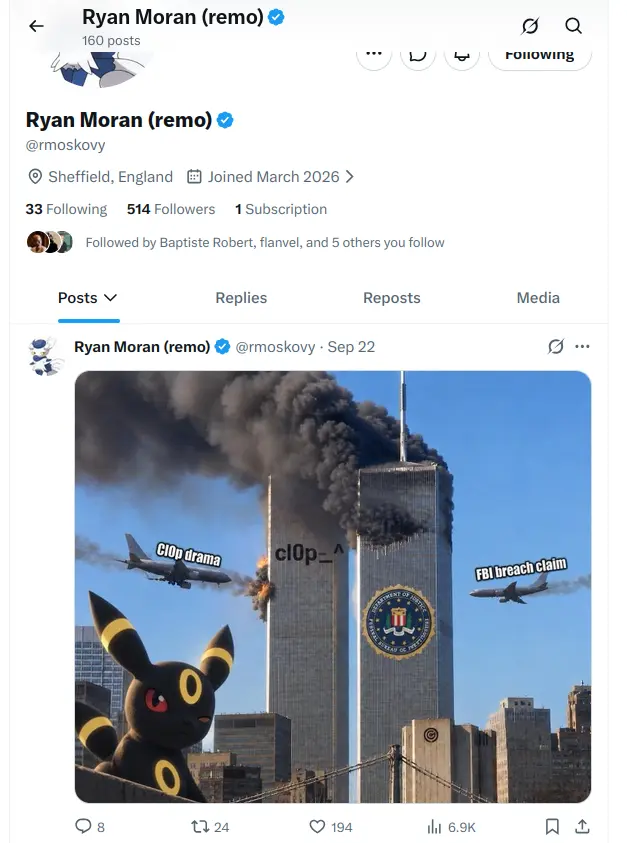
Sensing immediate vulnerability, “Rey” (Saif Al-din Khader) seized control of the volatile ShinyHunters brand assets. In an attempt to divert suspicion, Rey launched a public relations and trolling offensive on Twitter/X, mocking both the FBI and the rival Cl0p ransomware group. Utilizing stolen PGP keys and graphic memes featuring oversized Pokémon avatars associated with Van der Stap’s former alias, “Umbreon,” Rey attempted to pin the FBI and Cl0p breaches directly onto the newly arrested Dutchman.
September 29 – October 6, 2026: The Collapse and Detention
Rey’s diversionary tactics failed. On September 29, Dutch news outlets broke explosive new investigative reports indicating that Van der Stap was not only tied to data extortion, but was actively suspected of commissioning at least two overseas murders.
Simultaneously, pressure mounted in the Middle East. On October 3, international news agencies cited intelligence sources confirming that Saif Al-din Khader had been detained by Jordanian authorities in Amman and was actively cooperating with the FBI. By October 5 and 6, the dominoes had fallen: ShinyHunters’ primary darknet leak sites went permanently offline, and remaining infrastructure dissolved amid internal infighting and doxing campaigns waged by rival Telegram groups.
Supporting Context, Metrics, and Technical Vectors
To fully comprehend the threat landscape cultivated by the modern ShinyHunters syndicate, one must analyze the structural shift from closed-loop gang operations to a decentralized "franchise" model.
The "Dread Pirate Roberts" Franchise Model
Historically, the original ShinyHunters core comprised French cybercriminals who emerged around 2019, many of whom were subsequently arrested and imprisoned. However, rather than dying out, the brand name was continuously resurrected by independent freelancers and opportunistic youth.

Security researchers liken this operational model to the fictional Dread Pirate Roberts from The Princess Bride: the name and persona persist while the individuals behind the mask change via succession by arrest. In the 2026 iteration, figures like Rey functioned as brand-licensing middlemen. They leveraged old PGP keys, operated BreachForums lookalike portals, and collaborated with 5 to 6 distinct hacker cells. These freelancers supplied stolen SaaS platform credentials in exchange for a 25% to 30% cut of successful extortion ransoms, driving cumulative damages estimated by independent threat analysts to exceed $200 million.
The Jeppesen ForeFlight Extortion Vector
The catalyst that turned the FBI’s pursuit of Rey from a routine digital manhunt into an urgent national security priority was the targeting of Jeppesen ForeFlight. Jeppesen ForeFlight, a digital aviation and navigation subsidiary previously owned by Boeing, was sold to private equity firm Thoma Bravo in November 2025 for $10.55 billion.
Investigators confirmed that at the moment of his detainment, Rey was directly orchestrating the extortion of this former Boeing unit. The stolen data sets carried critical operational safety and navigation risks, drawing the immediate, unyielding ire of federal prosecutors.
Official Statements and Institutional Responses
The complex web of corporate entities, contractors, and law enforcement agencies issued calculated responses as the scandal unspooled:
- Boeing Corporate Communications: Acknowledging the digital security incident, Boeing released a formal statement: "We are aware of claims by a threat actor regarding data allegedly associated with Boeing and our former subsidiary Jeppesen ForeFlight. We are actively reviewing the matter with the Jeppesen ForeFlight team."
- Jeppesen ForeFlight Security Team: Seeking to calm enterprise clients and aviation partners, Jeppesen representatives maintained a firm posture: "Based on our investigation to date into this claim and proactive security posture, there was no impact to our operations or products."
- Neo Security (Employer of Pepijn van der Stap): Company owner Benjamin Korper confirmed that forensic investigators and Dutch law enforcement descended upon their offices during the September 15 raid. Korper noted that while third-party audits found no direct evidence that Van der Stap had compromised Neo Security or its clients, the revelations regarding violent criminal allegations forced an immediate distancing from the employee.
- The Federal Bureau of Investigation & Mandiant: Emphasized the critical necessity of rapid patch management. The weaponization of Oracle PeopleSoft CVE-2026-35273 demonstrated that even sophisticated Web Application Firewalls could be circumvented via URL-encoding bypass techniques, underscoring that human error in patch deployment remains the weakest link in corporate defense.
Future Outlook: The Death of a Brand and What Lies Ahead
The neutralization of Saif Al-din Khader in Amman and the incarceration of Pepijn van der Stap in Amsterdam signal a profound psychological and operational setback for the cybercrime underground.

- Brand Toxicity: The "ShinyHunters" banner has effectively been burned. Between the public doxing of its purported leaders (including Rey’s GitHub blog exposing the real-world identities of the core Cl0p operators) and aggressive federal enforcement, utilizing the moniker now acts as an immediate beacon for international law enforcement task forces.
- Increased Friction for Franchise Hackers: Freelance extortionists who rely on renting out stolen corporate credentials can no longer hide behind historic cybercriminal syndicates. The rapid erosion of anonymity on Telegram, combined with infighting channels like "The Battle" exposing amateur operators, means young cybercriminals face unprecedented risks of betrayal by both co-conspirators and compromised family networks.
- The Shift in Enterprise Risk Management: As organizations digest the lessons of the Oracle PeopleSoft zero-day exploits and the catastrophic contractor oversight at Accenture, the regulatory and compliance costs surrounding third-party SaaS integrations will escalate sharply.
Ultimately, while the takedown of Rey and the dismantling of the current ShinyHunters infrastructure mark a significant victory for global cybersecurity coalitions, the underlying economic incentives of data extortion ensure that new personas will inevitably attempt to fill the vacuum—testing the boundaries of corporate digital resilience in an increasingly hostile threat landscape.