EXECUTIVE OVERVIEW
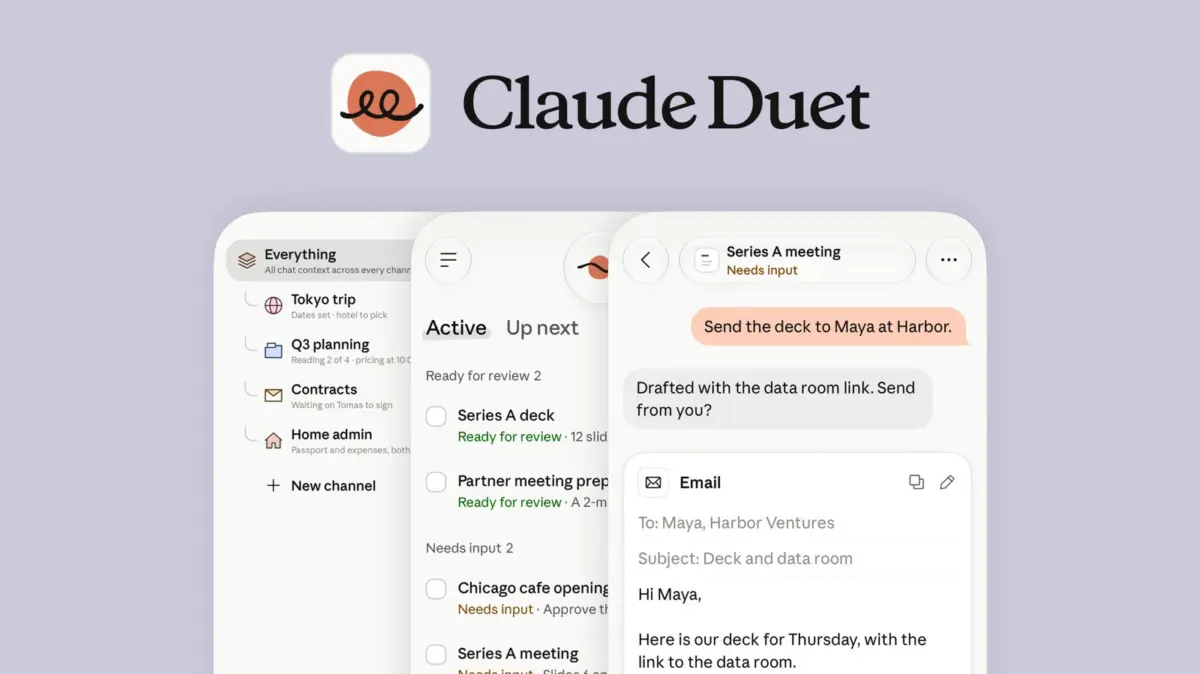
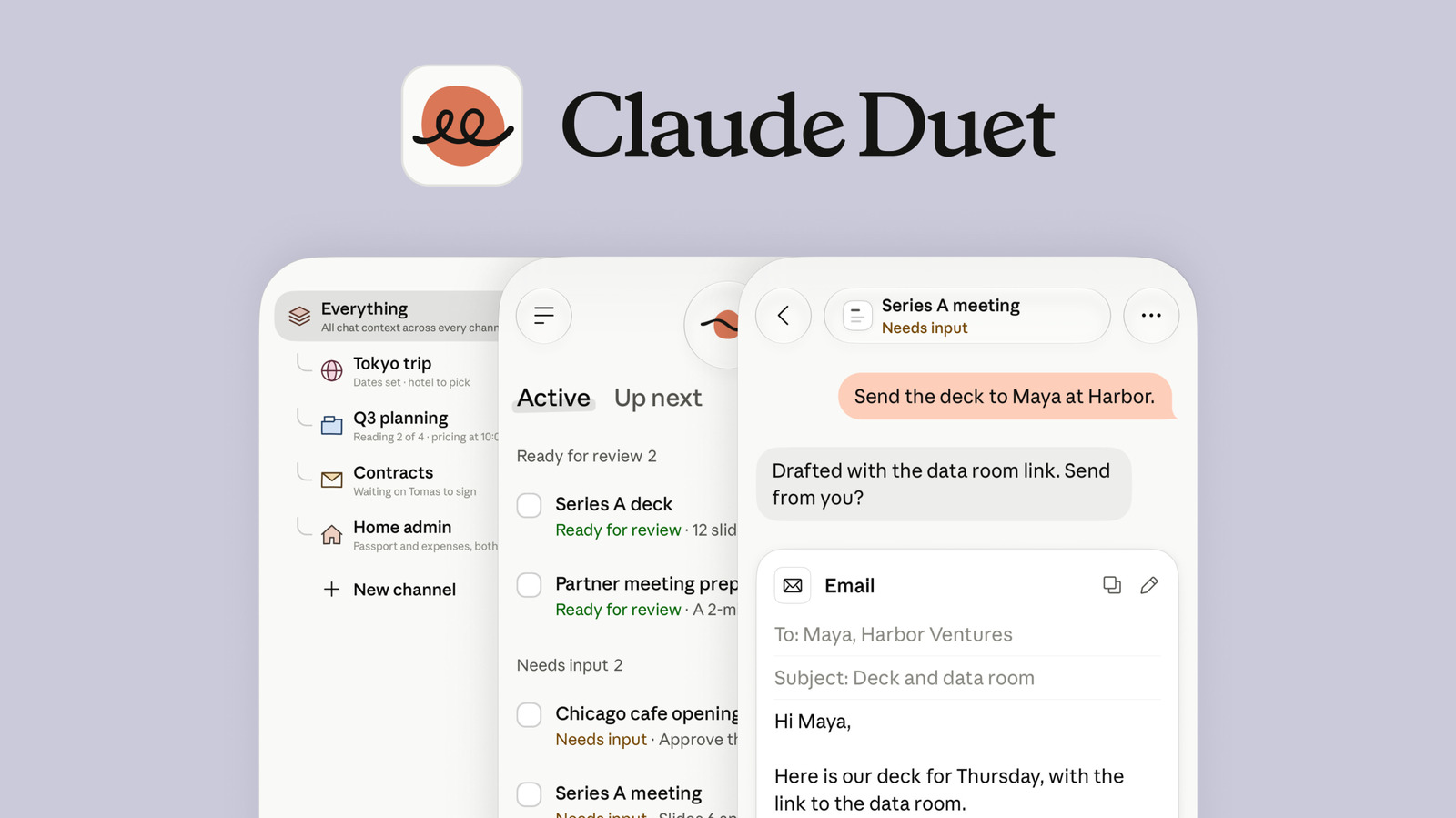
The artificial intelligence landscape has officially entered the era of the autonomous digital assistant. Anthropic, widely recognized for its safety-conscious approach to foundational language models and its flagship Claude ecosystem, has formally introduced Claude Duet. Billed as a proactive personal agent capable of managing complex workflows, parsing connected applications, and executing tasks in the background without constant human supervision, Duet represents Anthropic’s direct answer to Meta’s Muse and OpenAI’s recently announced Dots.
Unveiled via a research preview, Duet marks a significant evolution in how humans interact with generative AI. Rather than operating purely reactively—waiting behind a prompt window for a user to type a query—Duet is designed to integrate into the fabric of daily digital operations. It initiates actions, evaluates connected accounts periodically, aggregates relevant updates into concise morning or midday briefings, and operates autonomously on a dedicated virtual machine.
However, entering this high-stakes arena means navigating a fiercely competitive market defined by established tech giants. OpenAI and Meta have already laid deep foundations in the personal agent sector, raising questions about whether Anthropic’s late arrival will hinder its adoption. Furthermore, Duet’s launch reignites critical industry debates regarding data privacy, security vulnerabilities, the democratization of high-tier AI tools, and the mental friction users experience when entrusting their entire digital lives to algorithmic decision-makers.
DETAILED CHRONOLOGY: THE PUSH TOWARD AUTONOMOUS AGENTS
To understand the strategic importance of Claude Duet, one must examine the rapid sequencing of developments that have defined the AI sector over the past year.
For much of the generative AI boom, the paradigm remained anchored to conversational interfaces. Users visited a web browser or opened a mobile app, typed a prompt, waited for a response, and closed the session. While foundational models like Anthropic’s Claude 3 and 3.5 families, OpenAI’s GPT-4, and Meta’s Llama models pushed the boundaries of reasoning, coding, and creative writing, they remained fundamentally passive tools.
The Shift to Proactivity
The industry pivot toward proactive agents began in earnest as researchers realized that raw compute improvements alone were yielding diminishing returns in user convenience. Consumers and enterprise workers did not just want smarter chatbots; they wanted tools capable of closing the loop on multi-step workflows.
Meta laid down an early marker with the conceptualization of tools like Muse, aiming to unify personal communications, media consumption, and contextual reminders. Shortly thereafter, OpenAI unveiled Dots, its line of personal agents designed to manage calendars, draft communications, and interface with external software. These rollouts initiated an industry-wide race to capture the "digital butler" market—the software layer that sits between the operating system and the user, orchestrating daily productivity.
Anthropic’s Counter-Move
Anthropic, historically cautious about deploying autonomous capabilities due to safety and alignment concerns, realized it could no longer sit on the sidelines. On Wednesday, the company broke its silence on the matter by announcing Claude Duet as a research preview.
Unlike its competitors, who are initially gating their highest-end proactive agents behind prohibitively expensive tiers (OpenAI’s Dots, for instance, are currently restricted to Pro subscribers paying upwards of $100 per month), Anthropic has structured Duet to roll out to standard $20-per-month Pro subscribers once it achieves general availability. For now, US-based subscribers can join an exclusive waitlist via the official Claude platform to evaluate the research preview.
UNDER THE HOOD: ARCHITECTURE, CAPABILITIES, AND INFRASTRUCTURE
Claude Duet is not merely a reskinned chat interface; it represents a fundamental shift in software architecture and resource allocation.
Powered by Opus 5.5
At its core, Duet is driven by Anthropic’s advanced Opus 5.5 model. Known for striking a balance between elite reasoning capabilities and cost efficiency—nearly matching top-tier performance benchmarks at a fraction of the operational cost—Opus 5.5 provides the cognitive horsepower required to parse ambiguous instructions, structure data dashboards, and write functional code.
Standalone Apps and Virtual Machine Isolation
A major technical hurdle for early AI agents was the requirement to keep a browser tab or mobile app active. Duet bypasses this limitation by running on its own dedicated virtual machine.
Anthropic is releasing standalone mobile applications for both Android and iOS. This allows Duet to maintain background persistence:
- Continuous Execution: Even when the user steps away from their desk or locks their phone, Duet continues to process tasks, build web applications, compile sales forecasts, and check connected enterprise accounts.
- Asynchronous Briefings: Rather than bombarding the user with real-time notifications, Duet compiles actionable items from disparate applications into a single, cohesive daily briefing.
- Autonomous Safeguards: True to Anthropic’s ethos, Duet is engineered with a "human-in-the-loop" philosophy. While it can act independently, it is programmed to pause and request explicit user authorization before executing consequential actions on external platforms.
SUPPORTING CONTEXT & METRICS: PRICING, RATE LIMITS, AND ACCESSIBILITY
The commercial viability of AI agents often boils down to economics—specifically, how compute costs scale against subscription pricing and rate limits.
Pricing Stratification
The pricing strategy adopted by AI labs for personal agents is becoming a major battleground:
- OpenAI Dots: Currently restricted to elite tier subscribers starting at $100 per month, placing it out of reach for casual users and small businesses.
- Anthropic Claude Duet: Destined for standard $20 per month Pro subscribers upon general availability. This democratization strategy positions Anthropic to capture a vastly larger market share among independent professionals, developers, and mid-tier enterprises.
Rate Limits and Polling Mechanics
Running an autonomous agent that continuously scans external applications introduces a severe engineering challenge: API rate limits and token consumption. If an agent pings a user’s email, calendar, and project management tools every few seconds, a standard subscription tier would exhaust its monthly token allocation within hours.
Anthropic has mitigated this through intelligent polling logic. Duet checks connected accounts every few hours rather than continuously. Furthermore, the company has integrated Duet’s usage into the broader Claude ecosystem, meaning it shares rate limits with other tools like Claude Code.
To prevent user frustration, Anthropic has built granular customization controls into the research preview:
- Users can manually adjust how frequently Duet sends updates.
- Topics can be filtered so that low-priority alerts are batched into the daily briefing, while critical operational issues trigger immediate notifications.
- Feedback loops within the preview allow Anthropic’s engineering team to fine-tune the agent’s behavioral judgment based on real-world usage data.
SECURITY, PRIVACY, AND THE RISK OF DATA LEAKS
Granting an artificial intelligence agent deep access to one’s digital life—emails, files, calendars, financial summaries, and development environments—creates an unprecedented attack surface. Anthropic has addressed these concerns by baking new security frameworks directly into Duet’s architecture.
Classifiers and System Prompts
Duet incorporates a specialized classifier and hardened system prompts designed to thwart prompt injection attacks and unauthorized data exfiltration. In an era where malicious actors frequently attempt to hijack language models via hidden text embedded in emails or web pages, Anthropic’s classifier acts as an active defense barrier, screening incoming data before it reaches the core reasoning engine.
Data Ring-Fencing
Privacy safeguards implemented in Duet include strict boundaries around sensitive information categories:
- Credentials Isolation: Duet never directly sees or stores passwords, OAuth tokens, or raw sign-in credentials. It interacts with services through authenticated, scoped API tokens managed securely by the underlying infrastructure.
- Restricted Domains: Information relating to personal health or private finances is heavily ring-fenced. Duet is programmed to ignore or redact such data unless the user explicitly commands the agent to ingest and process financial or medical documents.
Anthropic has promised to release a comprehensive technical whitepaper detailing Duet’s safety architecture and alignment protocols in the coming days.
FUTURE OUTLOOK: THE PSYCHOLOGICAL AND INDUSTRY HORIZON
As Claude Duet makes its way into the hands of US subscribers, its success will depend on more than just benchmark scores or pricing models. It will test human psychology.
The Trust Deficit
For all the technical sophistication of Opus 5.5 and virtual machine isolation, deploying an autonomous agent requires a profound leap of faith. Context is the lifeblood of modern AI, but asking users to surrender their entire digital footprint to a cloud-based neural network crosses a psychological boundary that many are hesitant to cross. Enterprise adoption, in particular, will hinge on compliance certifications, data residency guarantees, and ironclad liability frameworks.
The Broader AI Ecosystem
The emergence of Claude Duet alongside Meta Muse and OpenAI Dots signals that the standalone chatbot is rapidly becoming a legacy interface. The future belongs to orchestration layers—agents that live in the background, negotiate with other bots, manage our schedules, write our code, and quietly coordinate the machinery of modern work.
Whether Anthropic’s calculated blend of affordability, strong safety guardrails, and asynchronous autonomy will be enough to outpace OpenAI and Meta remains to be seen. However, one thing is certain: the battle for your digital life has officially begun, and Claude Duet is a formidable contender in the ring.