Executive Overview
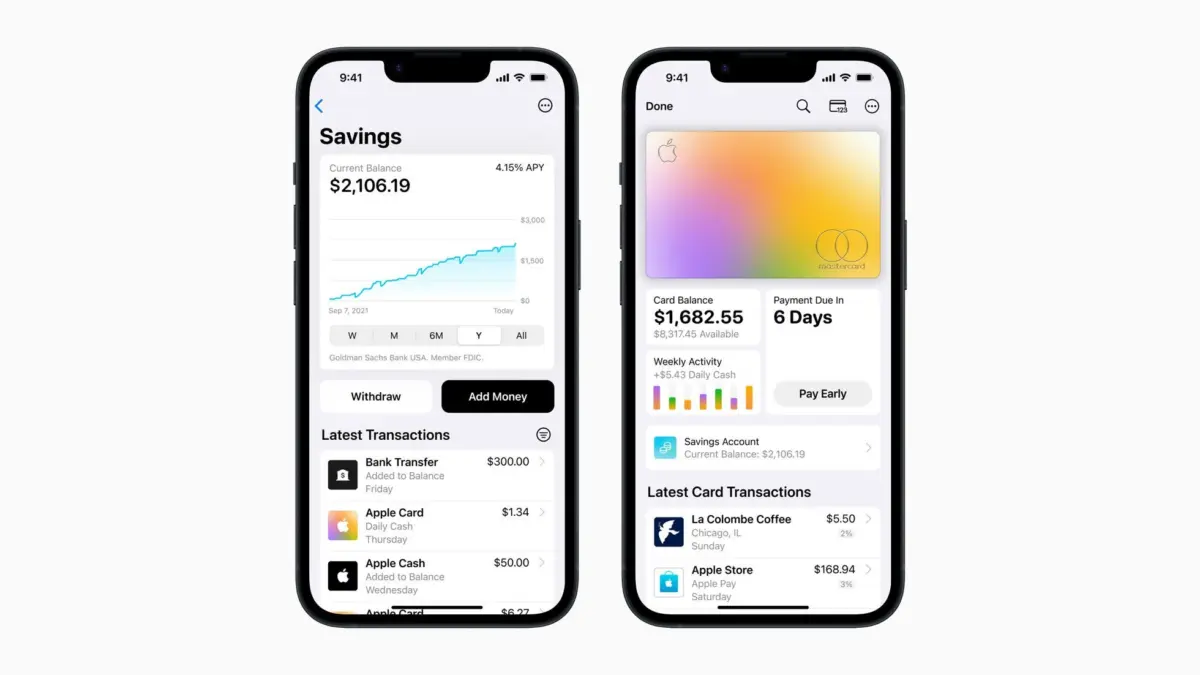
In a strategic maneuver that further blurs the lines between Silicon Valley and Wall Street, Apple—in partnership with banking titan Goldman Sachs—officially launched a high-yield savings account tailored exclusively for Apple Card holders. Announced on a Monday that marked yet another milestone in the tech giant’s aggressive expansion into consumer finance, the offering introduces a compelling 4.15% Annual Percentage Yield (APY).
For the average consumer, this means that the "Daily Cash" rewards earned from everyday Apple Card purchases can now be automatically funneled into an interest-bearing account. More importantly, the partnership extends far beyond automated rewards redirection. Account holders can deposit personal funds directly from external bank accounts up to a Federal Deposit Insurance Corporation (FDIC)-insured limit of $250,000, effectively positioning Apple—backed by Goldman Sachs’ banking infrastructure—as a formidable digital-first contender in the personal banking sector.
This launch is not an isolated experiment. It arrives on the heels of Apple’s rollout of its "Buy Now, Pay Later" (BNPL) service, Apple Pay Later, which allows users to split purchases into interest-free installments over six weeks. Together, these moves underscore a broader, systemic corporate strategy: transforming the iPhone into a comprehensive financial hub. By systematically integrating payment processing, short-term credit, peer-to-peer transactions, and now long-term high-yield savings directly into the iOS Wallet app, Apple is constructing a closed-loop financial ecosystem designed to increase user retention, enhance ecosystem lock-in, and capture lucrative fee revenues traditionally reserved for legacy financial institutions.
While the 4.15% APY significantly outperforms traditional brick-and-mortar competitors—such as Bank of America, which offers a paltry 0.01% APY—it exists within a fiercely competitive digital banking landscape where specialized online banks occasionally offer higher yields. Nevertheless, the frictionless user experience, deep integration with the iOS operating system, and absence of fees or minimum balance requirements give Apple a distinct competitive edge. This report provides an exhaustive examination of the account’s mechanics, the broader context of Apple’s fintech evolution, official statements from corporate leadership, and an analytical outlook on the future of consumer banking in the age of big tech.
Detailed Chronology of Apple’s Fintech Evolution
To understand the gravity of Apple’s high-yield savings account rollout, one must trace the deliberate, methodical evolution of the company’s financial services division over the past decade. Apple’s entry into finance was not born out of an overnight pivot, but rather as an organic extension of its hardware and software ecosystem, engineered to maximize device utility and customer loyalty.
Phase One: The Foundation of Mobile Payments (2014–2018)
The groundwork for Apple’s financial ecosystem was laid in September 2014 with the introduction of Apple Pay. Utilizing the iPhone’s Near Field Communication (NFC) chip and the Secure Enclave, Apple digitized the traditional credit card, allowing users to make contactless payments at physical terminals and within applications.
While initially viewed by legacy banks as a potential competitor, Apple Pay quickly proved to be a mutually beneficial infrastructure play. Apple charged participating banks a small fraction of a cent per transaction—a micro-fee that, multiplied by billions of global transactions, accumulated into a lucrative revenue stream. During this foundational period, Apple also introduced Apple Pay Cash (later rebranded simply as Apple Cash), enabling peer-to-peer money transfers via the Messages app, powered first by Discover and later by Green Dot Bank.
Phase Two: Entering the Credit Market with Goldman Sachs (2019)
In August 2019, Apple took a quantum leap forward by launching the Apple Card in collaboration with Goldman Sachs and Mastercard. The card represented a radical departure from traditional credit card paradigms. Designed with minimalism in mind, the physical card was forged from titanium, devoid of a card number, CVV, expiration code, or signature line—all sensitive data was safely sequestered within the Wallet app on the user’s iPhone.
Crucially, the Apple Card introduced "Daily Cash," an instant cashback rewards program that bypassed the traditional waiting period of monthly statement cycles. Users received 3% back on Apple purchases and select partners, 2% back on all purchases made using Apple Pay, and 1% back on physical card transactions. Daily Cash was deposited instantly into an Apple Cash card, which could be spent immediately, sent to friends, or used to pay down the card balance.
By partnering with Goldman Sachs—an investment banking behemoth eager to pivot toward consumer retail banking through its Marcus platform—Apple bypassed the regulatory hurdles of chartering its own bank while leveraging Goldman’s balance sheet and regulatory compliance framework.
Phase Three: Expanding the Credit Suite and Short-Term Lending (2022–Early 2023)
As macroeconomic conditions shifted and interest rates began to rise, Apple accelerated its fintech roadmap. In March 2023, the company officially rolled out Apple Pay Later, allowing eligible users to split purchases between $50 and $1,000 into four payments spread over six weeks, completely free of interest and late fees. This strategic move directly pitted Apple against established fintech giants like Klarna, Affirm, and Afterpay.
By handling the underwriting and lending decisions through a wholly-owned subsidiary called Apple Financing LLC (while utilizing Goldman Sachs as the Mastercard issuer for the payment credential), Apple demonstrated an increasing willingness to assume financial risk in exchange for deeper ecosystem engagement.
Phase Four: The High-Yield Savings Account Debut (April 2023)
The natural culmination of this financial pipeline arrived in April 2023 with the launch of the high-yield savings account. For years, financial analysts speculated on how Apple would utilize the massive cash reserves held within user accounts and Daily Cash balances. By introducing a 4.15% APY savings vehicle integrated directly into the Wallet app, Apple closed the loop. Users could now earn cash rewards, store them safely, grow them via high-yield interest, and deploy them across Apple’s suite of BNPL and payment products—all without ever downloading a traditional banking app or visiting a physical branch.
Supporting Context & Financial Metrics
The launch of Apple’s high-yield savings account occurs against a fascinating macroeconomic and competitive backdrop. To fully grasp the implications of Apple’s financial offering, one must analyze the prevailing interest rate environment, the stark disparity between traditional and digital banking yields, and the mechanics of the Goldman Sachs partnership.
The Macroeconomic Environment and Yield Disparities
In the wake of aggressive monetary tightening by the United States Federal Reserve to combat inflation, benchmark interest rates rose to levels not seen in over a decade. This macroeconomic shift forced commercial banks to reevaluate their deposit strategies. However, while the Federal Funds Rate climbed past 5%, many traditional, brick-and-mortar financial institutions stubbornly maintained near-zero yields on consumer savings accounts.
The following comparative metrics illustrate the vast chasm between traditional banking incumbents and digital-first alternatives:
- Bank of America (Standard Savings): 0.01% APY
- Chase Bank (Savings): 0.01% APY
- Wells Fargo (Way2Save Savings): 0.01% to 0.15% APY (depending on balance and linked checking accounts)
- Apple Card Savings Account (via Goldman Sachs): 4.15% APY
- Top-Tier Online High-Yield Savings Accounts (Market Average): 4.50% to 5.00+ % APY
While Apple’s 4.15% APY does not claim the absolute top spot on financial comparison aggregators, it is more than 400 times higher than the national average offered by legacy banking giants like Bank of America. For mainstream consumers who park their cash in traditional checking and savings accounts out of sheer inertia, the Apple savings account represents an effortless, highly visible alternative that requires zero administrative friction.
Mechanics of the Account: Features, Limits, and Protections
Apple engineered the savings account to be as accessible as possible, eliminating many of the punitive fees traditionally associated with consumer banking:
- No Monthly Fees: There are no maintenance fees, service fees, or minimum balance requirements to keep the account active.
- Automated Daily Cash Integration: Users can toggle a switch within the Wallet app to automatically route all future Daily Cash earnings directly into the savings account, compounding their rewards over time.
- External Funding: Beyond Daily Cash, users can link external bank accounts via Routing and Account numbers to deposit personal funds, creating a robust personal savings vehicle.
- Deposit Limits: To comply with regulatory frameworks and risk management parameters established by Goldman Sachs, individual deposits are capped at a maximum balance of $250,000.
- FDIC Insurance: Because the underlying banking services are provided by Goldman Sachs Bank USA, deposits are protected by Federal Deposit Insurance Corporation coverage up to the statutory limit of $250,000 per depositor, ensuring peace of mind against banking insolvencies.
The Goldman Sachs Partnership Dynamics
It is vital to examine the backend infrastructure of this product. Apple is not a chartered bank; legally, it cannot hold deposits or issue credit on its own balance sheet without heavy regulatory oversight. Therefore, Goldman Sachs serves as the chartered depository institution behind the Apple Card and the high-yield savings account.
However, this partnership has faced internal scrutiny within Goldman Sachs. As Goldman recalibrated its consumer retail strategy—scaling back its standalone Marcus brand amid rising credit loss provisions and mounting operational costs—its partnership with Apple remained a cornerstone of its digital consumer footprint. For Goldman, supplying the banking license and balance sheet allows them to capture massive deposit inflows at scale, providing a stable source of liquidity. For Apple, Goldman provides the regulatory clearance necessary to operate in the heavily regulated financial sector while keeping Apple’s brand firmly in the spotlight as the primary customer-facing interface.
Official Statements and Corporate Vision
The strategic philosophy driving Apple’s financial services expansion was articulated clearly by corporate leadership during the launch. Apple is positioning its financial tools not as profit-maximizing standalone products, but as ecosystem enhancements designed to improve the financial wellness of its users.
Jennifer Bailey, Apple’s Vice President of Apple Pay and Apple Wallet, captured this sentiment in an official corporate statement released alongside the announcement:
"Our goal is to build tools that help users lead healthier financial lives, and building Savings into Apple Card in Wallet enables them to spend, send, and save Daily Cash directly and seamlessly — all from one place."
This framing is deliberate. By describing financial management in terms of "health"—a term Apple frequently uses in conjunction with its Apple Watch fitness and health tracking initiatives—the company seeks to distance itself from the predatory lending practices historically associated with credit card companies and payday lenders. The emphasis is on seamless consolidation: spending through Apple Pay, sending money via Apple Cash, borrowing through Apple Pay Later, and saving through the high-yield account are all consolidated into a single, intuitive interface.
Furthermore, industry analysts have noted that Apple’s approach aligns with its broader corporate ethos: hardware sales drive software and service adoption, which in turn deepens ecosystem stickiness. By controlling the wallet interface, Apple ensures that consumers are less likely to churn to competing smartphone ecosystems like Android, as their financial infrastructure—credit cards, cash rewards, short-term loans, and now high-yield savings—is natively bound to their iOS device.
Future Outlook: The Intersection of Big Tech and Banking
As the dust settles on the initial rollout of Apple’s high-yield savings account, financial analysts, regulators, and banking executives are casting their gaze toward the horizon. What does this development portend for the future of global finance? How will traditional banks respond, and what regulatory hurdles lie ahead for Apple as it deepens its footprint in the financial sector?
1. The Intensification of the "Super-App" Wars
In Asian markets, super-apps like WeChat and Alipay have long dominated digital life, combining messaging, social media, shopping, and comprehensive financial services into a single platform. In the West, tech companies have historically operated in more siloed verticals.
Apple’s deliberate aggregation of payment credentials, peer-to-peer transfers, buy-now-pay-later credit, and high-yield savings within the iOS Wallet app represents the most successful Western approximation of a financial super-app. In the coming years, we can expect Apple to expand this suite further. Potential roadmap items frequently cited by industry insiders include:
- Investment and Wealth Management: Expanding beyond cash savings into fractional stock trading, exchange-traded funds (ETFs), or automated portfolio management.
- Insurance Products: Partnering with major insurers to offer localized health, auto, or device insurance directly through the Wallet app.
- Global Expansion: Rolling out the high-yield savings account and credit products to international markets outside the United States, navigating complex, fragmented regulatory environments across Europe, Asia, and Latin America.
2. The Defensive Posture of Traditional Banking
Traditional banks can no longer afford to ignore the existential threat posed by big tech. While regional and national banks maintain advantages in complex commercial lending, mortgages, and bespoke wealth advisory services, they are rapidly losing the battle for the retail deposit customer—particularly among Gen Z and Millennial demographics who prioritize digital-first, frictionless user experiences.
To stem the outflow of deposits to high-yielding digital alternatives like Apple/Goldman Sachs, traditional institutions will be forced to modernize their legacy software infrastructure, eliminate punitive fee structures, and offer competitive yields on basic savings products. Furthermore, expect to see more legacy banks forming defensive partnerships with fintech infrastructure providers to upgrade their native mobile apps.
3. Regulatory Scrutiny and Antitrust Pressures
As Apple’s influence over consumer finance grows, so too will the scrutiny from regulatory bodies such as the Consumer Financial Protection Bureau (CFPB), the Department of Justice (DOJ), and the Federal Reserve.
Key regulatory questions loom large:
- Ecosystem Monopolization: Antitrust regulators are already closely examining whether Apple’s refusal to allow third-party developers open access to the iPhone’s NFC chip for contactless payments constitutes anticompetitive behavior. If users are forced to use Apple Pay and Apple Wallet as the exclusive gateway for financial services on iOS, regulatory pushback will intensify.
- Data Privacy and Financial Surveillance: As Apple collects more granular data on consumer spending habits, creditworthiness, and savings behavior, privacy advocates will demand strict auditing to ensure financial data is not commingled with advertising profiles or misused.
- Systemic Risk: As tech companies amass billions of dollars in consumer deposits backed by partner banks, questions regarding systemic financial stability and consumer protection in the event of institutional strain will take center stage in congressional hearings.
Conclusion
Apple’s introduction of a high-yield savings account offering 4.15% APY is far more than a minor product update—it is a calculated strategic thrust into the heart of consumer banking. By fusing high-yield interest rates with the ubiquitous convenience of the iPhone’s Wallet app, Apple and Goldman Sachs have created a compelling financial engine that threatens to siphon billions of dollars in deposits away from legacy banks.
As the boundaries between technology and finance continue to dissolve, Apple is no longer just a hardware manufacturer or a software provider; it is rapidly cementing its status as an inescapable financial institution of the twenty-first century. For consumers, the immediate benefit is clear: higher returns on cash rewards with unprecedented ease of management. For the broader banking industry, the message is equally unmistakable: the digital transformation of money is accelerating, and the Silicon Valley juggernaut is leading the charge.