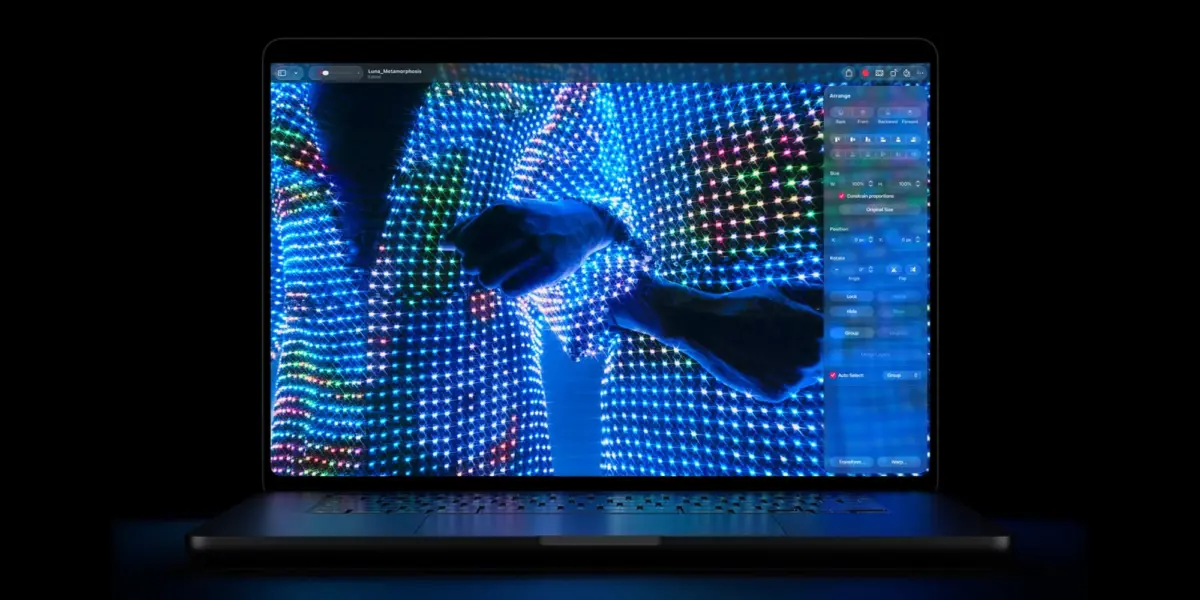
The landscape of personal computing is undergoing a seismic shift. For years, the debate surrounding laptop displays and input methods has remained relatively static, with Windows-based manufacturers experimenting with touchscreens and OLED panels while Apple steadfastly maintained its traditional form factors and high-end Mini-LED Liquid Retina displays. That era has officially come to an end.
With the recent landmark announcement of the redesigned, touchscreen-enabled MacBook Pro, Apple has not only broken its long-held aversion to touchscreen Macs, but it has also officially fired the starting gun for widespread industry adoption of OLED technology in portable computers. According to comprehensive new market intelligence and shipment forecasts published by supply chain research firm TrendForce, Apple’s entry into the OLED laptop space is projected to catalyze a massive multi-year expansion, driving global year-over-year shipment growth of nearly 40% in both 2026 and 2027.
Yet, this transition is far from a simple product refresh. Carrying a hefty premium starting price of $2,899 for the base 14-inch model and initially coexisting alongside existing Mini-LED configurations, the new MacBook Pro enters a nuanced market environment. At the same time, major display manufacturers are aggressively jockeying for position to supply Apple’s future hardware roadmap—most notably the highly anticipated OLED MacBook Air, now slated for a 2029 release.
This deep-dive report explores the mechanics of Apple’s tandem OLED integration, the multi-year supply chain evolution leading up to this moment, the economic and market forecasts shaping the rest of the decade, and what this monumental shift means for the future of the entire PC industry.
Detailed Chronology: From Rumor Mill to Reality
The arrival of Apple’s first touchscreen OLED MacBook Pro was not an overnight development; rather, it was the culmination of years of supply chain leaks, technological milestones, and strategic recalibrations. To fully understand the weight of Apple’s recent announcement, it is necessary to retrace the chronology that brought Cupertino to this pivotal juncture.
The Foundation: The M4 iPad Pro and Tandem OLED
The technological bedrock for Apple’s new MacBook Pro was actually laid in 2024, when the company debuted its ultra-thin M4 iPad Pro. That device marked Apple’s commercial introduction of "tandem OLED" technology. Unlike conventional single-layer OLED panels, tandem OLED architecture stacks two distinct emission layers on top of one another.
This ingenious engineering feat solves historical pain points associated with OLED screens in mobile computing: it yields significantly higher peak and sustained full-screen brightness compared to traditional single-layer panels, while preserving the unmatched deep blacks, infinite contrast ratios, and exceptional power efficiency that have made OLED the gold standard for high-end visual consumption. By proving out this technology on a tablet scale, Apple laid the necessary groundwork for scaling it up to the demanding thermal and power constraints of a professional-grade notebook.
The 2025 Supply Chain Signals
Long before the official press release hit the wires, the components ecosystem was already humming with activity. In September 2025, industry insider publication The Elec reported that Samsung Display—long rumored as Apple’s primary launch partner for notebook OLED panels—was actively preparing to initiate mass production of tailored 14-inch and 16-inch OLED panels specifically designed for Apple’s impending MacBook Pro redesign. At the time, supply chain checks indicated an estimated annual output target of 2 million to 3 million units, signaling that Apple was anticipating robust, albeit targeted, early demand from creative professionals and power users.
By late 2025, market analysts at TrendForce began adjusting their macroeconomic outlooks. In November 2025, the firm published an initial forecast predicting that global OLED notebook market share would surge to reach up to 12% between 2027 and 2028, explicitly attributing this anticipated acceleration to Apple’s imminent, albeit unannounced at the time, adoption curve.
Roadmaps and Realignments throughout 2026
As 2026 unfolded, the timeline surrounding Apple’s display roadmap came into sharper focus, though not without revisions. Earlier in the year, TrendForce released a comprehensive AMOLED market roadmap. This document outlined a clear two-tier strategy: Apple would introduce OLED displays to the high-end MacBook Pro lineup in late 2026, while the more consumer-focused MacBook Air lineup would follow suit later in the decade. Notably, the anticipated arrival window for the OLED MacBook Air experienced subtle delays, eventually being pushed back from an initial 2027 estimate to a targeted 2029 debut.
The final crescendo occurred in late October 2026, when a flurry of last-minute leaks detailed the exact pricing structure, cooling systems, and touch-integration specifications of the new MacBook Pro, culminating in Apple’s formal announcement on October 28, 2026. The following day, TrendForce dropped its updated empirical assessment of what this launch means for Apple’s shipping volumes and the broader competitive landscape.
Supporting Context & Metrics: The Numbers Behind the Screens
Apple’s entrance into any hardware category instantly alters the gravity of the market. According to TrendForce’s latest post-announcement data, Apple is projected to successfully ship between 1.2 million and 1.5 million units of the newly minted touchscreen MacBook Pro throughout 2027.
To contextualize these numbers, it is helpful to look at the macro-level trajectory of the OLED notebook sector:
2026 Growth: Global OLED notebook shipments are projected to skyrocket by nearly 40% year-over-year (YoY).
2027 Growth: This momentum will compound with another projected increase of more than 40% YoY in 2027.
Long-Term Projection: TrendForce’s long-range models estimate that total global OLED notebook shipments will climb steadily to reach 46.6 million units by 2030.
Growth Stabilization: While the market will experience explosive double-digit growth in the immediate wake of Apple’s launch (peaking with a 42.8% YoY growth rate in 2028), the rate of expansion is expected to moderate slightly, tapering down to a still-healthy 30.8% YoY growth rate by the turn of the decade.
Balancing Innovation and Cost: Market Headwinds
Despite the staggering growth figures, analysts urge caution regarding short-term adoption rates. The new MacBook Pro enters the market at a commanding baseline: the 14-inch model commands a premium starting price of $2,899.
Furthermore, TrendForce highlights a crucial transitional dynamic: the new OLED models are initially being made available alongside Apple’s existing inventory of high-performance Mini-LED MacBook Pro configurations. This dual-track strategy—pairing top-tier traditional displays with cutting-edge touch-enabled OLED screens at a higher price point—is expected to somewhat temper near-term replacement demand. Enterprise buyers and budget-conscious consumers may opt for the discounted Mini-LED models or wait for the technology to trickle down to lower price points before making the jump.
Official Statements & Industry Perspectives
Historically, the OLED notebook market has been carried almost entirely by Windows-centric ecosystem players. Heavyweights such as Lenovo, HP, and ASUS have spent the last several years gradually expanding their OLED laptop portfolios across various price tiers—from ultra-slim consumer convertibles to high-end gaming rigs. However, these brands often struggled to establish OLED as an industry-wide default due to fragmented consumer awareness and the absence of a unified, premium standard.
TrendForce’s official commentary underscores the profound validation that Apple brings to the table:
"Until now, the OLED notebook market has been driven primarily by Windows-based brands such as Lenovo, HP, and ASUS, which have gradually expanded their OLED offerings across different price segments. Apple’s arrival is expected to give the market additional momentum, encouraging brands to prioritize OLED models in their product roadmaps while strengthening consumer acceptance of the technology. This, in turn, could pave the way for broader OLED adoption in notebook displays."
In essence, Apple serves as the ultimate market validator. By endorsing tandem OLED technology and breaking its historical taboo against touchscreen laptops, Apple has signaled to the entire supply chain that OLED is no longer an experimental niche or a gimmick for high-end media creation, but the definitive future of portable display technology. Consequently, component suppliers, competing OEMs, and independent software vendors are already pivoting their long-term development strategies to align with this new paradigm.
Future Outlook: The Road to 2030 and the Battle for the MacBook Air
While the tech world is currently fixated on the debut of the touchscreen MacBook Pro, display analysts and supply chain insiders are already casting their gaze toward the horizon. The next major battleground in the Apple ecosystem is undoubtedly the MacBook Air, which remains the company’s highest-volume laptop product line.
The Supplier Face-Off for the 2029 MacBook Air
With Apple officially targeting 2029 for the release of its first OLED MacBook Air, a fierce commercial war is currently underway behind closed doors. Unlike the MacBook Pro, which relies heavily on Samsung Display for its complex tandem OLED panels, the future MacBook Air supply chain is wide open.
According to TrendForce reports, three major display giants are actively competing to secure future supply contracts for the upcoming MacBook Air:
LG Display: A long-time Apple partner with extensive experience in large-scale OLED manufacturing across mobile and television segments.
BOE: China’s leading display manufacturer, which has been aggressively upgrading its technological capabilities and striving to capture a larger share of Apple’s premium hardware tiers.
TCL CSOT: A rapidly rising powerhouse in the global display industry, heavily investing in advanced printing and tandem OLED architectures to break into the high-end consumer electronics space.
The outcome of this supplier competition will have massive financial implications for these panel makers, dictating production margins, fab investments, and market share distribution for the remainder of the decade.
Conclusion
Apple’s introduction of the touchscreen OLED MacBook Pro marks a watershed moment for personal computing. By combining tandem OLED architecture with touch capabilities in a pro-grade chassis, Apple has redefined user expectations for portable displays. While high price points and co-existing Mini-LED options may temper immediate upgrade cycles, the broader trajectory is set in stone. As global shipments barrel toward the 46.6-million-unit milestone by 2030, the laptop industry is officially entering the OLED era—and Apple is leading the charge.