Executive Overview
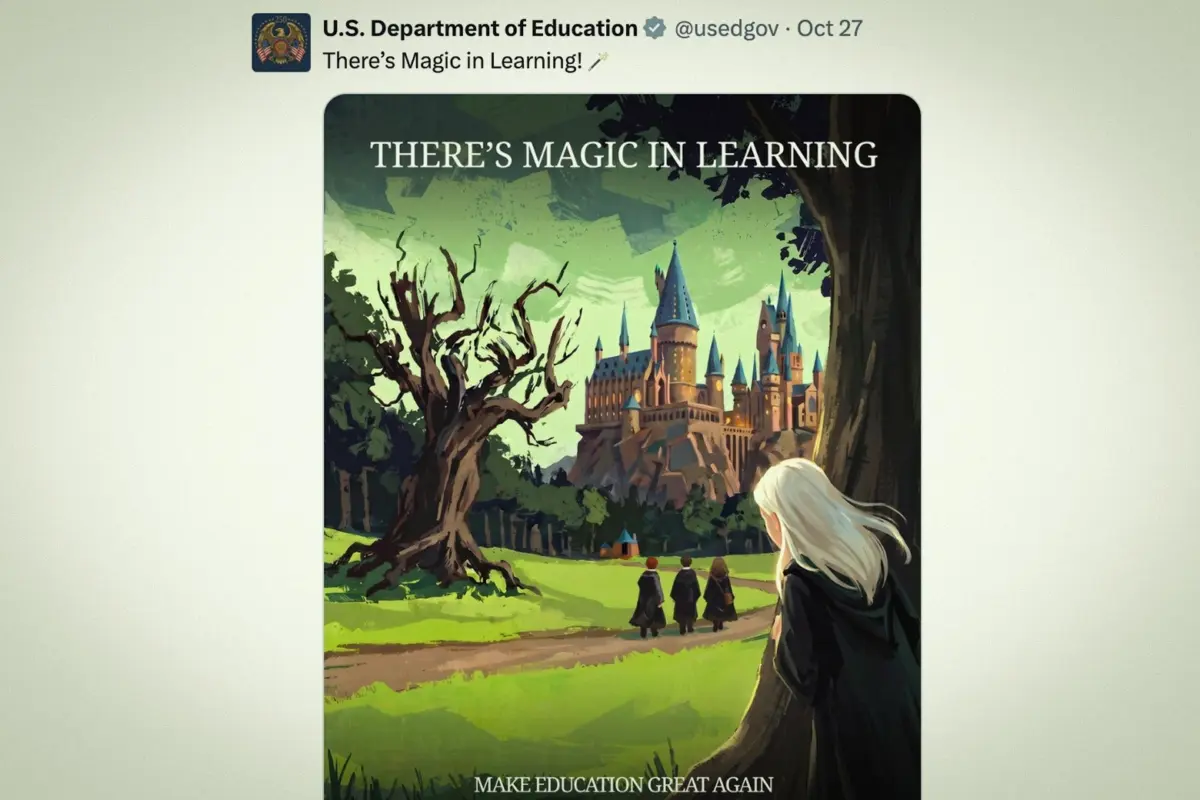
In a bizarre convergence of internet subcultures, federal communications, and artificial intelligence, the U.S. Department of Education recently managed to capture the modern digital zeitgeist—not through a milestone policy announcement or a celebratory literacy campaign, but by inadvertently promoting an obscure, right-wing, incel-adjacent Harry Potter meme.
The image in question featured an AI-generated rendering of a gender-swapped Draco Malfoy—colloquially known online as "Draco Malfoid"—accompanied by the bafflingly anachronistic caption: "There’s Magic in Learning—Make Education Great Again."
While casual observers may have written off the post as yet another instance of a tone-deaf government social media manager attempting to connect with youth culture, the reality is far more complex and culturally revealing. The ascent of "Draco Malfoid" represents a watershed moment in internet history: the first time mainstream conservative digital spaces have thoroughly embraced the historically female-dominated domain of fan fiction, albeit filtered through the funhouse mirror of machine-learning "slop" and manosphere slang.
This deep dive examines the anatomy of the meme, the linguistic roots of the "foid" moniker, the historic irony of right-wing internet culture appropriating fan fiction, and what the Department of Education’s digital blunder reveals about the permeation of fringe online slang into institutional corridors.
Detailed Chronology: The Birth and Rise of "Draco Malfoid"
To understand how a federal agency ended up participating in a niche internet joke, one must trace the timeline of a meme that metastasized across social media in a matter of weeks.
Phase 1: The Initial Artistry
Approximately a month prior to the Department of Education’s post, an X (formerly Twitter) user operating under the handle @redteneri published an original digital drawing. The artwork depicted the iconic antagonist of J.K. Rowling’s Harry Potter series, Draco Malfoy, reimagined as a female character featuring long, flowing blonde hair, large hoop earrings, and striking green eyes. The artist christened this interpretation "Dracaena Malfoy."
Initially, the drawing circulated within traditional artistic and fandom circles, eliciting a handful of human-made fan renderings and typical community engagement. However, the internet’s relentless algorithmic machinery quickly hijacked the concept.
Phase 2: Algorithmic Mutation and the "Foid" Tag
As the character crossed over from standard fan art spaces into broader algorithmic feeds, the nature of her depiction shifted drastically. A deluge of AI-generated images and videos flooded platforms like TikTok and X, stripping away the hand-drawn charm of the original artwork and replacing it with glossy, hyper-processed digital composites.
Concurrently, the character’s name underwent a derogatory mutation, morphing from Dracaena Malfoy into Draco Malfoid. The suffix "-foid" is not a random linguistic pairing; it is a well-documented misogynistic term originating within the incel (involuntary celibate) community on boards like 4chan. A portmanteau of "female" and "android" or "humanoid organism" (often shortened to "femoid"), the term is deployed to frame women as subhuman or robotic.
Phase 3: Fandom Invasion and AI "Slop"
Armed with AI video generation tools, users began churning out long-form, computer-generated episodes detailing an imagined "enemies-to-lovers" narrative arc between Harry Potter and Draco Malfoid at Hogwarts. The trend expanded into interactive media, including a dark academia romance visual novel hosted on itch.io titled Pureblood & Prejudice.
Malfoid fans aggressively infiltrated comment sections across social media—most notably targeting the official accounts of Harry Potter author J.K. Rowling—and declared ironic victory over mainstream cultural spaces. As one viral post on X exclaimed following the federal crossover: "MALFOID OCCUPIED GOVERNMENT."
Supporting Context & Metrics: The Gender Dynamics of Fan Fiction
The embrace of Malfoid by alt-right and manosphere-adjacent spaces represents a profound historical inversion of internet fan culture. For decades, fan fiction has been overwhelmingly conceptualized, produced, and consumed by women, LGBTQ+ individuals, and other marginalized demographics.
Demographics of the Fandom Ecosystem
Data from major digital publishing and community platforms underscores this gender split:
- Wattpad: As of recent demographic reports, more than 70 percent of Wattpad’s core readership is female, with over 80 percent falling into the Gen Z and millennial cohorts.
- Archive of Our Own (AO3): The premier repository for textual fan fiction features thousands of community-tagged stories navigating complex socio-political dynamics (e.g., 322 works currently indexed under the "Political Harry Potter" tag).
- Queer Romance Tropes: Major digital fandoms have historically coalesced around fictional queer romantic pairings. Prominent examples include the "Dreamnotfound" pairing within the gaming community, "Destiel" (SuperYouLock / Supernatural), and the legendary "Drarry" (Draco Malfoy and Harry Potter) pairing within the Harry Potter fandom itself.
The Irony of the Alt-Right "Discovery"
For years, hyper-masculine and politically conservative internet spaces frequently mocked fan fiction as frivolous, overly emotional, or inherently "cringe"—dismissing it as feminine emotional labor.
The rise of Draco Malfoid short-circuits this dynamic. By gender-swapping a classic fictional antagonist into a waifish, AI-rendered blonde archetype, right-wing internet users managed to repackage core fan-fiction tropes—such as enemies-to-lovers arcs and dark academia aesthetics—into a format digestible for military bros, meme-page administrators, and manosphere denizens. They began consuming and praising these narratives unironically, completely blind (or indifferent) to the fact that they were simply reinventing wheels that female fandom communities had been turning for decades.
Furthermore, the heavy reliance on AI-generated content marks a disturbing pivot. Traditional fan fiction required immense labor, with amateur writers spending countless hours crafting hundreds of thousands of words, often plagued by self-deprecating author notes ("Sorry for the errors, my English isn’t too good"). The Malfoid phenomenon, by contrast, is powered by automated text-to-image and video generators—what internet critics term "foidslop"—scraping decades of grassroots creative output to produce effortless, commodified digital media.
The Lexicon of the Manosphere: From Fringe Slang to Institutional Noise
To fully appreciate why the Department of Education’s tweet caused such a stir, one must examine how terms native to extremist or misogynistic online subcultures have trickled upward into the mainstream lexicon.
Etymology of "Foid" and "Foidslop"
- Foid / Femoid: Originating in the darker corners of 4chan and incel forums, the term reduces women to manufactured, subhuman objects.
- Foidslop: A derogatory descriptor applied to any cultural artifact created by or marketed toward women. Under this ideological framework, content ranging from a simple TikTok makeup tutorial ("Get Ready With Me") to blockbuster cinema (Barbie) or romance novels (Heated Rivalry) is dismissed as worthless precisely because its presumed creators and consumers are viewed with contempt.
The Normalization of Incel-Adjacent Slang
Incel terminology has not remained isolated within digital echo chambers. Over the past several years, words and suffixes derived from these communities—such as "-pilled" (e.g., red-pilled, black-pilled), "-maxxing" (e.g., lookmaxxing), and “chud”—have been thoroughly absorbed into general internet slang, utilized casually by teenagers, political commentators, and casual scrollers alike.
However, there is a distinct qualitative leap between teenagers deploying slang on TikTok and a federal executive agency incorporating an AI-generated meme tied directly to these linguistic roots. When the U.S. Department of Education posted its "Magic in Learning" graphic, it demonstrated a calculated awareness of fast-moving internet subcultures. Agency social media managers were not merely acting out of ignorance; they were deliberately winking at the timeline, attempting to harness viral algorithmic energy to look "relatable."
When run through advanced AI detection software (such as SightEngine), the image posted by the Department of Education registered a 99 percent probability of being artificially generated, cementing the federal government’s role not just as a participant in internet culture, but as a distributor of algorithmic slop.
Official Statements and Institutional Response
To date, the U.S. Department of Education has issued no formal statement addressing the origins of the image or the backlash from internet historians and fandom purists alike. Requests for comment regarding whether the agency utilized artificial intelligence tools to generate the graphic, or if the social media team understood the etymological roots of the "Malfoid" character, went unanswered as of press time.
Communication experts note that federal social media guidelines exist in a precarious gray area. While agencies are increasingly encouraged to adopt modern, engaging digital strategies to connect with younger demographics, incidents like the Malfoid post expose the inherent risks of leveraging fast-paced, highly volatile meme economies without conducting rigorous due diligence on the cultural baggage attached to them.
Future Outlook
The infiltration of the Draco Malfoid meme into the Department of Education’s official communications channel serves as a case study for the future of digital governance and cultural discourse.
- The Professionalization of Shitposting: As younger generations—raised entirely on hyper-ironic internet culture—enter the workforce and secure communications roles within government and corporate entities, the boundary between institutional dignity and online "shitposting" will continue to erode.
- The Synthetic Degradation of Creativity: The swift replacement of human-generated fan art and literature with automated AI "slop" mirrors broader labor concerns across creative industries. If decades of grassroots, community-driven labor by marginalized fan writers can be so easily digested, stripped of its feminist roots, and regurgitated as right-wing meme fodder by federal bots, the incentive for human creative collaboration diminishes.
- The Normalization of Extremist Lexicon: The ease with which terms born in misogynistic echo chambers can be scrubbed of their violent subtext and repurposed by government agencies indicates that fringe digital rhetoric will only become more deeply embedded in everyday public communication.
Ultimately, the Department of Education’s brush with Draco Malfoid is more than a fleeting social media gaffe. It is a symptom of a digital ecosystem where institutional authority and absurdist internet culture have collapsed into a single, glowing, AI-generated feed—proving that in modern America, even federal education policy is susceptible to the dark arts of wizarding-world incel lore.